
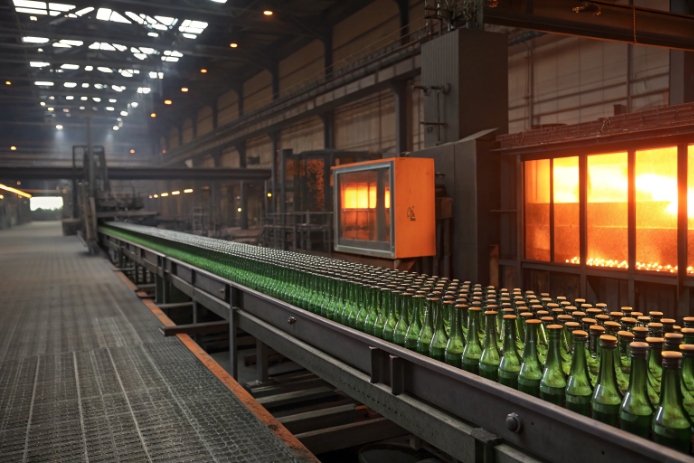
Shade drift can ruin a whole week of production. The bottle still meets dimensions, but customers see “wrong color” and send it back.
Yes. Redox level changes chromophore valence states in the melt, so it shifts absorption, tint, and brightness. Even small redox drifts can move ΔE beyond customer limits, especially in flint and amber.
Redox in glassmaking 1 is the balance between oxidizing and reducing conditions in the melt. That balance decides which chemical form a colorant prefers. Many colorants have more than one valence state. Each state absorbs light in a different way. That means the same “total iron” or the same “total chromium” can create different color, simply because redox moved.
Redox changes both tint and clarity at the same time
A bottle line often treats color and defects as separate topics. Real production does not separate them. Redox affects fining reactions, sulfate behavior, and bubble stability. Those effects change haze and brilliance. Customers may describe that as “color” even when the main shift is clarity. That is why a strict redox program supports both appearance and defect control.
The surface story is different from the bulk story
The glass is not perfectly uniform. Local redox can drift in hot spots, near batch piles, and near cullet clusters. A bottle can come out with an average color in spec but still show bands, swirls, or tone variation. That makes shade complaints harder to solve if the plant only checks one bulk sample per shift.
| Redox-driven variable | What it changes in the bottle | What customers call it | What production usually blames |
|---|---|---|---|
| Fe²⁺/Fe³⁺ balance | green/blue tint strength | “too green” | mold, temperature |
| Sulfur species balance | amber tone stability | “off amber” | colorant addition |
| Bubble and haze behavior | brightness and sparkle | “dull color” | forming, annealing |
| Local redox pockets | bands and streaks | “uneven shade” | batch mixing |
The next sections break down the mechanism, the real reasons small drifts create returns, how to tie furnace redox to lab color data, and how predictive models can stop drift before it ships.
Your goal is not “maximum oxidation” or “maximum reduction.” The goal is a tight redox window that matches your SKU and your customer’s eyes.
How does redox shift chromophore valence states?
A color recipe can look correct on paper and still fail in production. Redox decides which version of each chromophore shows up in the melt.
Redox shifts chromophore valence states by changing electron availability in the melt. This changes absorption bands for iron, chromium, manganese, selenium, and sulfur systems, so the same additive level can produce different shade.

Iron is the biggest daily driver in most bottle glass
Most container glass carries iron from raw materials and cullet. Iron exists mainly as Fe³⁺ and Fe²⁺. Fe²⁺ tends to give stronger blue-green absorption. Fe³⁺ tends to push yellow-brown tones. Small changes in the Fe²⁺ share can move flint tint fast, even when total Fe stays flat. (See iron in glass 2)
Chromium, manganese, and selenium respond sharply to redox
Chromium can exist in different states that have very different color impact. Manganese is often used to manage tint, but its behavior also depends on redox. Selenium and its supporting chemistry are also redox-sensitive, which matters in flint decolorizing systems. These systems can “flip” when the melt gets slightly more reducing or slightly more oxidizing.
Sulfur systems are redox-sensitive and also tied to fining
Sulfur can behave as sulfate under oxidizing conditions and as sulfide under reducing conditions. That matters for amber tone control and for unwanted yellowing or browning in other glasses. Sulfur also interacts with fining. So redox shifts can change both shade and bubble behavior at the same time.
| Chromophore system | What redox changes | Typical visible impact | Why small drift matters |
|---|---|---|---|
| Iron (Fe²⁺/Fe³⁺) | valence balance | green/blue tint strength | flint tolerance is tight |
| Chromium (Cr states) | valence and complexes | green tone / brown shift | strong absorption changes |
| Manganese (Mn states) | oxidation state | decolorizing strength | over- or under-correction |
| Selenium systems | active species level | pink/neutral balance | narrow working window |
| Sulfur (sulfate/sulfide) | species balance | amber tone and yellowness | also changes fining behavior |
What moves redox in a real furnace
Redox shifts come from simple sources:
- carbon and organics in cullet (see cullet quality 3)
- sulfate and nitrate dosage changes
- combustion tuning and air leaks
- pull rate changes that shift residence time
- batch carryover and foam cycles
A stable redox program treats these as control inputs, not surprises. When these inputs stay stable, chromophore valence states stay stable. Then color becomes repeatable.
Why do minor redox drifts cause off-shade returns?
Plants often ask why a “tiny” drift causes a “big” customer reaction. The answer is that color perception is harsh, and redox-sensitive systems amplify small changes.
Minor redox drifts cause off-shade returns because customers see small ΔE changes under their lighting, and because redox changes can shift both tint and clarity. A small Fe²⁺ change can move flint noticeably, and a small sulfur shift can move amber quickly.

Human eyes and customer lighting make the spec feel tighter than it looks
Many brands check bottles under specific LED or retail lights. That creates metamerism risk. A bottle that looks fine under one lamp can look off under another. Redox-driven shifts often change the shape of the spectrum, not just the intensity. That makes metamerism worse. (Read metamerism explained 4)
Bottles amplify small spectral changes through thickness and curvature
Color is not only chemistry. Color is also optical path length. A thicker heel, a thicker base, and a curved wall change the apparent shade. When redox drifts, the absorption change can show more strongly in thicker sections. Customers may compare two bottles by stacking them. That makes small differences look larger.
Redox drift can bring side effects that look like “shade”
Redox shifts can:
- change seed count and haze
- change cord visibility and flow lines
- change surface scum carryover risk
These effects can dull the bottle or make it look “milky.” Customers often call that “color shift,” even when L changed more than a or b*.
| Off-shade complaint | What usually moved first | Why it looks sudden | Fastest confirmation check |
|---|---|---|---|
| “too green” flint | Fe²⁺ fraction rose | small redox shift has big tint effect | Fe²⁺ proxy + ΔE trend |
| “dull / gray” | haze or seeds rose | clarity changed with redox | haze + seed count |
| “amber too light/dark” | sulfur species changed | narrow amber window | color data + SO₃/redox proxy |
| “banded shade” | local redox pockets | mixing and temperature drift | cord check + thermal map |
A plant can reduce returns by treating redox drift as a customer-facing risk, not only a furnace KPI. When the plant sets a tight internal warning band before the customer limit, the team gets time to correct.
How to correlate furnace redox with lab colorimetry?
Many teams measure color in the lab and measure oxygen in the stack, but the link still feels weak. The missing piece is a consistent bridge between furnace signals, melt redox proxies, and the exact color geometry the customer sees.
The best correlation uses a redox proxy in glass (like Fe²⁺/Fe total), stable sampling rules, and colorimetry on the same bottle zone each time. Then furnace signals like combustion O₂, cullet LOI, and sulfate dosage can be mapped to ΔE with control charts.
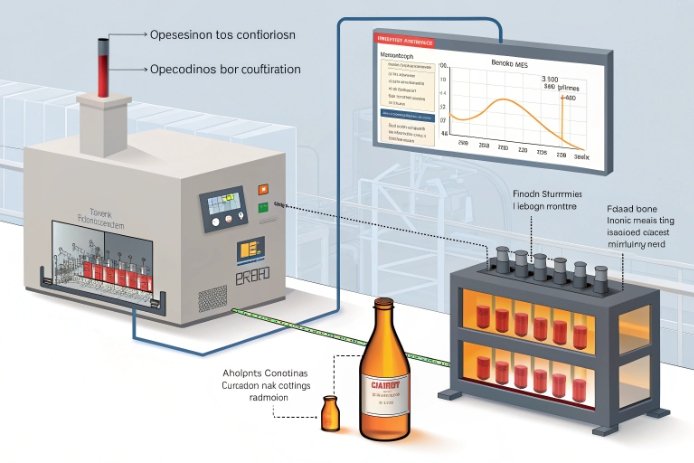
Step 1: Fix sampling, or the data will lie
Color and redox data must come from the same “glass moment.” That means:
- a fixed sampling time window
- a fixed bottle location (wall thickness zone)
- a fixed cooling and annealing condition
If sampling changes, the correlation will drift even if the furnace is stable.
Step 2: Use a melt redox proxy that is practical
A bottle plant needs a proxy that is repeatable and fast. Common options include:
- Fe²⁺ fraction by a defined lab method (See ASTM C169 5)
- a plant-specific oxidation index based on iron behavior
- supporting signals like SO₃ in glass and cullet LOI
The goal is not perfect chemistry detail. The goal is a stable indicator that moves when shade moves.
Step 3: Match lab colorimetry to customer reality
Colorimetry should follow the same settings each time:
- same illuminant and observer setting
- same measurement geometry and aperture
- same bottle thickness zone, or use a thickness-normalized rule
If the customer uses a light box, it helps to set an internal check under the same lamp type. (See color measurement standards 6)
Step 4: Build a simple “cause map” with control charts
A practical correlation system tracks:
- ΔE, L, a, b* per shift (Understanding CIELAB color space 7)
- Fe²⁺ proxy per day
- SO₃ in glass per day
- cullet LOI per lot
- furnace O₂ or combustion setting trends
| Data stream | What it represents | Best frequency | How it links to shade |
|---|---|---|---|
| ΔE / Lab* | what customer sees | per shift | direct result |
| Fe²⁺ proxy | melt redox | daily | tint driver in flint |
| SO₃ in glass | sulfur carryover | daily | amber stability + reboil risk |
| Cullet LOI | reducing load | per lot | pushes redox lower |
| Combustion O₂ trend | furnace atmosphere | continuous | shifts melt redox indirectly |
When this system runs for a few weeks, the correlation becomes clear. The plant stops arguing about “lab vs furnace.” The plant starts using early signals to hold shade steady.
Are predictive models stopping shade drift proactively?
Shade drift is predictable when inputs are measured. The hard part is turning many signals into one clear action before the bottle is made.
Predictive models can stop shade drift by acting like a “soft sensor.” They use furnace, batch, cullet, and forehearth data to forecast ΔE risk and recommend small setpoint moves. Adoption is growing when plants have clean data and strong discipline.
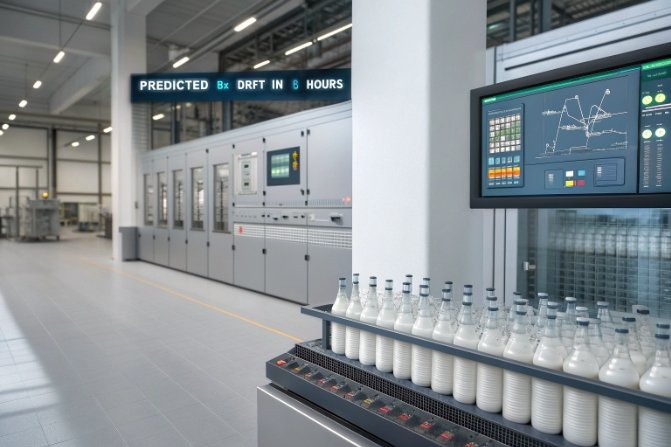
What predictive control does better than manual control
Operators react after they see drift. Models can act earlier because they watch leading indicators, such as:
- cullet LOI jump
- sulfate package change
- combustion ratio drift
- forehearth temperature gradient trend
A model can flag “shade risk” before ΔE moves outside the warning band. (See predictive control in glass 8)
The most useful model outputs are simple
A model does not need to say “redox is 0.31.” It needs to say:
- risk is rising for “too green” flint
- reduce reducing load or increase oxidation potential slightly
- adjust forehearth zones to avoid local reheating that changes redox pockets
These actions must be small and safe. Big swings create new problems.
A practical model roadmap for bottle plants
A simple approach works well:
1) Start with correlation and control charts.
2) Build a regression or simple ML model for ΔE prediction.
3) Add alarms and recommended actions.
4) Then connect to APC for limited setpoint nudges. (Read digitalization benefits 9)
| Model input group | Examples | Why it matters | Common pitfall |
|---|---|---|---|
| Batch and cullet | LOI, moisture, cullet mix | drives redox swings | missing lot traceability |
| Furnace signals | O₂ trend, pull rate, draft | shifts atmosphere and time | sensor drift not corrected |
| Forehearth | zone temps, stirring | creates local pockets | overfitting to one campaign |
| Lab outputs | Fe²⁺ proxy, SO₃, ΔE | anchors the truth | slow lab turnaround |
Predictive models do not replace good fundamentals. They reward good fundamentals. When cullet quality is stable and redox tools are consistent, models can reduce off-shade events and cut the number of emergency adjustments. (See sustainable glass melting 10)
Conclusion
Redox control is color control. Stable redox holds chromophore states steady, keeps ΔE stable, and prevents returns, especially for flint and amber bottles.
Footnotes
-
Technical article explaining the principles of redox in glass and its effect on color. ↩
-
Detailed guide on controlling iron redox state for consistent glass tint. ↩
-
FEVE report on cullet quality and its impact on glass manufacturing sustainability. ↩
-
Explanation of metamerism and why colors look different under various light sources. ↩
-
Standard test methods for chemical analysis of soda-lime glass components. ↩
-
Overview of color measurement techniques specifically for the glass industry. ↩
-
Guide to understanding the CIELAB color space and color coordinates. ↩
-
British Glass article on Model Predictive Control (MPC) applications in glass furnaces. ↩
-
Siemens discussion on digitalization and process control in the glass industry. ↩
-
Strategies for optimizing glass melting processes for sustainability and quality. ↩






