
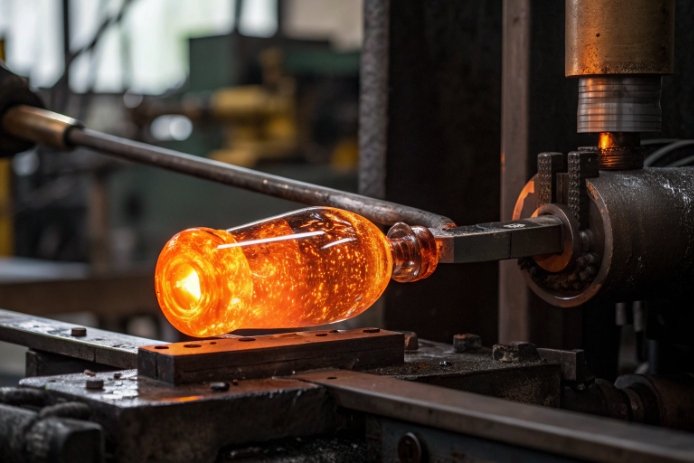
In high-speed glass manufacturing, consistency is currency. Many production managers chase mechanical adjustments to fix weight variations, unaware that the root cause lies upstream in the batch house. If your glass density shifts, your weight control creates a moving target.
Yes, composition is a primary driver of weight accuracy. The gob feeder dispenses a specific volume of glass based on flow rate; therefore, any change in glass density (caused by oxide ratios) or viscosity directly alters the mass of that gob, necessitating constant mechanical intervention.
The Invisible Variable: Density vs. Volume
At FuSenglass, we operate on a simple but unforgiving principle: The feeder shears volume, but the customer buys weight. The IS (Individual Section) machine 1‘s feeder mechanism uses a plunger and tube to push a specific amount of molten glass through an orifice ring. This process is volumetric.
If you set your machine to cut a gob the size of a golf ball, the weight of that golf ball depends entirely on the density of the material.
-
…Equation: $Mass = Volume \times Density$
-
The Reality: If your batch chemistry shifts—say, calcium oxide increases while silica decreases—the density of the glass rises. The feeder cuts the same "size" chunk of glass, but it now weighs 2 grams more. In the world of NNPB 2 (Narrow Neck Press and Blow) where tolerances are ±2g, this shift pushes you out of spec immediately.
Furthermore, composition dictates Viscosity. Viscosity 3 determines how fast the glass flows through the orifice ring. If the glass composition changes to become "stiff" (higher viscosity), less glass flows through the hole during the plunger stroke. The result is a lighter gob, even if density remained constant. Therefore, composition hits weight control from two sides: changing the mass per unit volume (density) and changing the flow rate (volume per unit time).
| …Factor | Definition | Impact on Gob Weight |
|---|---|---|
| Density ($\rho$) | Mass per unit volume (g/cm³). | Direct linear relationship. Higher $\rho$ = Heavier Gob. … |
| Viscosity ($\eta$) | Resistance to flow. | Inverse relationship. Higher $\eta$ = Slower flow = Lighter Gob. |
| Homogeneity | Consistency of the mix. | Streaks (Cord) cause erratic weight jumps. |
| Thermal Expansion | Volume change with temp. | Affects volume contraction after shearing. |
Understanding this relationship is the baseline. Now, let’s look at the specific chemical culprits.
Which oxide ratios (SiO₂–Na₂O–CaO–MgO–Al₂O₃) shift melt density and impact gob weight stability?
A standard soda-lime container glass 4 is a cocktail of oxides. While silica 5 is the backbone, the "modifier" oxides do the heavy lifting regarding density. Small tweaks in the recipe can have outsized effects on the scale.
The ratio of Calcium Oxide (CaO) to Silica (SiO₂) is the most potent lever for density changes. Substituting light Silica (2.20 g/cm³) with heavy Calcium Oxide (3.34 g/cm³) or Magnesium Oxide significantly raises melt density, while Sodium Oxide (Na₂O) has a moderate effect but drastically alters viscosity.
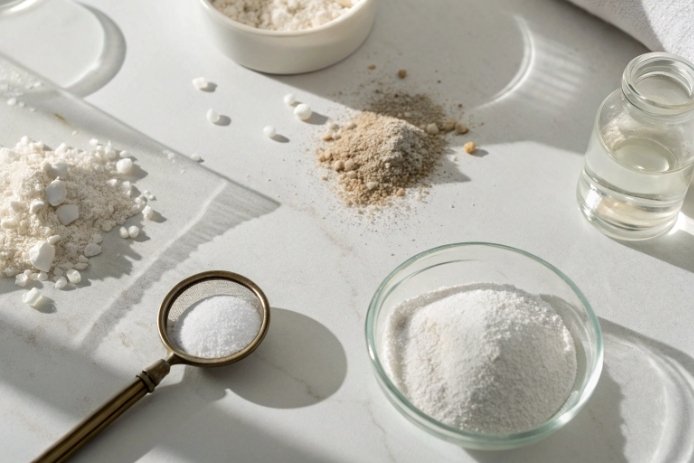
The Density Hierarchy of Oxides
To predict weight shifts, you must know the "Density Factors" of your ingredients. Used in models like the Huggins-Sun calculation 6:
-
SiO₂ (Silica): The lightest major component. Increasing sand content lowers density.
-
CaO (Calcia) & MgO (Magnesia): These stabilizers are significantly denser. If a batch house error over-doses limestone or dolomite, the glass density spikes.
-
Al₂O₃ (Alumina): Increases density moderately but massively increases viscosity. High alumina makes the glass "long" and stiff, slowing flow and reducing gob weight.
The Stability Sensitivity
In my experience, a density shift of just 0.005 g/cm³ is noticeable on a precision NNPB line.
-
Scenario: You reduce SiO₂ by 0.5% and increase CaO by 0.5% to improve melting speed.
-
Result: Density increases. For a 300g bottle, this might only add 1-2g of weight. But if you are running a 300g bottle with a ±2g tolerance, you have just consumed your entire safety margin. The machine operator will see the weight creeping up and will have to adjust the "Tube Height" or "Plunger Cam" to restrict flow. If the composition fluctuates throughout the day (poor batch mixing), the operator is chasing a ghost, constantly tweaking settings to maintain Cpk.
| Oxide | Component | Approx Density contribution | Effect on Gob Weight (if increased) |
|---|---|---|---|
| SiO₂ | Sand | Low | Decreases (due to lower density). |
| CaO | Limestone | High | Increases (due to higher density). |
| Na₂O | Soda Ash | Medium | Increases (due to lower viscosity/faster flow). |
| Al₂O₃ | Feldspar/Nepheline | Medium-High | Decreases (due to higher viscosity restricting flow). |
Do cullet percentage and colorants (Fe/Cr/Co, Se–S) change density (g/cm³) enough to require IS scale recalibration?
Many plants treat cullet 7 (recycled glass) as "free filler," but it is chemically distinct from the raw batch. Ignoring the density delta between your tank glass and your purchased cullet is a frequent cause of weight instability.
Yes, drastic changes in cullet ratio or heavy-metal colorants alter density enough to require scale recalibration. Cullet is often denser due to repeated melting (volatilization of lighter components), and colorants like Iron (Fe) and Chromium (Cr) add mass while altering infrared absorption, which changes thermal viscosity and flow rates.

…The Cullet Factor
Cullet is not just "glass." …It is glass that has been melted before. During previous melting, lighter volatiles (like Boron or Sodium) may have evaporated slightly, leaving a chemically richer, denser skeleton.
-
The Swing: If you run 20% cullet on Monday and swing to 60% cullet on Tuesday, your overall tank density will likely rise. The IS machine settings that produced a 500g gob on Monday will produce a 502g gob on Tuesday.
-
Foreign Cullet: If you buy cullet from outside sources, its oxide composition might differ from your target. A 1% difference in CaO in purchased cullet can throw your density off significantly.
Colorants and the "Thermal Density"
Colorants affect weight in two ways:
-
Physical Mass: Transition metals 8 (Iron, Chromium, Cobalt) are heavy elements. While added in small amounts (0.05% – 0.5%), they contribute to mass.
-
Thermal Blocking (The bigger factor): Darker glasses (Amber/Green with Fe/Cr) absorb infrared radiation in the forehearth. They present a "thermal barrier." The glass surface gets hot, but the bottom of the channel stays cold.
- Viscosity Gradient: This uneven heating creates uneven viscosity. The gob might be hotter/thinner on one side and colder/thicker on the other. This changes the flow coefficient through the orifice. Shifting from Flint (Clear) to Amber often requires a massive recalibration of tube height because the Amber glass flows differently due to this thermal absorption, effectively acting like a density shift.
| Component | Role | Density Effect | Thermal/Viscosity Effect |
|---|---|---|---|
| Factory Cullet | Recycled internal | Minimal shift. | Stabilizes melting. |
| Foreign Cullet | External source | High Risk. Variable density. | Unpredictable melting rate. |
| Iron (Fe₂O₃) | Green/Amber color | Increases slightly. | High. Blocks IR heat; changes flow. |
| Selenium (Se) | Flint decolorizer | Negligible. | Minimal. |
How does composition-driven viscosity/working range alter gob cut length, parison weight variation, and Cpk?
Viscosity is the friction of fluids. In glass, it is the governor of flow. If your chemistry makes the glass "short" (fast-setting) or "long" (slow-setting), the mechanics of the shear cut will react differently, causing shape and weight defects.
Viscosity defines the flow rate through the orifice ring. If composition lowers viscosity (e.g., high alkali), flow accelerates, creating heavier gobs. Conversely, high-viscosity glass creates "lazy" flow, leading to lighter gobs and "dog-bone" shapes that distort parison weight distribution and ruin Cpk.

The Flow Rate Equation
The flow of glass ($Q$) through the feeder is roughly governed by Poiseuille’s Law [^9] principles:
$$ Q \propto \frac{P}{\eta} $$
Where $P$ is pressure (head of glass + plunger force) and $\eta$ is viscosity.
-
Composition Shift: If Na₂O increases by 0.5%, viscosity ($\eta$) drops significantly.
-
Result: $Q$ increases. For the exact same shear cut time, more glass pours through. The gob weight spikes.
…Gob Shape and Parison Distribution
Viscosity doesn’t just change how much glass comes out; it changes how it looks.
-
Too Fluid (Low Viscosity): The gob elongates under gravity. It becomes thin and stringy. When it loads into the blank mold, it settles fast, creating thin bottoms.
-
Too Stiff (High Viscosity): The gob resists shearing. It creates a "dog-bone" shape (thick ends, thin middle). When this loads, air gets trapped, and the parison wall thickness varies wildly.
-
Cpk Impact: Process Capability (Cpk) [^10] measures stability. If viscosity is swinging due to batch errors, the weight is swinging. The automated plunger can try to compensate, but it’s reactive. You will see a "sawtooth" weight graph—high deviation, low Cpk. You cannot achieve a Cpk > 1.33 if your viscosity working point varies by more than ±2°C equivalent.
| Viscosity Condition | Cause (Composition) | Gob Characteristic | Weight/Forming Defect |
|---|---|---|---|
| Low Viscosity (Fluid) | High Na₂O / High CaO | Fast flow; Long gob. | Overweight; Thin Bottoms. |
| High Viscosity (Stiff) | High Al₂O₃ / High SiO₂ | Slow flow; Short gob. | Underweight; "Dog Bone"; Loading marks. |
| Variable Viscosity | Poor Batch Mixing | Erratic flow. | Weight hunting; High standard deviation. |
Which formulation and process checks—density prediction, composition SPC, forehearth setpoints—keep NNPB/lightweight bottles within ±1.5–2% weight tolerance?
To hold a ±1.5% tolerance on a lightweight bottle, you cannot rely on the machine operator’s thumb. You need a data-driven feedback loop connecting the lab to the furnace.
You must implement daily sink-float density measurements to track composition shifts (target ±0.003 g/cm³). Combine this with Automatic Gob Weight (AGW) control loops that adjust tube height, and use composition SPC to proactively adjust forehearth temperatures to compensate for calculated viscosity changes.

…The Sink-Float Density Test
This is the industry standard for daily validation.
-
…Method: A sample of glass is placed in a tube with a heavy liquid of known density gradient. …We observe where it floats.
-
Limit: The control limit should be ±0.003 g/cm³ from the target.
-
Action: If density trends up, we know CaO is likely high or SiO₂ is low. We alert the batch house.
Automatic Gob Weight (AGW) Control
Modern lines use AGW systems. The machine weighs the finished bottle (hot end or cold end) and sends a signal to the feeder.
-
The Loop: If weight trends down, the AGW raises the "Tube Height" or adjusts the "Needle" stroke to increase flow.
-
The Limitation: AGW is reactive. It acts after the error. If density is swinging wildly, AGW will "hunt," and you will lose bottles during the adjustment periods.
Temperature Compensation (Forehearth)
The smartest way to handle composition shifts is to use Temperature to fight Chemistry.
-
The Strategy: If lab analysis shows viscosity has increased (glass is stiffer), we don’t just change the tube height. We raise the forehearth temperature.
-
Why: Increasing temperature lowers viscosity. By heating the glass, we restore the original flow characteristics, keeping the gob shape and weight consistent without drastically altering the mechanical setup. This is "viscosity targeting."
| QC Check | Frequency | Target Tolerance | Corrective Action |
|---|---|---|---|
| Sink-Float Density | Daily (Morning) | $\pm 0.003$ g/cm³ | Check batch log; Adjust batch scale offsets. |
| XRF Composition | Weekly | Oxide % within spec | Reformulate batch recipe. |
| Gob Weight (Manual) | Every 30 mins | $\pm 1.0\%$ | Manual Tube adjustment (if no AGW). |
| Automatic Gob Weight | Continuous | $\pm 0.5\%$ | Auto-adjusts Tube Height / Needle. |
| Forehearth Temp | Continuous | $\pm 1^{\circ}$C | Adjust to maintain constant Viscosity ($\log 3$). |
Conclusion
Glass bottle weight control is not just a mechanical exercise; it is a chemical balancing act. Composition determines density and viscosity, the two physical properties that dictate gob mass. By strictly monitoring oxide ratios, understanding the density impact of cullet, and using temperature to normalize viscosity, FuSenglass ensures that every bottle we produce meets the most rigorous weight tolerances in the industry.
Footnotes
-
IS (Individual Section) machine is the most common machine used for high-speed glass container production. ↩
-
NNPB stands for Narrow Neck Press and Blow, a method for making lightweight bottles. ↩
-
Viscosity is a measure of a fluid’s resistance to flow, critical in glass forming. ↩
-
Soda-lime container glass is the industry standard glass type for beverages and food containers. ↩
-
Silica (Silicon dioxide) is the primary glass-forming oxide in the batch. ↩
-
Huggins-Sun calculation is a model used to predict glass properties like density from composition. ↩
-
Cullet refers to recycled broken or waste glass used to facilitate melting. ↩
-
Transition metals like Iron and Chromium are often used as colorants in glass.[^9]: Poiseuille’s Law describes the pressure drop in an incompressible fluid flowing through a tube.[^10]: Process Capability (Cpk) is a statistical measure of a process’s ability to produce output within specification limits. ↩






