
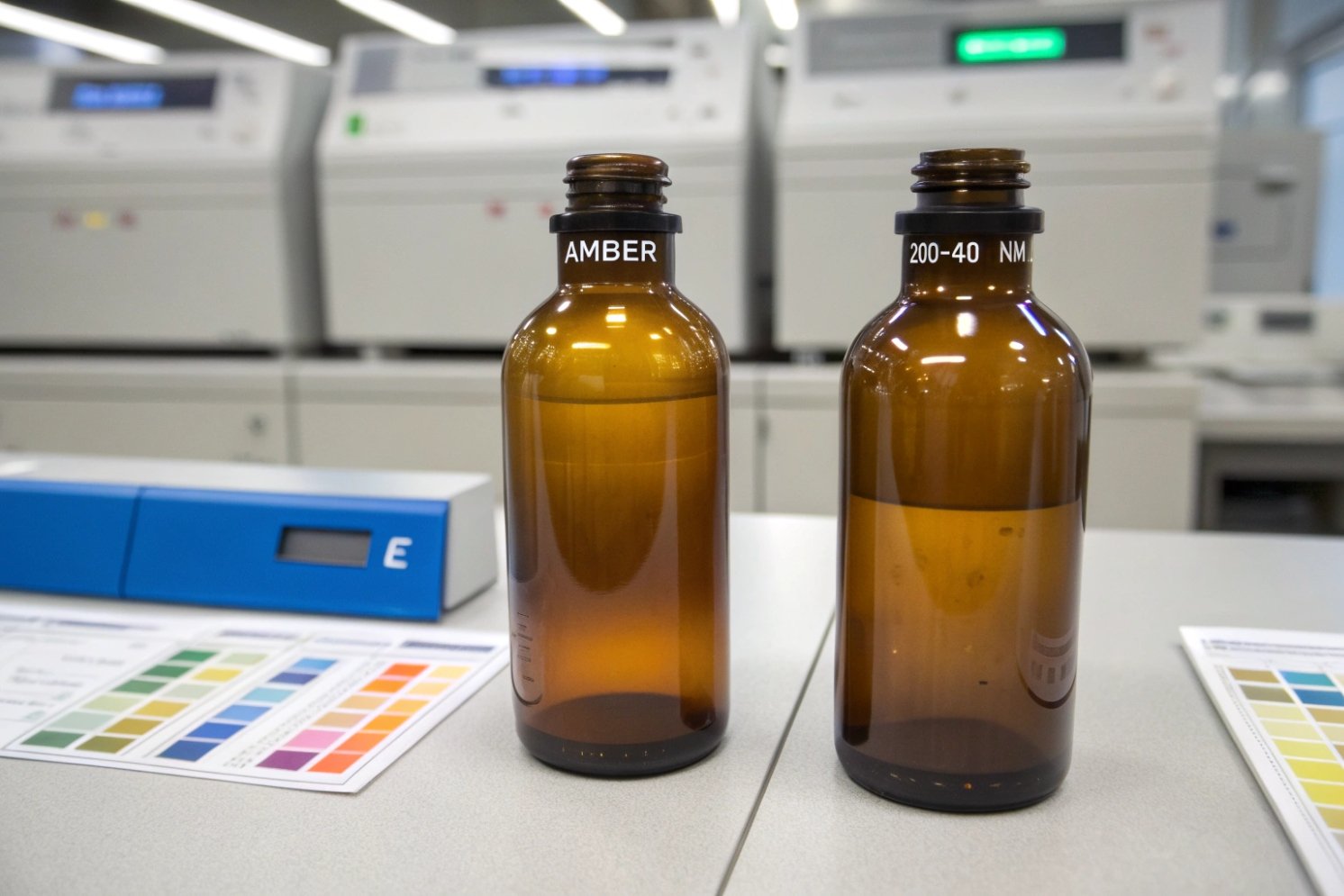
A bottle can look “almost the same” and still fail a buyer’s UV test. That small shift can trigger claims, holds, and rework while the product shelf life is already counting down.
Yes. Glass bottle color difference can change transmittance, especially in the UV–blue edge. ΔE tracks visible color change, while spectral transmittance shows how much UV and visible light really passes through the glass.
How do color difference and transmittance connect in glass bottles?
Color is a visible “summary” of a spectral curve
Bottle color is not magic. It is the result of a spectrum. When the glass absorbs more light in one part of the visible range, the transmitted light shifts in hue and the bottle looks darker or more amber 1 or more green.
The key point is simple: transmittance is the full curve, color is a human-weighted score of part of that curve. Color metrics focus on the visible range because eyes do not see UV. But many colorants and impurities that change visible color also affect the near-UV and blue region. This is why a “minor” color drift can create a “major” UV result drift.
Why a small tint change can move UV numbers fast
Many light-protective bottles rely on a steep absorption edge. Think of it like a cliff. On one side, little light passes. On the other side, more light passes. If that cliff shifts by a small amount, the %T at a sensitive wavelength can change a lot.
This is common with amber programs. The bottle can still “look amber” and yet the UV blocking at 350–400 nm can drift enough to matter for vitamins 2, botanicals, and some pharma liquids.
The “same ΔE” can still hide a UV problem
ΔE is built to match human vision. Human vision weights green more than deep blue, and it does not see UV at all. So a bottle can have a small ΔE and still leak more UV than expected.
That is why a good spec does not say “ΔE only.” It says “ΔE plus UV band transmittance.” This pair prevents most surprise failures.
| Control item | What it tells procurement | What it does NOT guarantee |
|---|---|---|
| ΔE (color difference) | Appearance drift vs a master | UV protection and shelf life protection |
| Spectral transmittance (290–450 nm or chosen band) | Real UV/blue shielding | Visual match to the master in all lighting |
| Both together | Stable look and stable protection | Nothing, this is the strongest practical combo |
What is ΔE and how does it relate to light?
Color disputes feel emotional because humans judge color fast. But procurement needs numbers that travel across borders and across labs.
ΔE is a single number that describes the distance between two colors in a defined color space (often CIE L*a*b*). It comes from measured light, but it compresses a spectrum into one easy-to-track difference score.
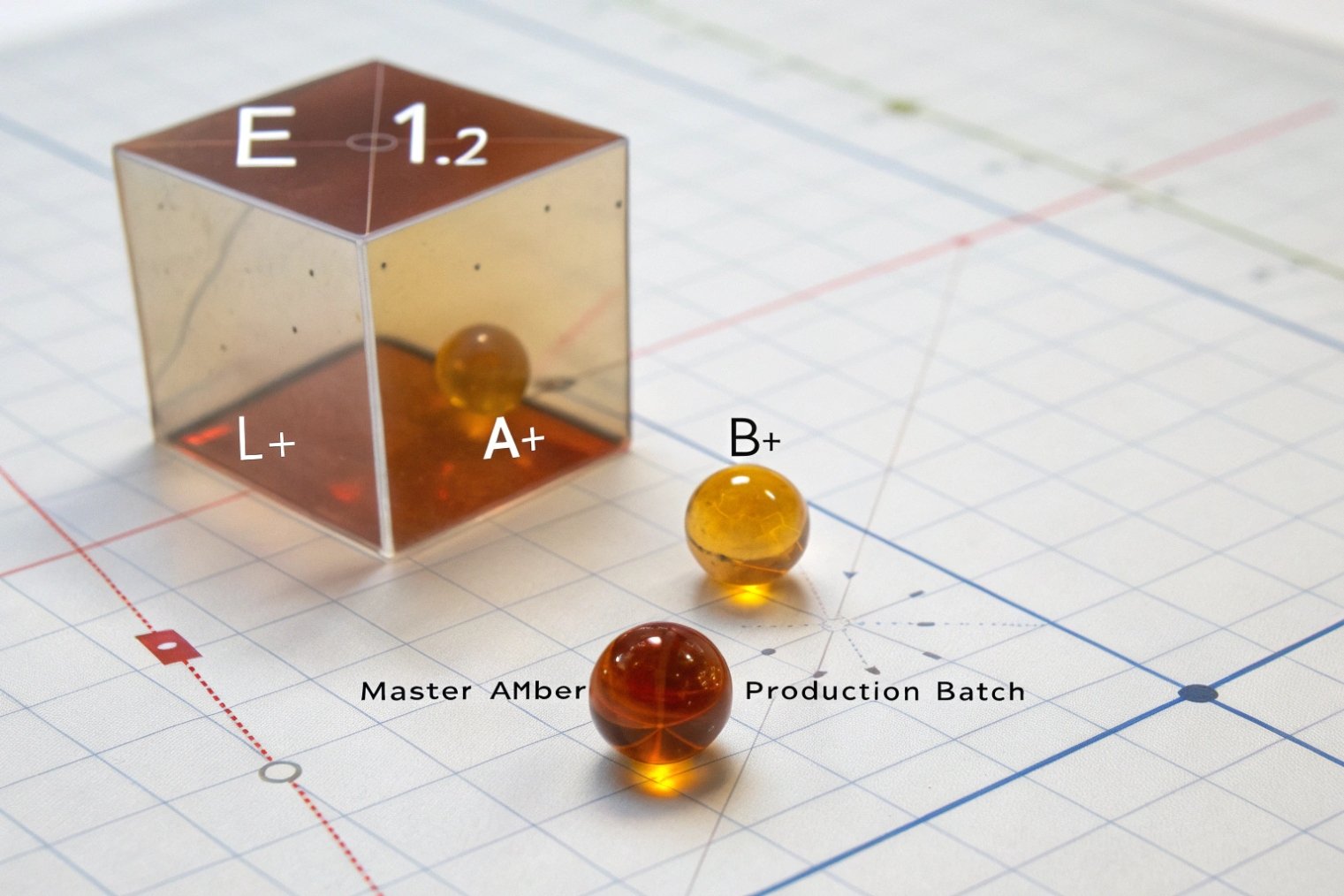
ΔE is a distance, not a color
ΔE does not tell “what color” the bottle is. It tells how far the sample is from the target.
Most packaging teams use CIE Lab* 3 values:
- L* is lightness (light to dark).
- a* is green to red.
- b* is blue to yellow.
ΔE is computed from the differences in these values. In modern buyer specs, ΔE00 (CIEDE2000) is common because it matches human perception better than older formulas.
Why minor color shifts change UV protection and shelf life?
A buyer may accept a small tint drift. But the product inside may not accept it. UV damage is quiet at first, then the complaint arrives months later.
Minor color shifts can change UV protection because the same chemistry that moves visible color often moves the absorption edge near UV–blue wavelengths, and that edge controls how much damaging light reaches the product.
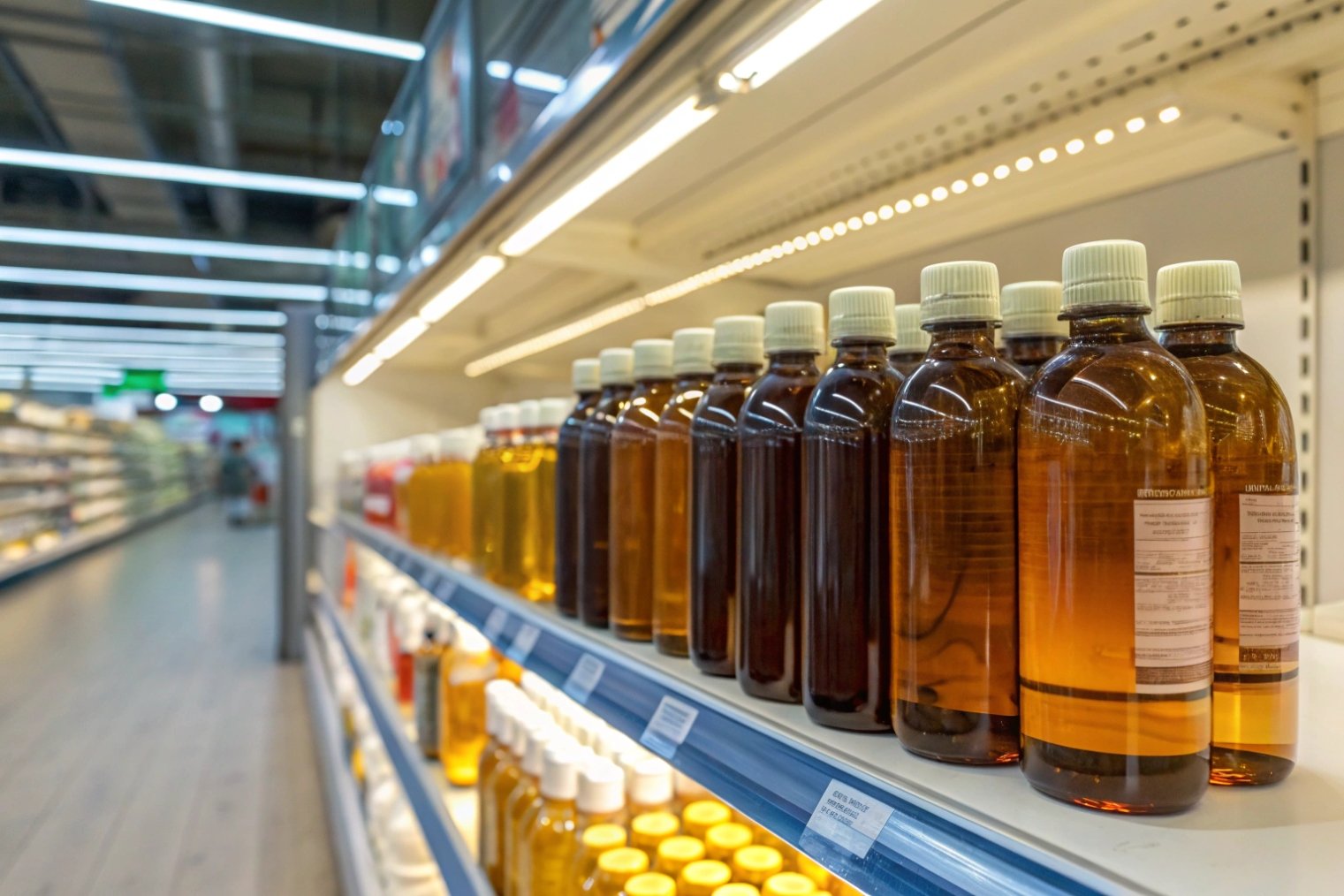
UV protection is often controlled in a narrow, sensitive band
Many light-sensitive products react strongly to UV and short-wave visible light. Even when the product is not pharma, photo-oxidation 4 still matters for flavors, colors, vitamins, and essential oils 5.
For protective glass programs, the acceptance test often focuses on a band like 290–450 nm. That band covers UV and the blue edge where many reactions start. When a bottle’s spectral curve shifts slightly, the worst-point %T in that band can shift more than the human eye expects.
How should procurement set ΔE and transmittance tolerances?
A spec that is too loose invites shelf life risk. A spec that is too tight causes waste and price pressure. The best spec is clear, measurable, and tied to product risk.
Procurement should set separate tolerances for ΔE (appearance control) and UV/visible transmittance (performance control), and lock the test method details so buyer and supplier measure the same way.
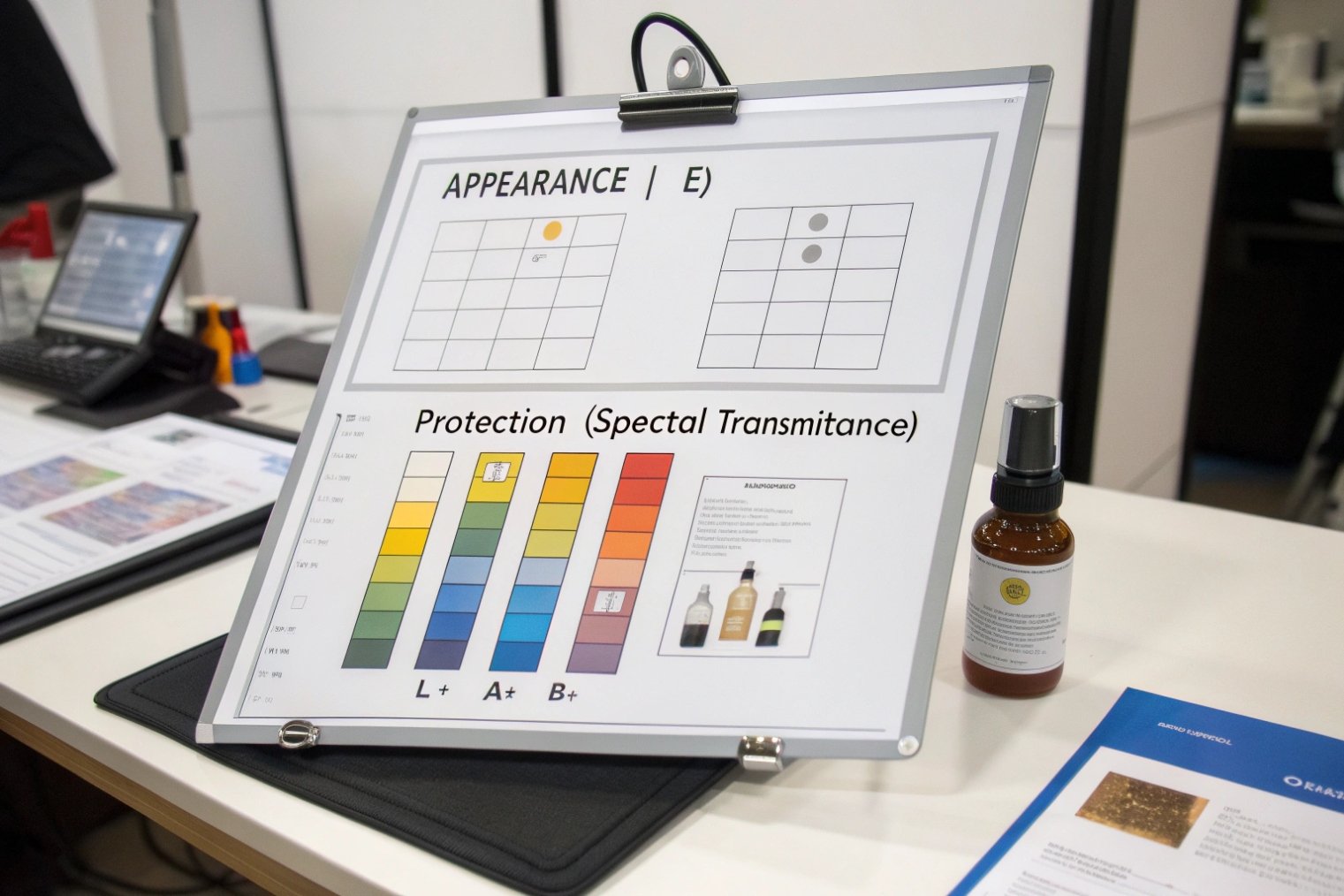
Step 1: Decide what “performance” means for the product
Start with the product, not the bottle.
- If the product is light-sensitive, performance must include a UV band limit.
- If the product is mostly appearance-driven, visible transmittance may matter more.
- If both matter, keep both.
A common robust approach is to define the wavelength range and use maximum %T in that band as the acceptance metric.
Are AI cameras catching color drift before shipment?
Manual color checks are slow and inconsistent. A spectrophotometer 6 is accurate, but it is not always fast enough for 100% inspection at line speed.
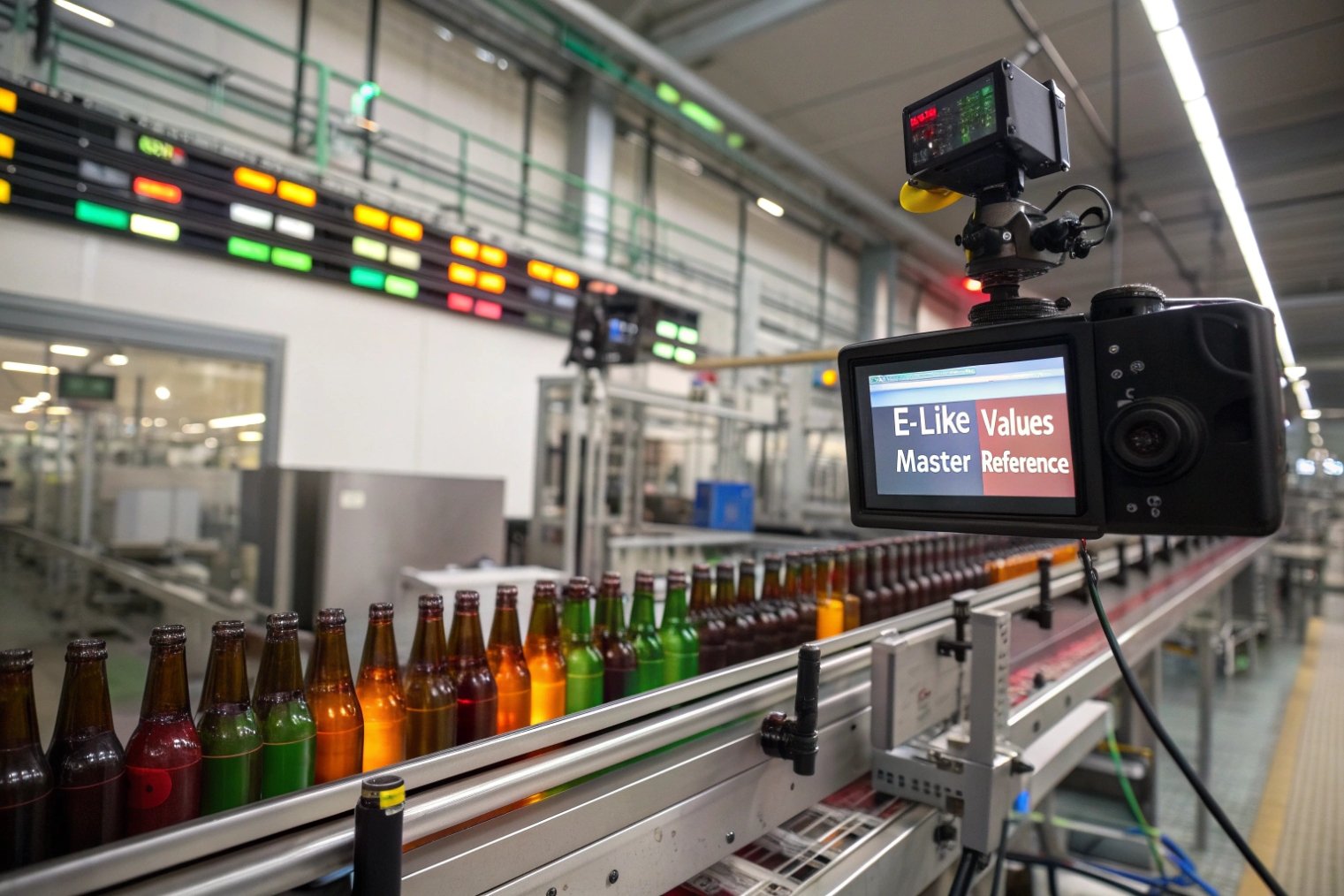
AI camera systems can catch color drift early when lighting is controlled and the system is calibrated, but they usually work best as a screening tool that is tied back to spectrophotometer masters for final acceptance.
What AI cameras do well in bottle production
In practice, vision systems help with 100% inspection for obvious drift and trend detection by lot. Modern setups use high-speed cameras, controlled lighting, and software that learns machine vision 7 defect patterns.
The best pattern is a two-layer system where the spectrophotometer defines the master and the AI camera screens production for drift signals. This reduces buyer risk and supplier waste.
Conclusion
Bottle color drift can signal transmittance drift, but ΔE alone is not UV protection. The safest procurement spec uses both ΔE and spectral transmittance, plus clear test methods.
⸻
Footnotes
-
Detailed information on the photoprotective properties of amber-colored glass in pharmaceutical and chemical packaging. ↩ ↩
-
Essential organic compounds that often require protection from light to maintain their potency and stability. ↩ ↩
-
Understanding the mathematical color space used to measure and specify colors in industrial manufacturing. ↩ ↩
-
An overview of the chemical process where light exposure leads to product degradation and oxidation. ↩ ↩
-
Research regarding the sensitivity of concentrated botanical extracts to ultraviolet and visible light exposure. ↩ ↩
-
An analytical instrument used to measure the intensity of light as a function of its wavelength. ↩ ↩
-
The application of computer vision to industrial automation for inspection, process control, and robot guidance. ↩ ↩






