
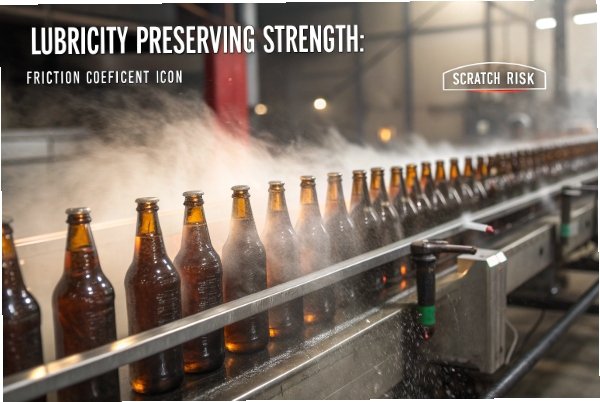
Production managers often focus on glass weight and distribution when solving breakage issues, overlooking the final step of the manufacturing process. While the Cold-End Coating itself is not a thermal barrier, it is the primary guardian of the bottle’s strength during thermal processing.
No, Cold-End Coating does not alter the glass’s intrinsic thermal shock resistance (Delta T). However, it is absolutely critical for preserving that resistance. By providing a lubricious layer that prevents glass-to-glass abrasion, CEC ensures the bottle remains free of surface flaws that would otherwise become initiation points for catastrophic failure during hot-fill or pasteurization.
The Lubricity-Strength Connection
At FuSenglass, we view Hot-End (HEC) and Cold-End as a dual system. HEC anchors the coating, but cold-end glass bottle coatings 1{#fnref1} (typically a Polyethylene emulsion) provide the "slip."
- The Problem: Glass has a high coefficient of friction. When two uncoated bottles touch, they "seize" and scratch. A microscopic scratch acts as a stress concentrator.
- The Thermal Risk: A pristine bottle might survive a 60°C thermal shock. A scratched bottle might fail at just 30°C.
- The CEC Solution: By reducing friction (often verified via slip/tilt methods), CEC allows bottles to slide past each other on the accumulation table and in the pasteurizer tunnel. This prevents the formation of the scratches that trigger thermal shock explosions.
| Coating Type | Typical Material | Application Temp | Thermal Role |
|---|---|---|---|
| Standard CEC | Polyethylene wax emulsion 2{#fnref2} | ~100°C – 130°C. | Durable. Survives hot water/pasteurization. Best for hot-fill. |
| Oleic Acid | Oleic acid vapor coating 3{#fnref3} | ~150°C. | Non-Durable. Washes off in water. Risk for pasteurization. |
| Stearates | Water-soluble polyoxyethylene stearate coatings 4{#fnref4} | < 100°C. | Low Durability. Good for dry filling only. |
How does cold-end coating (such as silicon-based or varnish coatings) influence the thermal shock behavior of glass bottles during hot-fill or sterilization?
The choice of coating material dictates whether your bottles survive the "Wet Process" of sterilization.
Durable coatings (like high-density PE) maintain lubricity even when wet and heated, preventing "seizing" inside the pasteurizer. Non-durable coatings (like stearates or simple oleics) can wash off in the hot water sprays of a tunnel pasteurizer. Once the coating is gone, the bottles rub, scratch, and shatter under the combined thermal and mechanical stress.
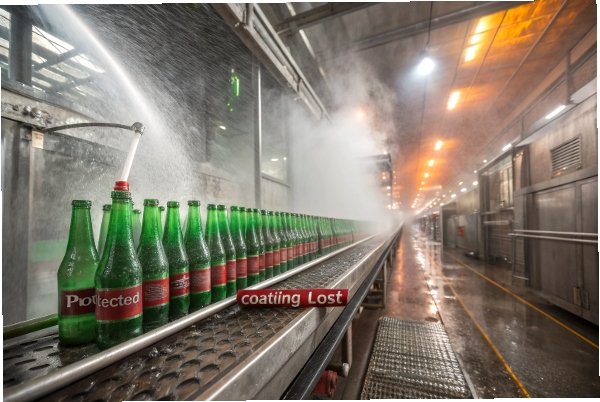
The "Wash-Off" Danger
In a tunnel pasteurizer, bottles are sprayed with hot water for 45-60 minutes.
-
Scenario: You use a cheap, water-soluble CEC.
-
Process: 10 minutes into the tunnel, the coating dissolves.
-
Failure Mode: The bottles are now "naked" glass. As they vibrate on the pasteurizer belt, they grind against each other. Surface flaws form immediately. The thermal expansion from the heat then rips these flaws open.
-
Durability Benchmark: Coatings marketed for pasteurized/hot-fill containers typically emphasize stability in the 100–150°C range, like high-temperature cold-end coatings for hot-filling and pasteurization 5{#fnref5}.
-
Silicon-Based Coatings: While silicones offer extreme lubricity and heat resistance (good for pharma), they are often "too slippery" and hydrophobic, causing labels to slide off or glue to fail in the hot bath. We generally recommend Polyethylene (PE) for food/beverage as the best balance of wash resistance and labelability.
Can cold-end coatings create weak points or interfere with heat transfer, leading to higher risks of cracking or failure?
There is a misconception that coatings act as insulators. This is false.
CEC layers are nanometers thin and have negligible impact on heat transfer rates; they do not insulate the bottle. However, excessive or uneven coating can cause "Labeling Failure," which leads to line jams. A jammed line creates massive mechanical pressure (crush load) on the hot bottles, leading to "Squeeze Breakage" inside the pasteurizer.
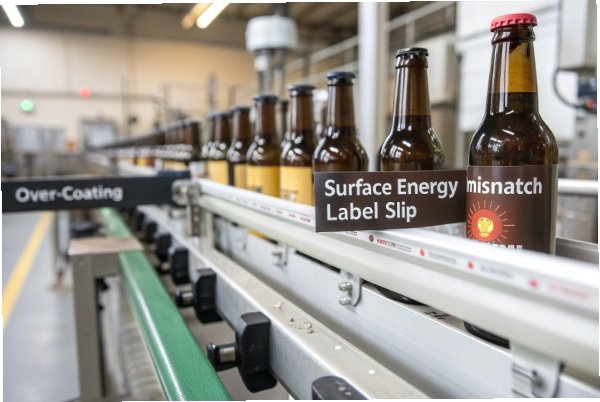
The Indirect Failure Chain
- Over-Coating: If the spray nozzles are set too high, the bottle becomes too slippery or the surface energy changes.
- Label Flagging: The glue doesn’t stick. The label peels off in the machine.
- The Jam: The loose label gets stuck in a starwheel or guide rail.
- The Crush: Bottles pile up behind the jam. Since they are hot (expanded) and under pressure, they crush each other.
- The "Thermal" Failure: The breakage looks like thermal shock, but the root cause was actually the coating thickness causing a mechanical jam.
For a broader technical overview of why dual-end treatments (hot-end + cold-end) are widely used to prevent handling damage, see commercial glass surface treatment processes 6{#fnref6}.
What factors, like coating thickness, curing, and application uniformity, should be controlled to minimize the risk of thermal issues?
Application control is a matter of Goldilocks: not too little, not too much.
The most critical control factors are the "Spray Pattern Uniformity" (to ensure total coverage), the "Bottle Temperature" at application (to ensure proper bonding/curing), and the "Emulsion Concentration" (to prevent over-coating). For pasteurizable ware, the coating must be fully cured and cross-linked to resist hot water.
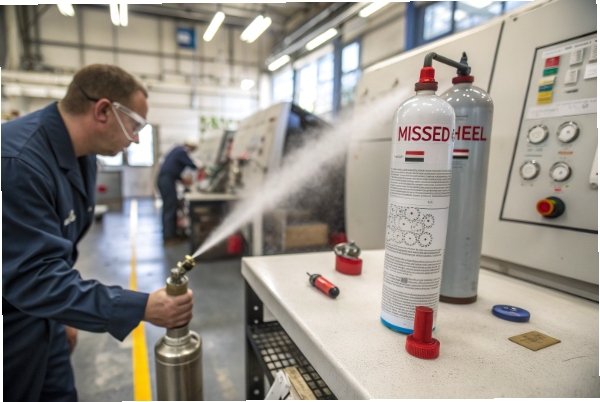
Temperature Window
CEC must be applied when the bottle is at a specific temperature (typically 100°C to 130°C).
- Too Hot (>150°C): The water in the spray evaporates instantly ("Leidenfrost effect"), and the wax droplets bounce off. No coating sticks. Result: Scratches.
- Too Cold (<80°C): The bottle doesn’t have enough energy to melt the wax particles into a smooth film. The coating ends up spotty and white. Result: Poor protection and ugly appearance.
Many suppliers explicitly define this operating envelope; for example, cold-end coating operating temperatures between 100°C and 150°C 7{#fnref7} are commonly referenced for hot-fill and pasteurized lines.
Concentration and Nozzles
- Dilution: We typically run PE emulsions at very low concentrations (e.g., 1:50 or 1:100 ratio with water).
- Position: Nozzles must be aimed between the rows of bottles (traveling overhead) or via under-belt sprays to coat the heel. If the heel is missed, the bottle is vulnerable at its most critical stress point.
| Parameter | Optimal Setting | Risk if Deviated |
|---|---|---|
| Bottle Temp | 100°C – 130°C | Too Hot: No adhesion. Too Cold: Spotty/Sticky. |
| Spray Type | Fine Atomization | Large droplets cause visual defects. |
| Coverage | Body + Shoulder + Heel | Missed Heel: High risk of base cracks. |
| Material | High-Density PE | Soluble Wax: Washes off in pasteurizer. |
What tests (thermal cycling, heat resistance, adhesion) should be performed to verify that cold-end coatings do not compromise a bottle’s heat resistance?
You must validate that the protection lasts through your specific process.
The "Caustic Wash Test" or "Pasteurization Simulator" is essential to prove coating durability. This should be followed by a "Slip Angle" test to confirm lubricity is retained. Finally, an "Abraded Thermal Shock" test compares the survival rate of coated vs. uncoated bottles after line simulation.
1. The Pasteurization Simulation (Wash Resistance)
- Method: Immerse coated bottles in a water bath at 65°C for 45 minutes (mimicking a pasteurizer).
- Check: Remove bottles and immediately rub them together wet.
- Criteria: They must still feel slippery. If they "squeak" or "seize" (glass-on-glass friction), the coating has washed off. This lot is unsafe for pasteurization.
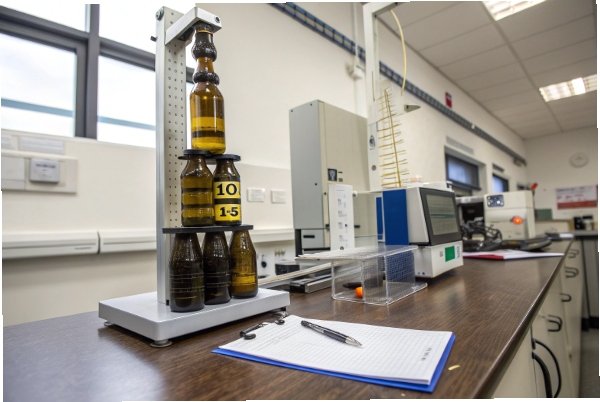
2. Slip Angle (Tilt Table)
- Method: Place three bottles in a pyramid on a table. Tilt the table slowly.
- Criteria: The top bottle should slide before the table reaches 15°.
A commonly cited implementation is the tilt-table slip angle test described with AGR equipment 8{#fnref8}.
- > 20°: Coating is too thin or washed off. Risk of line pressure breakage.
- < 8°: Coating is too thick. Risk of pallet instability (bottles sliding off trucks).
3. Label Adhesion Test
- Method: Apply standard label with standard glue. Allow to cure. Soak in hot water.
- Criteria: Label must remain attached. If it slides off easily, the CEC surface energy is incompatible with your adhesive (common with silicones).
4. Coating Measurement + Retained-Strength Validation
To prove “protection that lasts,” pair a quantitative coating check with performance testing:
- Thickness/level: Measure on-line or at-line with systems like the AGR Combined Coating Measurement System (CCMS) 9{#fnref9}.
- Retained strength: Validate that abrasion protection survives conveyor conditions using evidence-based approaches like AGR’s discussion of how coatings reduce damage under handling, including coatings and scratch protection under wet/dry sliding 10{#fnref10}.
| Test | Purpose | Pass Criterion |
|---|---|---|
| Wet Rub Test | Check durability in hot water. | No friction/squeaking after 45 min @ 65°C. |
| Slip Angle | Measure Friction ($\mu$). | 10° – 15° typical. |
| AGR Line Simulator | Abrade bottles mechanically. | No visible scratch rings. |
| Abraded Thermal Shock | Confirm Retained Strength. | 100% Pass $\Delta T$ 42°C after abrasion. |
Conclusion
Cold-End Coating is not just a finishing touch; it is the "armor" that allows a glass bottle to survive the thermal and mechanical violence of a filling line. For hot-fill and pasteurization, using a durable, wash-resistant Polyethylene coating—applied at the correct temperature—is the single most effective step you can take to prevent production line breakage.
Footnotes
-
Overview of common cold-end coating types and why lubricity prevents abrasive strength loss. ↩ ↩
-
Explains polyethylene wax emulsion coatings used to protect bottles from scuffing and fractures in handling. ↩ ↩
-
Describes oleic-acid vapor coatings and typical tradeoffs versus more durable emulsions. ↩ ↩
-
Documents water-soluble stearate and polyethylene cold-end coatings used historically for damage prevention. ↩ ↩
-
Shows why hot-fill/pasteurization lines need cold-end coatings that do not degrade at high temperature. ↩ ↩
-
Technical lecture explaining why dual-end surface treatments are widely applied to reduce container damage. ↩ ↩
-
Confirms typical cold-end coating operating temperature windows relevant to hot-fill and pasteurized containers. ↩ ↩
-
Provides a concrete slip-angle (tilt-table) procedure used to quantify container lubricity. ↩ ↩
-
Production-grade method for measuring coating levels during manufacturing to prevent under/over-coating. ↩ ↩
-
Evidence that coatings protect against scratch damage under wet/dry sliding—key to preserving thermal-shock survivability. ↩ ↩






