
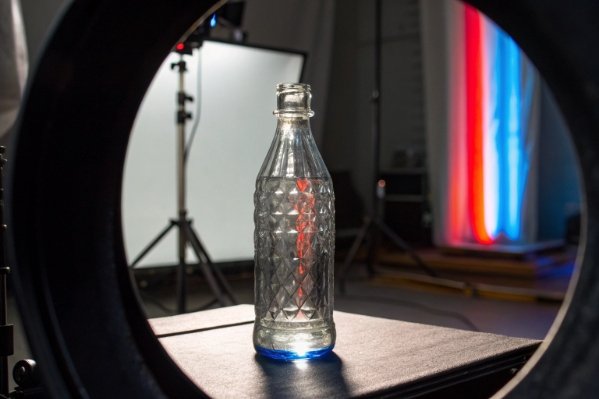
We often view glass breakage and chemical corrosion as separate problems, but they are frequently conspirators in the same crime. Invisible residual tension within the glass wall can act as a catalyst, inviting chemicals to attack weak points and causing bottles to fail spectacularly under standard loads.
Annealing stress does not change the chemical composition of the glass, but it drastically reduces its physical resistance to chemical attack. Residual tension stretches the atomic bonds, making them energetically vulnerable to "Stress Corrosion Cracking." This accelerates surface flaw propagation when exposed to moisture, acids, or alkalis, leading to delayed breakage and reduced shelf-life reliability.
The Invisible Energy: Why Annealing Matters
At FuSenglass, the most critical machine in our factory is not the furnace that melts the glass, but the "Lehr" that cools it down. This is where annealing 1 happens. When a glass bottle is formed at 1000°C and cools rapidly, the outside hardens while the inside is still soft. As the inside eventually cools and contracts, it pulls on the already rigid outer shell. This creates Residual Stress.
If we don’t manage this cooling curve perfectly (annealing), the bottle is left with permanent internal tension. It is like a loaded spring, waiting to snap.
Many brand owners believe that if a bottle passes the drop test, it is fine. But "Stress Corrosion" 2 is a silent killer. It is a phenomenon where chemical attack and mechanical stress combine to cause failure at stress levels far below the material’s theoretical limit. A poorly annealed bottle might look perfect on day one. But after six months of sitting in a warehouse with acidic juice inside, the chemical attack at the tip of microscopic surface flaws—accelerated by the internal tension—can cause the bottle to crack spontaneously.
We call this "Static Fatigue." The stress doesn’t break the bottle immediately; it helps the chemistry break the bottle over time.
The Annealing Impact Overview
| Feature | Properly Annealed Glass | Poorly Annealed Glass |
|---|---|---|
| Internal State | Relaxed / Slight Compression. | High Tension. |
| Bond Stability | Si-O bonds are stable. | Bonds are stretched and strained. |
| Corrosion Risk | Normal (Surface Leaching). | High (Stress Corrosion Cracking). |
| Failure Mode | External impact required. | Can occur spontaneously (Delayed breakage). |
| Thermal Shock | High Resistance. | Low Resistance (Shatters easily). |
To prevent this, we must understand the physics of how tension makes chemistry more dangerous.
How can residual stress from poor annealing accelerate stress corrosion and surface cracking in glass bottles?
Glass is strong in compression but incredibly weak in tension. When annealing fails, it leaves "tensile stress" on the glass surface. This tension literally pulls the atomic network apart, aiding corrosive agents in severing the bonds.
Residual tensile stress accelerates corrosion by lowering the activation energy required for chemical reaction at the tip of surface flaws. Water and corrosive ions (acids/alkalis) attack these stretched Si-O bonds preferentially. This chemical severing of the crack tip, combined with the mechanical pull of the residual stress, causes microscopic flaws to grow rapidly into catastrophic cracks (Stress Corrosion Cracking).
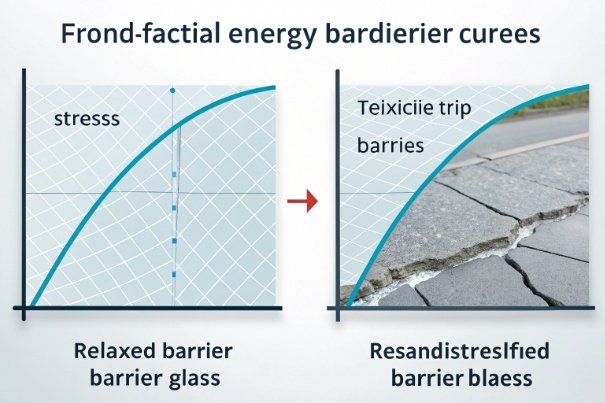
The Mechanism of Stress Corrosion Cracking (SCC)
Imagine a microscopic scratch on the surface of a bottle. Every bottle has them. In a relaxed bottle, the scratch is stable. But if the glass is poorly annealed and under Tension, the glass on either side of that scratch is trying to pull apart.
1. The "Zipper" Effect:
- At the very tip of the crack, the atomic bonds are stretched to their limit.
- When a water molecule or an acid proton ($H^+$) enters the crack, it attacks this stretched bond.
- Because the bond is already stressed, it takes very little chemical energy to snap it.
- Once it snaps, the crack moves forward one atom. The tension pulls it open further, exposing the next bond.
- The chemical attacks again. The crack grows.
2. Static Fatigue:
This process happens slowly. A bottle might hold pressure for 1 week, 1 month, or 1 year. But eventually, the crack grows long enough that the remaining glass can’t hold the pressure, and the bottle explodes. This is why "mystery breakage" in warehouses is almost always an annealing issue combined with humidity or product acidity.
3. Enhanced Leaching:
While stress primarily drives cracking, there is evidence that stressed glass networks are more open. This slightly increases the diffusion rate 3 of alkali ions out of the glass (leaching) and water into the glass (hydration), accelerating the formation of the "gel layer" that eventually flakes off.
Stress vs. Chemical Interaction
| Condition | Mechanical State | Chemical Action | Result |
|---|---|---|---|
| Compression | Atoms pushed together. | Crack tips are closed. Chemicals cannot enter easily. | High Durability. Flaws do not grow. |
| Neutral | Relaxed. | Normal hydrolytic attack. | Stable. Standard shelf life. |
| Tension | Atoms pulled apart. | Crack tips open. Chemicals attack stretched bonds. | Accelerated Failure. Cracks grow (SCC). |
| Thermal Shock | Transient Tension. | Rapid stress + Chemical presence. | Immediate Failure. |
This phenomenon is not theoretical; it happens in specific production scenarios that you likely use.
Stress corrosion requires three ingredients: a susceptible material (glass), a corrosive environment, and tensile stress. Certain manufacturing processes provide the perfect storm for these factors to converge.
Processes that induce thermal shock (Hot-Fill, Pasteurization) temporarily add thermal stress to any existing residual stress, pushing the glass closer to its breaking point. Alkaline washing is particularly dangerous because it acts as a "stress-enhanced" etchant, dissolving the glass network faster in high-tension areas, which can deepen surface flaws and lead to sudden line breakage.
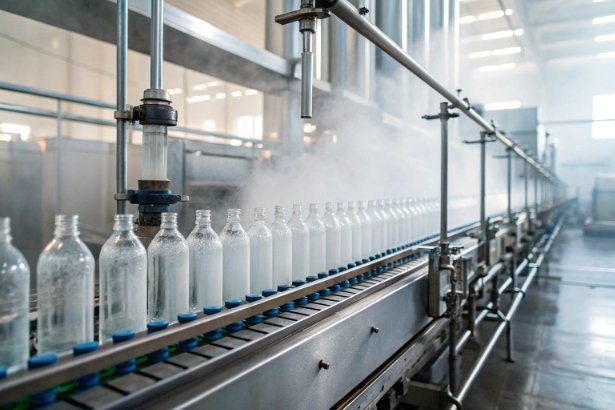
High-Risk Scenarios for Stressed Glass
At FuSenglass, we analyze the entire lifecycle of the bottle. If we know a client is using one of these processes, we tighten our annealing specifications immediately.
1. Carbonated Beverages (The Pressure Cooker):
- The Stress: Internal pressure (from CO₂) puts the bottle wall in permanent tension (Hoop Stress 4).
- The Corrosion: If the beverage is acidic (Soda/Beer) or the storage is humid, moisture attacks the outer surface flaws.
- The Annealing Factor: If the bottle also has residual annealing tension, the total tension exceeds the safety limit. The bottle bursts.
2. Hot-Fill & Pasteurization (The Thermal Spike):
- The Stress: When hot liquid hits cold glass, the inner surface expands, putting the outer surface in tension.
- The Risk: If the bottle was poorly annealed, it already has tension. Adding thermal tension on top of residual tension causes immediate "Thermal Shock" 5 breakage.
- Corrosion Link: The heat accelerates the chemical attack at the crack tip during the process.
3. Alkaline Washing (The Chemical Etch):
- The Chemical: Hot Caustic Soda (NaOH).
- The Mechanism: Alkali dissolves glass.
- The Stress Factor: Differential Etching. Stressed glass dissolves slightly faster than relaxed glass. If a bottle has high residual stress cords, the alkali will eat into those stress lines preferentially, creating deep grooves or "stress risers" 6 that weaken the bottle permanently.
4. Acidic Storage (Long Term):
- The Product: Vinegar, Wine, Pickles.
- The Risk: Slow Stress Corrosion Cracking (SCC) from the inside out. Even a tiny amount of residual tension can allow the acid to drive a crack through the wall over a period of 2 years.
Process Risk Matrix
| Process | Primary Stressor | Corrosive Agent | Role of Annealing |
|---|---|---|---|
| Carbonation | Internal Pressure (Mechanical) | Humidity / Condensation | Critical. Must minimize residual tension to handle pressure. |
| Hot Fill | Thermal Expansion (Transient) | Acidic Product | Critical. Prevents thermal shock failure. |
| Caustic Wash | Thermal + Chemical Etch | Sodium Hydroxide | High. Prevents deep etching of stress lines. |
| Warehouse Storage | Stacking Load | Humidity | Moderate. Prevents static fatigue breakage. |
You cannot see stress with the naked eye. You need specialized optics to catch "bad" bottles before they leave the factory.
How can you detect annealing stress before it becomes a corrosion or breakage issue (polariscopy, stress birefringence, breakage KPIs)?
We rely on the physics of light. Glass under stress becomes "birefringent" 7, meaning it splits light into two rays. By viewing the bottle through polarized filters, we can map the invisible tension forces inside.
The primary tool for detection is the Polariscope (Strain Viewer), which reveals stress patterns as colored fringes (isochromatics). We measure the "Optical Path Difference" in nanometers per millimeter of glass thickness. A "Maltese Cross" pattern on the bottom usually indicates good compression, while irregular, colorful streaks on the sidewalls indicate dangerous tensile stress that predisposes the bottle to corrosion failure.
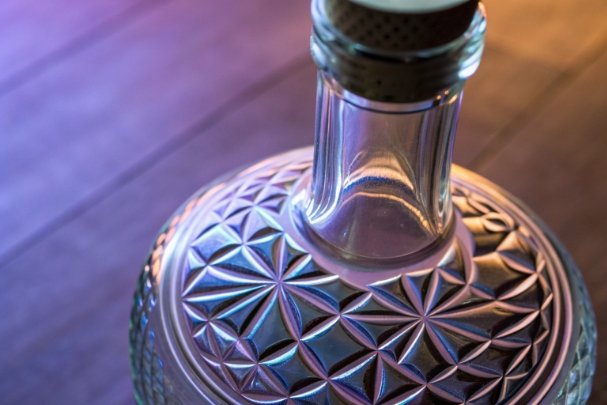
Visualizing the Invisible
In the FuSenglass QC lab, every hour, a technician sits in front of a purple light box. This is the Polariscope.
1. The Color Code (ASTM C148):
When we rotate the bottle under polarized light, we see colors. These colors correspond to the amount of retardation (stress).
- Black/Grey: Zero stress. (Perfectly annealed).
- Yellow/Orange: Low to Moderate stress. (Acceptable).
- Red/Blue/Green: High stress. (Danger Zone).
2. The "Maltese Cross":
On the bottom of the bottle (the base), we want to see a symmetrical cross shape.
- This indicates that the bottom is under Compression. Compression is good—it holds the bottle together and resists cracks.
- If the cross is warped, broken, or missing, the bottom is unstable.
3. The Sidewall Ring Sections:
We cut rings from the bottle wall and look at them under a microscope with a compensator (like a Berek or Babinet compensator).
- We measure the stress in nm/mm (nanometers of retardation per millimeter of thickness).
- Tension vs. Compression: We must distinguish them. Compression on the surface (skin) is required for durability. Tension in the core is the balance. If Tension reaches the surface, the bottle will fail chemically and mechanically.
4. Breakage KPIs:
If you don’t have a polariscope, look at your breakage.
- Thermal Shock Failures: If bottles break during filling/washing, check the annealing.
- Delayed Breakage: If bottles break 24 hours after filling, it is almost certainly Stress Corrosion Cracking driven by poor annealing.
Stress Measurement Grades (ASTM C148)
| Grade | Apparent Temper Number | Optical Path Difference (nm) | Status |
|---|---|---|---|
| Grade 1 | 1 | < 18 nm | Commercial Perfect. |
| Grade 2 | 2 | 18 – 35 nm | Excellent. |
| Grade 3 | 3 | 35 – 53 nm | Standard Acceptable Limit. |
| Grade 4 | 4 | 53 – 70 nm | Borderline. Risk of chemical failure. |
| Grade 5 | 5 | > 70 nm | Reject. High risk of SCC. |
How do you ensure your supplier is controlling this? You need to audit their "Lehr" and set strict acceptance criteria.
Annealing is a time-temperature recipe. Controlling the cooling rate through the "Annealing Point" and "Strain Point" is the only way to remove stress. Buyers must demand proof of this control.
Production must maintain a precise "Lehr Profile," ensuring the glass spends sufficient time at the annealing temperature (~550°C) to relax stresses before slow cooling. Buyers should mandate ASTM C148 stress checks (Target < Grade 3) on every pallet lot and require Thermal Shock Testing (ASTM C149) as a proxy for annealing quality, since poorly annealed bottles inevitably fail under thermal stress.
The Annealing Lehr: The Stress Eraser
The Lehr is a 20-meter long oven. The bottle enters red hot and leaves cool.
- Heating Zone: Brings the whole bottle to a uniform temperature (Annealing Point 8, approx 554°C for soda-lime). At this temp, the glass is soft enough for stress to relieve itself, but hard enough not to deform.
- Soaking Zone: Holds it there. This "erases" the thermal memory.
- Slow Cooling Zone (Critical): We cool it very slowly to the Strain Point 9 (~510°C). If we cool too fast here, permanent stress returns.
- Fast Cooling Zone: Once below the Strain Point, the glass is solid. We can cool it fast to room temp.
Buyer’s Control Plan:
1. The Specification (Purchase Order):
- "Residual Stress must be Grade 3 or lower according to ASTM C148 10."
- "No surface tension permitted on sidewalls."
2. The Sampling Plan:
- Stress changes if the belt speed changes or the factory draft changes.
- Require: 1 set of samples every 2 hours per mold cavity.
- If a sample fails (Grade 4+), the factory must quarantine production back to the last "Good" check and re-anneal it.
3. The Proxy Test (Thermal Shock):
If you can’t measure stress directly, test Thermal Shock (ASTM C149).
- Heat bottle to 60°C $\rightarrow$ Plunge into 20°C water ($\Delta T = 40^\circ C$).
- If the bottle breaks, the annealing is bad. A well-annealed bottle should easily survive $\Delta T = 42^\circ C$.
Buyer’s Quality Checklist
| Control Parameter | Method | Limit / Target | Frequency |
|---|---|---|---|
| Residual Stress | ASTM C148 (Polariscope) | Average Grade 2; Max Grade 3. | Every 2 Hours. |
| Thermal Shock | ASTM C149 | Pass $\Delta T$ 42°C. | Every 4 Hours. |
| Lehr Profile | Thermocouple Data Logger | Adherence to standard curve. | Daily / Shift change. |
| Surface Compression | Coating Measurement | Check Cold End Coating (lubricity). | Every Batch. |
Conclusion
Annealing stress is the "ghost" in the machine. It doesn’t change the chemistry of the glass, but it energizes the destruction of the bottle. By understanding that tension accelerates corrosion and leads to spontaneous failure, and by enforcing strict Polariscope standards (Grade 3 max), you ensure that your FuSenglass bottles are physically relaxed and chemically resilient, ready for whatever your product demands.
Footnotes
-
The process of cooling glass slowly to relieve internal stresses. ↩
-
A failure mechanism caused by the combined effects of tensile stress and a corrosive environment. ↩
-
The rate at which particles spread from areas of high concentration to low concentration. ↩
-
The stress exerted circumferentially in a cylinder wall due to internal pressure. ↩
-
Mechanical load caused by rapid temperature changes, often leading to breakage. ↩
-
A location in an object where stress is concentrated, often leading to failure. ↩
-
The optical property of a material having a refractive index that depends on the polarization and propagation direction of light. ↩
-
The temperature at which internal stresses in glass are relieved in minutes. ↩
-
The temperature below which permanent strain cannot be introduced or removed. ↩
-
Standard test methods for polariscopic examination of glass containers. ↩






