
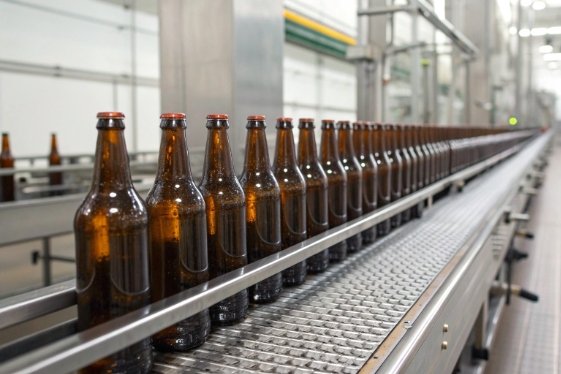
Adding a grip feature seems like a simple ergonomic upgrade, but in glass manufacturing, geometry dictates physics. Is your safety feature actually a thermal hazard?
Yes, textures significantly affect thermal performance. Embossed patterns increase surface area, altering cooling rates, while uneven wall thickness from deep textures can create stress concentrations (stress risers), significantly increasing the risk of breakage during thermal shock events like hot-filling or pasteurization.
The Physics of Texture and Thermodynamics
When we design a bottle at FuSenglass, we don’t just look at how it sits in the hand; we look at how it behaves in the furnace and the filling line. "Dive Deeper" into the reality of glass production reveals that any deviation from a smooth cylinder introduces complexity. Glass is a poor conductor of heat. When you add texture—whether it is for branding, aesthetics, or anti-slip functionality—you are altering the mass and the surface area of the container.
In my experience, the most common mistake brands make is designing a texture that looks great in a 3D render but performs poorly in a cooling tunnel. If you add heavy embossing to one side of the bottle to create a "grip zone," you are essentially creating a localized area of thicker glass. Thicker glass holds heat longer than thinner glass. When the bottle travels through the lehr (annealing oven 1) or a pasteurization tunnel, these different sections cool at different rates. This differential cooling creates residual internal stress. If this stress exceeds the tensile strength of the glass, the bottle will crack spontaneously, often long before it reaches the consumer. It is a delicate balancing act between ergonomic function and thermodynamic stability.
Surface Area vs. Thermal Mass
The relationship between the texture’s shape and its thermal behavior is governed by the ratio of surface area to glass volume.
| Feature Type | Thermal Characteristic | Result on Production Line |
|---|---|---|
| Smooth Wall | Consistent surface-to-volume ratio. | Uniform heating and cooling; predictable expansion. |
| Heavy Embossing | High thermal mass (thick glass). | Retains heat; cools slowly; risk of internal tension. |
| Fine Ribbing | High surface area (radiator effect). | Dissipates heat quickly; cools faster than the main body. |
| Recessed Grip | Thinner wall section. | Cools rapidly; structurally weaker against thermal shock. |
Now, let’s break down exactly how these geometric changes play out during the critical heating and cooling phases of your production line.
How do grip patterns alter heat transfer and cooling speeds?
Inconsistent cooling is the enemy of glass integrity. Textures act as functional modifiers to the thermal properties of the container, sometimes in ways you do not expect.
Ribs and embossing act as cooling fins, drastically increasing the surface area and speeding up heat dissipation in those specific zones. However, if the texture creates significant thickness variations, it leads to differential cooling, where one part of the bottle contracts while another is still expanded.
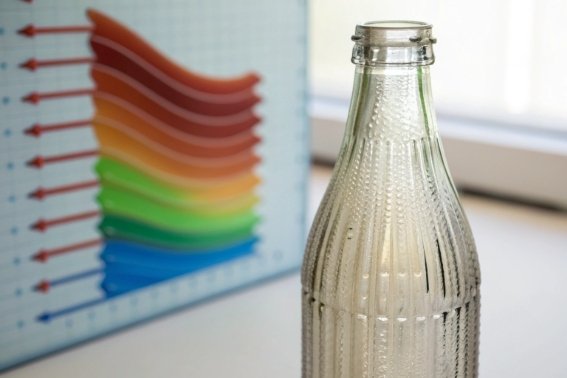
The "Cooling Fin" Effect
Think of the heatsink on a computer processor—it is made of fins to maximize air contact. When we mold sharp ribs or diamond patterns onto a glass bottle for grip, we are accidentally building a radiator. In a cooling tunnel, these textured areas will drop in temperature much faster than the smooth, thick base of the bottle.
Differential Cooling and Tensional Stress
Glass breaks under tension. When the ribbed surface cools (and contracts) faster than the smooth glass next to it, it pulls on the warmer glass. This tug-of-war creates "Tensile Stress." If you have a heavy logo or a thick anti-slip bar next to a thin wall, the temperature difference between them during rapid cooling can be substantial. I have seen bottles exit a pasteurizer intact, only to shatter minutes later because the internal tension created by this uneven cooling finally released.
Uniformity is Key
The goal in mold design is to maintain "Thermal Uniformity." If we must have texture, we try to ensure the glass wall behind the texture remains somewhat consistent, or we transition the thickness gradually. Abrupt changes in mass are where thermal failures are born.
Impact of Texture Geometry on Cooling
Different patterns interact with the surrounding air (or water spray) differently.
| Pattern Style | Heat Transfer Behavior | Risk Level |
|---|---|---|
| Vertical Ribs | Promotes vertical airflow; fast cooling. | Moderate; creates vertical stress lines. |
| Horizontal Rings | Traps air/water; can insulate or cool unevenly. | High; creates circumferential stress. |
| Diamond Knurling | Maximizes surface area; very rapid cooling. | High; complex stress vectors. |
| Random Roughness | Breaks up boundary layer; turbulent cooling. | Low to Moderate; generally safer than deep patterns. |
Do textures create stress concentrations that risk thermal shock?
A dropped bottle is an obvious break, but a bottle that explodes during hot-filling is a failure of geometry. Sharp textures are often the hidden culprit.
Absolutely. Sharp corners and deep embossing in the mold act as "stress risers." During rapid temperature changes, these points focus mechanical energy, making the glass exponentially more likely to crack than a smooth, uniform surface.
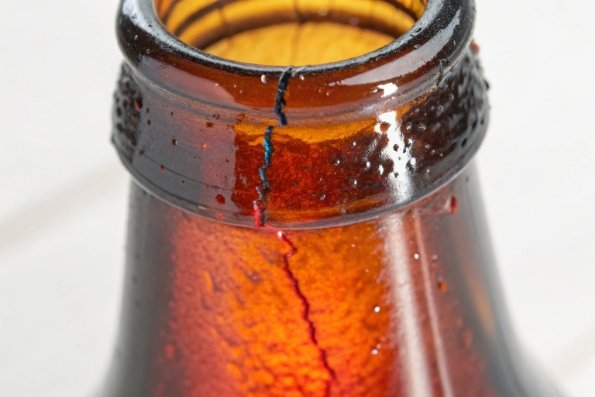
Understanding Stress Risers
In engineering, a "stress riser" or stress concentration 2 is a location in an object where stress is concentrated. For glass, this is usually a sharp corner or a deep notch. If your anti-slip design involves sharp, square-edged ridges, you are creating a series of weak points. When the bottle is filled with hot liquid (90°C), the inner wall expands. The outer wall, which is cooler, resists. This puts the outer surface in tension.
The Notch Sensitivity of Glass
Glass is a brittle material; it does not stretch. If there is a sharp notch (like a crisp detail in your embossed logo or grip), the tension focuses entirely on that tip. It acts like a wedge, driving a crack through the wall. This is why we always round the edges of any design feature. A smooth wave pattern is infinitely safer thermally than a sharp jagged pattern, even if the glass thickness is identical.
Hot-Fill vs. Cold Chain Risks
The risk is highest during Thermal Shock—a rapid change in temperature (Delta T).
-
Hot Fill: The bottle expands. Sharp external corners are pulled apart.
-
Rapid Cooling: The bottle contracts. Deep crevices trap heat while peaks cool, tearing the structure.
Stress Concentration Factors
The geometry of the detail determines the multiplier of the stress.
| Texture Feature | Stress Concentration Factor (K) | Thermal Shock Outcome |
|---|---|---|
| Smooth Surface | 1.0 (Baseline) | Even distribution of stress. Safe. |
| Large Radius Wave | ~1.2 | Slight focus, generally safe. |
| 90° Sharp Corner | ~3.0 – 5.0 | High risk. Likely initiation point for cracks. |
| V-Notch / Deep Cut | > 5.0 | Critical failure point. Almost guarantees breakage. |
Which anti-slip methods handle thermal cycling best?
Not all grip is created equal. Some methods weaken the glass structure physically, while others add grip without compromising the thermal integrity of the container.
Sprayed matte coatings (frosting) offer the best thermal safety because they do not alter the glass wall thickness. Molded embossing is safe if designed with large radii, while deep etching can introduce micro-cracks that weaken the structure.
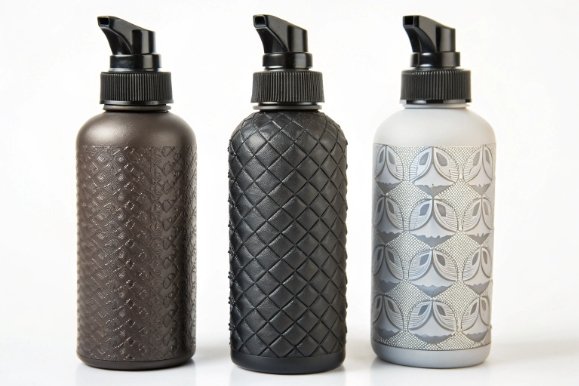
Molded Embossing: The Standard Choice
This is the most common method—building the texture into the mold. It is cost-effective but requires the engineering limitations we discussed above. It changes the physical shape of the glass. If done with gentle curves (fillets) and consistent wall thickness, it is thermally robust. If done with sharp angles, it is a liability.
Acid Etching / Sandblasting: The Risky Choice
Etching creates a non-slip surface by physically damaging the glass skin. While it looks premium, it introduces millions of microscopic flaws (Griffith flaws 3) onto the surface. Under thermal stress, any one of these micro-cracks can propagate into a full shatter. We generally advise against heavy sandblasting for bottles intended for aggressive thermal cycling (like retort processing 4).
Organic Coatings: The Safe Choice
Spraying a "soft-touch" or matte coating is the safest option thermally. You are adding a thin layer of polymer or epoxy over the glass.
-
It does not change the glass geometry (no uneven cooling).
-
It acts as a slight insulator, reducing thermal shock severity.
-
It adds a protective layer that can heal or cover micro-abrasions.
The downside is cost and potential durability issues with the coating itself, but strictly speaking of glass breakage, this is superior.
Method Comparison for Thermal Environments
Here is how the different anti-slip technologies stack up.
| Method | Grip Mechanism | Thermal Safety | Best Application |
|---|---|---|---|
| Molded Embossing | Geometry Change | Moderate (Design dependent) | Standard beverages, moderate hot-fill. |
| Acid Etching | Surface Roughness | Low | Spirits, cosmetics (Room temp fill). |
| Spray Coating | Chemical Adhesion | Very High | High-pressure carbonation, severe thermal shock. |
| Paper/Plastic Label | Material Friction | High | Cheap, effective, protects glass surface. |
What design rules guarantee thermal safety?
Guesswork causes explosions. To ensure your textured bottle survives the production line, you must rely on rigorous engineering principles and standardized testing.
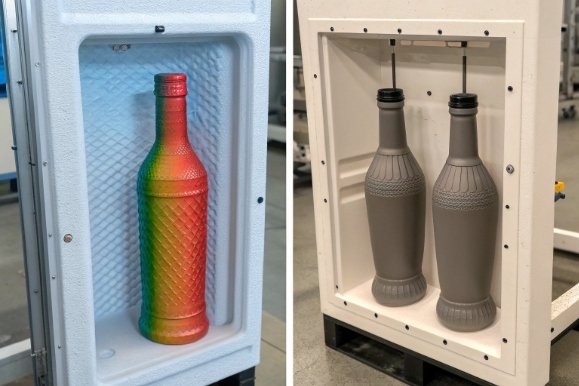
Maintain uniform wall thickness and use generous fillet radii on all embossed details. Validate designs with Finite Element Analysis (FEA) before molding, and perform physical ASTM C149 thermal shock testing on pilot samples to confirm limits.
The Golden Rules of Mold Design
At FuSenglass, we refuse to cut molds until the design passes our engineering review. The two non-negotiables are:
-
Uniformity: The wall thickness behind a texture should not deviate more than 15-20% from the surrounding wall.
-
Radii: Every corner must have a radius. No sharp edges. The internal radius of an embossed rib should be at least 50% of the wall thickness.
Simulation Before Production
We use Finite Element Analysis (FEA) 5 software to simulate thermal loads. We input the bottle 3D model, apply a virtual heat load (e.g., 90°C liquid), and the software highlights the "Red Zones" where stress exceeds the glass’s limit. If your anti-slip pattern glows red in the simulation, we redesign it before spending a dime on metal molds.
The Ultimate Test: ASTM C149
Simulation is good; destruction is better. The industry standard for verifying thermal performance is ASTM C149. We take the pilot bottles with the anti-slip texture and subject them to increasing temperature differentials (Delta T).
-
Start at Delta T = 42°C.
-
Increase by increments until failure.
-
A safe bottle for hot-fill packaging 6 should withstand a Delta T of at least 42-50°C without breaking.
If the failure origin point is consistently found at the anti-slip texture, the design is rejected.
Validation Checklist
Use this table to ensure your design is ready for the heat.
| Validation Step | Action | Success Criteria |
|---|---|---|
| Design Review | Check radii and thickness ratios. | No sharp corners; thickness variance <20%. |
| FEA Simulation | Simulate Hot Fill (90°C) & Pasteuization. | Max tensile stress < 1000 psi (approx). |
| Thickness Check | Section cut analysis of pilot mold. | Physical wall matches 3D model specs. |
| Thermal Shock | ASTM C149 Hot/Cold Bath. | Survival at Delta T 42°C (Standard) or 60°C (High perf). |
Conclusion
Textures add immense value to the user experience, but they demand engineering respect. Balance your grip requirements with thermal physics, ensure uniform thickness, and test rigorously to prevent expensive line failures.
Footnotes
-
A specialized oven used to cool glass slowly to relieve internal stresses. ↩
-
A localized area in a structure where stress is significantly higher than the surrounding area. ↩
-
Microscopic flaws on the surface of brittle materials that significantly lower their fracture strength. ↩
-
A sterilization process that uses high heat and pressure, demanding robust packaging. ↩
-
A computational method for predicting how a product reacts to real-world forces and heat. ↩
-
A method of filling bottles with hot product to ensure sterility, requiring thermal shock resistance. ↩






