Poor flow makes a good mold look bad. The gobs swing, the parisons go thin, and rejects climb before anyone agrees on the cause.
Yes. Formulation sets melt viscosity behavior, which controls gob flow, mold filling, and how forgiving the line is to temperature drift. Stable recipes plus stable forehearth control usually beat “more heat” as a long-term fix.
Flowability is mostly a viscosity-curve problem, and the recipe is the curve?
Flowability in bottle making is the ability of molten glass to move and shape predictably from the forehearth to the feeder to the blank mold. This depends on one thing more than anything else: the viscosity curve 1. Viscosity is not a single value. It is a curve that links temperature to resistance to flow. The curve decides how fast a gob stretches, how clean the shear cut is, how the parison skin sets, and how the glass redistributes before blow.
A bottle line does not want the “lowest viscosity.” It wants the “right viscosity at the right time.” If viscosity is too high, the gob fills poorly and seams do not weld. If viscosity is too low, the gob becomes noisy, the parison slumps, and thickness moves away from critical zones. The best throughput comes when viscosity stays inside a narrow band and stays there with minimal corrections.
Formulation influences flowability through:
-
network openness (how easily the melt moves)
-
working range steepness (how sensitive flow is to small temperature drift)
-
homogeneity (cords and pockets that make “two viscosities in one gob”)
-
devitrification margin (crystals that stiffen flow paths in cooler zones)
This is why two furnaces can run the same bottle design with different feeder setpoints. Their recipes create different curve positions and different curve steepness.
| What the line feels | Likely viscosity condition | What a recipe change can do | What a temperature change can do |
|---|---|---|---|
| short/stiff gobs, poor fill | viscosity too high | lower curve by increasing fluxing power | raise temp to lower viscosity |
| long/noisy gobs, slump | viscosity too low | raise curve by strengthening network | lower temp to raise viscosity |
| sensitive to tiny drift | curve too steep | flatten sensitivity via balanced chemistry | improve temperature uniformity |
| random thin spots | melt not homogeneous | reduce cords via better melting/refining chemistry | limited, may hide root cause |
The sections below answer your four questions in a way that helps production teams and buyers make the same decision with less argument.
What does “melt viscosity” mean for glass bottle forming flow, and what’s the ideal working range?
Viscosity is the melt’s resistance to flow. For bottle forming, it is the “master control” because it drives gob shape and how the parison forms.
Melt viscosity is how strongly molten glass resists deformation during delivery and forming. The ideal working range is a narrow viscosity band at feeder temperature where shear is stable, blank fill is complete, and parison shape holds without slump.
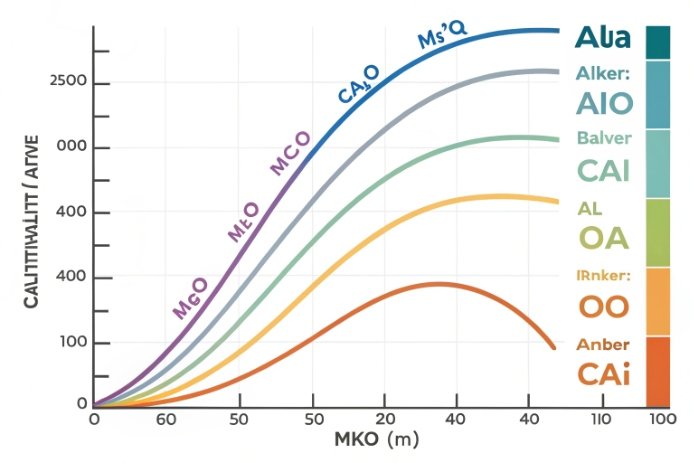
What viscosity means in practical forming language
-
At the orifice, viscosity controls stream stability and shear cut 2.
-
In the blank mold, viscosity controls how well the gob spreads and welds.
-
During parison settling, viscosity controls redistribution before the skin locks.
-
During blow, viscosity controls wall thickness distribution and roundness.
So viscosity is not only about “flow.” It is also about “timing.” Glass has to flow enough before it freezes, and it must stop flowing enough to hold shape.
The “ideal working range” is plant-specific, but the pattern is universal
Most plants define the ideal range indirectly, using:
-
gob temperature window (tight band)
-
shear stability (cut quality and gob length stability)
-
blank fill completeness (seam and fold rejects)
-
thickness spread by zone (heel/shoulder/finish)
-
defect mix stability (seeds and cords stay low)
A useful rule: the best working window is where the line needs the fewest corrections to stay in spec.
Why the curve shape matters as much as the setpoint
If the viscosity curve is steep, a 3–5°C drift can swing flow a lot. If the curve is flatter, the same drift causes less trouble. Recipe changes can alter steepness. Temperature control can reduce drift. Both matter.
| Control target | What “good” looks like | Why it implies the right viscosity band |
|---|---|---|
| gob weight stability | tight distribution | stable stream and cut |
| parison symmetry | low ovality | consistent fill and settle |
| seam/fold rejects | low and stable | good blank weld and flow |
| thickness mapping | tight zone spread | predictable redistribution |
| correction frequency | low | curve is forgiving and control is stable |
That sets the foundation. Next is how the batch recipe shifts gob flow and mold filling.
How does changing the glass batch recipe affect gob flow and mold filling?
A batch recipe change shifts how easily the silica network breaks down and how stable the melt stays through refining and conditioning.
Silica strengthens the network and raises viscosity. Soda ash (Na₂O) opens the network and lowers viscosity. Limestone (CaO) stabilizes the network and can raise viscosity and devit risk when high. Alumina (Al₂O₃) tightens the network for durability and stability, but also raises viscosity and can increase cords/stones if melting is incomplete.
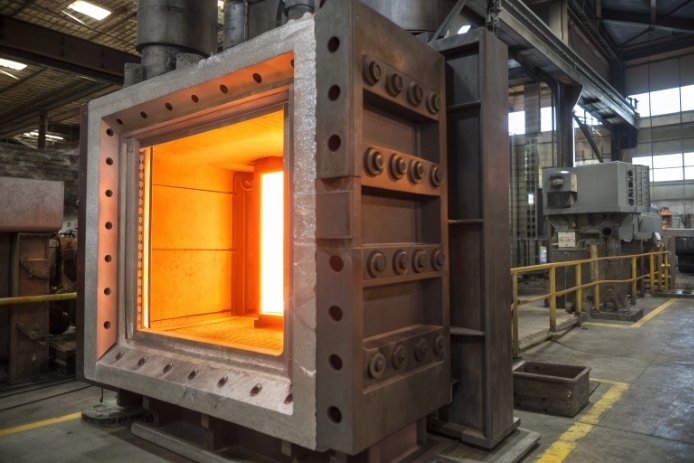
Silica (SiO₂): strength and clarity, but slower melting and higher viscosity
More SiO₂ generally means a stronger network. That helps durability and sometimes optical stability. Still, it increases viscosity and melting demand. If increased without enough fluxing support, it can cause:
-
under-melted particles
-
stones and cords
-
tighter feeder window
In forming, this shows up as stiff gobs and poor blank filling unless temperatures rise.
Soda ash (Na₂CO₃ → Na₂O): main flux, strong viscosity lever
Na₂O is the core reason soda-lime glass 3 is formable at container furnace conditions. Increasing Na₂O generally lowers viscosity and improves melting speed. But it also:
-
raises CTE
-
can reduce durability margin if stabilizers are not balanced
-
can increase volatility and correction sensitivity at high temperatures
In forming, too much Na₂O can make gobs too fluid, increasing slump and thickness variability.
Limestone (CaCO₃ → CaO): stabilizer with a devit ceiling
CaO stabilizes the network opened by Na₂O and supports durability. Still, high CaO can move the composition closer to calcium-silicate crystallization fields. That raises devitrification 4 risk in cooler zones, which can cause haze and cords-like distortion.
In forming, devit-related stiffening can show up as unstable flow even when feeder temperatures look correct.
Alumina (Al₂O₃): durability and drift control, with a viscosity cost
Al₂O₃ often improves chemical stability and reduces drift. It can make the melt less “touchy” over time. But it raises viscosity and can be slow to dissolve if raw material quality 5 or PSD is not controlled. That can increase cords/striae if the melt is not fully homogeneous.
Recipe shift summary table
| Ingredient change | Directional effect on viscosity | Likely forming impact | Main risk to watch |
|---|---|---|---|
| SiO₂ up | viscosity up | stiffer gob, poor fill | stones/cords if under-melted |
| Na₂O up | viscosity down | better fill, risk slump | durability drop, volatility |
| CaO up | often viscosity up and liquidus up | stable network, devit risk | haze/stones, cords-like distortion |
| Al₂O₃ up | viscosity up | tighter window, more stable long-term | cords/stones if incomplete dissolution |
This is why recipe changes must always be paired with melting completeness and devit margin checks.
Now the recycled content question: cullet changes melting and flowability in good ways and risky ways at the same time.
Does cullet percentage or recycled content impact forming stability, defect rates, and energy use?
Cullet is the fastest way to cut energy, but it is also a fast way to add variability if the stream is not controlled.
Yes. Higher cullet usually lowers melting energy and can stabilize melting because cullet melts early. But variable cullet chemistry can shift viscosity, redox, and devit margin, increasing defects and forming instability unless the cullet stream is well graded and clean.
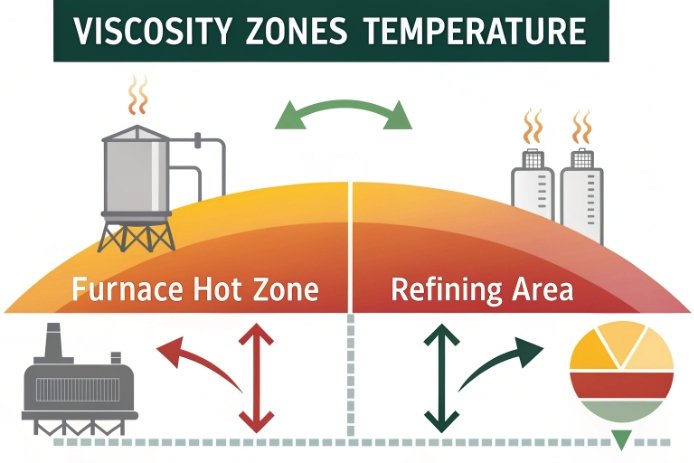
The upside: cullet improves meltability and energy efficiency
Cullet is already glass. It softens and melts earlier than raw batch. This can:
-
reduce furnace energy per ton
-
improve melt rate and pull stability
-
reduce carbonate decomposition load
-
support lower peak temperatures in some programs
Many plants see the biggest energy benefit when cullet 6 is clean and consistent.
The downside: cullet adds chemistry and contamination variability
Recycled content can change:
-
Na₂O/CaO/MgO balance (different container families)
-
iron and colorant load (flint color drift)
-
organics and fines (redox swings, foam, fining instability)
-
ceramics and stones (nucleation sites for devit)
These shifts show up as:
-
more correction cycles
-
more cords/striae
-
haze days from devit
-
higher seed counts if fining behavior changes
Cullet impact table
| Cullet change | What it improves | What it can worsen | Control action that keeps it safe |
|---|---|---|---|
| % cullet up (clean) | energy, melt rate | little, if stable | lock cullet grade + chemistry SPC |
| % cullet up (mixed) | energy | color drift, devit risk | tighten sorting + reject protocol |
| organics up | none | redox drift, foam, seeds | better cleaning, limit labels/fines |
| ceramics up | none | stones, devit nuclei | screening, ceramic removal tech |
The practical rule
High cullet works best when procurement treats cullet like a raw material with specs:
-
color grade (flint-only for flint)
-
contamination limits (ceramics, metals, organics)
-
chemistry trending (Fe₂O₃, CaO, MgO, Na₂O drift)
If those gates exist, recycled content can rise without losing forming stability.
Now the last question is the one that decides daily actions: when flowability is poor, do you adjust temperatures or reformulate?
When flowability is poor, should you adjust furnace/forehearth temperatures or reformulate the glass, and how do you decide?
Turning up heat is fast. Reformulating is slower. The decision should be based on whether the problem is a short-term drift or a structural mismatch between recipe and machine needs.
Adjust temperatures first when the recipe is known to work and the issue is a temporary drift. Reformulate when the line repeatedly runs at the edge of its temperature limits, needs constant corrections, or shows recurring devit/cord defects tied to composition or cullet variability.

Choose temperature adjustment when the issue is “control drift”
Temperature action fits when:
-
the SKU has a stable history on this furnace
-
recent changes include pull rate, ambient conditions, burner tuning, or forehearth control 7
-
defects are mainly “flow stiffness” or “flow fluidity” without new haze/stones
-
chemistry and cullet stream did not change
In this case, a small forehearth trim and improved temperature uniformity can bring flow back quickly.
Choose reformulation when the issue is “recipe mismatch” or “input variability”
Recipe action fits when:
-
you keep hitting the same flow limit even with good temperature control
-
devit haze/stones recur in cooler zones
-
cords/striae rise after raw or cullet source changes
-
energy use and volatility rise because temperatures must stay high
-
customer targets changed (durability or premium clarity)
In these cases, composition margin must be improved. That might mean:
-
adjust Na₂O/CaO/MgO balance for a better curve
-
use modest Al₂O₃ changes for stability
-
cap CaO to improve devit margin
-
tighten cullet grade rules to stop drift
Decision table for daily use
| Symptom | Best first move | When it becomes a reformulation case |
|---|---|---|
| stiff gob, seam/fold rejects | small forehearth temp increase | if you need chronic high temps to survive |
| long gob, slump, ovality | small forehearth temp decrease | if curve is too low due to recipe drift |
| haze/stones appear | stabilize temps and check cold spots | if it recurs, cap CaO and tune MgO balance |
| cords/striae rise | check melting/refining 8 stability | if tied to recipe/cullet change, reformulate or tighten cullet |
| foam and seed spikes | fix redox/fining and cullet organics | if persistent, redesign fining/recipe balance |
The simple “two-week rule”
If temperature corrections fix the issue and stability holds for two weeks with normal drift, the recipe is probably fine. If the same problem returns repeatedly, the recipe window or cullet control is not strong enough, and reformulation (or input governance) is the smarter long-term move.
Conclusion
Yes, formulation affects forming flowability by setting the viscosity curve, homogeneity 9, and devit margin. Use temperature trims for short-term drift, and use reformulation plus cullet control 10 when the problem is structural or recurring.
Footnotes
-
[Graphical representation showing the relationship between glass viscosity and temperature.] ↩
-
[Mechanism that cuts the molten glass stream into individual gobs for forming.] ↩
-
[Most common type of glass used for containers, composed of silica, soda, and lime.] ↩
-
[Unwanted crystallization in glass caused by improper cooling or composition.] ↩
-
[Importance of raw material quality and particle size distribution in glass batch melting.] ↩
-
[Recycled broken or waste glass used to lower melting energy and reduce raw material usage.] ↩
-
[Control systems for maintaining precise temperature in the glass conditioning channel.] ↩
-
[Process of removing bubbles and homogenizing the glass melt.] ↩
-
[Uniformity of the glass composition and structure, critical for defect-free production.] ↩
-
[Management of recycled glass quality to prevent contamination and process instability.] ↩