
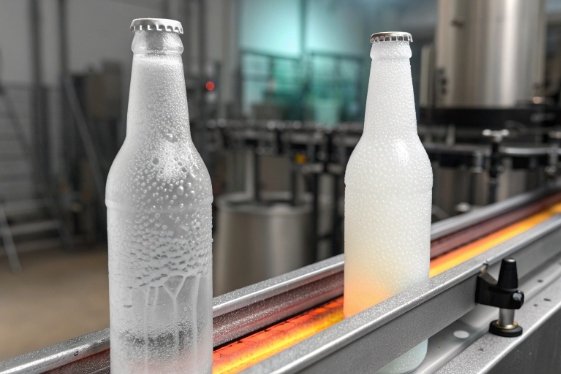
Frosted bottles look premium, but heat swings can turn “premium” into returns. Small surface changes can become crack starters when the line runs hot and fast.
A frosted finish can increase risk under temperature changes if it roughens the glass surface, adds micro-defects, or introduces a coating layer with mismatched expansion. With the right frosting method and QC, many frosted bottles still pass hot-fill and cycling.
Frosted bottles fail for three reasons: surface, layer mismatch, and process stress
Surface roughness changes how cracks start
A clear bottle has a smoother surface. Frosting often creates micro-roughness. Micro-roughness is not automatically “bad,” but it can act like tiny notches. Notches focus stress. Thermal shock 1 is stress plus time. So a frosted surface can reduce the safety margin during fast heating or fast cooling.
Acid-etched frosting is the most important case here because it changes the glass itself. It removes a thin layer and leaves a rough surface. If the etch is controlled, the risk stays low. If the etch is uneven, over-etched, or contaminated, the surface can carry more crack starters.
A “layer” can expand differently than the glass
Some frosted looks come from spray coatings or in-mold coatings. These are not the same as etched glass. A coating behaves like a thin film on top of glass. Film and glass can expand at different rates. During heating and cooling, that mismatch can create shear stress at the interface. If adhesion is weak, the coating can craze, flake, or create local stress points. The glass may still be fine, but the surface system becomes the failure trigger.
Process stress makes small differences look big
Hot-fill, pasteurization 2, and warehouse swings are not gentle. Bottles see inside-out temperature gradients, wet surfaces, and fast cooling zones. A frosted finish often reduces “forgiveness” during these transitions. This is why the same bottle can pass in one plant and fail in another plant with a colder rinse or faster conveyor cooling.
| Risk driver | What changes with frosting | What it looks like on the line | Best prevention |
|---|---|---|---|
| Glass surface micro-defects | roughness, micro-notches | cracks at shoulder/heel after cooling | tight etch control, stress inspection |
| Coating mismatch and adhesion | film expands differently | haze, crazing, flakes, then cracks | adhesion specs, thermal cycling tests |
| Handling abrasion | frosted surfaces scuff easier | scratch lines become crack starts | abrasion testing, packaging upgrades |
| Residual stress in the bottle | frosting cannot “fix” annealing | random breaks during temperature ramps | strain control, polariscopic checks |
A small lesson learned from a beverage project: the “frosted” look was blamed first. The real cause was a cold rinse right after hot-fill. The frosting only made the weak spot show up sooner.
Now it helps to separate frosting types, because they behave very differently under thermal cycling.
What types of frosting behave differently under thermal cycling?
A buyer can approve a frosted sample that looks perfect, then see failures after the first heat trial. That happens when “frosted” is treated as one finish.
Acid-etched frosting changes the glass surface, while spray-coated and in-mold frosting add a layer. Under thermal cycling, etched bottles mainly risk surface micro-defects, and coated bottles mainly risk adhesion and layer mismatch.
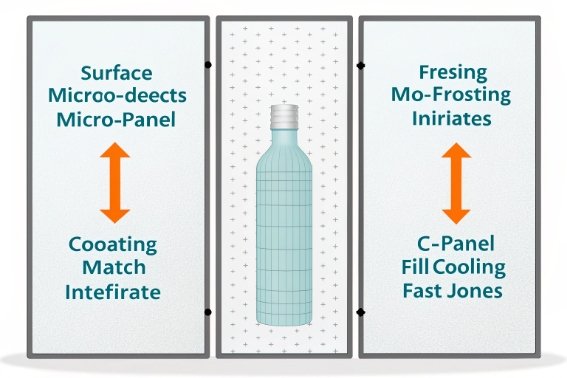
Acid-etched frosting
Acid etching 3 creates the frosted look by chemically attacking the surface. This is a permanent change to glass. The risk depends on etch depth, uniformity, and how well the glass is rinsed and neutralized. Over-etching can increase surface flaw density. Under fast cooling, those flaws become crack starters.
Etching can be safe when it is shallow and consistent. It can also be risky when the supplier uses aggressive etch to hit a “very matte” look without controlling time and chemistry.
Spray-coated frosting
Spray frosting is a coating. It can be organic, inorganic, or hybrid. Under thermal cycling, coatings can craze, soften, or lose adhesion. Heat and moisture accelerate this. The glass might survive, but the coating fails first. In some cases, coating defects create stress concentrators or become scratch points that later trigger cracks in the glass.
Spray coatings need strong adhesion and good flexibility. A “hard” coating is not always better if it cracks under cycling.
In-mold frosting (or in-mold coating)
In-mold finishes are applied during forming or as part of the hot-end/cold-end process. These can be more uniform than post-spray. They often bond better. Still, they are not immune. They must survive heat gradients and repeated washing.
| Frosting type | What it is | Typical thermal-cycling weak point | Best buyer spec |
|---|---|---|---|
| Acid-etched | glass surface is modified | micro-defects and strength loss if over-etched | etch depth control + stress inspection |
| Spray-coated | film on glass | adhesion loss, crazing, softening | adhesion + thermal cycling + abrasion |
| In-mold | integrated surface layer | interface stress if chemistry is off | process stability + batch traceability |
| “Matte label look” combo | etch + coating | stacked risks | require combined testing, not separate claims |
When selecting frosting, the safest path is to match the finish to the heat story. A dry, room-temperature cosmetic bottle can accept more finish options than a hot-fill sauce bottle.
Can a frosted layer create micro-cracks or stress points that reduce thermal shock resistance?
A frosted bottle can feel “grippy,” but the same texture can hide damage. Heat cycling does not forgive hidden weak points.
Yes. Etched frosting can increase micro-defects on the glass surface, and coatings can create stress points through cracking or poor adhesion. These can reduce thermal shock resistance, mainly by lowering the crack-start threshold.
Etched surfaces: micro-notches are the main issue
Glass breaks from flaws. That is normal. A smooth surface has fewer severe flaws. Etching creates a uniform roughness pattern. If it is controlled, the roughness is fine and the bottle stays strong enough. If it is not controlled, the roughness becomes uneven and deeper flaws form. Deeper flaws mean higher stress intensity 4 at the flaw tip. Thermal cycling then becomes the trigger, not the cause.
One detail that often gets missed: an etched finish can also make abrasion damage worse. A matte surface can pick up scuffs that are hard to see. Those scuffs can become crack starters during cooling in hot-fill.
Coatings: stress points come from crazing and interface shear
A coating does not usually “crack the glass” by itself. It can still reduce resistance in two ways:
-
Crazing: tiny cracks in the coating create sharp edges and scratch points.
-
Adhesion loss: small delamination zones create uneven contact and local stress concentration.
If the coating has a different expansion than glass 5, thermal cycling makes that mismatch repeat. Repetition grows defects over time, even if the first few cycles look fine.
What “reduced thermal shock resistance” looks like in practice
Most failures show up at geometry stress zones: shoulder, heel, base ring, and emboss areas. Frosting often does not change those zones, but it can reduce the margin so those zones fail earlier.
| Mechanism | What causes it | Early warning sign | How to catch it |
|---|---|---|---|
| Over-etch micro-defects | aggressive etch, poor control | higher break rate during cooling | surface microscopy + break mapping |
| Coating crazing | brittle coating, thermal mismatch | whitening lines, haze patterns | thermal cycling + visual grading |
| Adhesion loss | weak prep, wrong cure | peeling at edges, tape pull fails | cross-hatch + tape + wet aging |
| Abrasion crack starts | rough matte + handling | scuffs near contact points | abrasion testing + pack trials |
The key message for buyers: frosting itself is not the enemy. Uncontrolled frosting is.
How do hot-fill, pasteurization, and dishwasher or warehouse temperature swings affect frosted bottles in real use?
A frosted bottle may pass the lab once and still fail after repeated use. Real life adds moisture, abrasion, and uneven heating.
Hot-fill and pasteurization stress frosted bottles through fast temperature gradients and wet surfaces. Dishwasher cycles and warehouse swings add repeated expansion and abrasion. Etched finishes are more sensitive to surface flaws, and coatings are more sensitive to adhesion and chemical aging.
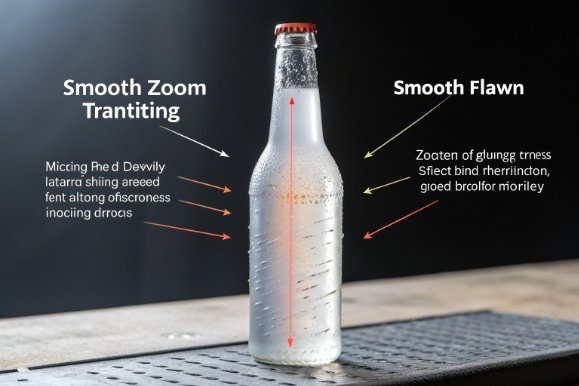
Hot-fill: the danger is fast cooling, not just hot liquid
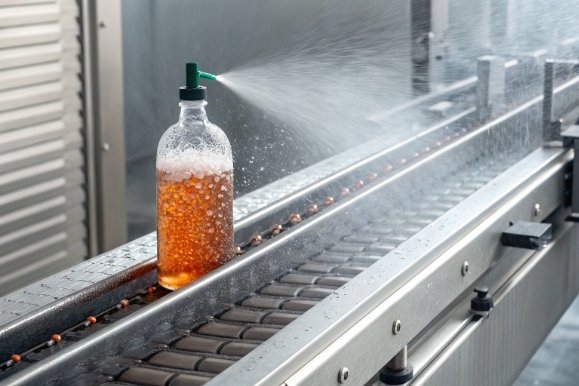
Hot-fill processing 6 often heats the inside first. Then the outside sees air or water cooling. This creates a gradient across the wall. Frosted bottles can be less forgiving if the surface already has flaw density. The biggest real-world trigger is a cold rinse too soon or a cold conveyor zone right after fill.
Pasteurization: long exposure and controlled ramps
Pasteurization cycles can be more gentle if ramps are smooth. The risk grows when ramps are sharp or when bottles enter the tunnel with uneven temperature. For coatings, pasteurization adds moisture and time. That can attack weak interfaces and cause haze changes or early crazing.
Dishwasher and consumer handling: repeated cycles plus abrasion
Dishwasher heat cycles create repeated expansion and contraction. Detergents also attack some coatings. For etched bottles, the main risk is abrasion 7 from contact with other items and racks. For coated bottles, the main risk is chemical resistance and adhesion in wet heat.
Warehouse and shipping: swings plus impact
Warehouse swings are slower, but they can be wide. The risk is usually not one swing. The risk is repeated swings plus handling scuffs. Frosted surfaces show scuffs differently, so damage can hide until the first hot-fill test.
| Scenario | Main thermal pattern | Etched frosting risk | Coated frosting risk |
|---|---|---|---|
| Hot-fill line | fast inside-out gradient | crack starts at rough zones | coating softening, scuffing, haze shift |
| Pasteurization | controlled heat + moisture | moderate, mainly if flaws exist | adhesion aging and crazing |
| Retort-like higher heat | harsher gradient + time | higher, needs strong base glass | high if coating not designed for it |
| Dishwasher cycles | repeated cycles + detergent | abrasion + hidden scratches | chemical attack + peeling |
| Warehouse swings | slow cycles + handling | scuffs become crack starts later | film brittleness over time |
Real use testing should mirror the real process. A cosmetic bottle spec is not a safe spec for a hot-fill sauce bottle, even if both are “frosted.”
What quality checks should buyers require before mass production?
A frosted sample can look perfect on day one. A production lot needs proof that the finish stays stable after heat, water, and abrasion.
Buyers should require thermal shock and thermal cycling tests on finished bottles, plus coating adhesion and abrasion tests when a layer is present. Add stress inspection and batch traceability so results match the shipment, not a lab sample.
1) Thermal shock and cycling on the finished bottle
Testing must use the finished bottle, not a clear bottle before frosting. The finish can change surface condition and performance. A strong plan includes:
-
hot-to-cold cycling that matches the process steps,
-
repeated cycles, not only one shock,
-
pass/fail tied to crack location mapping.
For hot-fill projects, the most useful test is a cycle that copies the line: fill temperature, hold time, and cooling method.
2) Adhesion tests for coated frosting
If the frosting is a coating, adhesion is the first gate. Useful checks include:
-
wet aging before tape pull,
-
heat-and-humidity conditioning, then re-test.
A coating that passes dry tape pull can still fail after pasteurization-like moisture and heat.
3) Abrasion resistance and scuff testing
Frosted finishes are often chosen for feel. That means they will be handled. Abrasion tests should simulate:
-
conveyor contact,
-
carton-to-carton rubbing,
-
dishwasher rack contact, if relevant.
4) Stress inspection and defect screening
Residual stress is a silent risk. Even a perfect finish cannot save a high-strain bottle. Stress inspection with polarized light 9 is fast and useful. Also require checks for stones, cords, and surface damage.
| Check | What it catches | Best for which frosting | Practical acceptance idea |
|---|---|---|---|
| Thermal shock / cycling | crack resistance under gradients | all frosting types | defined ΔT, cycles, crack-free rate |
| Stress inspection (polarized) | residual annealing stress | all frosting types | max strain band limit |
| Cross-hatch + tape pull | adhesion strength | spray-coated, in-mold layer | no peel, stable after wet aging |
| Abrasion / scuff test | scratch-driven crack starts | etched and coated | no deep scuffs after defined cycles |
| Chemical resistance | haze, softening, peeling | coated frosting | stable after detergent or product contact |
| Batch traceability docs | lot-to-lot stability | all | COA with batch ID + change control |
For mass production, the best requirement is simple: test results must be tied to the same batch ID 10 that ships. Without that, a report is only a promise.
Conclusion
Frosting can raise heat-change risk when it adds surface flaws or a weak coating layer. With the right frosting method and strong QC, frosted bottles can still handle real thermal cycles.
Footnotes
-
Definition of thermal shock and how sudden temperature changes cause glass failure. ↩
-
Overview of the pasteurization process and its thermal impact on packaging materials. ↩
-
Technical details on how acid etching modifies the glass surface to create a matte finish. ↩
-
Explanation of how surface flaws concentrate stress and lead to material failure. ↩
-
Why materials expand at different rates and how mismatch causes interface stress. ↩
-
The mechanics of hot-fill packaging and the cooling gradients that create bottle stress. ↩
-
Standard testing methods for evaluating glass surface resistance to scratches and wear. ↩
-
A common industry test for measuring coating adhesion strength on substrates. ↩
-
How polarized light inspection detects internal residual stress in glass containers. ↩
-
The importance of lot tracking for quality assurance and process validation in manufacturing. ↩






