

A pristine glass bottle is an engineering marvel of strength, but a single microscopic scratch can turn it into a ticking time bomb. If you ignore surface quality, you are inviting catastrophic failure on your filling line.
Yes, significantly. Glass strength is almost entirely determined by its surface integrity. Defects like scratches, abrasions, or checks act as stress concentrators, drastically lowering the threshold for thermal shock failure. A flawed bottle may shatter at a temperature differential ($\Delta T$) half that of a pristine one.
The Fragility of the Flaw: Understanding Brittle Fracture
At FuSenglass, we operate on a fundamental truth: Glass never fails from compression; it fails from tension. And that failure almost always starts at a surface flaw. Unlike steel, which can yield and stretch to redistribute stress, glass is a brittle material. It cannot deform plastically. When thermal stress—such as the rapid expansion caused by hot-filling—builds up, it searches for a weak point.
The Griffith Flaw Theory
In the 1920s, A.A. Griffith discovered that the theoretical strength of glass is enormous (approx. 14,000 MPa), but its practical strength is much lower (approx. 40-70 MPa). The discrepancy is due to microscopic surface flaws, now called Griffith fracture theory 1{#fnref1}.
- Stress Concentration: A scratch is not just a void; it is a lever. The stress at the tip of a sharp crack is multiplied by a factor ($K_t$) related to the crack’s depth and tip radius—exactly the concept summarized in stress concentration fundamentals 2{#fnref2}.
- The Thermal Trigger: When a bottle undergoes thermal shock (e.g., cooling tunnel), the outer skin goes into tension. If a scratch exists in that tension zone, the stress at the tip of the scratch can easily exceed the material’s limit, propagating a crack at the speed of sound.
- FuSenglass Standard: This is why we treat "scuffed" ware not just as a cosmetic defect, but as a structural hazard. A bottle that looks "a bit rough" is structurally compromised.
| Defect Type | Description | Thermal Impact |
|---|---|---|
| Pristine Surface | Smooth, continuous silica network. | High Thermal Shock Resistance (>60°C $\Delta T$). |
| Abrasion (Scuff) | Broad, shallow surface damage. | Moderate reduction (~45°C $\Delta T$). |
| Deep Scratch | Sharp, deep fissure. | Severe reduction (< 30°C $\Delta T$). |
| Check (Crack) | Penetrating fracture. | Zero resistance. Instant failure. |
With the physics established, let’s examine the specific mechanics of how these defects amplify thermal stress.
How do surface defects, such as scratches, chips, or bubbles, create stress concentrations that increase the risk of thermal shock or cracking?
Not all defects are created equal. The geometry of the flaw determines its lethality during heat processing.
Sharp defects like scratches and checks act as powerful "Stress Risers," multiplying the local tensile force by 10x or more, making them primary triggers for thermal shock. Blunt defects like bubbles (blisters) are less dangerous but can cause failure if they are located near the surface where wall thickness is compromised.
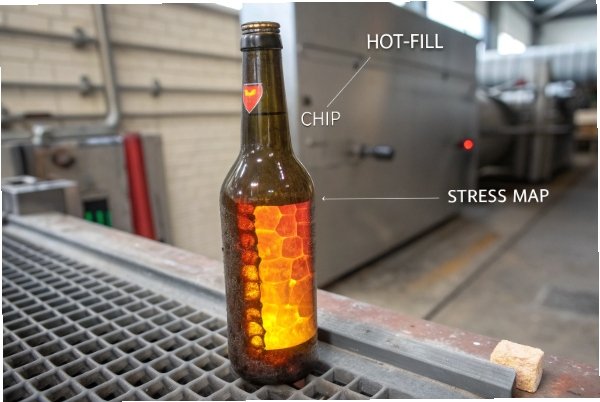
The Mechanics of the "Stress Riser"
Imagine stretching a rubber band. The tension is even. Now, cut a tiny nick in the side. When you pull, all the force concentrates at that nick, tearing it apart. Glass behaves the same way under thermal tension.
- Scratches/Checks: These are "sharp" flaws. The stress concentration factor ($K_t$) is extremely high because the radius of the crack tip is microscopic. During hot-fill, hoop stress pulls the bottle wall outward. A vertical scratch on the outside acts as a pre-perforation line.
- Chips: A chip reduces the effective wall thickness. If a 3mm wall has a 1mm chip, you have lost 33% of your structural material at that point. The remaining 2mm heats up faster than the surrounding glass, creating a localized hot spot and differential expansion.
Bubbles and Blisters (Seeds)
Gaseous inclusions inside the glass are generally less dangerous because they are spherical (blunt).
- Internal Bubbles: Usually benign unless they are huge.
- Surface Blisters: Dangerous. If the bubble is close to the skin, the thin layer of glass covering it acts like a fragile eggshell. Thermal expansion can pop this skin, leaving a sharp crater that becomes a starting point for a fracture—one of many defect mechanisms described in container-glass defect cause guides 3{#fnref3}.
| Defect | Geometry | Stress Concentration ($K_t$) | Risk Level |
|---|---|---|---|
| Check (Split) | Ultra-sharp tip. | Very High (> 20) | Critical. Explodes on contact with heat. |
| Deep Scratch | Sharp V-groove. | High (5 – 10) | High. Fails during cooling contraction. |
| Stone (Inclusion) | Solid particle. | High (due to CTE mismatch). | High. Stone expands differently than glass. |
| Bubble (Seed) | Spherical void. | Low (~ 3). | Low, unless surface-breaking. |
Which areas of a glass bottle (finish, shoulder, heel, base) are most vulnerable to surface defects affecting heat resistance?
A scratch on the neck might survive, but a scratch on the heel is a death sentence for the bottle. Location dictates survival.
The "Heel" (Base) and the "Shoulder" are the most vulnerable zones because they are contact points that endure both mechanical impact and the highest thermal stress gradients. The "Finish" is also critical, as defects here compound with capping torque to cause "ring-off" failure during heating.
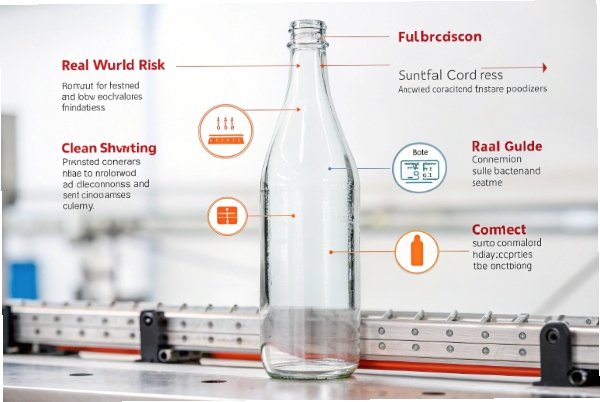
The Heel: The Achilles’ Tendon
The heel is where the sidewall meets the bottom.
- Mechanical Abuse: It is the primary contact point on conveyors. It gets banged and rubbed constantly.
- Thermal Stress: It is the thickest part of the bottle, meaning it holds heat the longest.
- The Perfect Storm: If the heel is scratched (from line rubbing), and then subjected to the differential cooling of the base vs. wall, the tension will focus on that scratch. This leads to "Bottom Separation"—failure origins and terminology are commonly illustrated in glass bottle morphology references 4{#fnref4}.
The Shoulder: The Expansion Zone
The shoulder often rubs against guide rails or dividers.
- Hoop Stress: During pasteurization, internal pressure makes the bottle try to become a sphere. The shoulder expands outward.
- Vulnerability: A scratch on the shoulder acts as a zipper. The hoop stress pulls the scratch open, resulting in a vertical split.
The Finish (Mouth): The Torque Trap
- Defect: Fine checks on the sealing surface.
- Interaction: Capping torque puts the finish in tension. Add heat (expansion), and the stress exceeds limits. The finish snaps off inside the cap.
| Bottle Zone | Primary Stress Source | Common Defect | Consequence |
|---|---|---|---|
| Heel | Thermal Gradient (Base vs Wall). | Impact Checks / Abrasions. | Bottom drops out. |
| Shoulder | Internal Pressure (Hoop). | Rub Marks / Scuffs. | Vertical sidewall split. |
| Finish | Capping Torque. | Line-over / Split Finish. | Leaker / Broken neck. |
| Bearing Surface | Vertical Load. | Fused Glass / Stones. | Unstable base / Crack origin. |
How can imperfections like surface roughness or inconsistencies in coating impact the bottle’s ability to withstand high temperatures?
It is not just deep cracks that matter; even the microscopic texture and coating quality play a role in thermal survival.
Surface roughness increases the coefficient of friction, leading to "glass-on-glass" damage that creates new flaws during processing. Inconsistent coating (Hot End or Cold End) leaves patches of glass unprotected, allowing these high-friction areas to seize and scratch, essentially "aging" the bottle instantly and reducing its thermal strength.
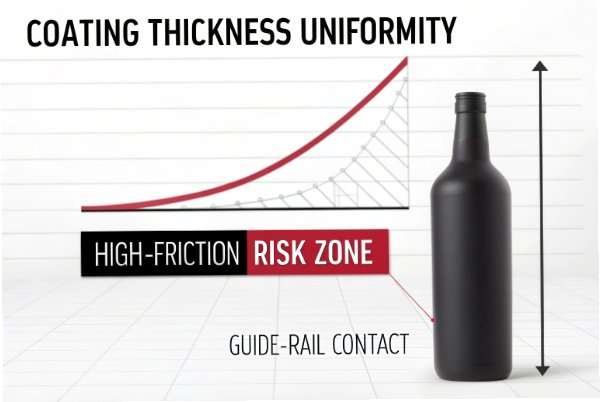
The Role of Friction
Pristine glass is slippery, but "rough" glass (weathered or uncoated) creates high friction.
- The Mechanism: When rough bottles touch in a pasteurizer, they don’t slide; they "bite." This stick-slip action generates micro-checks (chatter marks).
- Thermal Consequence: These fresh chatter marks are extremely sharp defects created during the thermal process, often leading to breakage mid-cycle—exactly why hot-end coating (tin oxide) priming 5{#fnref5} and durable cold-end lubrication matter.
Coating Inconsistencies
- Hot End Coating (HEC): If the tin oxide layer is missing (a "holiday"), the cold end coating won’t stick reliably.
- Cold End Coating (CEC): If the spray is uneven, you have "naked" glass spots; common CEC approaches and tradeoffs are summarized in cold-end coating overviews 6{#fnref6}.
- The Result: A bottle might pass QC, but 10 minutes into the hot filling line, the unprotected spot rubs against a guide rail, scratches, and then shatters when the cold water spray hits it.
- FuSenglass Protocol: We test slip angle to ensure coating uniformity and lubricity retention.
| Surface Condition | Friction Coefficient ($\mu$) | Defect Generation | Thermal Risk |
|---|---|---|---|
| Coated & Smooth | < 0.15 | None (Bottles slide). | Low. Strength preserved. |
| Uncoated / Rough | > 1.0 | High (Seizing/Galling). | High. Surface degrades rapidly. |
| Weathered | High | Micro-pitting (Haze). | Medium. Reduced base strength. |
| Patchy Coating | Variable | Localized scratching. | High. Unpredictable failure. |
What inspection methods (visual inspection, laser scanning, stress testing) should be used to detect and prevent surface defects that compromise heat resistance?
You cannot rely on human eyes to catch the microscopic flaws that kill bottles. You need a multi-layered automated defense.
We utilize a combination of high-speed Camera Vision systems (for visible stones/blisters), Laser/Check Detection machines (for reflecting light off invisible cracks), and Squeeze Testers (mechanical pressure) to cull defective ware. Offline, we perform destructive Thermal Shock testing on sampled bottles to validate the lot’s integrity.
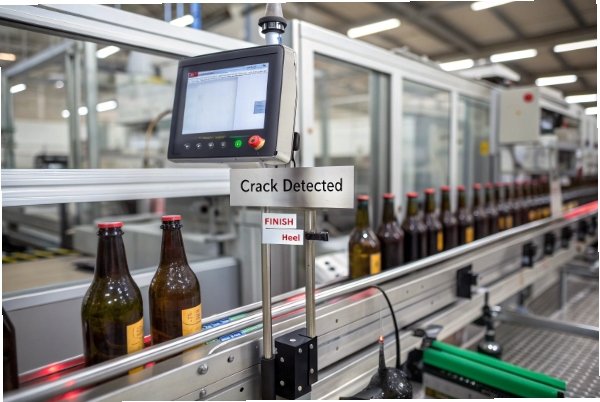
1. Check Detection (The Laser Defense)
This is the most critical tool for thermal safety.
- Technology: Emitters shine focused light beams at the finish, heel, and shoulder.
- Principle: A crack acts like a mirror. If the light hits a crack, it reflects back to a sensor.
- Sensitivity: Can detect "checks" that are invisible to the naked eye but fatal in a hot-fill line—this class of capability is typical in empty bottle inspection (EBI) systems 7{#fnref7}.
2. Camera Vision (Sidewall Inspection)
- Technology: High-resolution cameras with backlight.
- Principle: Detects stones, blisters, and glass strings.
- Rejection: Any opaque defect or large bubble is kicked off the line.
3. Squeeze Test (Online Pressure)
- Technology: Two belts apply side pressure to the passing bottle.
- Principle: If a bottle has a deep scratch or a thin wall, it is structurally weak. The pressure causes it to collapse or break inside the safety of the machine rather than on your filling line.
4. Offline Thermal Shock (ASTM C149)
- Technology: Lab test.
- Principle: Heat then plunge to impose $\Delta T$.
- Purpose: If we see a spike in failures, it proves that a batch of defects is slipping through.
To standardize acceptance, reference the test method itself: ASTM C149 thermal shock resistance of glass containers 8{#fnref8}. To confirm that residual stress isn’t the hidden multiplier behind defect-driven failures, screen with ASTM C148 polariscopic examination 9{#fnref9}. And for a practical “why scratches matter so much” explainer that aligns with plant experience, see this overview of thermal shock breakage in glass containers 10{#fnref10}.
| Inspection Method | Target Defect | Technology | Prevention Goal |
|---|---|---|---|
| Check Detector | Split Finish, Heel Checks. | Light Reflection. | Stop immediate leakers/bursters. |
| Sidewall Vision | Stones, Blisters, Scuffs. | Optical Contrast. | Remove stress risers. |
| Squeeze Tester | Deep Scratches, Thin Wall. | Physical Load. | Weed out weak bottles. |
| Slip Angle Test | Coating Failure. | Tilt Table. | Prevent line abrasion damage. |
Conclusion
Surface quality is not just about aesthetics; it is the structural armor of the bottle. By eliminating stress-concentrating defects like scratches and checks through rigorous coating application and automated inspection, FuSenglass ensures that your bottles possess the thermal resilience required for the most demanding production environments.
Footnotes
-
Explains why microscopic flaws drive real-world glass strength, despite high theoretical strength. ↩ ↩
-
Defines stress concentration and why sharp crack tips magnify local tensile stress. ↩ ↩
-
Practical defect matrix showing how checks/blisters form and why they become crack initiators. ↩ ↩
-
Helps interpret common fracture origins (heel/base) and failure terminology used in breakage diagnosis. ↩ ↩
-
Shows how hot-end tin-oxide coatings protect surface integrity and support retained strength in handling. ↩ ↩
-
Summarizes cold-end coating types and why lubricity prevents glass-on-glass abrasion before pasteurization. ↩ ↩
-
Example of industrial inspection capability used to detect defects before filling. ↩ ↩
-
Official thermal shock resistance test method used to validate hot-fill/pasteurization survivability. ↩ ↩
-
Standard polariscopic method to grade residual stress that can amplify defect-driven thermal failures. ↩ ↩
-
Operational explanation of how thermal shock exploits surface flaws and why preventing scratches preserves heat resistance. ↩ ↩





