
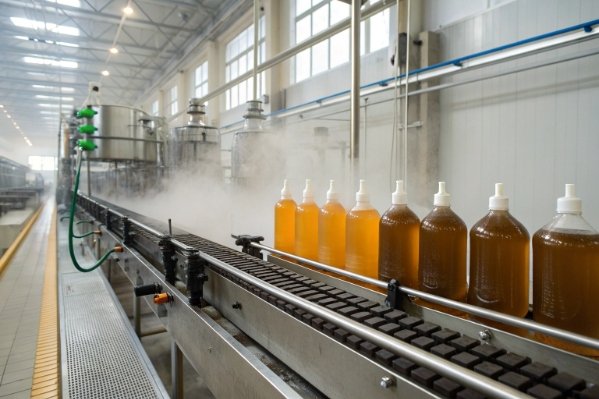
Alkaline residues left in glass bottles can alter the pH of your beverage, degrade pharmaceutical stability, and leave unsightly haze. While water rinsing is standard, it isn’t always enough to guarantee a chemically neutral surface.
Neutralization is not always mandatory for standard beverage bottles if rinsing volume is sufficient; however, it is essential for pharmaceutical glass, sensitive cosmetic formulations, and operations using hard water to eliminate all trace alkalinity and prevent scale buildup.
Do Glass Bottles Need a Neutralization Step After Alkaline Washing?
The Chemistry of the Final Surface
In the high-speed world of glass manufacturing and bottling, we rely heavily on Sodium Hydroxide 1 (Caustic Soda) to strip away mold, grease, and dirt. It is aggressive and effective. But as I often tell clients visiting the FuSenglass production lines, "Getting the dirt out is easy; getting the cleaner out is the challenge."
Glass surfaces have a natural affinity for sodium ions. When washed in a strong alkaline solution, the glass surface can retain a microscopic layer of high-pH residue, even after a quick water rinse. For a standard soda bottle, this might be negligible. But for a delicate perfume or a pH-balanced pharmaceutical serum, that trace alkalinity can be disastrous. It can destabilize the product or cause "flake" formation over time.
Rinsing vs. Neutralization
There is a distinct difference between rinsing and neutralizing.
- Rinsing is a physical process of dilution. You are using large volumes of water to wash away the caustic solution. Ideally, with enough water, the pH returns to neutral (7.0).
- Neutralization is a chemical process. We introduce a mild acid solution to react with the remaining alkali base. Acid + Base = Salt + Water. This instantly drops the surface pH without requiring excessive water volumes.
Decision Framework: To Neutralize or Not?
| Feature | Standard Water Rinsing | Acid Neutralization Step |
|---|---|---|
| Mechanism | Physical Dilution. | Chemical Reaction. |
| Water Usage | High (Requires multiple zones). | Moderate (Chemical does the work). |
| Risk of Residue | Moderate (Depends on water hardness/pressure). | Very Low (Chemically eliminated). |
| Cost | Low (Water/Energy). | Medium (Acid cost + Dosing system). |
| Best Application | Beer, Soda, Standard Food Jars. | Pharma, Spirits, Cosmetics, Hard Water Areas. |
The decision rests on your product’s sensitivity and your water quality.
When Is Neutralization Necessary After Caustic Washing, and When Is Thorough Rinsing Enough?
Relying solely on rinsing in a high-speed line can leave "alkali bloom" or invisible residues. You must assess the risk based on your product’s chemical stability and the local water conditions.
Neutralization is necessary when filling pH-sensitive products (pharmaceuticals, high-end spirits), using hard water (to prevent scale), or when water conservation limits rinse volumes; thorough rinsing is typically sufficient for robust, high-volume beverages like carbonated soft drinks.
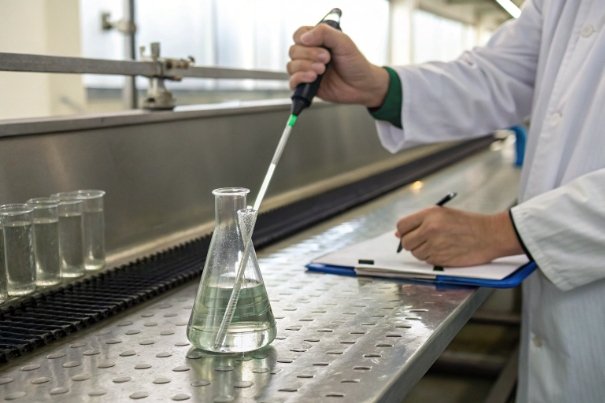
The Case for Neutralization
In my experience, three specific scenarios dictate a mandatory neutralization step:
- Hard Water Operations: If your factory water has high calcium/magnesium content, rinsing a caustic-washed bottle with fresh water creates Calcium Carbonate 2 ($CaCO_3$). This leaves white "water spots" or haze on the glass as it dries. An acid neutralization rinse dissolves these mineral deposits, ensuring a sparkling clear bottle.
- Pharmaceuticals (Type I Glass): For injectable drugs or sensitive syrups, the internal surface alkalinity is strictly regulated (ISO 4802 3). Even a slight pH shift can degrade the drug. Neutralization ensures the surface is chemically inert.
- Water Scarcity: Rinsing requires massive amounts of water to dilute 3% NaOH down to 0%. By using a dilute acid spray, you can achieve neutrality with a fraction of the water volume, which is crucial for factories in water-restricted regions.
When Rinsing is "Good Enough"
For the vast majority of the food and beverage industry—think beer, ketchup, jam, and soda—neutralization is overkill.
These products are often acidic themselves (Soda pH ~2.5, Beer pH ~4.0). Any microscopic trace of alkalinity left on the glass is instantly neutralized by the product itself without affecting flavor or safety. As long as the washer has a robust 3-stage rinsing section with fresh water, the carryover risk is acceptable.
Operational Scenarios
| Scenario | Recommendation | Rationale |
|---|---|---|
| Beer / Soda Line | Rinse Only | Product is acidic and robust; high volume rinsing is cost-effective. |
| Premium Vodka/Gin | Neutralize | Neutral spirit flavor is easily tainted by alkali; clarity is paramount. |
| Pharmaceutical Vials | Neutralize | Strict compliance (USP/EP) for surface hydrolytic resistance. |
| Hard Water Area | Neutralize | Prevents calcium scale/spotting on the dried bottle. |
| Recycled Bottles | Neutralize | Older glass surfaces are rougher and trap more alkali. |
If you see white haze on your bottles after they dry, your rinsing is failing, and neutralization is your fix.
Which Neutralizers Are Commonly Used, and What pH Targets Are Safe?
Choosing the wrong acid can leave an odor or corrode your washing machine equipment. You need a safe, food-grade acid that effectively counters alkalinity without introducing new contaminants.
Citric Acid and Phosphoric Acid are the industry standards due to their safety and efficacy; target a final surface pH of 6.5 to 7.5 to ensure neutrality without creating an acidic environment that could corrode closures.
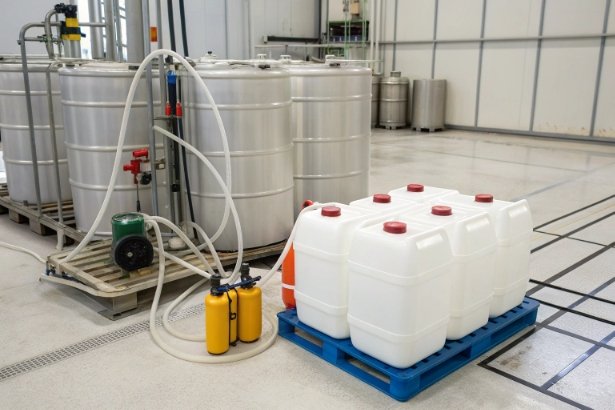
Citric Acid: The Safer, Greener Choice
Citric Acid is the go-to for the food and beverage industry.
- Pros: It is 100% food-safe, biodegradable, and odorless. It also acts as a chelating agent 4, which helps bind heavy metals and water hardness minerals.
- Cons: It is more expensive than mineral acids and can support bacterial growth if the solution sits stagnant for too long (it’s food for bugs).
- Usage: Typically used at 0.5% to 1.0% concentration.
Phosphoric Acid: The Industrial Workhorse
Phosphoric Acid is widely used in larger industrial washers.
- Pros: It is a mineral acid, so it doesn’t degrade. It is excellent at removing rust and mineral scale (beer stone 5) from the machine itself, keeping the nozzles clean.
- Cons: It requires careful handling. It contains phosphates, which can be an environmental discharge issue in some jurisdictions.
- Usage: Used at very low concentrations, typically 0.1% to 0.3%.
Acids to Avoid
- Acetic Acid (Vinegar): While effective, it is volatile. It makes the whole bottling hall smell like vinegar, and residual vapors can taint the flavor of delicate beverages (like water or vodka).
- Hydrochloric/Sulfuric Acid: Generally too aggressive and dangerous for food-grade bottle washing. They can corrode stainless steel machine parts if not perfectly managed.
Setting the pH Target
The goal is Neutrality (pH 7.0), not acidity.
If you over-neutralize and leave the bottle acidic (pH < 5):
- You risk corroding metal caps (crowns, twist-offs) applied immediately after filling.
- You might affect the taste of neutral water.
We aim for the final rinse water exiting the bottle to match the pH of the incoming fresh water supply, usually between 6.5 and 7.5.
Neutralizer Comparison
| Acid Type | Efficacy | Odor | Scale Removal | Cost | Best For |
|---|---|---|---|---|---|
| Citric Acid | Good | None | Good | High | Food/Pharma, Soft Water. |
| Phosphoric Acid | Excellent | Low | Excellent | Medium | Beer/Dairy, Hard Water. |
| Acetic Acid | Moderate | High | Poor | Low | Not Recommended (Odor). |
| Nitric Acid | High | High | Good | High | Passivating Stainless Steel 6 (Not for bottles). |
Select the acid that fits your water hardness and environmental regulations.
How Can Neutralization and Rinsing Be Optimized?
Simply dumping acid into the rinse tank is not optimization; it’s waste. You must strategically place the dosing and control the flow to prevent defects like etching and spots.
Optimize the process by introducing the neutralizer in the second-to-last rinse zone (warm), using deionized (DI) water for the final spray to prevent spotting, and automating acid dosing based on conductivity readings.
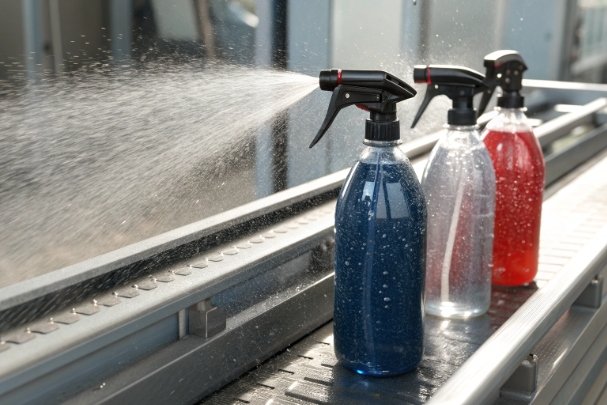
The Zone Strategy
In a typical 4-zone rinse section, the sequence matters:
- Zone 1 (Recovery): Hot water recovered from Zone 2. Removes 80% of caustic.
- Zone 2 (Neutralization): Warm water ($40^{\circ}C$) with dosed acid. This is where the reaction happens. The warmth helps the reaction speed and solubility.
- Zone 3 (Fresh Water): Cold fresh water. Rinses away the salts formed in Zone 2.
- Zone 4 (Final Rinse): Deionized or Softened water spray. Ensures spot-free drying.
Preventing "Water Spots"
Water spots are the enemy of premium glass. They are usually Ca/Mg salts.
- The Fix: Use a "wetting agent" or rinse aid in the neutralization zone (often combined with the acid). This reduces surface tension 7, allowing water to sheet off the glass rather than beading up and drying into spots.
- Final Blow: Ensure robust air knives (blowers) remove bulk water before the bottle enters the sterilization tunnel or filler.
Preventing Etching
Ironically, rinsing can sometimes cause etching if done wrong. If you spray cold water onto hot, caustic-soaked glass, the thermal shock 8 can damage the surface.
- The Fix: Gradual temperature step-down ($80^{\circ}C \rightarrow 60^{\circ}C \rightarrow 40^{\circ}C$). Ensure the acid concentration is not so high that it attacks the glass surface (rare, but possible with strong mineral acids).
Avoiding Alkaline Carryover
The most common failure is empty acid drums.
- Optimization: Use automated conductivity controllers. As alkalinity rises (or acidity drops) in the rinse tank, the pump should automatically stroke to add more acid. Don’t rely on manual dosing.
Optimization Checklist
| Problem | Root Cause | Optimization Strategy |
|---|---|---|
| White Spots | Hard water salts. | Use Phosphoric/Citric acid; Switch final rinse to DI water. |
| Haze/Bloom | Caustic residue. | Increase fresh water flow; Check acid dosing pump. |
| Salty Taste | Over-neutralization. | Reduce acid concentration; Increase Zone 3 fresh water flow. |
| Glass Breakage | Thermal shock. | Smooth temperature gradient in rinse zones ($<20^{\circ}C$ delta). |
| High Water Bill | Inefficient rinsing. | Implement neutralization to reduce water volume needs. |
Automation is key. A conductivity probe never sleeps; an operator might.
What Post-Wash QC Tests Confirm Bottles Are Ready for Filling?
Trusting the machine settings is not enough; you must verify the physical output. A bottle that looks clean can still be chemically contaminated.
Standard QC protocols include measuring the pH and conductivity of the final rinse water (must match input water), conducting Phenolphthalein spot tests for alkali detection, and visual inspection for water sheeting (cleanliness).

The Phenolphthalein "Drop Test"
This is the simplest, most effective shop-floor test.
- Method: Take a washed bottle from the line. Add a few drops of Phenolphthalein 9 indicator solution.
- Result: If the liquid turns Pink/Fuchsia, the pH is > 8.2. This indicates Failed Washing/Rinsing. There is caustic residue.
- Frequency: Every hour or at every shift change.
Conductivity and pH Metering
For a more quantitative approach, we measure the water inside the bottle.
- Method: Pour 50ml of distilled water into the washed bottle, shake it, and pour it into a beaker. Measure with a pH meter and Conductivity meter.
- The Standard:
- pH: Should be within ±0.5 of the plant’s fresh water source.
- Conductivity: Should not exceed the fresh water conductivity by more than 50 µS/cm (microsiemens). A spike in conductivity 10 means dissolved salts (cleaner residue) are present.
The "Water Break" Test (Visual)
This tests for physical cleanliness (oils/grease), which alkali removes.
- Method: Rinse the bottle and hold it upside down.
- Result: The water should sheet off evenly in a continuous film. If the water beads up or breaks into rivulets, there is still oil or grease on the glass. The wash concentration was too low.
Methylene Blue Test (Surface Coating)
For bottles with cold-end coatings, we sometimes use Methylene Blue to check if the coating is intact, but it can also highlight rough spots caused by etching.
QC Protocol Summary
| Test | Parameter | Pass Criteria | Frequency |
|---|---|---|---|
| Phenolphthalein | Alkalinity | Colorless | Hourly. |
| pH Meter | Acidity/Alkalinity | 7.0 ± 0.5 (Source Dependent) | Start/End of Batch. |
| Conductivity | Dissolved Solids | < Source + 50µS | Continuous (In-line). |
| Visual Inspection | Foreign Objects | None | 100% (Electronic Inspector). |
| Water Break | Oil/Grease | Continuous Sheet | Daily Setup. |
If the phenolphthalein turns pink, stop the line. You are filling caustic soda into your customer’s beverage.
Conclusion
While not strictly mandatory for every beverage, neutralization is the hallmark of a premium, controlled washing process. By using Citric or Phosphoric Acid to target a neutral pH, and verifying with Conductivity and Phenolphthalein tests, you ensure that your glass packaging is as pure as the product it holds.
Footnotes
-
A strong alkaline compound used in cleaning agents, also known as lye. ↩
-
A common chemical compound found in rocks and shells, causing water hardness and scale. ↩
-
The international standard for hydrolytic resistance of the interior surfaces of glass containers. ↩
-
A bonding process where ions and molecules bind to metal ions, useful in removing scale. ↩
-
A mineral deposit of calcium oxalate that builds up on brewing equipment. ↩
-
A non-electrolytic process to remove free iron from the surface of stainless steel. ↩
-
The tension of the surface film of a liquid caused by the attraction of the particles in the surface layer. ↩
-
Mechanical stress caused by rapid temperature changes, potentially leading to breakage. ↩
-
A chemical compound often used as a pH indicator, turning pink in basic solutions. ↩
-
A measure of water’s ability to pass electrical flow, directly related to the concentration of ions. ↩






