
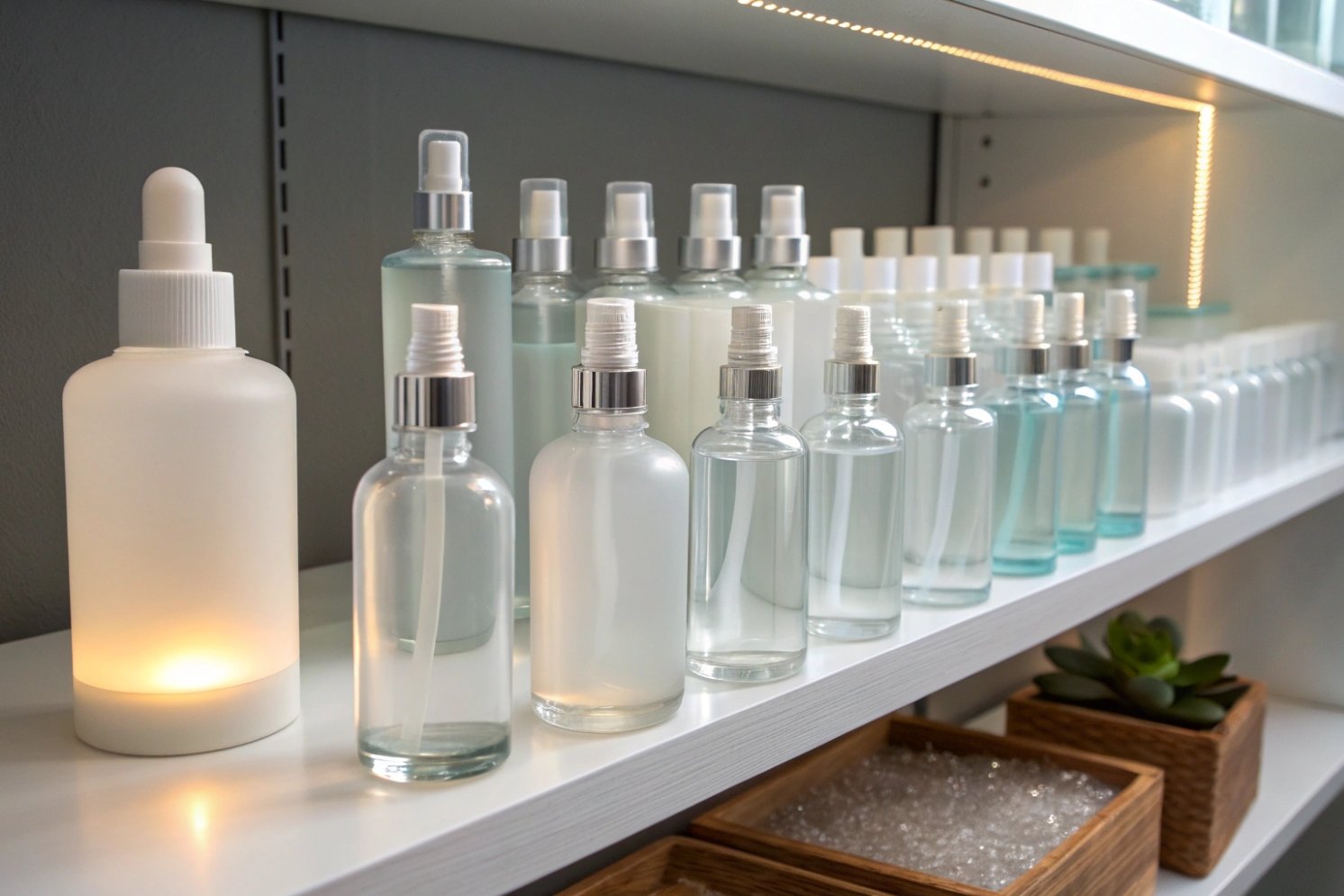
Many people choose frosted bottles for a “premium look”, but light does not care about design language. It keeps moving toward your formula.
Frosted glass reduces direct light transmittance by scattering it, but it is not a true UV barrier. It adds moderate protection and strong branding benefits, especially when combined with color, coatings, and smart formulation.
In projects with skincare, spirits, and aromatherapy oils, I see the same pattern. Frosting alone rarely saves a light-sensitive SKU 1. It works best as a layer in a broader protection strategy, not as the only shield.
How does acid-etching or sandblasting change optical scattering?
Frosted glass looks “soft” because the surface is no longer smooth. That change also rewrites how light travels.
Acid-etching and sandblasting roughen the glass surface so incoming light is scattered instead of passing straight through. This lowers direct transmittance, spreads energy, and makes light inside the bottle more diffuse.
What frosting actually does to light
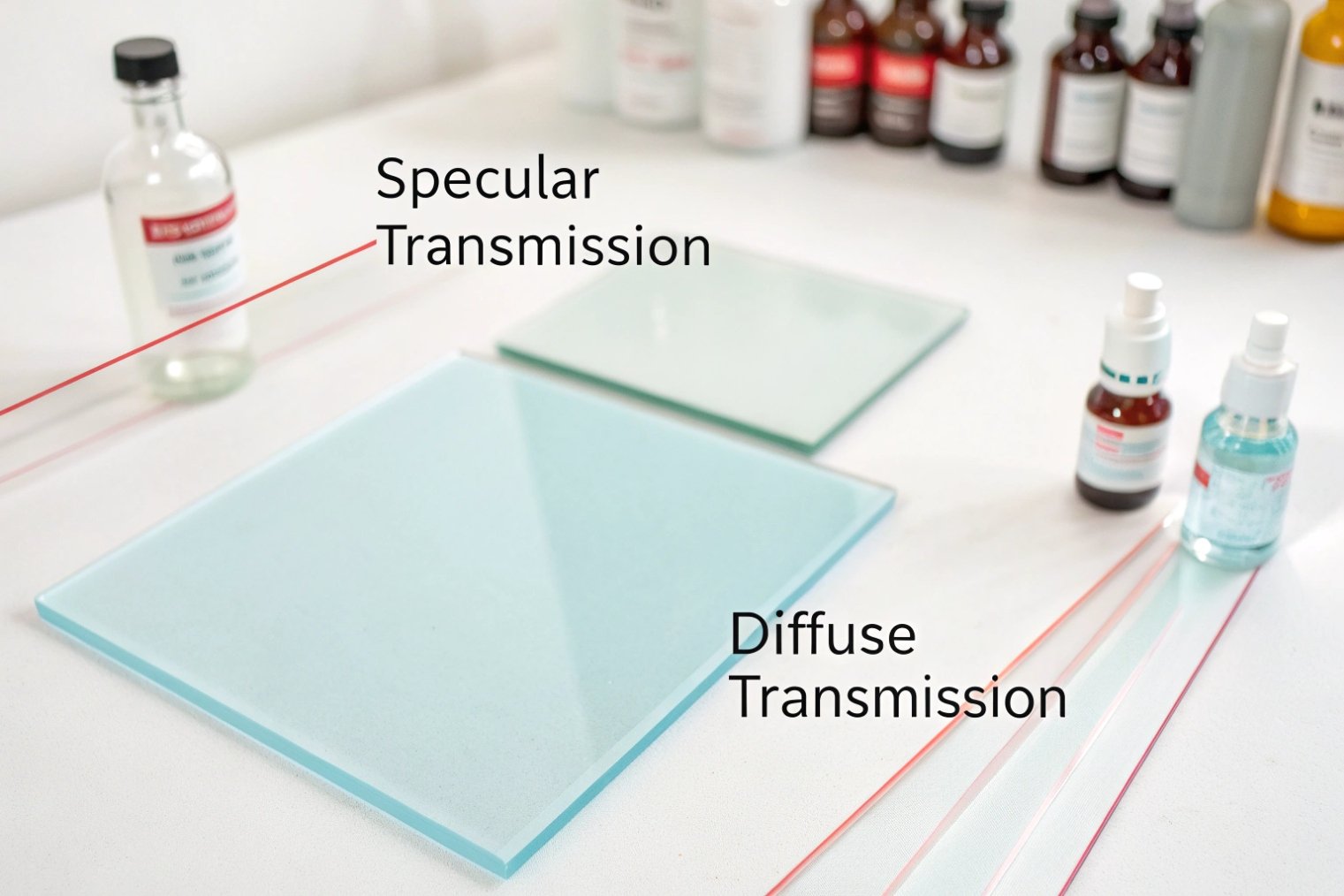
On a clear, polished bottle, most light that enters the glass exits on the other side in a straight path. This is specular transmission 2. The product sees a quite sharp beam.
When we frost the surface, we create countless tiny hills and valleys:
-
Sandblasting does this with physical abrasion.
-
Acid-etching does it by dissolving micro-pits into the surface.
-
Spray or baked-on matte coatings mimic this through chemistry.
Now, when a light ray hits the surface, it meets many angles. Some light still goes through, but in many directions. Some reflects back. Some refracts sideways. The result is diffuse transmission 3:
-
Direct glare is lower.
-
The image behind the bottle turns blurry.
-
The light inside the bottle is softer and less focused on one spot.
In pure energy terms, total luminous transmittance often drops only modestly. Most measurements show that many frosted glasses still let a large share of visible light through. The big change is how that light is distributed.
Here is a simple comparison:
| Property | Clear polished glass | Frosted (etched or blasted) glass |
|---|---|---|
| Surface | Smooth | Rough, micro-textured |
| Main light behavior | Specular transmission | Diffuse transmission |
| Total visible transmittance | Very high | Slight to moderate reduction |
| Image clarity | High, see details | Low, blurred shapes only |
| Internal light pattern | Focused beams | Soft, spread light |
From a protection point of view, scattering helps because fewer photons hit one exact location in the liquid with full intensity. For products with antioxidants or UV absorbers, this can slow local hot spots of photodegradation. But the spectral content of the light is almost the same. Frosting does not “delete” UV the way amber colorants do.
What performance and branding gains come from frosting?
Many marketers ask for frosting first for looks, not stability. The good news is that when we design it carefully, we get both aesthetic and performance benefits.
Frosted bottles soften light, hide minor defects, and convey a premium, “velvet” look while adding modest extra light protection. They also improve privacy and help position skincare, spirits, and home fragrance as high-end.

Performance benefits beyond beauty
From a technical and product angle, frosting can:
-
Reduce direct light intensity on any single point in the liquid.
-
Mask minor contents changes like slight haze or sediment that might worry consumers but remain within spec.
-
Even out light entry around the bottle, especially if frosting is heavier over thin wall areas.
On clear flint glass, frosting is often the first step up when products start to show mild light sensitivity but do not yet justify a full shift to amber or violet glass. It is especially useful when formula work already includes antioxidants and UV stabilizers, so we only need to “take the edge off” the light.
Branding and sensory gains
From a branding point of view, frosting is very powerful:
-
It creates a soft-touch, satin visual that feels calm and premium.
-
It supports minimalist labels, because the bottle itself does part of the design work.
-
It suggests “gentle” and “care” in personal care lines 4.
-
It can signal cold, pure, and smooth in spirits and beverages.
These cues are hard to get from a high-gloss clear bottle without adding heavy print or sleeves. Frosting becomes part of the brand signature.
A simple side-by-side view:
| Dimension | Clear flint bottle | Frosted bottle |
|---|---|---|
| First visual impression | Clean, sharp, “clinical” | Soft, refined, “skincare / premium” |
| Contents visibility | Full details, every bubble visible | Shapes and color visible, details softened |
| Perceived price tier | Entry to mid | Mid to high |
| Light behavior | Strong highlights and glare | Soft, even reflections |
| Typical categories | Water, basic sauces, mass skincare | Perfume, serums, spirits, home fragrance |
So frosting sits at an interesting intersection: it is not a full technical barrier like amber, but it raises both perceived value and real-world light performance at the same time.
How to specify frosting depth to balance aesthetics and protection?
Two frosted bottles can look very similar in a photo but behave differently in light tests. The missing detail is usually how strong the frosting actually is.
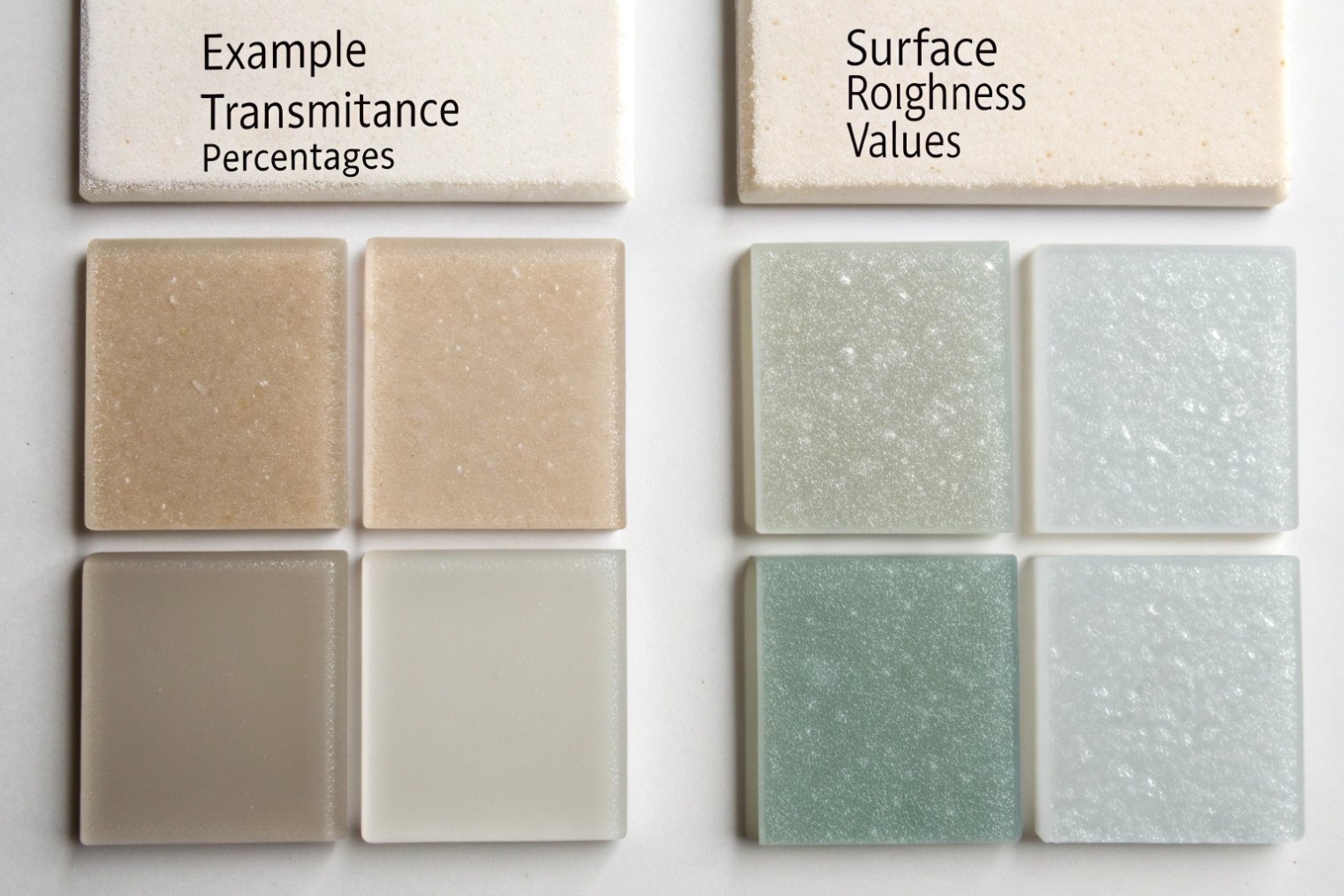
To balance looks and protection, brands should specify frosting intensity (roughness or haze), coverage area, and consistency tolerances, then link those to simple transmittance targets rather than choosing “just frosted” by eye.
What “depth” really means in practice
Frosting depth is a mix of several technical parameters:
-
Surface roughness / Ra: how tall the microscopic peaks and valleys are.
-
Feature size: whether the texture is fine and satin or coarse and grainy.
-
Coverage: full-body vs partial frosting, banding, or only certain panels.
-
Process strength: acid concentration and time, or blasting pressure and grit.
Stronger frosting raises diffuse reflection and lowers direct transmission. But if we go too far, the bottle looks chalky, feels rough in hand, and may trap dirt or be harder to clean during production.
A practical way to talk with suppliers is to use both visual standards and simple optical metrics:
-
Provide a “reference bottle” that shows your target look.
-
Define a luminous transmittance 5 window (for example, 60–75% through a standard panel).
-
Specify no glossy patches and a max variation in haze or transmission across the surface.
Turning this into a specification
Here is what a combined spec framework can look like:
| Spec element | Example target |
|---|---|
| Appearance | Smooth satin frosting, no coarse grains |
| Frosting coverage | Full body, except neck sealing surfaces |
| Luminous transmittance | 65–80% at 550 nm, 3 mm wall, frosted side in |
| Haze or diffusion index | Minimum threshold to avoid “see-through” text |
| Uniformity | No clear windows, ΔT between spots ≤ 5 percentage points |
| Process | Acid-etched, single side, sealed and cleaned |
For more light-sensitive formulas, we can combine frosting with tinted or amber glass. In that case, frosting does not carry the main blocking role. It enhances the barrier of the tint and helps even out any thin-wall zones.
A simple decision guide:
| Goal | Recommended frosting level |
|---|---|
| Purely aesthetic, non-sensitive fill | Light satin, high transmittance |
| Moderate sensitivity, flint glass | Medium frosting + strong labels / cartons |
| Higher sensitivity, tinted glass | Medium to strong frosting on amber / green |
| Premium, high protection | Strong frosting + amber/violet + secondary pack |
The more sensitive the product, the more we lean on color and thickness, and the more frosting becomes a “fine tuning” tool rather than the main weapon.
Are nano-texture finishes outperforming traditional frosting methods?
In recent years, we see more talk about nano-structured, “anti-glare” or “moth-eye” glass. These finishes look smoother but can manipulate light very precisely.
Nano-texture finishes can control reflection and scattering at a smaller scale than classic frosting. They can improve anti-glare performance and appearance, but for pure light-blocking they still rely on color and coatings, just like traditional frosting.
How nano-textures differ from classic frosting
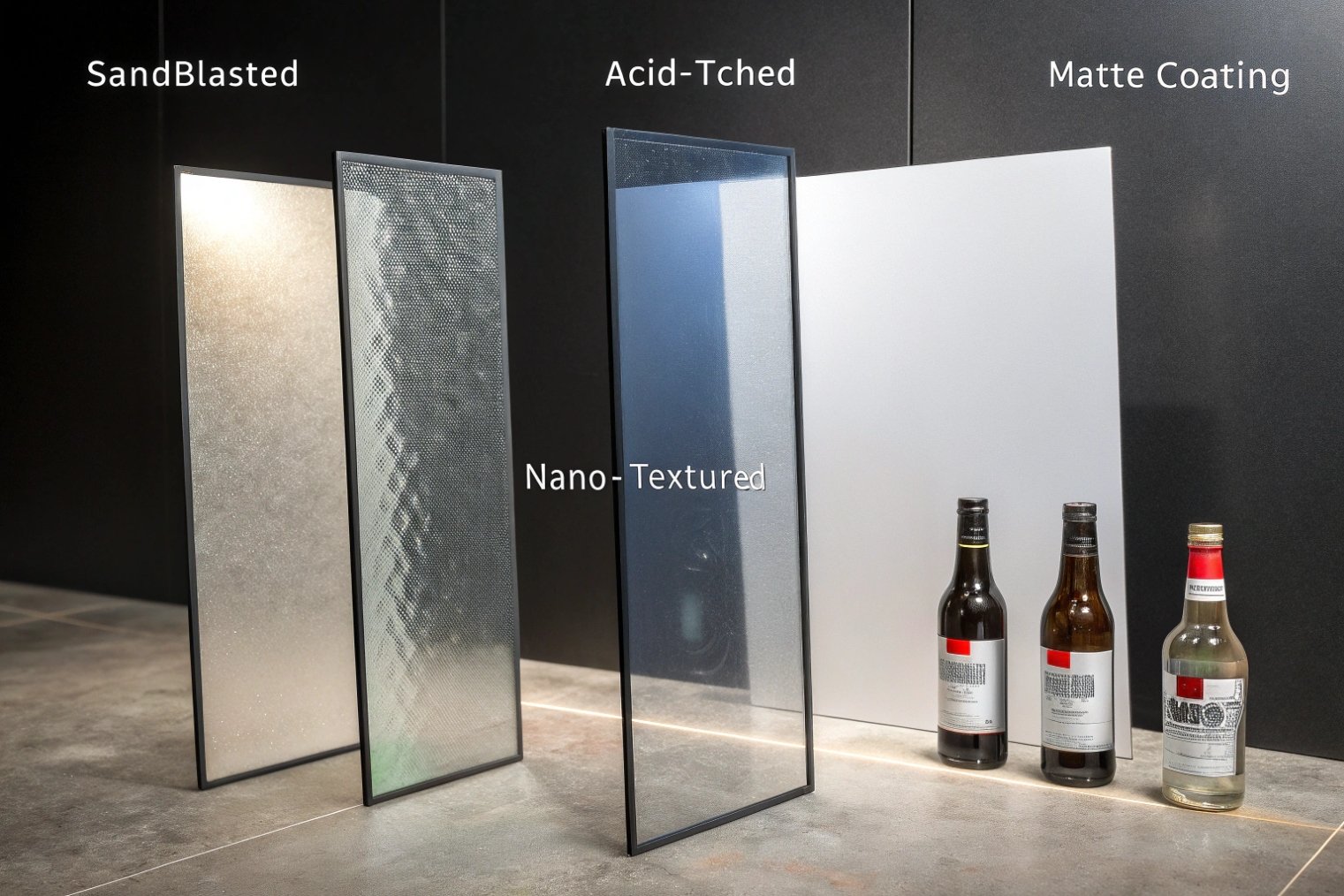
Traditional frosting creates irregular features in the micron range. Nano-texture finishes 6 push structure sizes down toward the wavelength of light itself. This enables:
-
More controlled anti-reflection or anti-glare behavior.
-
Surfaces that look almost clear but have reduced mirror-like reflections.
-
Finishes that feel smoother to the touch than coarse frost.
In packaging, this can give a premium, “almost invisible” coating that kills glare on shelf photos and digital displays while still leaving the bottle mostly transparent.
But in terms of spectral blocking, nano-textures alone do not magically remove UV. They improve how light is reflected and how glare appears to the eye. The core attenuation of harmful wavelengths 7 still depends on:
-
Glass composition and colorants.
-
Coatings with UV-absorbing chemistry.
-
Wall thickness and any internal UV filters in the formula.
Where nano-finishes may win in the future
For brands, the real potential of nano-textures is in combining:
-
Better visual control (no harsh reflections, more legible labels).
-
Smoother touch and easier cleaning compared with coarse sandblast frosting.
-
Targeted optical behavior, like strong scattering at certain angles while keeping a clear frontal view.
From a specification and sourcing view, we can think of the landscape like this:
| Finish type | Main light effect | Feel and look | Best use today |
|---|---|---|---|
| Sandblasted frosting | Strong diffuse scattering | Rougher, “handmade” | Craft spirits, rustic skincare |
| Acid-etched frosting | Fine diffuse scattering | Smooth, soft satin | Premium cosmetics and spirits |
| Matte spray coatings | Surface roughness + absorption | Tunable, depends on paint | Color + texture in one step |
| Nano-textured finishes | Controlled scattering / reflection | Very smooth, refined | High-end packs, anti-glare displays |
For now, nano finishes are more about refinement than raw light-blocking power. They sit best on top of the same fundamentals: pick the right glass color, thickness, and coatings first. Then use nano-texture to polish the visual and tactile experience without sacrificing optics.
Conclusion
Frosted glass softens and scatters light, boosts perceived value, and adds a modest protection layer, but real defense still comes from glass color, thickness, coatings, and well-tested formulations.
Footnotes
-
Stability testing protocols for sensitive skincare and pharmaceutical products. ↩ ↩
-
Principles of specular reflection where light travels in straight lines. ↩ ↩
-
How diffuse transmission scatters light to reduce direct intensity. ↩ ↩
-
Latest trends and packaging insights for personal care lines. ↩ ↩
-
Standardized methods for measuring luminous transmittance in glass. ↩ ↩
-
Advancements in nano-texture finishes for high-performance glass surfaces. ↩ ↩
-
Health and product risks associated with harmful wavelengths of UV. ↩ ↩






