
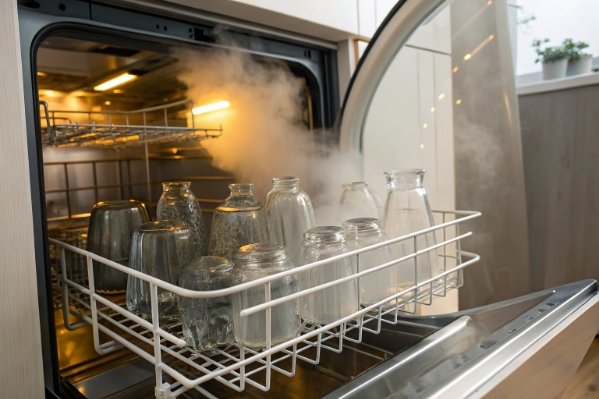
For brands promoting sustainability and reusability, the dishwasher is the ultimate torture test. A bottle that survives the factory might emerge from a home appliance looking etched, faded, or shattered.
Dishwasher cycles affect glass bottles through two distinct mechanisms: chemical corrosion (etching) caused by high-alkaline detergents stripping ions from the surface, and physical stress caused by thermal cycling. While glass is durable, it is not immune to the cumulative "aging" effect of modern cleaning chemistry.
Dive Deeper: The Hostile Environment of the Dishwasher
At FuSenglass, we often have to manage the expectations of clients who want to label their products "Dishwasher Safe." They assume glass is invincible. In reality, the environment inside a dishwasher is a perfect storm designed to destroy dirt, but it creates collateral damage on the vessel itself.
The dishwasher environment attacks glass on three fronts simultaneously: Thermal, Chemical, and Mechanical.
-
Thermal Energy: Water temperatures often reach 65°C–75°C, followed by a "drying cycle" that can spike higher or rapid cooling. This expansion and contraction fatigue the material.
-
Chemical Aggression: Detergents are highly alkaline (pH 10–12). They are designed to dissolve fats and proteins. Unfortunately, this high pH also attacks the silica network of the glass, causing "hydrolytic attack."
-
Mechanical Abrasion: Water jets and the rattling of items against each other can cause micro-scratches, which then become entry points for chemical attack.
This process is cumulative. A bottle might look perfect after 10 cycles, but by cycle 50, the surface chemistry has changed. The sodium and calcium ions that stabilize the glass surface are slowly leached out, leaving a silica-rich but porous "gel" layer. This layer scatters light, creating the dreaded "cloudy" appearance that cannot be wiped off.
The Three Pillars of Dishwasher Stress
| Stress Factor | Mechanism | Result on Glass |
|---|---|---|
| Alkalinity (pH 10+) | Chemical Leaching | Dissolves the glass surface structure (Silica network). |
| Heat (70°C+) | Kinetic Acceleration | Doubles reaction rate for every 10°C rise; drives thermal expansion. |
| Soft Water | Ion Hunger | Soft water "starves" for ions, pulling them aggressively from the glass. |
| Drying Cycle | Evaporation | Bakes detergent residues onto the surface; creates thermal gradients. |
Now, let’s analyze the specific defects that arise from this harsh environment and how to engineer your bottle to withstand them.
Why do some glass bottles turn cloudy or etched after repeated dishwasher cycles (detergent, water hardness, and heat)?
Consumers often complain that their favorite glass water bottles have turned milky white. Is this a film they can clean off, or is the glass itself destroyed?
Cloudiness is usually permanent "glass corrosion" caused by soft water and alkaline detergents leaching sodium ions from the surface structure. While hard water can leave reversible limescale deposits, true dishwasher etching is an irreversible physical degradation of the silica network.
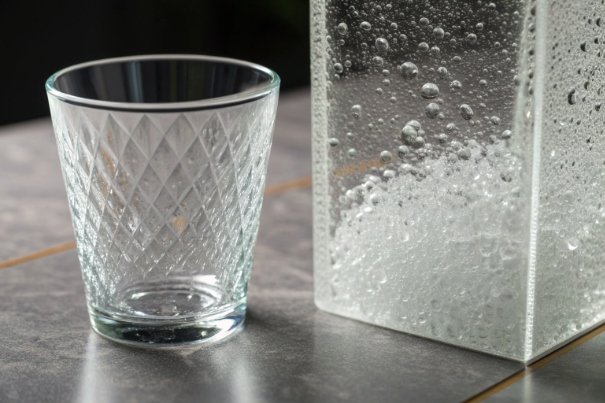
The Chemistry of Etching vs. Filming
It is critical to distinguish between the two types of cloudiness.
-
Filming (Limescale): This is additive. Minerals (Calcium/Magnesium) from hard water deposit on the glass.
-
Etching (Corrosion): This is subtractive. The glass material is removed.
- Test: Vinegar does nothing. The surface feels rough or "draggy" to the fingernail.
The Paradox of Soft Water
Counterintuitively, soft water is worse for glass than hard water.
Hard water is saturated with minerals. Soft water is "hungry." When you combine soft water with high heat and alkaline detergent, the water satisfies its hunger by pulling ions (Sodium $Na+$) out of the glass composition.
This leaching process leaves behind microscopic pits and a hydrated silica layer. This uneven surface scatters light, making the clear glass look foggy or iridescent (like an oil slick). Once this happens, the bottle is ruined. Phosphate-free detergents, while good for the environment, are often more aggressive on glass because they rely on other chelating agents that can accelerate this attack.
Factors Accelerating Corrosion
| Factor | Effect on Etching | Why? |
|---|---|---|
| Water Hardness | Low (Soft) = High Risk | "Hungry" water dissolves glass ions faster. |
| Temperature | High = High Risk | Increases the solubility of the silica. |
| Detergent pH | High (Alkaline) = High Risk | Breaks the Si-O-Si bonds (Hydrolysis 2). |
| Glass Type | Soda-Lime = High Risk | High alkali content is easily leached. |
Can dishwasher heat + rapid drying cycles increase thermal shock risk for soda-lime vs. borosilicate glass bottles?
While a dishwasher is not a blast furnace, the transition from a hot wash to a cold rinse, or a wet wash to a super-heated drying cycle, creates stress.
Standard soda-lime glass is susceptible to thermal shock in industrial dishwashers or during the heated drying phase where temperatures can spike, whereas borosilicate glass (with a low CTE) is virtually immune to these variances. For soda-lime, the risk is highest when a hot bottle is hit with cold rinse water.
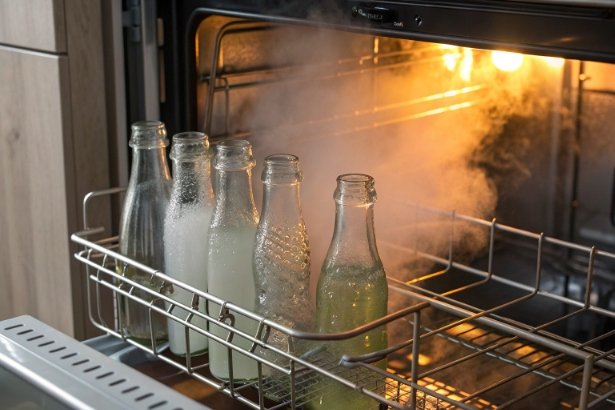
The Thermal Profile of a Wash
A typical cycle isn’t a flat line. It’s a roller coaster.
-
Pre-Rinse: Cold/Warm.
-
Main Wash: Ramp up to 60°C–70°C. Glass expands.
-
Rinse: Often involves draining hot water and refilling with cold mains water.
- The Danger: This sudden drop ($\Delta T$) creates tensile stress on the glass surface.
-
Drying: Heating elements turn on. Temperatures can exceed 80°C.
Soda-Lime vs. Borosilicate
-
Soda-Lime (The Standard): CTE 3 ~9.0. Safe $\Delta T$ is ~40°C.
- If the dishwasher drops from 65°C to 15°C (mains water in winter), the $\Delta T$ is 50°C. This is the danger zone. Thin-walled soda-lime bottles or those with existing scratches may crack.
-
Borosilicate (The Premium): CTE ~3.3. Safe $\Delta T$ is ~120°C+.
- A dishwasher cannot physically produce a temperature swing large enough to break borosilicate glass 4. This is why Pyrex measuring jugs last forever.
Design Recommendations for Soda-Lime
If you are using soda-lime glass 5 (which is 90% of the market due to cost):
-
Thicker Walls: Increases durability but holds heat longer.
-
Annealing: Must be perfect (Grade 1 or 2).
-
Shape: Avoid square corners. Round bottles distribute the thermal load of the drying cycle more evenly.
Thermal Risk Comparison
| Glass Type | Expansion (CTE) | Dishwasher Risk | Primary Failure Mode |
|---|---|---|---|
| Soda-Lime (Annealed) | High | Moderate | Thermal shock 6 during cold rinse influx. |
| Soda-Lime (Tempered) | High | Low | Immune to standard dishwasher swings. |
| Borosilicate | Low | Zero | Practically indestructible by heat. |
| Crystal (Lead/Zinc) | Very High | High | Sensitive to heat; risk of cracking. |
Which bottle decorations and coatings fail first in dishwashers (UV coating, screen printing, frosting, hot stamping), and how can you make them dishwasher-safe?
A pristine glass bottle is useless if the brand logo washes off after five cycles. The dishwasher is a graveyard for organic inks and metallic foils.
Organic decorations like low-temperature screen printing, UV coatings, and "real gold" hot stamping degrade rapidly due to the caustic detergent and hot water. To ensure dishwasher durability, brands must switch to inorganic methods like High-Fire Ceramic Decals (ACL) or Acid Etching.
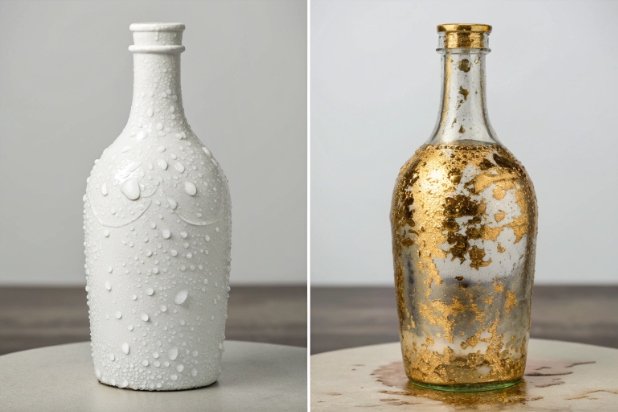
The Hierarchy of Durability
At FuSenglass, we categorize decorations by their "bond mechanism."
-
Mechanical Bond (Weak): Organic inks sit on top of the glass. The hot water swells the ink, and the detergent attacks the interface. The print peels or flakes.
-
Chemical/Fused Bond (Strong): Inorganic ceramic enamels are melted into the glass. They become part of the bottle.
Failure Modes by Type
-
Hot Stamping (Gold/Silver Foil): The Weakest Link.
-
Failure: The foil oxidizes (turns black) or flakes off entirely. Detergents eat the adhesive layer.
-
Fix: Use "Dishwasher Resistant" synthetic metallic inks, though they lack the true mirror shine.
-
-
Frosting (Spray vs. Acid):
-
Spray Frost (Organic): Scratches easily in the dishwasher rack. Can peel in sheets.
-
Acid Etch (Chemical): Permanent. It is the glass itself. 100% Dishwasher safe.
-
-
Screen Printing:
-
Organic Ink (Low Temp): Fades, chalks, or scratches off.
-
ACL (Ceramic Frit): Fired at 600°C. The glass flux melts into the bottle. It will survive 500+ cycles.
-
Decoration Selection Guide
| Decoration | Technology | Dishwasher Durability | Notes |
|---|---|---|---|
| Standard Paper Label | Adhesive | None | Washes off in 1 cycle. |
| Hot Stamping Foil | Heat Transfer | Low | Fades/Flakes in <20 cycles. |
| Organic Screen Print | Epoxy/UV Ink | Medium | Survives ~50 cycles (depends on curing). |
| Ceramic Decal (ACL) | Glass Enamel | Excellent | Permanent (500+ cycles). |
| Acid Etching | Chemical Removal | Excellent | Permanent texture. |
| Feeder Color | Colored Glass | Excellent | Color is integral to material. |
How should brands define and test a “dishwasher safe” claim for glass bottles (cycle count, temperature profile, inspections, and pass/fail criteria)?
"Dishwasher Safe" is not a legally protected term in many regions, but using it without validation is a recipe for returns and bad reviews.
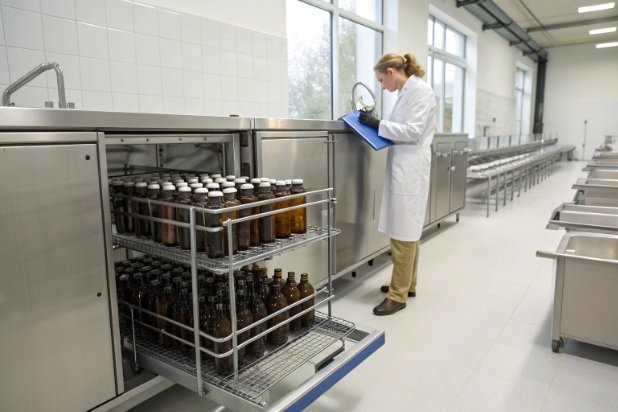
Brands should validate their claim using the BS EN 12875-1 standard, subjecting the bottles to at least 125 industrial cycles (equivalent to ~300 domestic). Success is defined by zero gloss loss, zero print delamination (Cross-Hatch test), and no visible clouding.
Setting the Standard
Since "safe" is subjective, you must quantify it.
-
Domestic Use: The average home runs the dishwasher 4-5 times a week. That’s ~250 cycles per year.
-
Commercial Use: A bar or restaurant might run 10 cycles a night.
The Test Protocol (EN 12875 Simulation)
To prove a bottle is reusable and durable, we recommend the following rigorous protocol:
-
The Machine: Use an industrial standardized testing dishwasher (not a home unit) to ensure consistent dosing and temperature.
-
The Detergent: Use a standardized IEC reference detergent (high alkali, aggressive) to simulate worst-case scenarios.
-
The Cycle:
-
Wash at 65°C.
-
Rinse at 80°C (Sanitizing).
-
Air dry.
-
-
Duration: Run for 125, 250, or 500 cycles.
Pass/Fail Criteria (The Inspection)
After the cycles are complete, the bottles are compared to a "Reference Sample" that was never washed.
-
Visual Clouding: Investigated in a light box against a black background. Any haze = Fail.
-
Decoration Adhesion:
-
Tape Test: Apply aggressive tape to the print and rip it off (ASTM D3359 7).
-
Cross-Hatch: Scratch a grid into the print and apply tape. 0% removal allowed.
-
-
Gloss Meter: Measure the reflectivity of the glass. A drop of >10% gloss indicates surface corrosion has started.
Testing Levels for Certification
| Claim Level | Cycle Count (Test) | Real World Equivalent | Suitable For |
|---|---|---|---|
| "Hand Wash Recommended" | 0 – 50 | Incidental use | Decaled spirits, Gold foil |
| "Dishwasher Safe" (Basic) | 125 | ~6 Months Daily Use | Standard Soda-Lime |
| "Dishwasher Safe" (Durable) | 500 | ~2 Years Daily Use | ACL Printed Bottles 8 |
| "Commercial Safe" | 2000+ | Restaurant Service | Tempered / Borosilicate |
Conclusion
The dishwasher is a chemically aggressive, thermally volatile environment that tests the limits of glass chemistry. While glass is inherently robust, the combination of alkaline corrosion and thermal shock can degrade poor-quality glass and strip organic decorations. For a brand to confidently claim "Dishwasher Safe," you must specify high-quality glass (optimized silica balance 9), utilize ceramic-fired decorations, and validate performance through rigorous standardized cycle testing 10.
Footnotes
-
Hard mineral deposits, primarily calcium carbonate, left behind by evaporating hard water. ↩
-
A chemical reaction where water breaks down the molecular bonds of a substance. ↩
-
A material property that quantifies how much a substance expands when heated. ↩
-
A type of glass with very low thermal expansion, highly resistant to thermal shock. ↩
-
The most common glass type for containers, requiring careful thermal management. ↩
-
Failure of glass due to rapid temperature changes, causing stress and breakage. ↩
-
Standard test method for assessing adhesion strength by tape test. ↩
-
Applied Ceramic Labeling, a process of fusing glass-based ink to the bottle for durability. ↩
-
The key component of glass that determines its chemical durability and resistance to corrosion. ↩
-
Testing procedures defined by organizations like ISO to ensure product durability claims. ↩






