
A bottle can meet every drawing spec and still crack on a customer line. The reason is simple: one side expands faster, and glass hates tension.
Yes. Uneven thermal expansion creates thermal stress. If stress rises above the glass strength—often at the heel, shoulder, or finish—cracks start even when the average CTE is correct.
Uneven expansion is really uneven temperature plus uneven stiffness
Most cracking cases are not “CTE problems.” They are “CTE + temperature gradient + geometry” problems. Glass expands when heated. If every point in the bottle heats evenly, expansion is smooth and stress stays low. In real production, heating is never even. The inside wall heats first in hot-fill. The outside wall stays cooler, especially at the base sitting on metal or a cool conveyor. That creates a temperature gradient 1 across the thickness. The hot layer wants to expand. The cold layer resists. The result is tensile stress in one region of the wall.
Uneven expansion becomes worse when thickness varies. Thick glass heats slowly, so thick zones lag in temperature. Thin zones heat quickly. The mismatch creates a stress hinge at thickness transitions. This is why thick-bottom premium bottles often crack more than uniform lightweight bottles.
Composition differences can also create uneven expansion, but this is usually a secondary driver in a well-controlled bottle plant. Most bottles are chemically uniform within one melt. The bigger risk is local chemistry pockets from cords or unmelted batch, or from strong cullet variability that shifts composition over time. Those chemical effects are real, but most field cracks are dominated by thermal gradients and residual stress 2 from poor annealing.
A useful way to think about it is this: cracking happens when three things stack at the same point:
1) a fast temperature gradient,
2) a stress concentration from thickness or shape,
3) residual stress from cooling or handling.
| Uneven expansion driver | What it really is | Most common bottle zone | Typical crack style |
|---|---|---|---|
| Wall thickness variation | uneven heating and stiffness | heel, base corner, shoulder | heel cracks, vertical splits |
| Temperature gradient | hot inside, cool outside | base and shoulder transitions | checks, star cracks |
| Residual stress | locked-in tension from lehr | finish and heel | delayed cracks |
| Composition differences | local CTE/viscosity pockets | cords path | rare, streak-linked failures |
The next sections answer the practical questions: what causes uneven expansion, how thermal cycles create stress, what design and process controls reduce risk, and what QC tests prove readiness before shipping.
What causes uneven thermal expansion in glass bottles (wall thickness variation, temperature gradients, or composition differences)?
Cracks do not start where the bottle is “average.” They start where the bottle is different.
Uneven thermal expansion is mainly caused by temperature gradients across the wall and by thickness variation that makes different zones heat at different speeds. Composition differences can contribute when the melt is not homogeneous, but they are less common than thermal and thickness causes in container production.
1) Wall thickness variation: thick heats slow, thin heats fast
A thick heel or heavy base acts like a heat sink 3. During hot-fill, the inside surface heats quickly, but the thick mass stays cooler deeper inside. That creates a strong gradient. Thin panels heat more uniformly, so they see less internal mismatch. The worst risk is not “thick” or “thin.” The worst risk is sharp thickness transitions.
Common sources of thickness variation:
-
unstable gob temperature and weight
-
parison distribution drift on the IS machine 4
-
mold wear and misalignment
-
lightweighting without redesigning transitions and radii
2) Temperature gradients: inside and outside rarely match
Temperature gradients come from the process and the line:
-
hot liquid warms the inside first
-
outside cools by air, conveyors, starwheels, and rinse sprays
-
base contact cools faster than free surfaces
-
line stops create local overheating followed by sudden cooling
Even with perfect thickness, a fast gradient can crack a bottle if the process is harsh enough.
3) Composition differences: local CTE differences from cords or batch pockets
Composition-driven uneven expansion can happen when:
-
unmelted batch clusters survive and create local stiffness pockets
-
cullet swings shift composition over time (lot-to-lot)
These are usually detected as optical cords, stones, or unusual property drift. Most plants see them as quality issues before they show as thermal cracking.
| Cause | Primary mechanism | Early warning signal | Best upstream fix |
|---|---|---|---|
| Thickness variation | heat flow mismatch | cavity weight spread | parison control + mold maintenance |
| Process gradient | fast ΔT across wall | cracks during hot-fill ramp | preheat + controlled cooling |
| Residual stress | stress already stored | polariscope patterns drift | lehr tuning and spacing |
| Composition pocket | local CTE/viscosity | cords/haze + property drift | melting and mixing control |
If the plant must choose one focus, thickness uniformity and lehr stress control deliver the biggest thermal-crack reduction for the least recipe disruption.
How do hot-fill, pasteurization, and sterilization cycles create thermal stress that leads to cracks?
Thermal stress is the price of fast heating and cooling. The harsher the ramp, the higher the stress spike.
Hot-fill creates a sharp inside-to-outside temperature gradient in seconds, which can trigger heel and shoulder cracks. Pasteurization adds longer cycles and repeated stress, which can grow microcracks. Sterilization/retort can add the highest ramp severity and the most cycles, so even moderate residual stress can cause failures.
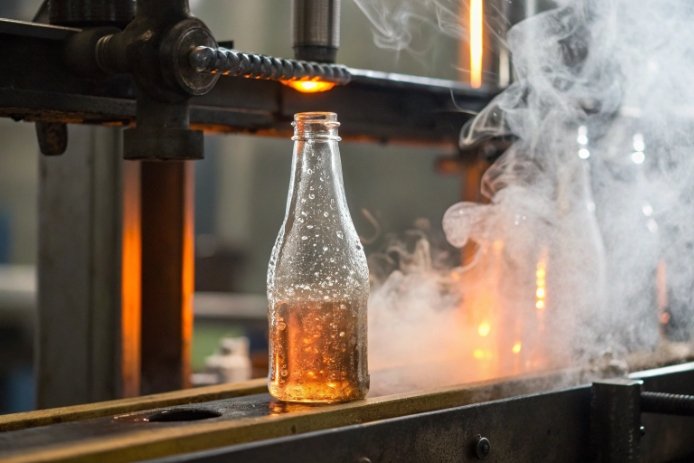
Hot-fill: fast heating inside, cool outside
Hot-fill 6 stress starts at the inner wall. The inner layer expands. The outer layer stays cool and restrains it. The heel is vulnerable because it is thick and often cooled by contact surfaces. If the bottle is then cooled quickly (cold rinse or cool air), the gradient can reverse. That reversal can create a second stress peak.
Hot-fill cracks often show as:
-
heel/base corner cracks
-
vertical splits from the base upward
-
shoulder checks in bottles with abrupt transitions
Pasteurization: slower ramps but repeated exposure
Pasteurization 7 often heats more uniformly than hot-fill, but it adds time and cycles. Small defects can grow. If bottles carry residual stress from under-annealing, the repeated cycle becomes a crack accelerator.
Sterilization/retort: severe thermal demand
Sterilization cycles can have high temperatures and strong cooling steps. This is where low-CTE materials add margin, but soda-lime can still succeed with correct ramp design, thickness control, and good annealing. If any one of those is weak, retort failures can appear fast and can look like “random cracking.”
| Process | Main stress source | Highest-risk bottle zones | Typical operational trigger |
|---|---|---|---|
| Hot-fill | fast inside heating + fast cooling | heel, base corner, shoulder | high fill temp, cold rinse |
| Pasteurization | repeated cycling | shoulder transitions, finish | long dwell, uneven loading |
| Sterilization | harsh ramps + high peak | heel and finish | aggressive cool-down, pressure changes |
A reliable way to reduce cracks is to map the worst-case ΔT and ramp rate for each process step, then confirm that the bottle’s stress state after annealing leaves enough safety margin.
Which design and process controls reduce uneven expansion and thermal shock cracking (uniform thickness, proper annealing, controlled cooling)?
Many teams try to solve thermal cracking with one change. The fastest results come from controlling three levers together.
Reduce uneven expansion and cracking by designing for uniform thickness and smooth radii, ensuring strong and even annealing to remove residual stress, and controlling process ramps (preheat, stable fill temperature, controlled cooling, and avoiding sudden cold shocks).
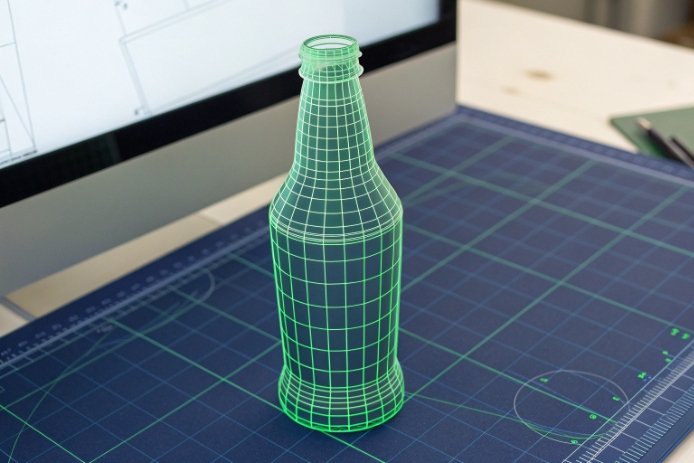
Design controls: keep thickness smooth and transitions gentle
-
Keep body wall thickness as uniform as practical.
-
Limit base mass and avoid sharp heel corners.
-
Use generous radii at base-to-wall and shoulder transitions.
-
Avoid sudden thickness steps created by push-up geometry or heavy embossing.
-
Balance thickness around the circumference to prevent one-side stress.
Annealing controls: reduce stress and make it uniform by cavity
-
Maintain correct lehr 8 reheat and soak so thick zones relax.
-
Control airflow symmetry and bottle spacing.
-
Prevent drafts and cold spots that create one-side cooling.
-
Track stress patterns by cavity and time, not only by average.
Process controls: manage the thermal cycle, not only the peak temperature
-
Pre-warm bottles if hot-fill ΔT is high.
-
Keep fill temperature stable and avoid stop-start extremes.
-
Use staged cooling rather than sudden cold rinses.
-
Control conveyor and starwheel contact cooling, especially under heavy bases.
-
Align closure torque and capping temperature to avoid finish stress stacking.
| Control lever | What it reduces | Fastest KPI to watch | Common mistake |
|---|---|---|---|
| Uniform thickness | gradient mismatch | weight spread by cavity | lightweighting without redesign |
| Smooth radii | stress concentration | crack origin mapping | sharp heel corners |
| Proper annealing | residual stress | polariscope patterns | rushing lehr speed |
| Controlled cooling | peak ΔT | thermal test pass rate | cold shocks “to speed up line” |
The strongest projects set “maximum thickness variation” and “maximum residual stress pattern” as mandatory, then tune the hot process around those limits. That approach reduces cracking without forcing a glass-family change.
What QC tests can verify cracking risk from uneven thermal expansion before mass shipment (stress inspection, thermal shock testing, sampling standards)?
Thermal cracking risk must be verified in a way that matches how the customer uses the bottle. A single lab number cannot replace process-based tests.
Use stress inspection (polariscope) as a fast every-batch control, run thermal shock or thermal cycling tests that replicate the customer process, and apply a sampling standard that covers cavities, time windows, and worst-case thickness groups.
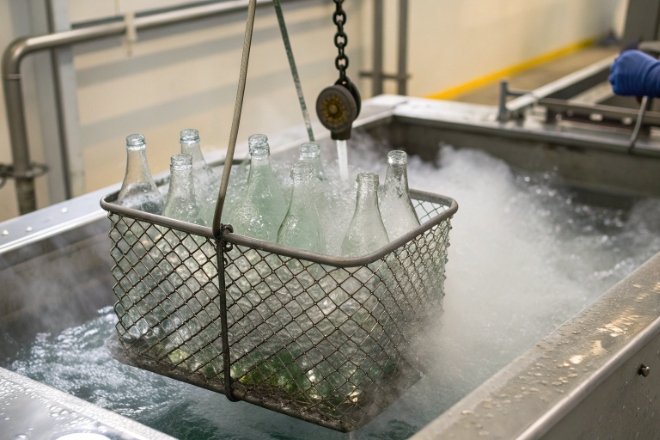
1) Stress inspection: the daily safety gate
A polariscope 9 shows residual stress patterns. The important rules are:
-
inspect the same zones every time (heel, shoulder, finish)
-
document reference images for pass/fail
-
track results by cavity number
-
test after any lehr or mold change
This catches under-annealing and uneven cooling before bottles ship.
2) Thermal shock and thermal cycling tests: prove survival in the real profile
For hot-fill:
-
fill at target temperature
-
hold for a defined time
-
cool under defined conditions (include worst-case cold rinse)
-
include stop-start simulations
For pasteurization/sterilization:
-
run a full cycle replication
-
include worst-case cooling steps
-
repeat multiple cycles if the customer does so
The goal is to reproduce gradients and contact cooling, not only a peak temperature.
3) Sampling standards: catch cavity and time-based drift
A good sampling plan covers:
-
start, middle, end of production run
-
each cavity (or a rotating subset with full coverage daily)
-
selection of heavier-base bottles if variation exists
-
extra sampling after process or lehr changes
4) Failure analysis: link cracks to controls
When a test fails, record:
-
crack origin (heel, shoulder, finish)
-
cavity number
-
thickness at origin zone
-
stress pattern images
This turns failures into control actions.
| QC tool | Frequency | What it proves | “Go/no-go” decision |
|---|---|---|---|
| Polariscope stress check | each shift | residual stress is low and uniform | stop if stress exceeds limit |
| Thickness/weight mapping | daily / per change | uniformity and hot spots | quarantine if variation spikes |
| Thermal shock test | per batch/lot | survives hot-fill profile | reject if cracks occur |
| Thermal cycling test | per campaign gate | survives pasteur/retort | approve only if stable |
| Cavity correlation chart | continuous | isolates one bad cavity | fix mold/lehr, not whole batch |
When these tests are used together, thermal cracking becomes predictable. The plant can ship with confidence because the risk is measured, not guessed.
Conclusion
Uneven expansion can crack bottles because thermal gradients and thickness transitions create tensile stress. Uniform thickness, strong annealing, controlled ramps, and the right QC tests stop failures before shipment.
-
How temperature differences create stress across glass thickness. ↩
-
Internal tension remaining in glass after improper cooling. ↩
-
An object or material that absorbs and dissipates heat. ↩
-
The primary machine used to form glass containers. ↩
-
Visible streaks of different glass composition causing stress. ↩
-
Process of filling containers with hot liquid to ensure sterility. ↩
-
Heat treatment to kill bacteria in food and beverages. ↩
-
A long oven used for annealing glass containers. ↩
-
Instrument for visualizing internal stress patterns in glass. ↩






