
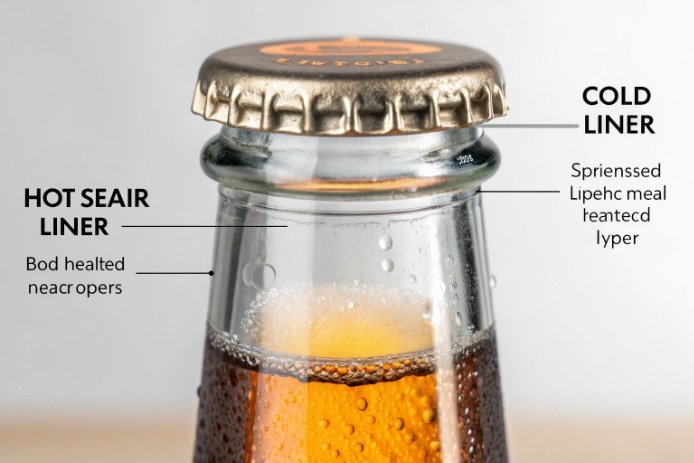
A seal can pass at room temperature and fail on a hot-fill line. The parts did not “change a lot.” They moved by microns, and the liner lost just enough compression to open a leak path.
Yes. Thermal expansion affects sealing because the glass finish, cap, and liner expand and soften at different rates. That changes liner compression, thread load transfer, and torque retention, which can create micro-leaks during heating and cooling cycles.
Sealing performance is a contact-pressure problem under temperature change
A closure seal works when the liner maintains continuous contact and enough pressure on the sealing land 1. Temperature change attacks both requirements:
- Geometry shifts: the glass neck expands slightly; the cap often expands more; the liner may soften.
- Force shifts: the liner creeps under compression at heat; torque relaxes; vacuum or pressure loads change the interface.
Even if the glass coefficient of thermal expansion (CTE) 2 is stable, the closure system is a multi-material assembly. Plastic caps and many liners have much higher thermal expansion and much lower stiffness at elevated temperature than glass. This is why the seal often becomes weakest right after a hot-fill-hold process 3, when product pressure is high and liners are soft.
The finish is also the most tolerance-sensitive part of the bottle. Ovality, land waviness, and thread profile variations create local low-pressure zones. Heat makes those low-pressure zones more likely to leak, because the liner becomes less able to “bridge” gaps.
A good sealing program treats thermal cycling as normal, not as an exception. It builds a compression margin, then validates it at temperature.
| What changes with temperature | What it does to the seal | When risk is highest | What you see |
|---|---|---|---|
| Glass finish expands (small) | changes seating geometry slightly | heat-in | minor drift, not the main driver |
| Cap expands (often bigger) | relaxes thread fit and load | heat-in and warm hold | torque drop |
| Liner softens and creeps | reduces contact pressure | warm hold | micro-leaks, dye ingress |
| Cooling creates vacuum | pulls on seal | cool-down | loss of vacuum, air ingress |
| Pressure spikes | pushes on seal | right after fill | “burp” leaks |
The next sections answer your four questions in detail: how temperature changes neck dimensions and liner compression, what happens to torque and seal integrity through hot-fill cooling, which closure types and liners are most stable, and how to validate sealing reliability before shipment.
How does temperature change alter glass neck dimensions and liner compression, leading to micro-leaks?
Micro-leaks usually happen when contact pressure drops locally. Temperature change can cause that drop in two ways: small dimension shifts and large liner stiffness shifts.
Temperature increases expand the glass finish slightly and can reduce liner stiffness and compression force. Differential expansion between glass and cap plus liner softening can reduce sealing pressure at the land, opening micro-channels—especially where ovality or waviness already exists.
Estimating how much the glass finish expands
A practical first estimate for finish OD change is:
- ΔD = D₀ × α × ΔT
For a 28 mm finish, soda-lime α ≈ 9×10⁻⁶/K, and ΔT = 60°C:
- ΔD ≈ 28 × 9×10⁻⁶ × 60 ≈ 0.015 mm (15 µm)
That is small. The more important effect is that the cap and liner often change more than the glass.
Why micro-leaks appear even with tiny glass expansion
Micro-leaks happen because:
- liners soften and creep at temperature,
- torque relaxes, reducing axial load,
- the seal relies on a narrow land and continuous contact.
If the land is slightly tilted or the finish is oval, the seal pressure is already uneven. Heat makes the liner less able to fill gaps. A micro-channel opens and allows weeping or air ingress.
Where micro-leaks start
- at the thinnest liner contact zone
- at the lowest-pressure spot created by ovality
- at land waviness or small chips
- at thread seating inconsistency
| Cause | What temperature does | Leak mechanism | Best control |
|---|---|---|---|
| Finish ovality | expands unevenly in real lines | local low pressure zone | roundness control by cavity |
| Land waviness | liner softens | micro-channel remains open | land flatness spec + inspection |
| Liner creep | pressure drops over time | seal relaxes | low compression set characteristics 4 liner |
| Cap expansion | thread load reduces | less axial compression | cap material choice + torque band |
A seal that is stable at temperature is designed to maintain pressure even after predictable relaxation. That requires torque retention planning and liner selection.
What happens to application torque, cap back-off, and seal integrity during hot-fill cooling cycles?
Torque is not the seal, but torque is a good indicator of how much clamp load is left after cycling.
During hot-fill heat-in, liners soften and cap materials expand, so back-off torque often drops and seal compression can decrease. During cooling, vacuum forms and tests the seal. If compression is too low or the finish is uneven, micro-leaks can occur and the cap can back off slightly, leading to loss of vacuum or sticky necks.
Phase 1: Cap application and early heat soak
- Application torque is applied at a specific capper setting.
- As temperature rises, liners soften and creep.
- Cap shells expand, which can reduce thread grip and load transfer.
- Internal pressure can rise briefly, increasing the load demand on the seal.
Risk: short-term weeping right after fill, especially if a cold rinse hits the outside and creates additional gradients.
Phase 2: Warm hold and relaxation
- Liner compression set develops.
- Back-off torque declines.
- If the system has low compression margin, the seal load can fall below the threshold.
Risk: slow micro-leaks that show as sticky residue later.
Phase 3: Cool-down and vacuum formation
- Cooling creates vacuum.
- Vacuum pulls on the seal and can draw air through micro-channels.
- Loss of vacuum can happen even with no visible product leak.
Risk: loss of vacuum (food) or seal weakness in later handling.
| Cycle stage | What changes | Seal risk | What to measure |
|---|---|---|---|
| Heat-in (0–5 min) | liner softens, pressure rises | weeping | hot leak test + immediate back-off torque |
| Warm hold (5–30+ min) | creep and relaxation | compression loss | torque vs time curve |
| Cool-down | vacuum forms, cap shrinks | air ingress or back-off | vacuum retention + leak test |
| Storage (24–72 h) | set continues | delayed leakage | aged back-off torque + dye ingress |
The most useful practice is to measure torque at several time points, not only at application. Many failures come from ASTM D2063 torque retention 5 behavior over time, not from initial torque.
Which closure types and liner materials perform best under thermal cycling (ROPP, lug, CT, PP/PE liners, TPE, foam)?
No closure type is “best” in all cases. Performance depends on how the system creates sealing force and how the liner behaves under heat and time.
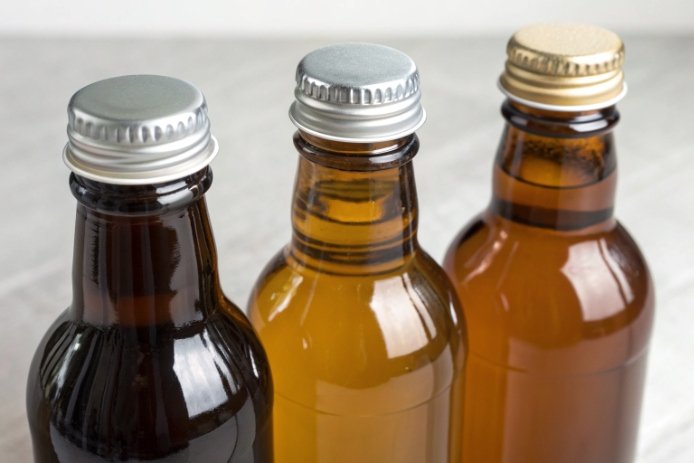
For thermal cycling, systems that maintain stable axial load and use low-compression-set liners perform best. ROPP and metal CT can be stable when finish roundness and land quality are controlled. Lug closures work well in vacuum systems when liners are designed for hot-fill and vacuum retention. Plastic CT can be more sensitive due to higher expansion and creep. For liners, heat-stable TPE and well-designed foam systems often outperform basic PP/PE liners when cycling is severe, but selection must match product, temperature, and regulatory needs.
Closure sensitivity by type
ROPP (aluminum roll-on):
- Often good torque retention and consistent sealing when formed correctly.
- Sensitive to finish roundness and land flatness.
- Performs well when the liner is chosen for heat and the capper settings are stable.
- Common in spirits and beverages using Roll-On Pilfer Proof (ROPP) caps 6.
Lug / twist-off:
- Common in hot-fill foods with vacuum.
- Sensitive to liner design and vacuum profile.
- Can be very reliable with the right compound and proper cooling curve.
- Widely used in metal lug closures 7.
Continuous thread (CT):
- Metal CT often holds better under heat than plastic CT.
- Plastic CT can creep and expand more, reducing load during heat soak.
- Defined by the spiral thread geometry in continuous thread (C-T) closures 8.
Pump/sprayer:
- More interfaces and leak paths.
- Often needs gasket materials that hold compression and resist creep.
Liner behavior under cycling
A good liner for cycling has:
- low compression set at temperature,
- good recovery after cooling,
- chemical resistance to the product,
- stable friction behavior so torque translates to compression.
PP/PE liners can work in mild conditions, but in harsher heat they can soften and creep more than specialized compounds. TPE and engineered foam/compound liners can offer better resilience, but they must be validated for your exact cycle and product.
| Option | Strength under cycling | Typical sensitivity | Best use case |
|---|---|---|---|
| ROPP + heat-grade liner | high | finish roundness | beverages, oils, spirits, some hot-fill |
| Lug + vacuum-grade liner | high | vacuum and land flatness | hot-fill foods, jars/bottles with vacuum |
| Metal CT + resilient liner | medium to high | torque control | wide range, moderate cycles |
| Plastic CT + standard liner | medium | creep and expansion | mild cycles, controlled conditions |
| Pump/sprayer + gasket | variable | multiple leak paths | personal care, household |
The best choice is the one that keeps sealing pressure above the minimum even after heat soak and cool-down. That should be proven with testing, not assumed.
How can you validate sealing reliability with thermal cycling, vacuum/pressure tests, and leak detection before shipment?
Sealing reliability is not proven by one room-temperature leak test. It is proven by cycling through the worst temperatures, then testing the seal when it is weakest.
Validate sealing reliability by running thermal cycling that replicates hot-fill or pasteurization, measuring torque retention over time, and performing leak detection both at heat and after cool-down using vacuum/pressure decay and sensitive methods like dye ingress. Use sampling that covers cavities, time windows, and worst-case finish geometry.
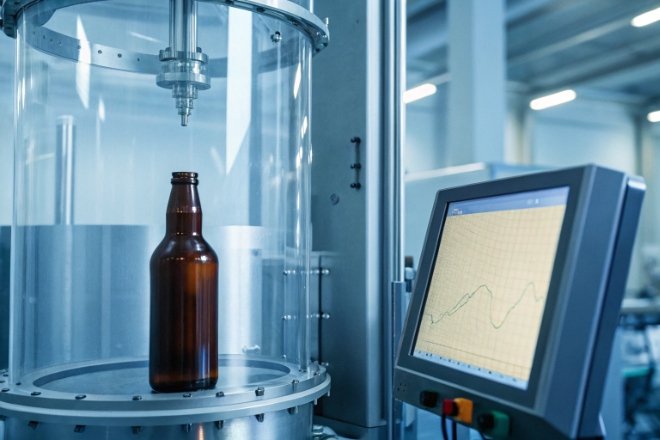
A practical validation sequence
1) Baseline dimensional and stress checks
- finish OD and roundness by cavity
- land flatness and defects
- polariscope examination (ASTM C148) 9 on finish and heel
2) Thermal cycling to replicate reality
- bottle start temperature (include worst-case cold bottles)
- hot-fill temperature and hold
- cooling steps and timing (rinses, air, contact)
- repeat cycles if the product is pasteurized or retorted
3) Torque retention measurement
- application torque
- immediate back-off torque
- back-off after heat soak
- back-off after cool-down
- back-off after 24–72 hours
4) Leak detection at the right times
- leak test while hot or warm (when liners are soft)
- leak test after cool-down (when vacuum forms)
- dye ingress for micro-channels
- vacuum retention checks for vacuum products
- pressure tests for carbonated or pressurized products
A reliable quantitative choice for rigid packages is the vacuum decay method (ASTM F2338) 10, run both warm and after cool-down when the system is most vulnerable.
Sampling rules that stop weak cavities from shipping
- sample across cavities, not only across time
- include heavy-base or high-ovality bottles as a worst-case group
- test at least one “after change” lot (after lehr/cap/liner changes)
- keep retention samples for aging
| Test | Why it matters | Best timing | Pass indicator |
|---|---|---|---|
| Thermal cycle simulation | creates real stress and liner behavior | qualification + changes | no leaks, no finish damage |
| Torque audit (multi-time) | shows relaxation and back-off risk | each lot or weekly | torque stays in band |
| Vacuum decay / pressure decay | quantitative leak detection | hot + after cool-down | decay within limit |
| Dye ingress | detects micro-leaks | after cycling | no dye penetration |
| Vacuum retention | protects shelf life | after cool-down and aging | vacuum stays above target |
| Stress inspection | protects margin | each shift | stable stress patterns |
A supplier can ship plated, decorated, or hot-fill bottles with confidence when the seal system is validated in the same thermal window the customer will use. That is the best way to prevent “passed in factory, failed in market.”
Conclusion
Thermal expansion affects sealing by shifting geometry and reducing liner compression during cycling. Choose closures and liners for torque retention, control finish tolerances, and validate with hot-cycle leak and torque tests before shipment.
Footnotes
-
Defines the bottle “land” (sealing surface) and why flatness matters for leak prevention. ↩ ↩
-
Provides soda-lime glass thermal expansion data used for estimating dimensional changes with temperature. ↩ ↩
-
Explains hot-fill-hold steps and why vacuum formation occurs during cooling, stressing seals. ↩ ↩
-
Standard reference for measuring compression set, a key predictor of liner relaxation under heat. ↩ ↩
-
Standard method for measuring closure torque retention, helping diagnose clamp-load loss after cycling. ↩ ↩
-
Practical explanation of ROPP systems and why roll-on forming and fit affect sealing consistency. ↩ ↩
-
Overview of lug closures and why they’re common in hot-filled, heat-processed glass packaging. ↩ ↩
-
Defines continuous thread closures and how CT differs from lug finishes in thread engagement. ↩ ↩
-
Standard for polariscopic examination of glass containers to assess anneal quality and residual stress. ↩ ↩
-
Standard for nondestructive vacuum decay leak detection, useful for finding micro-leaks after thermal cycling. ↩ ↩






