
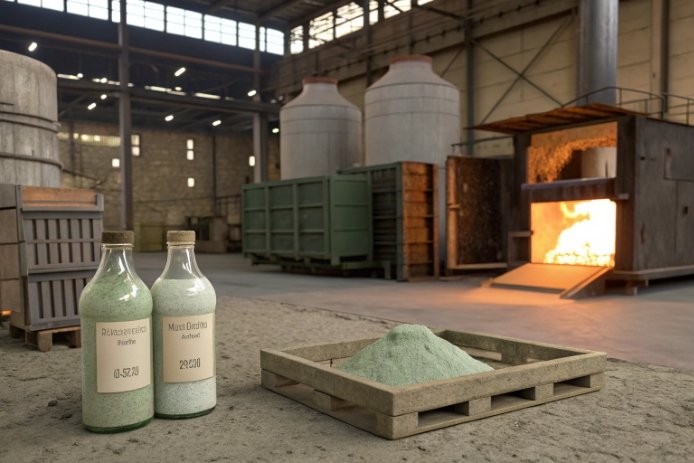
Clear bottles can turn slightly green fast, especially when recycled cullet rises. That small tint can trigger brand complaints, returns, and painful rework.
Yes, MnO₂ can decolorize clear bottle glass by shifting iron and manganese valence states and balancing color tones. But it demands tight redox control, careful dosing, and a plan to avoid long-term purple solarization.
How MnO₂ fits into a modern flint color strategy?
What MnO₂ really does in flint glass
MnO₂ is not a “magic eraser” for green. It is a redox-active tool. In a soda-lime melt, iron exists mainly as Fe²⁺ and Fe³⁺. Fe²⁺ pushes a blue-green tint, while Fe³⁺ pushes more yellow. MnO₂ acts as an oxidizer and helps drive the melt toward a more oxidizing balance, which reduces the Fe²⁺ share. At the same time, manganese in higher valence states can add a faint purple tone. When tuned correctly, that purple can cancel the remaining yellow-green and make the bottle look clearer.
Why MnO₂ is harder with high recycled cullet
High recycled cullet usually brings:
- higher total iron and more Fe²⁺ potential,
- more organics (labels, inks) that push reduction (see cullet quality impact 1),
- more variability batch-to-batch.
That means MnO₂ demand becomes less stable, so the same dose does not always give the same Lab* result.
The trade space: clarity, stability, and long-term color
MnO₂ can achieve a clean look, but it also increases risk of:
- overcorrection (pink/purple cast),
- cord-like shade variation if redox gradients exist,
- solarization (purple shift after UV exposure).
A practical decision table before using MnO₂
| Decision question | If “yes” | If “no” |
|---|---|---|
| Is your furnace redox stable hour-to-hour? | MnO₂ can be predictable | MnO₂ will swing shade |
| Is the brand sensitive to long-term purple shift? | Add UV/solarization controls | Choose other decolorizers |
| Is cullet sorted to tight flint purity? | Lower MnO₂ needed | MnO₂ demand rises and varies |
| Do you have fast color feedback (lab or inline)? | Dosing can be trimmed safely | Risk of late surprises |
MnO₂ works best when it is treated as part of a full system: cullet quality + redox control + color measurement + slow, disciplined corrections.
That foundation makes the next sections easier, because each one is about controlling one piece of that system.
If the goal is consistent flint, it helps to start with the core mechanism: how MnO₂ neutralizes iron-driven green.
How does MnO₂ neutralize the green tint caused by iron impurities in clear glass bottles?
A flint line can pass thickness and strength checks and still fail because the shelf look is “too green.” That is a color chemistry issue, not a forming issue.
MnO₂ reduces the green tint mainly by oxidizing iron (lowering Fe²⁺ relative to Fe³⁺) and by adding a small counter-tone from manganese in higher valence states. The result is a more neutral transmission through the bottle wall.
Iron is the main reason flint turns green
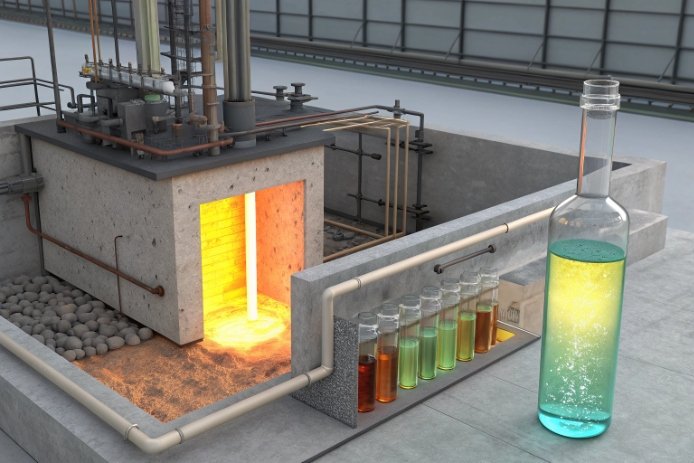
Most “clear” bottle glass contains iron from sand, cullet, and furnace carryover. In the melt, iron splits between Fe²⁺ and Fe³⁺. Fe²⁺ has stronger absorption in the red region, so transmitted light looks greener. If the melt becomes more reducing, Fe²⁺ increases and the bottle looks greener even if total iron does not change. (See iron redox control 2)
MnO₂ pushes the melt in an oxidizing direction
MnO₂ is an oxidizer in the batch. It helps raise oxygen activity in the melt. That makes it harder for iron to remain as Fe²⁺. When Fe²⁺ drops, the green cast drops.
Manganese also acts like a “color balancer”
A small amount of higher-valence manganese can contribute a faint purple tone. Purple is roughly opposite yellow-green in the visual sense, so it can neutralize remaining tint (complementary colors). This is why MnO₂ was historically called a “glassmaker’s soap” in older practice. Still, the same effect is the risk: too much manganese tone means visible pink/purple.
Why this can fail without tight mixing
Even if the average melt redox is correct, local reducing pockets can form near dirty cullet entry or under batch blanket zones. Those pockets can create higher Fe²⁺ and reduced manganese locally. When that glass mixes downstream, it can create cords or shade streaks.
| What shifts | What happens in the melt | What the bottle looks like | What to stabilize |
|---|---|---|---|
| Redox becomes more reducing | Fe²⁺ rises | greener | cullet organics, combustion balance |
| MnO₂ dose too high | manganese tone rises | pink/purple | dosing discipline, lab feedback |
| Poor mixing | redox gradients persist | cords, shade bands | bubbling/mixing, forehearth uniformity |
| High iron cullet | baseline tint increases | harder to hit “water clear” | cullet sorting, alternative decolorizers |
MnO₂ neutralization is real and effective. But it only stays effective when the redox environment stays stable. That leads to the next question: what dose is typical, and what controls the “right” number?
What MnO₂ dosage is typically needed for decolorization, and what factors affect the optimal amount?
A common mistake is asking for one dose number. The right dose is a moving target because cullet and redox change.
Typical MnO₂ use for flint decolorization is often in the hundreds to low thousands of ppm range in the finished glass, but the optimal amount depends on total iron level, Fe²⁺ fraction, cullet contamination, furnace atmosphere, and target bottle thickness and color limits.
Practical starting ranges (used as trial anchors)
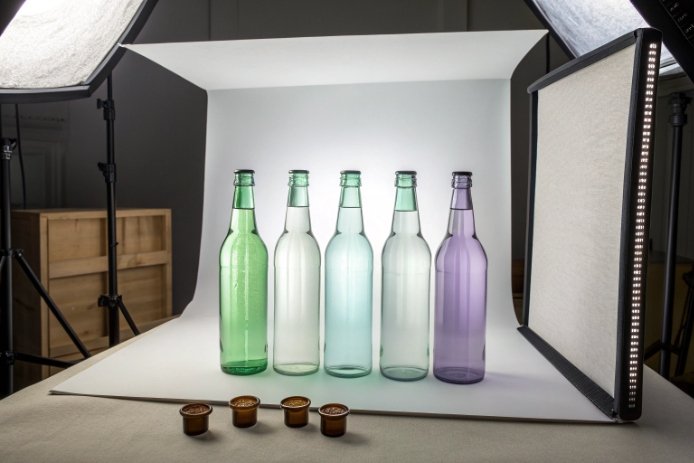
In soda-lime container flint, a practical starting window is often:
- ~0.02–0.10 wt% MnO₂ equivalent in the glass (about 200–1000 ppm), for mild iron and stable redox.
- Up to ~0.20 wt% in harder cases, but this is where purple risk rises fast.
These are not “rules.” They are trial anchors for pilot adjustments, then refined by colorimetry.
The factors that move the optimal dose most
1) Total iron in glass (Fe₂O₃ total)
More total iron usually needs more correction. Still, if iron is mostly Fe³⁺, the green may be mild. That is why total iron alone is not enough.
2) Iron redox state (Fe²⁺/Fe total)
This is often the biggest driver for “sudden green.” If Fe²⁺ rises, MnO₂ demand rises. (Read redox impact on color 3)
3) Cullet quality and organics
Labels and coatings act like reducers. They shift redox and increase Fe²⁺. They also create variability, which makes MnO₂ control harder.
4) Furnace atmosphere and oxygen staging
If combustion is slightly reducing in the melt zone, MnO₂ gets “consumed” fighting reduction. Then dose becomes less efficient.
5) Bottle thickness and target color metric
A thicker wall amplifies color. A customer who measures transmission at a fixed thickness might reject a bottle that looks fine in a quick visual check.
How to dose safely in production
- Make small dose steps and hold long enough to see the steady result (because furnace lag is long).
- Track both ΔE (see Delta E explained 4) and the direction of drift (a and b), not only “clear or not.”
- Watch for early warning signs of overcorrection: rising negative b* shift or visible pink cast in heavy sections.
| Factor | If it increases | MnO₂ demand tends to | Best paired control |
|---|---|---|---|
| Total Fe | higher baseline absorption | increase | stronger cullet sorting |
| Fe²⁺ fraction | greener tint | increase sharply | stabilize redox and organics |
| Cullet variability | drift and oscillation | increase and swing | blending lots, tighter specs |
| Oxidizing atmosphere | Fe²⁺ drops | decrease | avoid over-oxidizing shifts |
| Thickness | stronger perceived color | increase | measure color at standard thickness |
A good MnO₂ program is a feedback loop, not a fixed recipe. It needs a second plan too: what happens months later when bottles sit in light?
Can MnO₂-decolorized bottles turn purple over time under UV light, and how can manufacturers prevent solarization?
Solarization is the quiet risk that shows up after the bottle leaves the plant. A buyer might not see it in incoming QC, but the consumer sees it later.
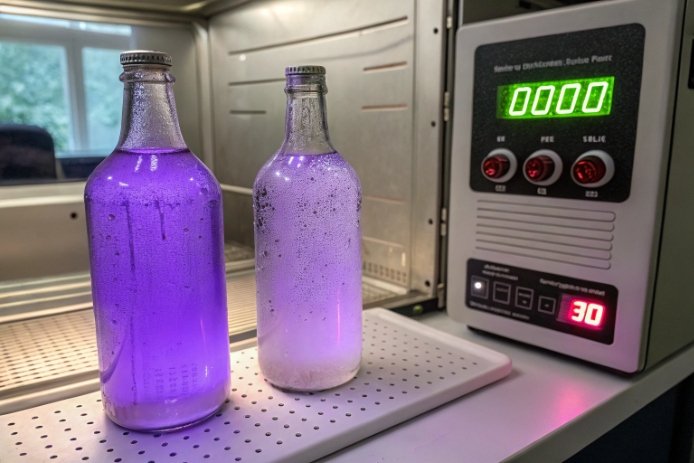
Yes. Mn-decolorized glass can develop a purple/amethyst tint after UV exposure, because manganese-related color centers can change under light. The risk rises with higher Mn content and certain redox histories, so prevention relies on minimizing Mn, stabilizing redox, and adding UV management strategies.
Why solarization happens with manganese
Manganese in glass can shift between oxidation states (Mn²⁺/Mn³⁺) and can form color centers under UV exposure. Over time, this can push the glass toward a purple tone. The effect is strongest when:
- Mn level is high,
- the melt redox history creates a manganese state that is more sensitive,
- the bottle sees long UV exposure (sunlight, outdoor storage, retail windows).
This is why old “clear” glass from decades ago can turn purple. It often used Mn-based decolorization and then saw years of sunlight.
How to prevent solarization in real bottle programs
1) Use the minimum effective MnO₂ dose
If Mn is only a “trim” for neutralization, the solarization risk is lower.
2) Prefer redox stability over aggressive Mn correction
If Fe²⁺ is controlled by furnace oxygen balance and cullet cleanliness, Mn can be reduced. That reduces both purple risk and shade drift.
3) Add UV-management additives when the application needs it
A small addition of UV-absorbing oxides (often discussed as cerium-based choices in glass) can reduce UV transmission and reduce solarization risk. This must be validated, because it can change appearance and cost. (See cerium in glass 5)
4) Control storage and exposure assumptions with customers
If bottles will be stored outdoors or used in UV-rich applications, Mn-based decolorization is a weaker choice unless UV control is built in.
5) Test solarization like a product feature, not like a defect
A practical qualification includes accelerated UV exposure tests (like ASTM G154 6) and then colorimetry checks on Lab* drift.
Solarization control checklist
| Prevention lever | What it reduces | What it may change | How to validate |
|---|---|---|---|
| Lower Mn dose | UV purple shift risk | less decolorizing power | UV aging + ΔE trend |
| Better redox stability | Mn demand and gradients | fewer cords, fewer oscillations | feeder redox + colorimetry |
| UV-absorbing additive | UV penetration | cost, slight tint | transmission + UV aging |
| Better cullet sorting | iron variability | higher cullet cost | incoming cullet audits |
| Application screening | wrong-fit SKUs | none | customer use-case review |
Solarization prevention is mostly about disciplined minimum dosing and stable furnace conditions. If a brand will not accept any long-term purple shift, it is often better to move to a different decolorizer strategy, especially when recycled cullet is high.
That leads straight into the final question: what alternatives perform better for consistent flint at high recycled content?
What are the best alternatives to MnO₂ for producing consistent clear bottles with high recycled cullet content?
High cullet is a cost and CO₂ win, but it usually raises iron and variability. That is exactly when MnO₂ becomes harder to control.
For high-cullet flint, the best alternatives to MnO₂ are usually a balanced selenium–cobalt decolorizing package (with strong redox control), improved cullet sorting and blending to lower iron variability, and selective use of UV/redox helpers like cerium-based approaches when needed. The “best” choice depends on customer tint tolerance and cullet supply stability.

Option 1: Selenium + cobalt (the common modern flint approach)
A controlled Se/Co package can neutralize iron-driven green by balancing complementary absorption. This approach is widely used because it can be tuned tightly and does not carry the same “sun purple” reputation as manganese. Still, it is sensitive to redox:
- too reducing can shift selenium behavior (see selenium retention 7),
- too oxidizing can weaken the intended correction,
- poor mixing can create cord-like shade streaks.
This option works best with stable oxygen activity and stable cullet.
Option 2: Raise cullet quality instead of raising decolorizer dose
If the plant improves cullet stream stability, it often needs less decolorizer. The highest ROI controls are:
- optical color sorting for flint purity (see sorting tech 8),
- CSP (ceramics/stone/porcelain) rejection to avoid stones,
- washing and drying to reduce organics that push redox,
- blending lots to remove spikes.
This is often the fastest route to consistent shade when recycled content rises.
Option 3: Redox and UV helpers (selective, validated use)
Some plants consider cerium-based approaches to support oxidation state control and reduce UV sensitivity. This can help stabilize iron state and also reduce solarization risk for sensitive SKUs. The tradeoff is cost and the need to validate appearance and customer acceptance.
Option 4: Process-first control with fast feedback
Even the best decolorizer package fails if the furnace swings. The highest-value process tools for high cullet flint include:
- steady combustion control and oxygen staging,
- feeder redox monitoring (or a strong proxy) (read in-line sensors 9),
- gob and color analytics tied to time lag,
- slow, model-like correction rules that avoid oscillation.
| Alternative | Best strength | Main risk | Best-fit scenario |
|---|---|---|---|
| Se + Co package | strong “neutral” correction | redox sensitivity | high-cullet flint with good redox control |
| Lower-iron cullet strategy | reduces variability at the source | supply cost | premium flint programs |
| Cerium-based helper | UV and oxidation support | cost and tint impacts | UV-exposed products and strict stability |
| Process-first control | stabilizes any chemistry choice | needs discipline and sensors | plants pushing >50–60% cullet |
For most bottle makers, the most consistent result comes from combining cullet stability with a Se/Co-based decolorization approach, while keeping MnO₂ as a limited tool for specific cases where solarization risk is acceptable and control is strong. (See sustainable melting 10)
Conclusion
MnO₂ can decolorize bottle glass, but it is a redox-dependent tool with solarization risk. Stable cullet, steady oxygen control, and modern Se/Co strategies usually deliver more consistent flint at high recycled content.
Footnotes
-
FEVE sustainability report on cullet quality and recycling benefits. ↩
-
Technical article on controlling iron redox for consistent glass color. ↩
-
Detailed guide on redox chemistry and its effect on glass colorants. ↩
-
Explanation of Delta E as a standard metric for color difference. ↩
-
Research on cerium oxide’s role in glass redox and UV absorption. ↩
-
Overview of ASTM G154 testing for UV resistance of materials. ↩
-
Study on sulfate fining and selenium retention mechanisms. ↩
-
Overview of sensor-based sorting technologies for glass recycling. ↩
-
Information on in-line redox sensors for glass melting control. ↩
-
Strategies for sustainable and optimized glass melting processes. ↩






