
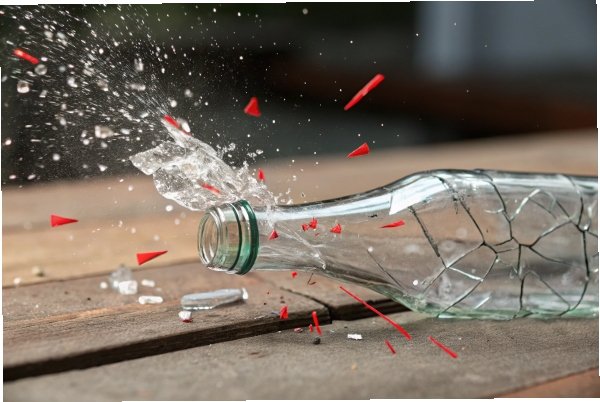
Glass breakage is often dismissed as bad luck, but "spontaneous" explosions are frequently the result of a preventable manufacturing negligence called under-annealing.
Yes, absolutely. Insufficient annealing leaves high levels of residual tensile stress locked within the glass structure. This internal tension acts like a pre-loaded spring, drastically reducing the bottle’s strength so that even minor thermal changes, capping pressure, or transit vibrations trigger catastrophic shattering.
The Physics of the "Loaded Spring"
At FuSenglass, we often describe annealing as the "memory wipe" for glass. When a bottle is formed, it undergoes violent temperature changes—the molten gob at 1100°C hits a mold at 500°C. This creates extreme temperature gradients: the skin cools and hardens instantly while the core remains molten. If the bottle is allowed to cool naturally from this state, the thermal differences lock into permanent mechanical stress. The skin ends up in compression, but the core ends up in tension.
Why Tension is the Enemy
Glass is incredibly strong in compression (you can stack tons on it) but weak in tension. Under-annealing leaves the glass with a high baseline of tensile stress. Ideally, a bottle should have near-zero internal stress so it can use its full strength to resist external forces. An under-annealed bottle is already using up 50% or 80% of its strength just holding itself together. It is a "loaded spring" waiting for a trigger—an effect explained by residual stress in glass 1{#fnref1}.
The Consequences of Failure
When an under-annealed bottle fails, it doesn’t just crack; it often bursts. The released energy from the internal tension drives cracks at extreme speeds, often resulting in projected shards ("fly rock") that pose a severe safety hazard. For terminology and failure pattern context, see glass fracture basics 2{#fnref2}.
| Stress State | Definition | Impact on Durability | Failure Mode |
|---|---|---|---|
| Well-Annealed | Uniform molecular structure; low tension. | High. Can absorb shock and heat. | Simple cracks or chips if abused. |
| Under-Annealed | Core in high tension; Skin in compression. | Low. Pre-stressed near limit. | Explosive shattering. |
| Un-Annealed | Extreme gradients (temporary stress fixed). | Critical. Will likely break on its own. | Spontaneous fragmentation. |
With the danger established, let’s examine the specific triggers that turn this potential energy into kinetic destruction on your production line.
How does residual stress from under-annealing trigger sudden breakage during hot-fill, capping, or transport impacts?
A bottle sitting on a shelf might survive under-annealing, but your production line is a torture test. Hidden stress magnifies every external force, turning routine handling into a disaster.
Residual stress acts as a cumulative load; it stacks on top of process stresses. When the thermal expansion from hot-filling or the hoop stress from capping is added to the existing internal tension, the total force exceeds the glass’s tensile limit, causing immediate structural failure.
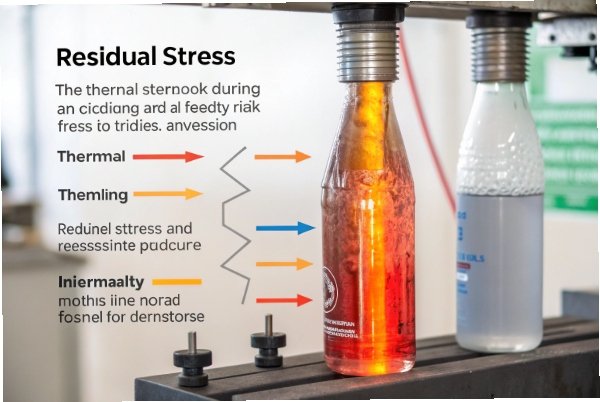
The Principle of Superposition
Engineering defines failure when Total Stress > Material Strength.
$$ \sigma{Total} = \sigma{Residual} + \sigma_{Process} $$
- Scenario A (Good Annealing): Residual Stress is 5 MPa. The Hot-Fill process adds 20 MPa. Total = 25 MPa. The glass strength is 40 MPa. Result: Safe.
- Scenario B (Bad Annealing): Residual Stress is 25 MPa (invisible to the eye). The Hot-Fill process adds 20 MPa. Total = 45 MPa. Result: Explosion.
This stacking is why the material property that matters most is the tensile strength of glass 3{#fnref3}, not just “how thick it looks.”
Specific Triggers
- Hot-Fill (Thermal Shock): Hot liquid causes the inner surface to expand. This creates tension on the outer surface. If the outer surface is already under tension from poor annealing, the glass splits instantly. This is the classic "bottom drop-out" failure—often discussed under thermal shock in glass 4{#fnref4}.
- Capping (Mechanical Load): Applying a lug cap creates radial loading on the finish; the cap/finish interaction is dominated by hoop (circumferential) stress 5{#fnref5}. If the neck is under-annealed, threads shear off or the neck splits vertically.
- Transport (Impact): Vibration adds cyclic loading. Under-annealed glass has poor fracture tolerance; small bruises can propagate into full cracks—see fracture mechanics of brittle materials 6{#fnref6}.
| Trigger Event | Stress Type Added | Under-Annealed Reaction | Typical Breakage Pattern |
|---|---|---|---|
| Hot Filling | Thermal Tension (Expansion) | Immediate tensile overload. | Bottom separation or vertical body split. |
| Capping | Radial Compression / Tension | Inability to flex/strain. | Vertical neck cracks; Thread shearing. |
| Pasteurization | Internal Pressure | Pressure finds weak tension zones. | Sidewall explosion (shards blown outward). |
| Conveyor Impact | Impact / Vibration | Low fracture toughness. | Butterfly bruises turn into full cracks. |
Which bottle zones (finish, shoulder, heel, base) show the earliest signs of under-annealing stress and why?
Complex shapes are the enemy of uniform cooling. Identifying where stress hides allows you to predict where failures will occur.
The heel (base transition) and the shoulder are the most vulnerable zones because they contain the thickest glass. These areas hold heat longer than the thin sidewalls, leading to differential cooling rates that lock in high tension if the lehr does not provide adequate soak time to normalize the temperature.
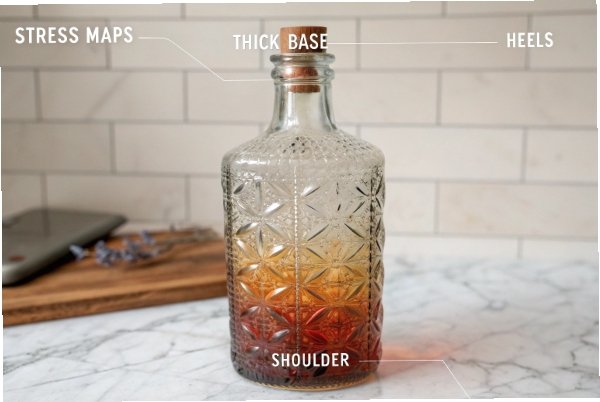
The Heel and Base: The Heat Sink
The connection between the bottom plate and the sidewall (the heel) is often the thickest part of the container, especially in heavy-base spirit bottles.
- The Mechanism: In the lehr, the thin sidewalls cool down to the strain point quickly. The thick base is still hot. As the base finally cools later, it contracts. But the sidewalls are already hard and won’t move. The base pulls inward, creating a ring of massive tension right at the heel.
- The Sign: A "Cross" pattern seen under a polariscope in the bottom center, or a circumferential crack just above the base.
The Shoulder: The Structural Arch
The shoulder is where the bottle transitions from a wide body to a narrow neck. Glass distribution often thickens here.
- The Mechanism: Similar to the base, if the shoulder cools slower than the neck, it creates tension at the neck root.
- The Risk: This is dangerous for capping. The capper grabs the bottle here. If the shoulder is pre-stressed, the top-load force of the capper will collapse the bottle.
The Finish: Rapid Cooling Risk
The finish (mouth) is at the top and exposed to the most airflow. It often cools too fast.
- The Sign: "Check" marks or fine hairline cracks in the threads. While less common to cause explosion, these cause leakers.
| Bottle Zone | Thickness Characteristic | Cooling Behavior | Stress Risk Level |
|---|---|---|---|
| Heel / Base | Very Thick (>5mm) | Slowest to cool; retains heat. | Highest. Source of spontaneous bottom detachment. |
| Shoulder | Variable / Thick | Uneven cooling gradients. | High. Vulnerable to capping load. |
| Sidewall | Thin / Uniform | Fast cooling. | Low. Usually anneals well naturally. |
| Finish / Neck | Exposed / Complex | Rapid cooling; prone to shock. | Medium. Threads prone to checking. |
What lehr process mistakes (wrong soak temperature, short dwell, uneven airflow) most often lead to under-annealing?
The annealing lehr is a precision instrument, not just a conveyor oven. Small deviations in its profile create invisible but deadly defects.
The most common causes of under-annealing are an insufficiently high soak temperature (preventing full stress relaxation), too short a dwell time for the glass mass (rushed production), and uneven airflow (drift) which cools one side of the bottle faster than the other, creating asymmetric stress.
Mistake 1: The "Cold" Soak
The glass must reach its annealing region to relax; operators often benchmark against the annealing point and strain point concepts 7{#fnref7}.
- The Error: Setting the temperature too low to save energy or avoid deformation.
- The Result: Viscosity never drops enough for structural relaxation, so forming stress remains locked in.
Mistake 2: Rushing the Dwell (Time)
Relaxation is a function of time.
- The Error: Increasing belt speed without extending heating/soak length.
- The Result: Thick zones never equalize; the bottle exits “skin-annealed” but “core-stressed.”
Mistake 3: Uneven Cooling (Drift)
Ideally, cooling is uniform.
- The Error: Drafts, broken dampers, or uneven fan distribution.
- The Result: One-sided cooling locks asymmetric stress, leading to weak bottles and leaners.
| Process Parameter | Error | Physical Consequence |
|---|---|---|
| Soak Temperature | Set too low (< 550°C). | Molecular structure remains rigid; stress not relieved. |
| Belt Speed | Too fast (Short dwell). | Heat fails to penetrate thick core/base. |
| Cooling Rate | Too steep (> 5°C/min). | Re-introduces stress after annealing (Thermal Shock). |
| Airflow Balance | One-sided draft. | Asymmetric stress; bottle "leans" or warps. |
What inspection and test methods (polariscopic checks, thermal shock, internal pressure) best detect under-annealed bottles before shipment?
You cannot inspect quality into a product, but you must screen defective ware out. Since stress is invisible, you need tools that make the invisible seen.
Polariscopes are the primary defense, allowing operators to visualize stress patterns (birefringence) as colored fringes. However, destructive Thermal Shock testing (ASTM C149) is the critical validation, proving the container can withstand rapid temperature changes, while Burst Pressure testing confirms the structural integrity limits.
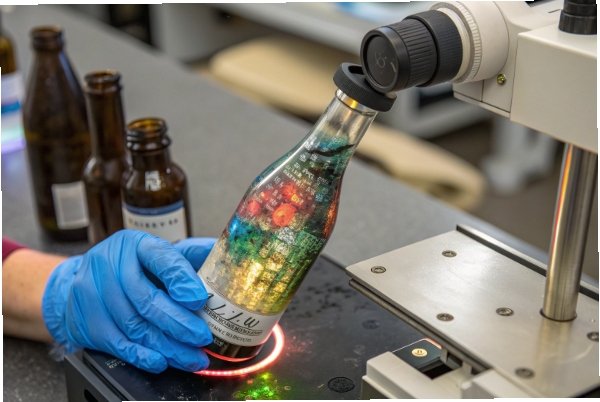
The Polariscope: The First Line of Defense
This non-destructive test uses polarized light to reveal tension via birefringence 8{#fnref8}.
- Grading (ASTM C148): Compare observed fringe intensity against reference discs using ASTM C148 polariscopic examination 9{#fnref9}.
- Grade 1-2: Safe. (Target).
- Grade 3: Warning. (Adjust lehr).
- Grade 4-5: Reject. (Quarantine lot).
Thermal Shock Test (ASTM C149): The Real-World Sim
We torture the bottle to ensure it survives your process using ASTM C149 thermal shock resistance 10{#fnref10}.
- The Test: Heat bottle in a controlled bath and plunge into cooler water to impose $\Delta T$.
- Failure Interpretation: Bottom drop-outs often indicate base/core stress; shoulder/neck failures often indicate soak/time imbalance.
Internal Pressure Test (Context)
For carbonated beverages or sparkling wines, pressure testing complements thermal shock; under-annealed bottles typically burst earlier and fragment more violently.
| Test Method | Type | What it Detects | Frequency |
|---|---|---|---|
| Polariscope | Non-Destructive | Visual stress patterns; Grade 1-5. | Every 30 mins (Lehr end). |
| Thermal Shock | Destructive | Resistance to rapid temp change. | Every 2-4 hours. |
| Pressure Test | Destructive | Burst strength limit. | Every shift (Carbonated ware). |
| Fragmentation | Destructive | Breakage safety (particle size). | Daily audit. |
Conclusion
Insufficient annealing is a silent killer of glass performance, transforming stable containers into fragile hazards. By strictly maintaining lehr dwell times, ensuring uniform cooling, and rigorously validating with polariscopes and thermal shock tests, FuSenglass ensures that every bottle we ship is stress-free and ready for the rigors of your production line.
Footnotes
-
Explains why locked-in residual stress can exist even when a bottle looks cosmetically perfect. ↩ ↩
-
Defines brittle fracture behavior and common container-glass breakage patterns and terminology. ↩ ↩
-
Summarizes why tensile strength governs crack initiation and why tension is the critical failure mode. ↩ ↩
-
Practical explanation of thermal shock and why sudden temperature swings trigger cracks at flaws. ↩ ↩
-
Clarifies hoop stress so capping and pressure loads at the finish can be quantified. ↩ ↩
-
Provides the fundamentals of crack initiation and propagation in brittle materials like glass. ↩ ↩
-
Defines annealing/strain points via viscosity, supporting correct soak setpoints in lehr profiles. ↩ ↩
-
Explains birefringence—why stressed glass shows fringe patterns under polarized light. ↩ ↩
-
Standard method reference for grading container stress via polariscopic examination. ↩ ↩
-
Standard thermal shock method used to validate container survivability in hot-pack and pasteurization conditions. ↩ ↩






