
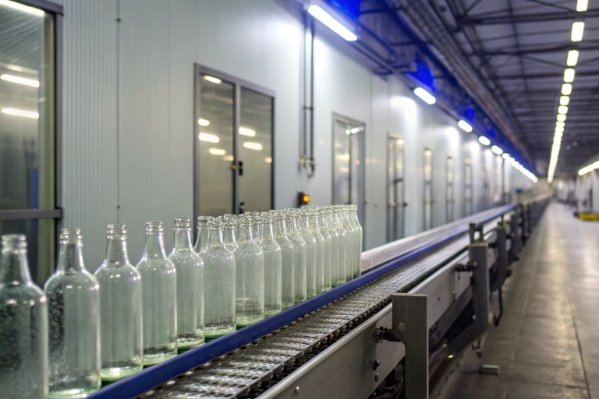
Glass corrosion and surface degradation can ruin a brand’s premium image and compromise product integrity. UV coatings offer a rapid, robust solution to seal the glass surface against aggressive chemical environments.
Yes, high-quality UV-cured coatings, particularly epoxy-acrylates, provide excellent resistance to both acid and alkali corrosion by forming a densely cross-linked polymer network that effectively seals the glass surface from chemical attack and environmental weathering.
Can a UV Coating on Glass Bottles Resist Acid and Alkali Corrosion?
The Chemistry of Protection
In the glass manufacturing world, we often treat "glass" as the ultimate barrier, but as I’ve discussed before, the surface of glass is chemically active. It has silanol groups 1 (Si-OH) that can react with moisture and ions. UV coatings change the game by applying a layer of photopolymerizable resin—essentially liquid plastic that turns solid instantly under ultraviolet light.
At FuSenglass, we have shifted significant production volume to UV curing because it creates a "thermoset" network. Unlike air-drying paints that simply evaporate solvents to leave a film, UV coatings undergo a chemical reaction called cross-linking 2. The photoinitiators in the spray absorb UV energy and trigger the oligomers to snap together into a tight, three-dimensional grid.
This grid is what provides corrosion resistance. Because the molecules are locked together so tightly, acid molecules ($H^+$) and alkali ions ($OH^-$) physically struggle to penetrate the coating to reach the glass underneath. For a brand owner, this means your bottle won’t just look good on the shelf; it will survive the accidental spill of a high-pH cleaning agent or the acidic environment of a citrus-based serum without the coating peeling or the glass clouding.
The Limits of Resistance
However, not all UV coatings are invincible. The resistance is directly proportional to the "cross-link density." If a coating is under-cured (not enough UV energy) or formulated with cheap monomers, the grid is loose. Chemicals can permeate, causing the coating to swell, soften, and eventually detach from the glass.
For general industrial applications, UV coatings are fantastic against organic acids (like citric or acetic acid found in foods) and weak alkalis. But they face challenges with extreme caustic environments, such as industrial bottle washing lines using hot sodium hydroxide, unless specifically formulated with high-performance epoxy resins.
Comparison of Coating vs. Bare Glass Resistance
| Parameter | Bare Soda-Lime Glass | Standard UV Acrylic Coating | High-Performance UV Epoxy Coating |
|---|---|---|---|
| Acid Resistance | High (except HF) | Good (Surface protection) | Excellent (Complete barrier) |
| Alkali Resistance | Poor (Etches/Clouds >pH 9) | Moderate (May soften) | High (Resists saponification) |
| Water Barrier | N/A (Hydrophilic surface) | Hydrophobic | Highly Hydrophobic |
| Solvent Resistance | Excellent (Inert) | Variable (Attacked by ketones) | Good (Cross-linked stability) |
| Mechanism | Material Inertness | Polymer Barrier | Densely Cross-linked Shield |
Understanding that "UV Coating" is a broad category is the first step. You must select the specific resin backbone that suits your chemical environment.
What Types of UV Coatings Are Used on Glass Bottles, and Which Ones Resist Acids and Alkalis Best?
Choosing the wrong resin type can lead to catastrophic coating failure when exposed to harsh chemicals. You need to match the chemical backbone of the coating to the specific threats your product faces.
Epoxy acrylates offer the highest chemical resistance against acids and alkalis due to their rigid structure, while urethane acrylates provide toughness, and polyester acrylates offer a balanced, cost-effective solution for general use.
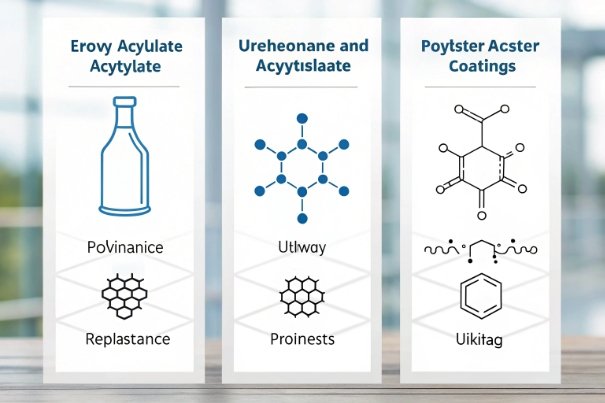
Epoxy Acrylates: The Heavyweights
When a client asks me for maximum durability, I steer them toward Epoxy Acrylates. In the hierarchy of UV resins 3, these are the "tanks." They are derived from epoxy resins (like Bisphenol A) reacting with acrylic acid.
Why are they best for corrosion? They cure very fast and very hard. The chemical structure is extremely rigid, which makes it very difficult for acids or alkalis to diffuse through the matrix. If you are bottling a product with a pH of 3 (like a strong AHA toner) or a cleaning product with a pH of 10, epoxy acrylate is your safest bet. The downside is that they can be brittle. If the bottle is flexible or subject to high thermal shock, we might need to modify them, but for pure chemical defense, they are unrivaled.
Urethane Acrylates: The Tough Defenders
Urethane Acrylates are the premium choice for luxury cosmetics. While their pure chemical resistance is slightly lower than epoxies, they offer superior toughness and flexibility.
The urethane linkage ($NH-CO-O$) provides a balance of hardness and elasticity. This is crucial if the "corrosion" involves physical abrasion combined with chemical attack. For example, a bottle in a handbag rubbing against keys while being exposed to spilled perfume. Urethanes are also excellent at resisting "yellowing," making them ideal for clear coatings over flint glass. However, they can be sensitive to strong alkalis which can hydrolyze the urethane bond over time.
Polyester Acrylates: The Economic Middle Ground
Polyester Acrylates are the workhorses. They are widely used because they are cost-effective and have low viscosity, making them easy to spray. Their chemical resistance is "good enough" for standard beverages and dry goods.
However, polyesters are susceptible to hydrolysis 4. If exposed to hot water and high alkalinity (like a dishwasher), the polyester backbone can break down faster than epoxy or urethane. I rarely recommend these for pharmaceutical or aggressive industrial chemical packaging.
Resin Performance Matrix
| Resin Type | Acid Resistance | Alkali Resistance | Flexibility | Cost | Best Application |
|---|---|---|---|---|---|
| Epoxy Acrylate | Excellent | Excellent | Poor (Brittle) | Low-Med | Industrial chems, Acids. |
| Urethane Acrylate | Good | Good | Excellent | High | Premium Cosmetics, Perfume. |
| Polyester Acrylate | Moderate | Moderate | Moderate | Low | Beverage, One-way glass. |
| Silicone Acrylate | Moderate | Good | High | Very High | Release coatings, Slip agents. |
Selecting the resin is not just about price; it’s about predicting the chemical warfare your bottle will endure.
What pH Range, Contact Time, and Temperature Can UV-Coated Glass Bottles Withstand?
Overestimating the capabilities of a coating can lead to product recalls and field failures. You must define the operational envelope—pH, time, and temperature—before production begins.
High-quality UV coatings typically withstand a pH range of 3 to 10 at room temperature indefinitely; however, resistance decreases significantly as temperature rises above 60°C or with prolonged immersion in extreme pH solutions.
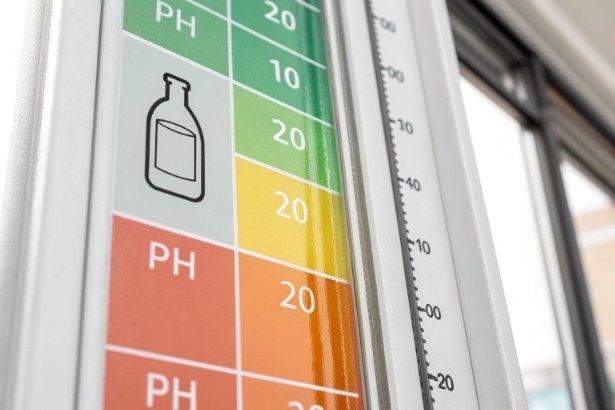
The "Safe Zone": pH 3 to 10
For the vast majority of consumer products, a standard commercial UV coating is perfectly stable.
- Acids (pH 3-6): Most beverages, wines, and cosmetic serums fall here. UV coatings are generally unaffected. The polymer matrix is stable against the hydronium ions 5.
- Neutrals (pH 7): Water, oils. No issue.
- Weak Alkalis (pH 8-10): Hand soaps, some shampoos. Modern UV acrylates handle this well, provided the exposure isn’t combined with abrasion.
The Danger Zone: Extremes and Heat
The failure mode usually happens at the extremes.
- Strong Alkalis (pH > 11): Sodium Hydroxide (Caustic Soda) is a coating killer. It attacks the interface between the glass and the coating. Glass itself dissolves in high pH, and if the alkali penetrates the coating (which happens faster if the coating is swollen by heat), it creates "undercutting." The coating doesn’t dissolve; it delaminates. It peels off in sheets.
- Strong Acids (pH < 2): While the polymer might survive, strong mineral acids can discolor certain pigments mixed into the UV spray.
The Multiplier Effect of Temperature
Temperature is the catalyst. A UV coating that resists pH 12 detergent for 24 hours at 20°C might fail in 10 minutes at 70°C.
Heat increases the kinetic energy of the chemical ions, allowing them to penetrate the polymer network faster. It also expands the coating (thermal expansion), opening up the molecular gaps.
At FuSenglass, we warn clients about "Hot Filling." If you hot-fill a product at 85°C into a UV-coated bottle, the coating temporarily softens. If any product spills on the outside during this soft phase, it can permanently mark the finish.
Operational Limits Summary
| Condition | Safe Limit (Standard UV) | Safe Limit (High-Perf Epoxy UV) | Failure Mode |
|---|---|---|---|
| pH Range | 4.0 – 9.0 | 2.0 – 12.0 | Saponification 6 / Delamination |
| Temp (Continuous) | < 50°C | < 80°C | Softening / Yellowing |
| Temp (Short Term) | < 80°C | < 120°C | Thermal Shock Cracking |
| Immersion Time | 24 Hours (Water) | 30+ Days (Chems) | Swelling / Blistering |
| Alcohol Contact | Splash only | Immersion OK | Solvation / Stickiness |
Knowing these boundaries allows us to engineer the process—for example, by adding a thermal post-cure to boost the cross-link density for demanding applications.
Which Chemical Resistance and Adhesion Tests Should Buyers Request?
Subjective visual checks are insufficient for verifying invisible chemical barriers. You must demand standardized quantitative testing to validate the coating’s durability.
Buyers should request ASTM D3359 for adhesion (Cross-Hatch), ASTM D1308 for spot chemical resistance, and ASTM D870 for water immersion to rigorously verify the coating’s integrity.
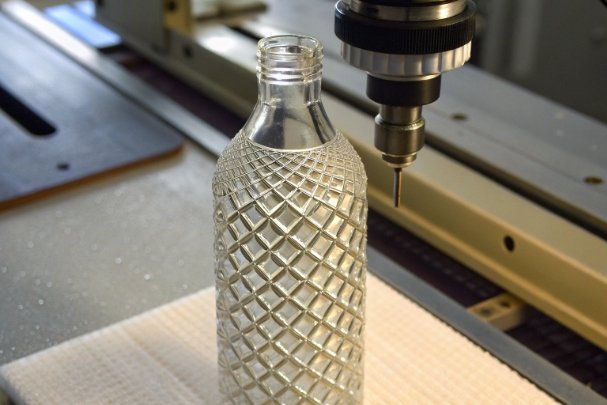
The Holy Grail: ASTM D3359 (Cross-Hatch Adhesion)
I cannot stress this enough: Chemical resistance means nothing without adhesion. A coating can be chemically inert, but if it falls off the bottle, it fails.
The Cross-Hatch test involves cutting a grid into the coating, applying tape, and pulling it off.
- The Request: "All coated ware must pass ASTM D3359 7 Method B with a rating of 5B (0% removal)."
- The "Wet" Variation: Smart buyers ask for this test after the chemical resistance test. A coating might pass dry, but after soaking in alcohol or water, it might lose adhesion. Request a "Wet Adhesion" test.
ASTM D1308: The Spot Test
This simulates the real-world scenario of a product drip running down the side of the bottle. We apply a droplet of the specific chemical (e.g., the perfume, the essential oil, or a pH 10 cleaning solution) onto the surface and cover it with a watch glass to prevent evaporation.
- Duration: Typically 24 hours.
- Evaluation: We look for softening, blistering, or gloss change.
- Why Request It: It’s non-destructive to the bottle shape (unlike immersion) and tests the exact formulation you are selling.
ASTM D870: Water Immersion
Water is the universal solvent and the most common cause of coating failure (blistering).
- The Test: Submerge the bottle in distilled water at 38°C for 24 to 48 hours.
- The Pass Criteria: No blistering, no wrinkling, and crucially, no loss of adhesion immediately after removal.
MEK Rub Test (ASTM D5402)
While technically for solvent resistance, this is the quickest proxy for "Degree of Cure." If the UV lamps were dim or the line speed too fast, the coating is under-cured. Rubbing it with Methyl Ethyl Ketone (MEK) will dissolve it.
- The Spec: ">50 Double Rubs with no breakthrough."
Essential Test Protocol for Buyers
| Test Name | Methodology | Key Variable to Define | Purpose |
|---|---|---|---|
| Cross-Hatch | ASTM D3359 | Tape strength (Permacel 99) | Base Adhesion |
| Spot Test | ASTM D1308 8 | Chemical list (e.g., Ethanol, Citric Acid) | Drip/Spill Resistance |
| Immersion | ASTM D870 9 | Temp (Room vs 40°C) & Time | Humidity/bulk storage capability |
| MEK Rub | ASTM D5402 | Number of Rubs (20, 50, 100) | Curing validation |
| Caustic Wash | Custom/ISO | NaOH concentration (e.g., 2%) | Bottle washer survival |
Don’t just ask "is it resistant?". Ask for the test report number.
How Should You Specify UV Coating Thickness, Curing, and Adhesion Requirements?
Vague specifications allow manufacturers to cut corners on material and energy, leading to latent defects. You must specify physical parameters to ensure the coating performs as tested.
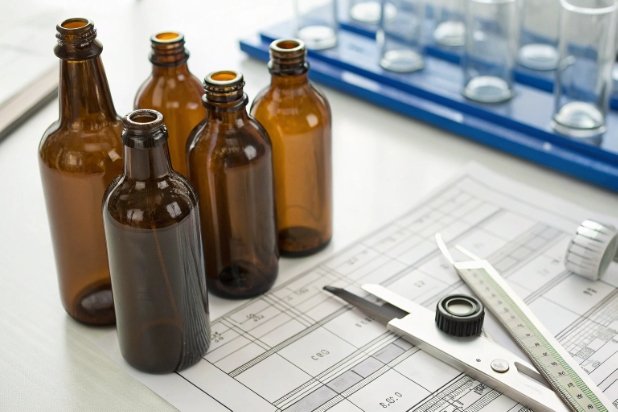
To prevent corrosion failures, specify a dry film thickness (DFT) of 15–25 microns, mandate a minimum UV energy density (e.g., 600 mJ/cm²) for full curing, and require 5B adhesion performance both pre- and post-immersion.
Defining Thickness (DFT)
Thickness is a double-edged sword.
- Too Thin (<10 microns): You get pinholes. Corrosion starts at these microscopic gaps where the bare glass is exposed.
- Too Thick (>35 microns): The UV light cannot penetrate to the bottom layer near the glass. You get a hard shell on top and soft, uncured "goo" on the bottom. This causes poor adhesion and easy stripping.
- The Spec: "Target Dry Film Thickness (DFT): 20 microns ± 5 microns." This ensures a continuous barrier without curing issues.
The Energy of Cure
This is the hidden variable. The chemical resistance comes from the cross-linking, which is driven by UV energy (Joules). A factory might run the line faster to save money, delivering less energy.
- The Spec: "Minimum UV Cure Energy: 600-800 mJ/cm² (Mercury H-bulb)."
- Verification: Ask for "Radiometer readings" 10 from the production run. This proves the lamps were actually delivering the punch needed to lock the chemical resistance in.
Adhesion Promoters (Silanes)
Glass is hydrophilic; UV plastic is hydrophobic. They hate each other. To get them to stick and resist water creeping in (corrosion), we pre-treat the glass with Silane (Pyrosil or spray).
- The Spec: "Pre-treatment: Flame treatment followed by Silane application required."
Without this, even the best UV epoxy will fall off in a humid warehouse.
Documentation Requirements
When you send your RFQ (Request for Quote) to FuSenglass or any manufacturer, include a "Technical Requirements" section. Do not leave it to the factory’s discretion.
Buyer’s Specification Checklist
| Parameter | Recommended Specification | Why it Prevents Corrosion |
|---|---|---|
| Film Thickness | 15 – 25 microns | Prevents pinholes (too thin) and under-cure (too thick). |
| Cure Energy | > 600 mJ/cm² | Ensures max cross-linking density (chemical shield). |
| Pre-treatment | Pyrosil / Silane | Essential for preventing under-film corrosion. |
| Surface Tension | > 38 dyne/cm (pre-coat) | Ensures the liquid coating wets out the glass fully. |
| Adhesion | Class 5B (ASTM D3359) | Ensures the barrier stays attached under stress. |
| Resin Type | Epoxy-Acrylate preferred | Specifies the chemical backbone for max resistance. |
By controlling the inputs (Specs), you control the output (Performance).
Conclusion
A UV coating is a powerful ally against glass corrosion, transforming a vulnerable surface into a chemically resistant fortress. By selecting the right Epoxy Acrylate chemistry, staying within the pH 3-10 safe zone, and enforcing ASTM testing protocols, you can confidently use coated glass for even the most demanding applications.
Footnotes
-
Functional groups on glass surfaces responsible for reactivity and adhesion. ↩
-
The chemical process where polymer chains are linked together, increasing strength and resistance. ↩
-
Synthetic resins that harden when exposed to UV light, widely used in industrial coatings. ↩
-
The chemical breakdown of a compound due to reaction with water. ↩
-
The positive ion present when an Arrhenius acid is dissolved in water. ↩
-
The hydrolysis of an ester under basic conditions, a common failure mode for coatings in alkalis. ↩
-
Standard test methods for measuring adhesion by tape test. ↩
-
Standard test method for effect of household chemicals on clear and pigmented organic finishes. ↩
-
Standard practice for testing water resistance of coatings using water immersion. ↩
-
Instruments used to measure the intensity and energy of UV light sources during curing. ↩






