

A glass bottle is an engineering paradox: it is chemically inert and rigid, yet its practical strength is entirely defined by the condition of its surface. A bottle that can withstand massive internal pressure when pristine can shatter with a mild temperature change if it is scratched.
Yes, scratches drastically reduce heat resistance. They act as stress concentrators (Griffith flaws) that disrupt how tension is distributed on the glass surface. During thermal shock, stress focuses at the tip of the scratch; once the local stress intensity exceeds the glass’s fracture toughness, the crack propagates catastrophically at temperatures far below the bottle’s design capability.
The Mechanics of Failure: Why Surface Integrity Matters
At FuSenglass, we operate on the principle that glass strength is extrinsic, not intrinsic. While the theoretical strength of the molecular silica bond is enormous, the practical strength of a container is governed by its weakest surface flaw.
The Physics of Stress Concentration
When a bottle undergoes a rapid temperature change (thermal shock), such as moving from a hot filler to a cold pasteurizer spray, the glass experiences differential expansion or contraction. This generates tensile stress on the surface.
- Smooth surface: Stress distributes evenly.
- Scratched surface: A scratch behaves like a notch. Stress piles up at the sharpest point of the notch, described by the stress concentration concept and quantified in mechanics as a stress concentration factor 1{#fnref1}.
A simple way to express the amplification is:
$$ \sigma{local} = \sigma{nominal} \times K_t $$
For a sharp scratch, $K_t$ can be very high, meaning a nominal stress that would be safe on pristine glass can become failure-level at the scratch tip. This is the same root reason the “real” strength of glass is far below its theoretical strength—central to the Griffith criterion for fracture 2{#fnref2}.
The “Reduced ΔT” Reality
Heat resistance is typically discussed as the maximum temperature differential ($\Delta T$) a bottle can survive. Scratches reduce the practical $\Delta T$ because the failure threshold becomes “crack-tip limited,” not “material limited.” This is exactly why thermal shock guidance for containers emphasizes avoiding surface damage; see operational explanations of thermal shock breakage in container glass 3{#fnref3}.
| Surface Condition | Stress Distribution | Approx. Survival $\Delta T$ | Risk Level |
|---|---|---|---|
| Pristine | Uniform | > 75°C | Near Zero. |
| Light Scuff | Minor turbulence | ~ 55°C | Low. |
| Deep Scratch | High concentration | < 40°C | High. |
| Impact Check | Critical point load | < 20°C | Extreme. |
Understanding the physics is the first step. Now, let’s examine which scratches are lethal and where they hide.
How do scratches create stress concentration points that increase cracking under thermal shock?
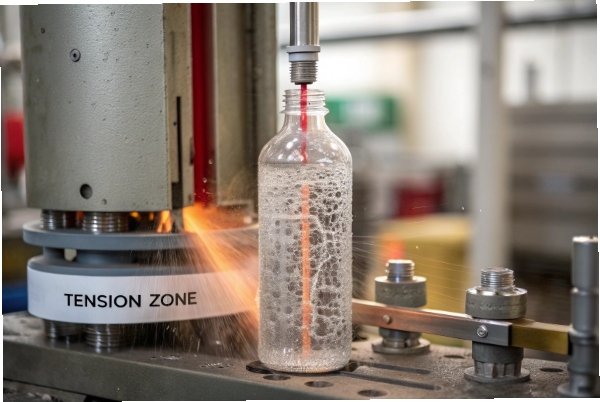
Thermal shock is essentially a tensile-loading event. When the outside surface cools quickly (e.g., cold spray on a hot bottle), it tries to contract while the interior remains hot, generating surface tension. A scratch is an “initiator” inside that tension field.
A scratch’s sharp root increases local stress intensity. Under thermal loading, tension pulls the scratch open. When the stress intensity factor at the tip exceeds the glass’s critical fracture toughness ($K_{Ic}$), crack growth becomes unstable and the bottle fractures abruptly. This is the same brittle-fracture mechanism described in standard fracture mechanics 4{#fnref4}.
Why “Fresh” Scratches Are Worse
A fresh scratch is typically sharper than an old one. Older damage may be slightly “blunted” by surface reactions and handling, but a new scratch created minutes before a pasteurizer (for example, by a burr on a guide rail) can be especially dangerous because its tip radius can be extremely small—maximizing stress concentration.
What is the impact of scratch depth and location on hot-fill or sterilization survival?
Not all scratches are equally fatal. Depth matters, but location is the multiplier because different bottle zones see different thermal gradients and mechanical loads.
Scratches on the heel (base transition) and shoulder are the most dangerous because these zones see the highest thermal gradients and/or pressure-driven hoop stresses. Finish defects are also critical because they combine with capping torque and vacuum pull-down.
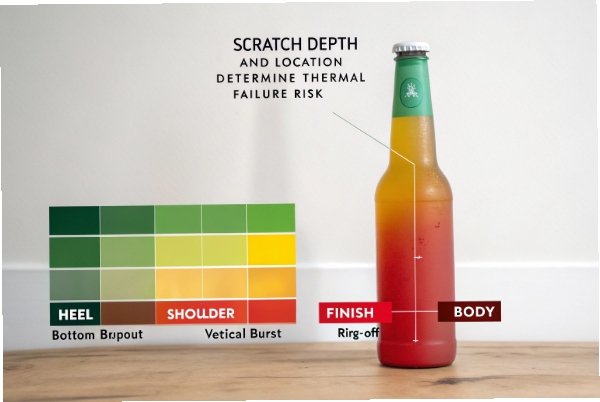
- Heel: Thick glass, slow heat equalization, high gradients → bottom drop-out risk.
- Shoulder: Pressure + thermal cycling → “zipper” splits from vertical scratches.
- Finish: Torque + contraction of closure during cooling → ring-off / leakers.
| Location | Critical Defect Depth (relative) | Failure Mode | Thermal Sensitivity |
|---|---|---|---|
| Heel | Lowest threshold | Bottom drop-out | Highest |
| Shoulder | Low threshold | Vertical burst | High |
| Finish | Very low threshold | Ring-off / leaker | Medium–High |
| Body | Higher threshold | Body split | Lower (until severe) |
How can manufacturing and handling be optimized to prevent scratches?
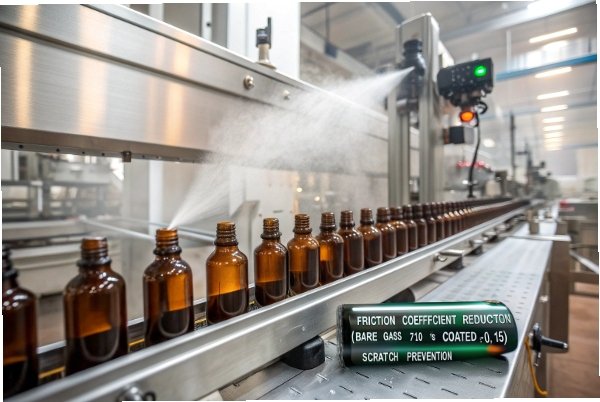
The best fix is prevention: reduce friction and eliminate sharp/hard contact points.
Two core defenses:
- Surface coatings to preserve retained strength:
- Hot-end tin oxide + cold-end lubricious coatings reduce glass-on-glass abrasion and preserve surface integrity (see overviews of hot-end container glass coating 5{#fnref5} and cold-end coating types 6{#fnref6}.)
- Gentle conveying:
- Replace metal rails with polymer wear strips (UHMW-PE, nylon grades).
- Reduce back pressure with low/zero-pressure accumulation.
- Synchronize conveyor speeds to prevent grinding.
What tests should be used to assess scratch impact on heat resistance?
You want to measure retained strength, not just pristine strength.
Best practice validation:
- Abrasion simulation (line simulator or controlled rub) → create realistic scratches.
- Thermal shock test as the pass/fail metric using ASTM C149 thermal shock resistance 7{#fnref7}.
- Residual stress screening to ensure “breakage” isn’t actually under-annealing, using ASTM C148 polariscopic examination 8{#fnref8}.
| Test Method | Objective | Pass Criterion | Relevance |
|---|---|---|---|
| Abraded thermal shock (ASTM C149) | Measure retained strength | No breakage at required $\Delta T$ | Direct |
| Standard thermal shock | Measure pristine strength | Higher $\Delta T$ pass | Baseline |
| Slip angle (tilt table) | Verify lubricity/coating | Slide angle in target window | Preventative |
| Microscopic audit | Identify scratch severity | No critical checks in heel/finish | Diagnostic |
Conclusion
Scratches are the silent killers of thermal performance. By concentrating stress, they rob the bottle of its natural ability to withstand heat. The solution is a robust defense: reliable hot-end and cold-end coatings, gentle low-pressure handling, and validation via abraded thermal shock testing so your safety margins are real—not theoretical.
Footnotes
-
Defines stress concentration and why notches/scratches amplify local tensile stress. ↩ ↩
-
Explains why microscopic flaws control brittle fracture strength (Griffith criterion). ↩ ↩
-
Practical explanation of thermal shock in container glass and why surface damage drives failure. ↩ ↩
-
Fundamentals of fracture mechanics and unstable crack propagation in brittle materials. ↩ ↩
-
Explains hot-end oxide coatings that protect glass surfaces and preserve retained strength. ↩ ↩
-
Summarizes common cold-end coatings and why lubricity prevents abrasion damage. ↩ ↩
-
Standard thermal shock resistance test method used to validate hot-fill/pasteurization survivability. ↩ ↩
-
Standard polariscope method to grade residual stress that can amplify scratch-driven failures. ↩ ↩





