

Breakage on the filling line is often blamed on the glass formulation, but the invisible culprit is frequently the air that cooled it. Improper airflow management locks in destructive tension before the bottle even reaches the annealing lehr.
Cooling air configuration is the primary architect of a bottle’s internal stress profile. Uneven or aggressive airflow creates differential cooling rates that lock in permanent tensile stress, drastically reducing the bottle’s ability to withstand thermal shock during hot-filling or pasteurization processes.
The Thermodynamics of Air Cooling
At FuSenglass, we treat cooling air not just as a way to harden glass, but as a sculpting tool for stress. Glass is a poor conductor of heat. When a blast of air hits the surface, the skin cools instantly, but the core remains much hotter. This creates a massive thermal gradient.
- The Stress Mechanism: The cooling skin tries to contract, but the hot core holds it back. This puts the skin into tension. If this tension exceeds the glass’s tensile strength (which is low), the surface rips open, creating microscopic cracks known as "checks"—a common container defect class described in defect references such as glass checks and crack-related defects 1{#fnref1}.
- The Heat Resistance Link: These checks act as stress risers. When you later fill this bottle with hot liquid, thermal stress exploits those flaws, producing classic thermal shock breakage 2{#fnref2}.
Proper cooling configuration is about balancing "Heat Removal" (to set the shape) with "Thermal Uniformity" (to prevent checking). It is a battle between speed of production and integrity of the container.
| Cooling Phase | Air Source | Objective | Thermal Risk if Misconfigured |
|---|---|---|---|
| Mold Cooling | Stack Air / Vertiflow | Heat removal from mold equipment. | Surface Chilling: Orange peel / skin stress. |
| Dead Plate | Fixed Nozzles | Set the bottom/finish to prevent sagging. | Thermal Shock Checks: Cracks in heel or baffle. |
| Lehr Cooling | Drift Fans | Controlled stress relief (Annealing). | Re-introduced Stress: High residual tension. |
| Cold End | Forced Air Tunnel | Final temp drop for coating/packing. | Cold Checks: Impact weakness. |
Understanding the physics is step one. Now, let’s look at how specific airflow errors destroy thermal performance.
How does uneven cooling, such as excessive or insufficient airflow, lead to residual stress and increase thermal shock risk in glass bottles?
The symmetry of cooling is just as important as the intensity. A bottle cooled on one side but not the other becomes a "bimetallic strip" of tension, warping and weakening the structure.
Uneven cooling creates asymmetric stress distributions. Excessive airflow ("Thermal Shocking") freezes the surface while the core is hot, locking in tension that ruptures during heating. Insufficient airflow allows the glass to remain too soft, leading to structural deformation and variable wall thickness, creating weak spots that fail under thermal load.
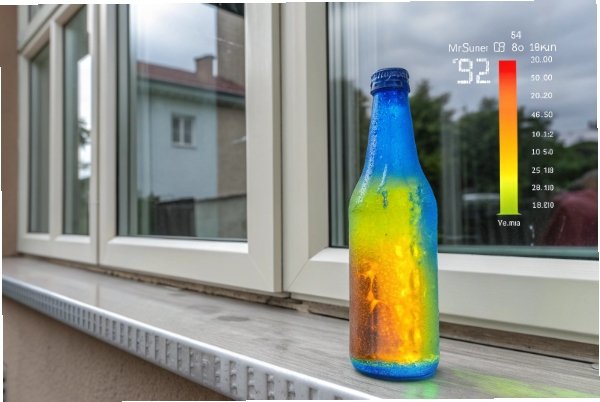
Excessive Airflow: The "Check" Factory
On the IS machine, operators often crank up the cooling wind to run the machine faster.
- The Mechanism: A high-velocity jet of air hits the heel (bottom corner) of the bottle on the dead plate.
- The Defect: The surface cools far faster than the interior, creating tension that generates heel checks.
- Thermal Shock Risk: The heel is a high-stress point during hot-fill and cooling; flaws here often show up as “bottom drop-out” patterns, consistent with common container failure origin analysis 3{#fnref3}.
Insufficient Airflow: The "Sag" Factor
If cooling is too weak, the bottle leaves the mold too hot.
- The Mechanism: The glass is still soft; gravity distorts the profile.
- The Defect: Wall thickness becomes inconsistent (thin on one side, thick on the other).
- Thermal Shock Risk: During pasteurization, thick vs thin zones heat/cool differently, and the bottle fails at transitions.
Uneven "Drift" (Asymmetry)
In the annealing lehr, biased airflow can cool one side of the belt faster.
- The Mechanism: One side of the bottle reaches the strain region earlier than the other.
- The Result: Permanent asymmetric stress is locked in, a condition visible as birefringence under polarized light.
| Airflow Error | Physical Consequence | Thermal Failure Mode |
|---|---|---|
| Blast at Heel | Heel Checks (Micro-cracks). | Bottom Dropout during Hot-Fill. |
| Blast at Finish | Split Finish / Crazing. | Leaking or neck separation during capping. |
| One-Sided Draft | Out-of-Round / Warpage. | Explosion in pasteurizer (pressure + stress). |
| Low Overall Flow | Settle Wave / Thin Walls. | Vertical cracks from uneven expansion. |
What is the optimal cooling rate during the lehr process to ensure uniform stress distribution and prevent deformation or cracking?
The lehr is not just an oven; it is a stress-management tool. The cooling rate here must be surgical.
The optimal cooling rate depends on thickness, but generally, the "Critical Annealing Range" requires slow cooling (commonly targeted below ~3–4°C/min) to avoid permanent residual stress. Once the glass passes below the strain region, faster cooling is permitted for throughput—provided it does not create temporary “cold checks.”
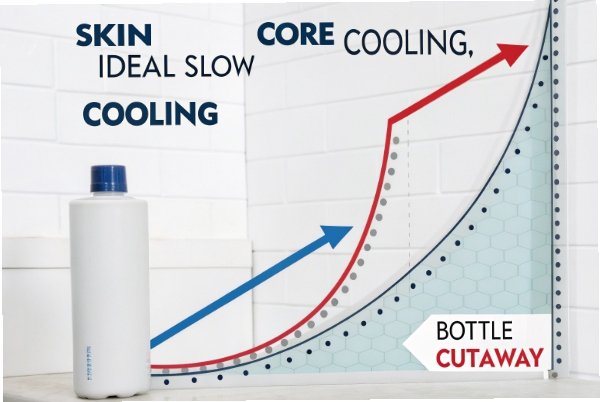
The Critical Annealing Range (The "Slow Zone")
This is the phase where the glass transitions from viscoelastic to rigid. Cooling too fast here locks residual stress; standard teaching references on annealing and controlled cooling 4{#fnref4} outline why shallow cooling gradients through the annealing/strain region matter.
- Operational control: Dampers closed, recirculation low, consistent zone setpoints.
- Target outcome: Minimize skin-to-core temperature differences.
The Rapid Cooling Zone (The "Fast Zone")
Below the strain region, the structure is effectively “frozen,” so higher cooling rates no longer create permanent residual stress. However, overly aggressive cold-end air can still cause temporary breakage, especially at the finish and heel.
| Temperature Zone | Glass State | Max Cooling Rate | Objective |
|---|---|---|---|
| ~554°C → ~500°C | Viscoelastic transition | Very slow (< ~4°C/min) | Prevent permanent residual stress. |
| ~500°C → ~400°C | Solid (high temp) | Moderate (< ~10°C/min) | Safe transition; avoid checks. |
| ~400°C → ~100°C | Solid (rigid) | Fast (> ~20°C/min) | Cool for handling and coating. |
| < 100°C | Cold end | Max ambient | Prepare for packing. |
How do factors like nozzle placement, air velocity, and cooling zone temperature affect the bottle’s structural integrity and heat resistance?
On the forming machine, the dead plate is where the battle for heat resistance is won or lost. The setup of the cooling wind nozzles is an art form.
Nozzle placement must target the thickest glass (base and finish) to equalize temperature, while air velocity must be high enough to remove heat but low enough to avoid surface checking. Misalignment creates "hot spots" that act as thermal reservoirs, pulling the glass into tension as they finally cool.
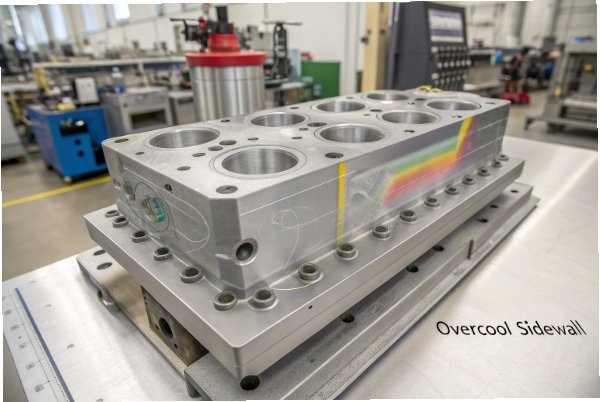
Nozzle Placement: Targeting the Mass
Glass bottles are rarely uniform. The base and the finish are thick; the sidewalls are thin.
- Common error: Over-cooling thin sidewalls while under-cooling base/finish.
- Best practice: Aim cooling to equalize heavy sections first; allow sidewalls to cool more naturally to avoid checking.
Air Velocity: The "Check" Threshold
- High velocity: Faster set-up, higher machine speeds.
- Risk: Skin cooling outruns core cooling, creating checks.
- Control strategy: Use high-volume, low-pressure delivery where possible, and modulate with cycle timing; these ideas align with broader glass surface treatment and handling sensitivity 5{#fnref5}, because surface flaws drive failure later.
Cooling Zone Temperature (Stack Air)
Mold temperature influences surface condition:
- Over-cooled molds: Increase risk of surface defects and checking.
- Too hot molds: Risk sticking and shape defects.
- Thermal resistance tie-in: The smoother the surface and the fewer the checks at birth, the more “retained strength” the bottle carries into hot-fill.
| Parameter | Configuration Strategy | Impact on Heat Resistance |
|---|---|---|
| Nozzle Angle | Bias to base/finish; avoid sidewall direct blast. | Reduces stress differential and checks. |
| Air Velocity | Use controlled flow (VFD/regulated). | Prevents shock checks from jets. |
| Nozzle Distance | Close to finish; farther from thin body. | Protects thin glass from thermal shock. |
| Duration | Timed tightly to cycle. | Ensures rigidity without over-chilling. |
What tests (polariscopic stress analysis, thermal cycling) can validate the cooling air setup for heat-resistance performance?
You cannot see airflow, but you can see its fingerprints in the glass. Validation requires looking for the specific defects that airflow creates.
Polariscopic analysis is used to detect residual stress patterns indicative of uneven cooling, while ASTM C149 thermal shock testing is the definitive pass/fail metric. Plants also use cold-end breakage tracking to link specific air adjustments to fracture locations.
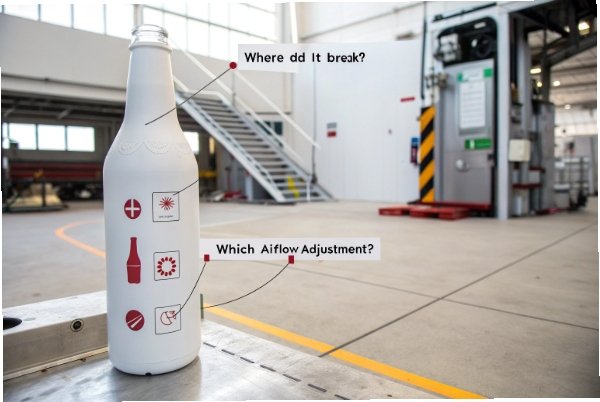
1. Polariscopic Stress Analysis (ASTM C148)
We look through the bottle using polarized light and grade it via ASTM C148 polariscopic examination 6{#fnref6}.
- Target: Grade 2 or lower.
- Airflow fingerprints:
- Bottom cross: Indicates bottom cooled differently than walls (often lehr cooling imbalance).
- Heel ring: Often correlates with dead-plate wind too aggressive at the heel.
- Asymmetry: Color/fringe shift to one side indicates drift imbalance.
2. Thermal Shock Test (ASTM C149)
The ultimate validation is ASTM C149 thermal shock resistance 7{#fnref7}.
- Protocol: Heat then plunge to impose $\Delta T$.
- Breakage mapping: Heel failures point to wind checks; shoulder failures point to distribution/cooling imbalance; finish failures point to localized over-chill or high stress at the neck.
3. Visual "Check" Inspection
Use bright light and magnification to detect crescents/hairline checks at heel and finish. If present, the wind is too aggressive or poorly aimed.
| Test Method | Defect Detected | Corrective Action (Airflow) |
|---|---|---|
| Polariscope | High bottom stress (cross). | Flatten lehr cooling; rebalance drift airflow. |
| Thermal Shock | Heel/bottom drop-out. | Reduce dead-plate wind; adjust nozzle angle/distance. |
| Visual light | Finish checks. | Re-align finish nozzles; reduce pressure. |
| Breakage tracking | Repeat location patterns. | Correlate to specific nozzle banks/zone fans. |
Conclusion
Cooling air is the double-edged sword of glassmaking. Used correctly, it sets the ware while preserving surface integrity and minimizing residual stress; used poorly, it inflicts invisible wounds that doom the bottle to failure later. By configuring nozzles to equalize thick zones, controlling air velocity to avoid checking, and validating with polariscopic grading plus thermal shock testing, you protect the bottle’s true heat resistance long before it reaches the filler.
Footnotes
-
Defect-cause matrix describing how cooling and forming conditions generate checks and other crack initiators. ↩ ↩
-
Explains why surface flaws drastically reduce thermal shock resistance and drive sudden breakage. ↩ ↩
-
Bottle morphology reference that helps interpret fracture origins like heel/bottom failures. ↩ ↩
-
Lecture on annealing/tempering showing why slow cooling through annealing/strain range prevents residual stress. ↩ ↩
-
Technical overview connecting surface condition and handling damage to retained strength (and later thermal failure). ↩ ↩
-
Standard method for grading residual stress via polariscope, useful for diagnosing airflow imbalance. ↩ ↩
-
Standard thermal shock test used to validate hot-fill/pasteurization survivability and compare air setups. ↩ ↩





