
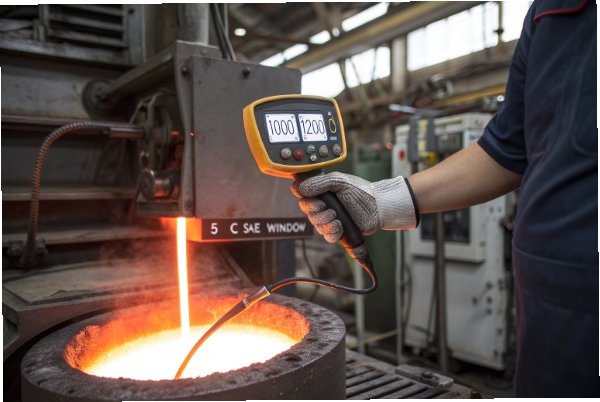
The "Forming Window"—the specific temperature range where glass is plastic enough to shape but stiff enough to hold that shape—is the heartbeat of the manufacturing process. Straying from this window doesn’t just make "ugly" bottles; it creates structural weaknesses that are invisible until the bottle is subjected to heat.
Yes, the forming temperature window is critical. It dictates the "Glass Distribution" (wall thickness uniformity). If the glass is too hot, it runs to the bottom, creating thin shoulders. If it is too cold, it fails to blow into the mold corners, creating stress risers. Both scenarios drastically reduce the bottle’s ability to withstand thermal shock.
The Viscosity-Distribution Connection
At FuSenglass, we manage the forming process by managing viscosity. Glass doesn’t have a melting point; it has a softening curve described by the glass viscosity–temperature curve 1{#fnref1}.
- The Gob Temperature: Typically around 1000°C – 1200°C; operators often define this by a target viscosity as described in gob temperature vs. viscosity guidance 2{#fnref2}.
- The Physics:
- Too Hot (Low Viscosity): The glass flows like water. Gravity takes over. You get a "heavy bottom" and "paper-thin sidewalls."
- Too Cold (High Viscosity): The glass flows like cold honey. It resists the compressed air. You get thick, uneven walls and potential "loading marks."
Thermal Resistance Impact: Thermal shock resistance is determined by the thinnest point of the bottle. If your forming temperature is unstable, your wall thickness will vary. A bottle with a 3mm bottom and a 1.5mm sidewall has a massive thermal gradient potential. The thick bottom holds heat, the thin wall cools fast, and the bottle shears itself apart at the interface.
| Condition | Viscosity State | Physical Defect | Thermal Risk |
|---|---|---|---|
| Optimal Window | Balanced Flow | Uniform Wall Thickness (Even cooling). | Low. Max heat resistance. |
| Too Hot | Too Fluid | Run-down / Thin Shoulders. | High. Thin spots rupture under pressure. |
| Too Cold | Too Stiff | Cold Checks / Loading Marks. | Critical. Pre-existing cracks explode. |
| Variable | Unstable | Wavy Walls (Settle Wave). | High. Unpredictable stress points. |
How does the forming temperature (both high and low ends) influence the residual stress and thermal expansion properties of glass bottles?
The forming temperature sets the stage for how stress is locked into the glass. While it doesn’t change the chemical Coefficient of Thermal Expansion (CTE), it dictates the geometry that has to cope with that expansion.
Low forming temperatures are the most dangerous for thermal resistance. Forming "cold" glass induces high mechanical stress during the blow, often creating microscopic "Cold Checks" or fissures that act as stress concentrators. High forming temperatures generally cause distribution issues, leading to localized weak spots that cannot support the hoop stress of expansion.
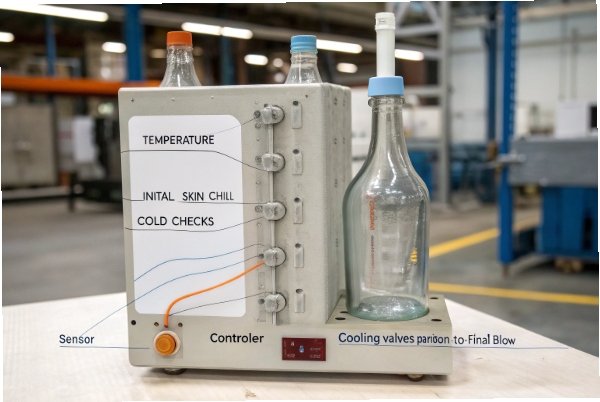
The "Cold Check" Danger
When a gob is too cold (or the mold is too cold), the glass skin chills instantly upon contact.
- The Mechanism: The machine tries to blow this chilled skin. Instead of stretching smoothly, the surface "tears" microscopically.
- The Result: A dense network of micro-cracks (“checks”), consistent with container defect references like fire cracks and related surface discontinuities 3{#fnref3}.
- Thermal Impact: These checks are invisible to the naked eye. But when you fill the bottle with hot liquid, the tension opens these checks, and the bottle shatters—classic thermal shock breakage behavior in containers 4{#fnref4}.
The "Hot Spot" Danger
When the gob is too hot, the parison (the initial shape) sags.
- The Mechanism: The glass is still moving after the machine releases it.
- The Result: Deformed or "leaner" bottles with uneven stress profiles and defects such as thin ware / thin shoulder conditions 5{#fnref5}.
- Thermal Impact: The annealing lehr struggles to normalize these bottles because the mass is concentrated in the wrong places (e.g., a slug bottom). This leaves residual tension in the thick areas.
What are the effects of a narrow or wide forming temperature window on bottle strength and the potential for thermal shock?
The "Working Range" of the glass (the temperature difference between the Softening Point and the Annealing Point) determines the forgiveness of the process.
A wide forming window (typical of "Long Glass" with lower Calcium/higher Silica) allows for more consistent distribution and higher strength, as the glass remains workable longer. A narrow window ("Short Glass") freezes quickly; if the process timing isn’t perfect, the glass sets up with internal stress, significantly increasing thermal shock potential.
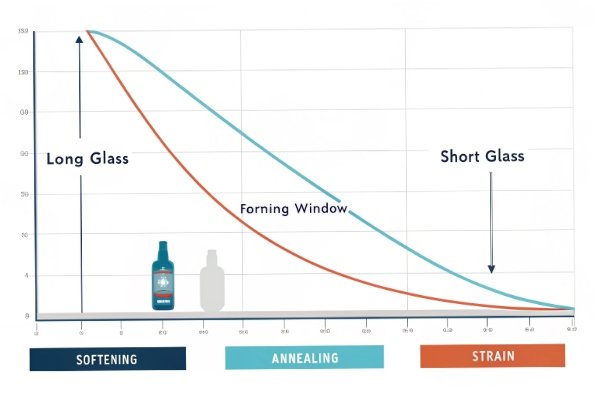
Long vs. Short Glass
The “long vs short” concept is fundamentally about the slope of viscosity vs temperature, summarized clearly in Lehigh’s glass properties lecture on long and short glasses 6{#fnref6}.
- Long Glass (Wide Window): Stays soft for a long time.
- Pros: Easier to blow complex shapes (square shoulders) with even walls. Better thermal consistency.
- Cons: Takes longer to set, limiting machine speed.
- Short Glass (Narrow Window): Sets up instantly.
- Pros: High machine speeds (beer bottles).
- Cons: If the mold is 10°C too cold, the bottle is defective. The margin for error is zero. "Short" glass is notoriously brittle in thermal shock testing if not managed perfectly.
Process Stability
If your furnace temperature fluctuates (changing the window dynamically), you get "Layering."
- Effect: The inner glass layer is hot, the outer layer is cold.
- Result: Stress and defect modes accumulate, aligning with common root-cause tables in container defect causes and remedies guides 7{#fnref7}.
How does controlling the cooling rate after forming, in relation to the forming temperature, impact heat resistance during subsequent hot-fill or sterilization?
The milliseconds after the bottle leaves the mold are just as critical as the forming itself. This is the "Dead Plate" time.
If the forming temperature is high, the bottle requires aggressive cooling (wind) to hold its shape. If this cooling is applied unevenly to the hot glass, it creates "Thermal Shock Checks" on the skin. Conversely, if the bottle is formed cold, it needs less cooling; over-cooling it will shatter it on the conveyor.
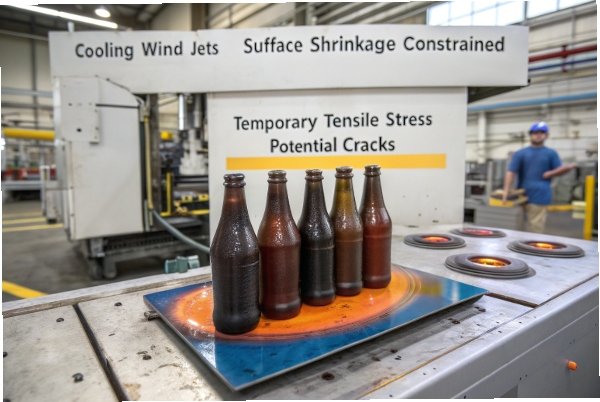
The "Skin Effect"
Glass is a poor conductor. When you blast hot glass with cooling air:
- Surface: Temperature drops rapidly.
- Core: Temperature remains high.
- Tension: The surface tries to shrink, the core prevents it. This creates temporary surface tension.
- Later Life: During hot-fill, the hot liquid heats the inside and reverses the stress gradient. If those initial cooling checks exist, the bottle fails.
A practical, production-focused discussion of these downstream “handling-to-failure” paths is captured in glass container defect identification references 8{#fnref8}.
Mold Cooling Balance
The molds themselves are water-cooled or air-cooled.
- Hot Mold: Good for surface finish (shiny), bad for sticking.
- Cold Mold: Good for speed, can cause surface checks.
- Thermal Resistance: We aim for the "hottest possible mold" that allows the bottle to release. This minimizes the $\Delta T$ between the gob and the mold, reducing the thermal shock the glass experiences during creation.
What process control methods (temperature monitoring, oven calibration) and tests (polariscopic stress, breakage tracking) can ensure that the forming temperature window does not negatively impact heat resistance?
You must monitor the invisible thermal history of the bottle.
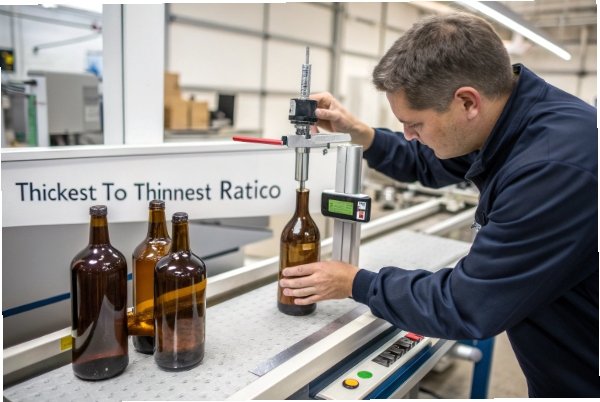
We utilize Infrared (IR) Pyrometers to monitor Gob and Mold temperatures in real-time, ensuring they stay within the ±5°C "Safe Window." This is validated by sectioning bottles to measure glass distribution (Ratio < 2:1) and performing "Hot End" pressure testing to catch structural weakness early.
1. Infrared Pyrometry (The Eyes)
- Gob Monitor: Measures every gob; this approach is increasingly supported by research on online viscosity/temperature monitoring in container glass 9{#fnref9}.
- Mold Monitor: Measures mold surface temperature to prevent cold-mold checking or hot-mold sticking.
2. Thickness Distribution (The Verification)
- Method: Cut the bottle vertically.
- Check: Measure the ratio of the thickest point to the thinnest point in the same horizontal plane.
- Spec: For Hot-Fill, we demand a ratio better than 2:1 (e.g., if thin side is 1.5mm, thick side cannot exceed 3.0mm).
- Why: Uneven walls = Uneven expansion = Breakage.
3. Polariscope Stress Screening (The Insurance)
Even “perfect looking” bottles can hide stress. Use polarized inspection aligned with ASTM C148 polariscopic examination of glass containers 10{#fnref10} to confirm forming + early cooling didn’t create stress patterns that will later amplify thermal shock failures.
| Control Method | Parameter | Target | Thermal Benefit |
|---|---|---|---|
| IR Gob Monitor | Temp Stability | $\pm 2^{\circ}C$ | Consistent Viscosity & Weight. |
| Sectioning | Wall Thickness | Ratio < 2:1 | Uniform thermal expansion. |
| Polariscope | Stress | Grade 1 | Confirms no "Cold Check" stress. |
| Mold Thermocouples | Cooling Rate | Constant | Prevents surface chilling/checking. |
Conclusion
The forming temperature window is not just a production parameter; it is the structural DNA of your bottle. By maintaining a stable, optimized viscosity and managing the cooling rates on the machine, FuSenglass eliminates the "hidden" defects like cold checks and poor distribution that ultimately lead to thermal failure in your facility.
Footnotes
-
Defines long vs short viscosity behavior and why steep viscosity curves create a narrow processing window. ↩ ↩
-
Practical reference linking gob temperature targets to viscosity levels used by container-glass operators. ↩ ↩
-
Visual defect glossary explaining surface discontinuities (cracks/checks) that later propagate under thermal stress. ↩ ↩
-
Explains how thermal shock exploits scratches/checks, causing rapid crack propagation in container glass. ↩ ↩
-
Lists thin-ware causes (e.g., parison too soft) tied to overheated glass and poor distribution. ↩ ↩
-
Clearly explains “long glass” vs “short glass” as shallow vs steep viscosity–temperature curves. ↩ ↩
-
Root-cause matrix for common forming defects when glass is too hot/cold or timing is off. ↩ ↩
-
Shows how early-life defects and marks link to later breakage and performance risk. ↩ ↩
-
Research on monitoring viscosity/temperature in container glass manufacturing to stabilize forming behavior. ↩ ↩
-
Standard method for visualizing and grading residual stress patterns in glass containers using a polariscope. ↩ ↩






