
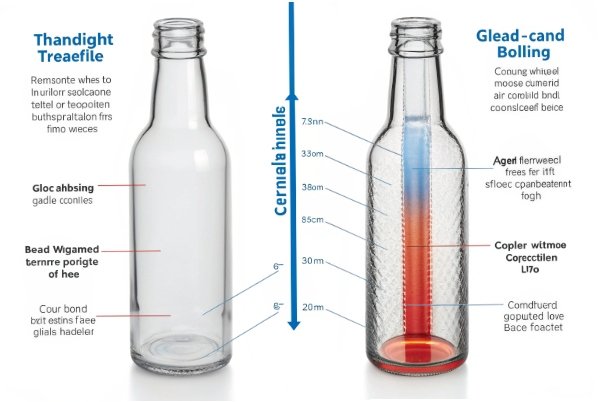
Reducing glass weight is a powerful way to cut logistics costs and carbon footprint, but it strips away the structural safety margin we often take for granted. Without careful engineering, this reduction can turn your filling line into a breakage zone.
Yes, lightweighting significantly increases cracking risk if not compensated by precise manufacturing. The reduced thermal mass cools faster, creating higher thermal gradients, while thinner walls have less ability to withstand the mechanical "hoop stress" exerted by capping machines and expanding contents.
The Engineering Challenge of "Less is More"
At FuSenglass, we champion the "NNPB (Narrow Neck Press and Blow) 1{#fnref1}" revolution, but we are also the first to warn clients about its physics. In a standard bottle, the "finish" (the neck and mouth) is often the heaviest, thickest part of the container. It acts as a rigid anchor. When you lightweight a design, you aren’t just making the walls thinner; you are fundamentally changing how the glass reacts to energy—both thermal and mechanical.
The Thermal Mass Deficit
A lightweight finish has less mass to absorb heat. When you introduce a hot-fill liquid (say, at 85°C), a standard heavy neck warms up relatively slowly. A thin, lightweight neck heats up almost instantly. However, the real danger is in the cooling tunnel. The thin glass loses heat rapidly, contracting while the closure (often metal) and the liquid inside are still hot. This differential contraction creates intense tensile stress on the outer skin of the glass finish, which is a classic thermal shock failure mechanism 2{#fnref2}. If there is even a microscopic surface flaw, the glass cannot distribute this stress, and it snaps.
The Structural Trade-off
Think of the finish as a bridge arch. A thick arch can support a heavy load even if the load is slightly off-center. A thin arch requires the load to be perfectly distributed. Lightweight finishes have a much narrower "process window." They cannot tolerate:
- Misaligned Cappers: A slight wobble in the capping head that a standard bottle would ignore will crush a lightweight finish.
- Thermal Shock: The "Delta T" (temperature difference) threshold is often lower because the thinner glass creates sharper thermal gradients.
| Feature | Standard Finish | Lightweight Finish | Risk Factor |
|---|---|---|---|
| Wall Thickness | > 3.0mm typical | 1.8mm – 2.2mm | High: Less material to absorb shock. |
| Thermal Inertia | High (Slow reaction) | Low (Fast reaction) | Medium: Rapid expansion/contraction cycles. |
| Capping Tolerance | High (Forgiving) | Low (Unforgiving) | Critical: Requires precise torque control. |
| Primary Failure | Base/Heel impact | Finish/Neck split | High: Finish becomes the weakest link. |
Understanding that the risk is elevated is the first step. Now, let’s identify exactly which geometric changes push the glass to its breaking point.
Which lightweighting changes at the finish (ring thickness, thread height, lip radius) most increase cracking risk?
In the quest to shave grams, designers often trim the external features of the neck. While this looks sleek, removing material from these key load-bearing areas can be disastrous for hot-fill applications.
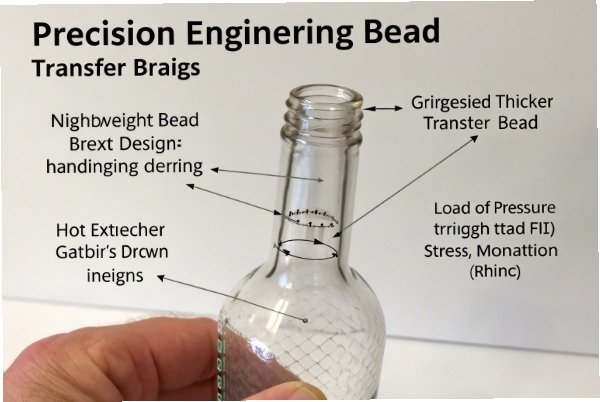
The reduction of the "Transfer Bead" (or Neck Ring) thickness and the sharpening of the "Lip Radius" are the most dangerous changes. A thin transfer bead fails to distribute capping load, leading to vertical cracks, while a sharp lip radius creates a high-stress leverage point that chips under the vacuum pressure of cooling.
The Transfer Bead: The Bumper
The transfer bead (the ring below the threads) is not just for handling the bottle during manufacture; it acts as a stiffening rib. In lightweight designs, this bead is often reduced in height and width to save weight.
- The Risk: During capping, the bottle is gripped here. If this bead is too thin, the gripper fingers apply point-loading that deforms the bore. Under hot-fill conditions, the glass is already thermally expanded. The mechanical squeeze on a thinned bead often initiates a "split finish"—a vertical crack that runs down the neck.
The Lip Radius: The Vacuum Seal
The very top edge of the bottle (the sealing surface) must be rounded. In lightweight molds, ensuring a generous radius is difficult because the glass cools so fast it doesn’t "flow" as well into the mold corners.
- The Risk: A "sharp" or tight radius on the inner lip is a stress riser. During pasteurization or hot-fill cooling, a vacuum forms inside the bottle. This vacuum sucks the cap down. If the contact point is a sharp glass edge rather than a smooth curve, the mechanical pressure from the cap liner can shear the inner edge of the glass, causing "saddle" fractures or chips.
Thread Height and Profile
Reducing the thread profile (making threads shallower) saves glass but reduces engagement.
- The Risk: "Thread Stripping." The cap might jump threads under the internal pressure of pasteurization because there isn’t enough glass overlap to hold it.
| Lightweight Feature | Function | Failure Mode in Heat |
|---|---|---|
| Thinned Transfer Bead | Gripping/Stiffening | Vertical Cracking: Cannot withstand gripper/capper side-load. |
| Reduced Thread Height | Cap Engagement | Cap Jumping: Threads slip under steam pressure (Retort). |
| Sharp Lip Radius | Sealing Surface | Chipping/Shearing: Liner pressure snaps the inner edge. |
| Narrow Bore Wall | Structural Integrity | Ovalization: Neck distorts under heat and load. |
How do capping torque, cap type, and liner hardness interact with a lightweight finish under hot-fill or pasteurization?
You cannot run a lightweight bottle on a line set up for heavy glass. The energy transfer is totally different. The "brute force" sealing method will result in a factory floor covered in broken glass and spilled product.
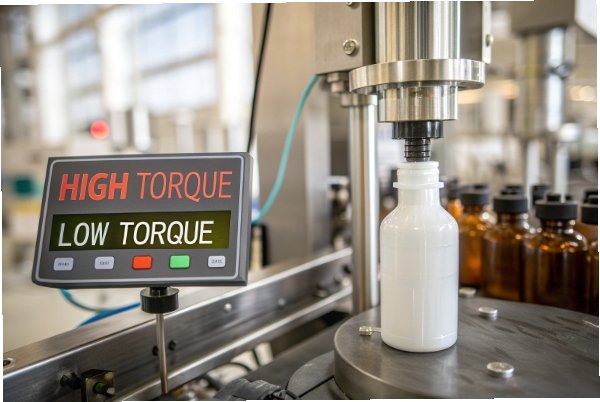
Lightweight finishes demand a "low-torque, high-seal" strategy. High capping torque combined with rigid metal caps (lug/twist-off) and hard liners transfers excessive shear force to the thin glass. When heat is added, this pre-stressed glass exceeds its tensile limit and shatters.
The "Stored Energy" Trap
When you tighten a cap, you are storing potential energy in the threads.
- Heavy Glass: Can handle high stored energy (e.g., 25 in-lbs torque).
- Lightweight Glass: Has a lower energy threshold. If you apply that same 25 in-lbs, you have pre-loaded the glass to 90% of its breaking point.
- The Trigger: Then comes the heat. The hot-fill liquid expands the glass. That thermal expansion adds the final 10% of stress needed to cause catastrophic failure.
This is why you must understand and control hoop stress 3{#fnref3} at the finish—especially when the closure contracts faster than the glass during cooling.
Cap Type: Plastic vs. Metal
- Metal (Lug/Twist): Rigid. When the bottle expands, the metal resists. This fight causes stress. For lightweight glass, we recommend checking the "lug count." More lugs (e.g., 6 vs 4) distribute the load better.
- Plastic (Screw): Elastic. It stretches slightly as the glass expands. This compliance is much safer for lightweight finishes.
Liner Hardness
Hard liners (like stiff Plastisol) require high down-force to create a seal. This down-force crushes the thin sealing surface of a lightweight bottle.
- Solution: We strongly advise using softer, profile-injected liners or foamed liners for lightweight ware. They seal with less torque and less down-force, protecting the fragile finish.
To keep torque and sealing measurable (not guesswork), align your QC method with ASTM D3198 (application and removal torque) 4{#fnref4}.
| Parameter | High Risk (Avoid) | Low Risk (Recommended) | Why? |
|---|---|---|---|
| Cap Material | Hard Steel (Tinplate) | Aluminum or Polypropylene | Plastic/Aluminum yields; Steel fights the glass. |
| Liner Type | High-density PVC | Foamed PE / Soft Plastisol | Soft liners seal at lower torque. |
| Torque Setting | Static High Torque | Dynamic / Minimal | Prevents pre-loading stress. |
| Capping Speed | High Impact / Snap | Ramped / Smooth | Sudden shock waves crack thin necks. |
What production factors (wall thickness uniformity, annealing stress, micro-checks) make lightweight finishes fail more often?
The margin for manufacturing error in lightweight glass is zero. In a standard bottle, a thin spot might still be 2mm thick. In a lightweight bottle, a thin spot is paper-thin and fatal.
Inconsistent wall thickness ("wedge bottom" or uneven neck distribution) is the primary killer. Lightweight processes (NNPB) are prone to "settle waves" in the neck—ripples of varying thickness. These ripples create uneven cooling rates, locking in residual stress that acts as a time-bomb during thermal cycling.

The Curse of the "Settle Wave"
In the NNPB process, a plunger forms the internal cavity. If the "gob" (molten glass ball) isn’t perfectly consistent, you get a "settle wave"—a band of glass in the neck or shoulder that is thicker than the rest.
- Thermal Impact: During pasteurization, this thick wave heats up slower than the surrounding thin glass. This creates a "tug-of-war" (differential expansion) right at the neck. Since the surrounding glass is too thin to support this stress, a circumferential crack forms along the wave line.
Annealing Challenges
Lightweight bottles fly through the production line faster. Sometimes they move too fast through the annealing lehr (cooling oven).
- The Issue: The thin finish cools rapidly, while the thicker shoulder takes longer. If the lehr curve isn’t adjusted for this specific weight distribution, the finish hardens while the shoulder is still soft. As the shoulder finally cools and contracts, it pulls on the already-hard finish, locking in permanent tension.
A stable lehr profile is the foundation of stress control; if you need a quick technical refresher on why, see how annealing relieves residual stress 5{#fnref5}.
Micro-Checks (Crizzling)
Lightweight molds run hotter. If the plunger touches the glass too long (thermal checking), it creates microscopic fissures on the inside of the bore. In a heavy bottle, there is enough bulk material to stop these cracks from propagating. In a lightweight bottle, the crack has nowhere to go but all the way through. For defect language and examples, operators often standardize on published glass finish defect references 6{#fnref6}.
| Production Defect | Cause | Consequence in Market |
|---|---|---|
| Settle Wave | Uneven Gob/Plunger | Thermal Crack: Breakage at the wave line during cooling. |
| Poor Annealing | Incorrect Lehr Curve | Spontaneous Breakage: Neck separates days after filling. |
| Thin Bore | Off-center Plunger | Crushed Neck: Fails under capper top-load. |
| Check under Thread | Mold Release Issue | Leaker: Gas escapes; product spoils. |
What specs and QC tests (finish stress, torque window, leak/thermal cycling) best prevent finish cracking in lightweight bottles?
You cannot just "visual check" your way to safety with lightweight ware. You need quantitative data that simulates the aggressive environment of your filling line.
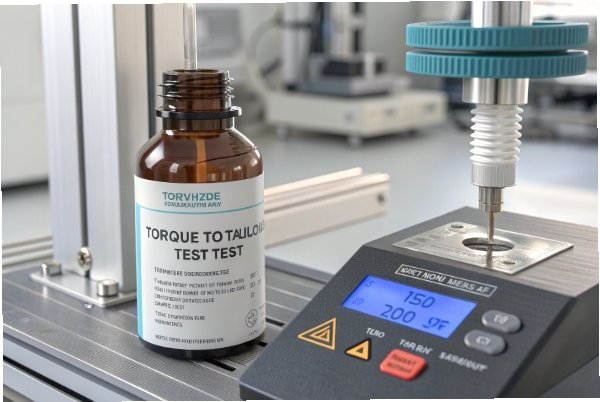
You must validate the "Torque Process Window" and perform "Finish-Specific Thermal Shock" testing. We recommend a "Secure Seal Test" (SST) combined with a thermal ramp to identify the exact torque at which the finish fails, then setting your production limit at 70% of that value.
The Torque-to-Failure Test
Don’t just test if the cap is on; test when the glass breaks.
- Method: Apply increasing torque to the cap until the finish strips or cracks.
- Data: If standard ware breaks at 35 in-lbs, lightweight might break at 20 in-lbs.
- Spec: Set your capper’s "Trip Torque" well below this failure point (e.g., 12-15 in-lbs).
Many plants pair this with a documented cap torque testing workflow 7{#fnref7} so results are repeatable across shifts.
Finish-Focused Thermal Shock
Standard ASTM C149 focuses on the bottle body. For lightweight ware, we modify this.
- Protocol: We dip only the neck into hot water, then cold.
- Why? This simulates the specific shock of a hot-fill fluid hitting the cold neck, or a cold cap hitting a hot neck.
- Criteria: Zero "checks" allowed. Even a non-leaking check is a fail.
For the baseline pass/fail logic and lab setup, reference ASTM C149 (thermal shock resistance) 8{#fnref8}.
Polarized Light Stress Measurement
We use polariscopes to measure the "Real Temper Number" specifically at the neck.
- Spec: For lightweight hot-fill ware, the residual stress at the finish must be Grade 2 or lower. Grade 3 is acceptable for heavy glass but risky for light.
If you need a standard method anchor for finish stress inspection, align with ASTM C148 (polariscopic examination) 9{#fnref9}.
Spec Alignment: Neck Finish Dimensions
Finally, make sure your finish print and closure print are speaking the same language. Many teams reduce mismatch risk by referencing a supplier-facing neck finish dimensions guide 10{#fnref10} for T/E/H/S measurement points and ovality checks.
| QC Test | Objective | Pass/Fail Criteria (Lightweight) |
|---|---|---|
| Torque-to-Failure | Find structural limit. | Must exceed required seal torque by 50%. |
| Thermal Shock (Modified) | Test finish integrity. | $\Delta T$ 42°C survival; No hairline checks. |
| Polariscope | Check residual stress. | Stress Grade < 2 (Low Birefringence). |
| Top Load (Vertical) | Test capper resistance. | Must withstand 200kg vertical pressure. |
Conclusion
Lightweight glass is the future of sustainable packaging, but it is unforgiving of error. It requires a holistic approach: "Gentle" bottle design (generous radii), precision manufacturing (perfect distribution), and "soft" capping strategies (low torque, soft liners). By respecting these physics, FuSenglass helps you reduce weight without reducing reliability.
Footnotes
-
Explains container-glass forming basics and where NNPB fits into modern lightweighting approaches. ↩ ↩
-
Clear explanation of how rapid temperature differentials create tensile stress and initiate cracks in glass. ↩ ↩
-
Defines hoop (circumferential) stress to quantify cap clamp loads on thin glass finishes. ↩ ↩
-
Standard method for measuring application/removal torque—critical for setting safe torque windows on lightweight finishes. ↩ ↩
-
Practical overview of lehr/annealing control and why residual stress drives delayed cracking. ↩ ↩
-
Visual defect library for finish checks and sealing-surface flaws that often trigger heat-assisted breakage. ↩ ↩
-
Step-by-step guide to closure torque measurement and troubleshooting for consistent QC execution. ↩ ↩
-
Official ASTM scope for thermal shock resistance testing used to validate hot-fill and pasteurization survivability. ↩ ↩
-
Standardized polariscopic inspection method to detect residual stress concentrations at the finish. ↩ ↩
-
Measurement reference for neck finish dimensions (T/E/H/S) and ovality checks to prevent closure mismatch failures. ↩ ↩






