
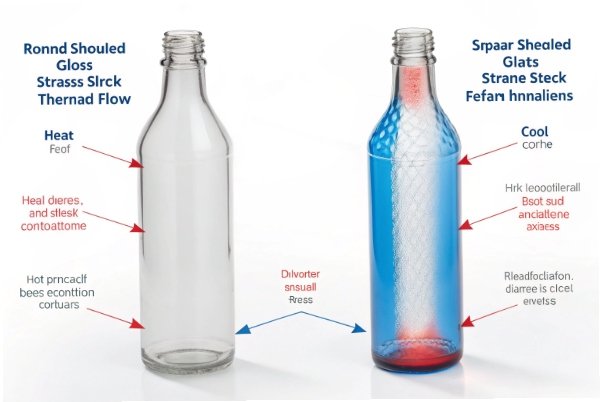
Thermal shock failures in premium glass packaging can destroy product value and brand reputation in seconds. If you are debating between the aesthetic appeal of square shoulders and the durability of round ones, you need the engineering facts. The choice of shoulder geometry fundamentally alters how glass endures rapid temperature changes.
Yes, they differ significantly. Round shoulders distribute thermal stress evenly, minimizing failure risks, while square shoulders create stress concentrations at the corners. However, with large corner radii and precise manufacturing controls like uniform wall thickness, square-shouldered bottles can be engineered to meet rigorous thermal shock standards.
The Physics of Glass Geometry and Thermal Stress
When we design bottles at FuSenglass for clients requiring hot-fill or pasteurization processes, the conversation often starts with aesthetics but quickly moves to physics. Glass is a brittle material with low tensile strength. When it is subjected to a sudden temperature change—like filling a cold bottle with hot liquid—the inner surface expands while the outer surface remains unchanged, creating tensile stress on the outer surface and compressive stress on the inner surface. The geometry of the bottle dictates how these stresses travel and where they concentrate.
Understanding Stress Risers
The most critical concept here is the "stress concentrator" or "stress riser" 1{#fnref1}. In a perfectly spherical or cylindrical vessel, stress flows tangentially and is distributed over a large area. This is why pressure vessels and laboratory flasks are round. A sharp corner, such as the shoulder of a square bottle, interrupts this flow. The stress lines bunch up at the turn, multiplying the local stress intensity. If this local stress exceeds the tensile strength of the glass (which is relatively low compared to its compressive strength), a crack initiates.
The Role of FuSenglass Engineering
In my 20+ years of experience, I have seen that "square" in the glass industry is rarely a true 90-degree angle. It is a stylized square with rounded edges. The difference between a "safe" square bottle and a "dangerous" one often lies in the subtlety of these transition curves. We utilize advanced simulation software to map these stress points before a single mold is cast—often using finite element analysis (FEA) 2{#fnref2}. Understanding that geometry is not just about shape—it is about the path of least resistance for thermal energy—is the first step in selecting the right packaging for sensitive products like pharmaceuticals or hot-filled beverages.
| Feature | Round Shoulder | Square Shoulder | Thermal Implication |
|---|---|---|---|
| Stress Distribution | Uniform and tangential | Concentrated at corners | Round handles $\Delta T$ better naturally. |
| Expansion Mechanics | Radial symmetry allows even expansion | Asymmetric expansion creates shear | Square requires thicker walls to compensate. |
| Manufacturing Ease | High consistency in blowing | Harder to get even glass distribution | Thin corners in square bottles are weak points. |
| Typical Use Case | Carbonated drinks, Retort foods | Spirits, Perfumes, Cold-fill | Square is often avoided for high-heat processes. |
Understanding these fundamental differences helps us move beyond simple aesthetics to functional engineering. However, the shoulder is just one part of the equation. Let’s examine how specific geometries handle the dynamic stresses of processing.
Which shoulder geometry better reduces thermal stress during hot-fill, cooling, and temperature cycling?
Production line downtime caused by bursting bottles during the cooling tunnel phase is a nightmare for any operations manager. You need a design that survives the entire thermal cycle, not just the shelf.
Round shoulder geometry is superior for reducing thermal stress because its continuous curvature prevents the localization of tensile forces. It allows the glass to expand and contract uniformly during cycling, whereas square shoulders mechanically constrain expansion, generating peak stresses that can lead to immediate failure.
The Mechanics of Hot-Fill and Cooling
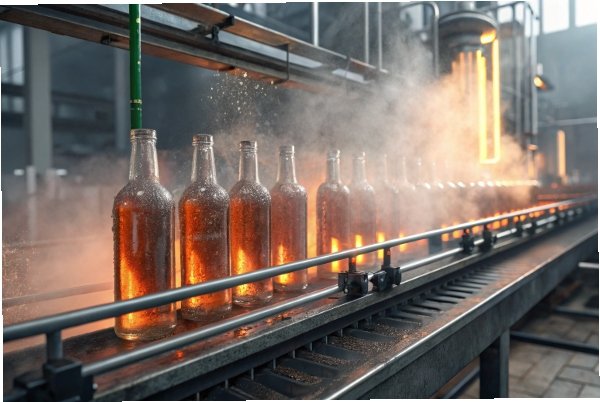
During a hot-fill process (often around 85°C to 90°C), the glass absorbs heat and expands. The danger zone is often not the filling, but the subsequent cooling tunnel or a pasteurization cycle where the bottle is sprayed with water. Rapid cooling causes the outer surface to contract while the inner core remains hot and expanded. This differential creates immediate tensile stress on the skin of the bottle.
In a round-shoulder bottle, this contraction is hoop-like and uniform. The arch of the shoulder supports the structure, much like a Roman arch supports weight. There are no "corners" to lock the material in place, so the glass structure moves in unison.
The Problem with Square Geometries in Cycling
In a square-shoulder bottle, the flat panels and the curved corners cool at different rates. The corners act as rigid pillars. When the flat panel tries to contract, it pulls against these rigid corners. This creates a "diaphragm effect" on the flat sides and massive tension at the shoulder radius. During temperature cycling—going from hot to cold and back—these alternating forces fatigue the glass at the microscopic level. If there is a microscopic surface flaw (a check) at that corner, the thermal stress will act as a lever, prying that crack open. For high-volume production lines using aggressive thermal cycles (like autoclave sterilization), we almost universally recommend minimizing the "squareness" of the shoulder to ensure survival.
| Thermal Phase | Round Shoulder Behavior | Square Shoulder Behavior | Risk Level (Square) |
|---|---|---|---|
| Hot Filling | Even expansion; low stress. | Corners resist expansion; tension builds. | Moderate |
| Pasteurization | Uniform heat soak. | Uneven heating at thick corners. | Low |
| Cooling Tunnel | Uniform contraction (Hoop stress). | Differential contraction; panel pull. | High |
| Storage (Ambient) | Stable. | Residual stress if annealing was poor. | Low |
How do shoulder angle and corner radius change thermal-shock cracking risk compared with round transitions?
Designers often push for sharp, edgy looks to stand out on the shelf, but sharp angles are the enemy of thermal integrity. You must find the balance between visual impact and physical durability.
The thermal-shock cracking risk is inversely proportional to the corner radius; sharper angles drastically increase the stress concentration factor (Kt). A generous radius blends the stress flow similarly to a round bottle, while a tight radius acts as a notch that magnifies thermal tension.
The Mathematics of the Radius
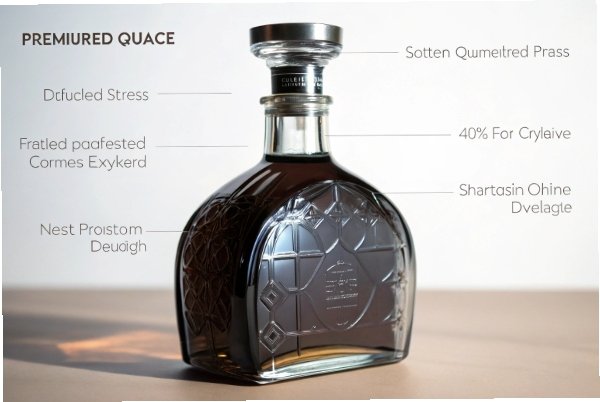
In engineering terms, we look at the Stress Concentration Factor ($K_t$). For a perfectly round transition, $K_t \approx 1$. As the shoulder angle becomes sharper (approaching 90 degrees) and the radius of that corner ($r$) decreases, $K_t$ shoots up—exactly as shown in standard mechanics notes on stress concentration factors ($K_t$) 3{#fnref3}. A "sharp" square shoulder might have a stress factor of 3x or 4x compared to the flat glass next to it. This means if the general thermal stress is 10 MPa, the corner is experiencing 30 or 40 MPa.
Optimizing the "Squircle"
At FuSenglass, when a client demands a square look, we employ what we call the "Squircle" approach. We increase the radius of the shoulder transition as much as the design permits.
- Shoulder Angle: A slope (e.g., 45 degrees) is safer than a flat horizontal shelf (90 degrees). The slope allows some vertical vector for expansion.
- Corner Radius: We advise a minimum corner radius of 6mm to 10mm for bottles undergoing moderate thermal stress. Anything under 3mm is a high-risk zone for thermal shock.
By softening the transition from the neck to the body, we allow the thermal energy to dissipate rather than accumulate. We often see cracks initiating exactly at the "break line" where the neck meets a flat square shoulder because that is where the thermal gradient is steepest. Modifying this angle by just 10 or 15 degrees can improve thermal shock resistance (Delta T) by 10°C or more.
| Geometric Parameter | Design A (Sharp) | Design B (Softened) | Design C (Round) |
|---|---|---|---|
| Shoulder Angle | 90° (Flat shelf) | 45° (Sloped) | Continuous Curve |
| Corner Radius | < 3mm | 8mm – 12mm | N/A (Full Radius) |
| Stress Factor ($K_t$) | High (~3.0+) | Moderate (~1.5) | Low (1.0) |
| Max Safe $\Delta T$ | ~35°C | ~50°C | ~60°C+ |
What manufacturing controls (wall-thickness uniformity, annealing quality, residual stress) matter more than shoulder shape for heat performance?
Even the most perfectly designed round bottle will fail if it is manufactured poorly. Conversely, a square bottle can be incredibly robust if made with precision. Design is only half the battle.
Manufacturing controls are often more critical than shape; specifically, wall-thickness uniformity is paramount, as thin spots cool too fast and thick spots hold heat, creating fatal gradients. Furthermore, proper annealing is non-negotiable to remove residual stress that would otherwise compound with thermal shock to shatter the glass.
The "Glass Distribution" Factor
The most common cause of failure in square bottles is not the shape itself, but the glass distribution. When blowing a square bottle, the glass tends to be thickest in the corners and thinnest in the middle of the flat panels. This variation is deadly.
- Thick Corners: Retain heat longer.
- Thin Panels: Cool instantly.
This difference creates internal tension even without external thermal shock. At FuSenglass, we use mold and forming controls to maintain wall-thickness uniformity 4{#fnref4} so the wall thickness ratio between the corner and the panel stays within tight tolerances (e.g., < 2:1 ratio).
The Critical Role of Annealing
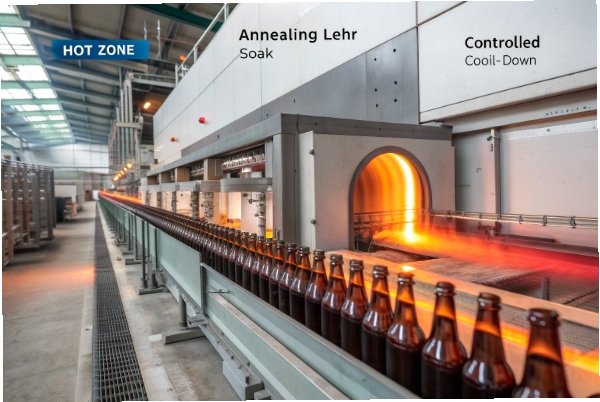
Annealing is the process of slowly cooling the glass in a "lehr" to relieve internal strains formed during forming. If a bottle has high residual stress (bad annealing) and you subject it to hot-fill, you are adding thermal stress on top of pre-existing stress—this is why lehr control and residual stress evaluation matter, including polariscopic examination of glass containers 5{#fnref5}.
- Round Bottles: Can forgive slightly imperfect annealing because their geometry naturally resists stress.
- Square Bottles: Unforgiving. If a square shoulder has residual stress, a $\Delta T$ of just 30°C might shatter it.
We monitor birefringence with polariscopes to ensure residual stress stays within your agreed acceptance limits before any hot-fill validation begins.
| Manufacturing Defect | Impact on Round Bottle | Impact on Square Bottle | Priority Control |
|---|---|---|---|
| Thin Glass Distribution | Reduces impact resistance, but thermal risk is moderate. | Critical Failure Risk. Panels collapse or check. | Mold design & Gob temp control. |
| Poor Annealing | Reduced lifespan; spontaneous breakage rare. | High Risk. Corners explode under thermal load. | Lehr transit time & temp curve. |
| Settle Wave (Baffle Mark) | Cosmetic mostly. | Creates a stress line on the shoulder. | Baffle alignment. |
| Mold Seam Quality | Aesthetic. | Seam on a corner acts as a pre-crack. | Mold maintenance. |
What validation tests and pass/fail criteria should be used to compare round vs square shoulders for pasteurization or steam sterilization?
You cannot rely on theoretical designs; you must validate with destructive testing. Standards provide the baseline, but your specific process determines the real pass/fail line.
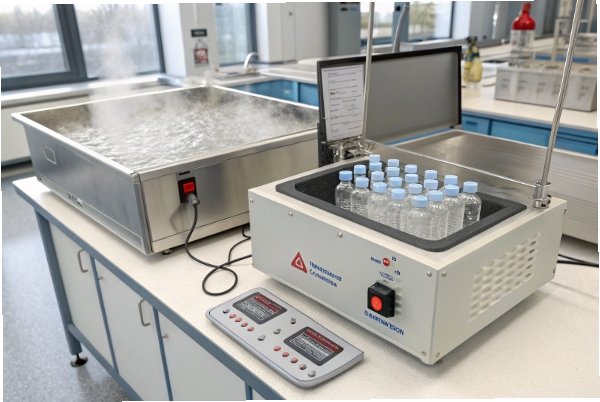
The gold standard for validation is ASTM C149 (Standard Test Method for Thermal Shock Resistance), utilizing a progressive hot-to-cold water bath test. For pasteurization, bottles should pass a $\Delta T$ of at least 42°C without failure, while steam sterilization requires passing more aggressive ramp-up cycles and internal pressure tests.
The ASTM C149 Protocol
This test involves immersing the bottle in a hot water bath, allowing it to reach equilibrium, and then immediately transferring it to a cold water bath within seconds, following ASTM C149 thermal shock resistance 6{#fnref6}.
- Baseline Test: We test a sample size (e.g., n=50) of both round and square designs.
- Incremental Stress: We start at a temperature differential ($\Delta T$) of 30°C and increase it by 5°C increments until 50% of the lot fails.
- Comparison: You will likely see the square bottles fail at a lower $\Delta T$ than the round ones. The goal is not to match the round bottle, but to exceed your process requirement.
Pass/Fail Criteria for Sterilization
For pasteurization and other thermal cycles, thermal shock can be combined with internal pressure and vacuum effects.
- Pasteurization (Tunnel): The bottle must survive a $\Delta T$ of 42°C. We set our factory acceptance level above the process minimum to provide a buffer.
- Steam Sterilization / Retort-Like Stress: Where pressure is involved, validate internal pressure strength using a recognized method like ASTM C147 internal pressure strength 7{#fnref7}. Square bottles often show earlier failures because flat sides flex under load.
- Fracture Analysis: When a bottle fails the test, analyze the origin. If it starts at the shoulder corner, the geometry is the root cause; if it starts at a seam or random flaw, it is a manufacturing anomaly.
If you operate across markets, align your specification package with international methods such as ISO 7459 thermal shock resistance/endurance 8{#fnref8} so supplier results remain comparable.
| Test Method | Typical Target ($\Delta T$) | Protocol Summary | Pass Criteria |
|---|---|---|---|
| Thermal Shock (ASTM C149) | 42°C (Pasteurization) 60°C (Hot Fill) |
Hot bath $\to$ Cold bath transfer < 15s. | 0 failures in sample set (n=30) at target $\Delta T$. |
| Internal Pressure (ASTM C147) | 150-200 psi (Carbonated) 50 psi (Still) |
Pressurize to destruction. | Must hold 1.5x max process pressure. |
| Polariscope Exam | Grade < 2 | Check residual stress rings. | No visible stress concentration at shoulders. |
| Vertical Load | 500-1000 N | Top-down pressure (capping). | Shoulders must not buckle. |
For readers who want practical testing context beyond the standard title, this overview of the ASTM C149 bath-transfer setup 9{#fnref9} is a helpful visualization.
Conclusion
Round shoulders will always be the champion of physics, offering superior natural resistance to thermal stress. However, square shoulders can be successfully used in heat-intensive processes if—and only if—you engineer them with generous corner radii and enforce strict manufacturing controls on wall thickness and annealing. At FuSenglass, we help you navigate this trade-off, ensuring your design is as durable as it is beautiful—especially when verified through a documented ASTM C14 glass container standards framework 10{#fnref10}.
Footnotes
-
Defines stress concentration and explains why corners amplify local stress during thermal and mechanical loading. ↩ ↩
-
Explains how FEA predicts weak spots and stress peaks before committing to tooling. ↩ ↩
-
Shows the relationship $\sigma_{max}=Kt\sigma{nom}$ and why smaller radii raise $K_t$. ↩ ↩
-
Research on finite-element modeling in glass-container processes, useful for understanding thickness/distribution effects. ↩ ↩
-
Lists relevant ASTM C14 container standards, including polariscopic exams and thermal shock methods. ↩ ↩
-
Official ASTM C149 scope for thermal shock resistance in bottles/jars used in hot-pack and pasteurization. ↩ ↩
-
Practical summary of ASTM C147 internal pressure testing for glass containers under sustained pressure conditions. ↩ ↩
-
ISO method framework for thermal shock resistance/endurance, useful for global procurement alignment. ↩ ↩
-
Visual walkthrough of ASTM C149 procedure and apparatus for clearer lab setup communication. ↩ ↩
-
Subcommittee hub summarizing container test standards—handy for building a complete validation plan. ↩ ↩






