
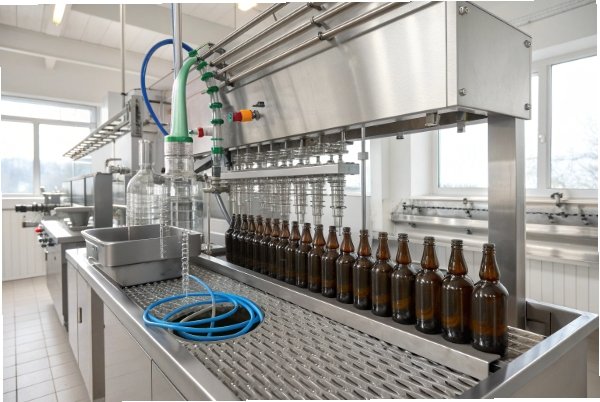
Contamination fears drive manufacturers to rinse, but introducing water creates severe thermal risks. You face a critical dilemma: prioritize absolute hygiene or prevent catastrophic line breakage?
Pre-rinsing is not strictly necessary if using certified dust-free glass, but it remains a hygiene best practice. However, using cold water is dangerous; steam or ionized air are the superior alternatives that sanitize effectively without causing fatal thermal shock during the hot-fill process.
The Hygiene vs. Thermal Shock Dilemma
Balancing the demand for sterile packaging with the physical limitations of glass is one of the toughest challenges in the beverage industry. As the face of FuSenglass, I have spent two decades watching clients struggle with this exact decision. The instinct is always to wash. It feels safer. You assume that a rinsed bottle is a clean bottle. However, in a hot-fill environment, a rinsed bottle is often a cold bottle, and that is where the danger lies.
When you introduce liquid water into a glass container moments before filling it with 85°C-95°C product, you are manipulating the thermal profile of that container. If not managed perfectly, you are setting the stage for thermal shock in container glass 1. The decision to rinse is no longer just about hygiene; it is a thermodynamic calculation. We must consider the source of the glass. If you are buying from a premium manufacturer like FuSenglass, where pallets are shrink-wrapped and top-capped in a clean room, the biological load is negligible. In these cases, the risk of thermal shock from a cold water rinse often outweighs the benefit of removing non-existent dust.
However, for lines running high-risk products or using glass stored in open warehouses, cleaning is mandatory. The key is to shift our mindset from "washing" to "conditioning." We are not just cleaning the bottle; we are preparing it to survive the thermal leap it is about to take.
Risk Assessment: Rinse vs. No-Rinse
| Factor | Rinse Process (Water) | No-Rinse / Dry Clean |
|---|---|---|
| Hygiene Assurance | High (Removes dust & microbes) | Medium (Dependent on storage quality) |
| Thermal Risk | Critical (Cooling effect) | Low (Ambient temp maintained) |
| Line Complexity | High (Plumbing, heating, drainage) | Low (Air knives or simple inversion) |
| Sustainability | Low (High water usage) | High (Zero water waste) |
| Breakage Potential | High (If parameters drift) | Low (Consistent temp profile) |
Understanding this trade-off is the first step. Now, we must look at how to mitigate the risks if you decide that rinsing is non-negotiable for your product safety.
When does pre-rinsing increase thermal-shock risk by cooling the bottle surface before hot filling?
Ignoring the thermal impact of rinse water turns your cleaning station into a bottle-breaking machine. Cold water strips heat from the glass instantly, creating a fatal temperature gap.
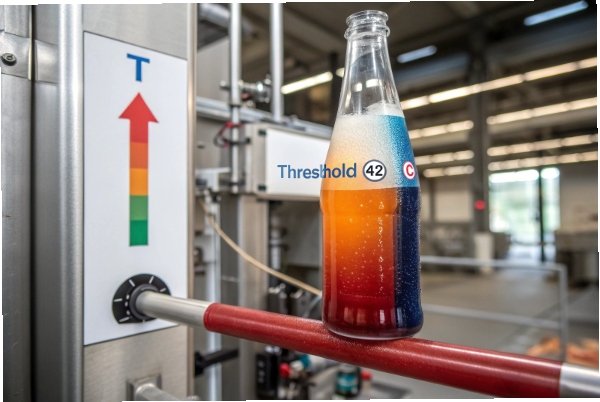
Pre-rinsing increases thermal-shock risk when the rinse water temperature is significantly lower than the hot-fill temperature. This rapidly cools the glass, widening the Delta T ($\Delta T$) beyond the material’s safety threshold (typically 42°C for soda-lime glass), leading to immediate structural failure.
The Thermodynamics of the Rinse Cycle
Glass is an amorphous solid with poor thermal conductivity. When you spray water inside a bottle, the heat transfer is efficient and immediate on the inner surface. If you use ambient mains water—which can be as cold as 10°C to 15°C in winter—you are actively chilling the bottle.
Let’s do the math. Your hot filling temperature is 90°C.
- Scenario A (No Rinse): The bottle is at ambient warehouse temperature (20°C). The $\Delta T$ is 70°C. This is already risky and usually requires a warming tunnel.
- Scenario B (Cold Rinse): You rinse with 15°C water. The bottle cools to 15°C. The $\Delta T$ rises to 75°C.
- Scenario C (Evaporative Cooling): Even if the water is 20°C, as the residual film evaporates, it sucks latent heat from the glass, potentially dropping the surface temperature further.
The "Thermal Crash" Phenomenon
I have investigated lines where operators couldn’t figure out why bottles were exploding at the filler. They checked the filler temp, the conveyor speed, and the glass quality. The culprit was the rinser. They were running cold water. The bottle would leave the rinser, travel 3 meters to the filler, and essentially be a block of ice relative to the hot juice. The stress created is tensile stress on the outer surface, which is where glass is weakest.
Temperature Differential Danger Zones
| Rinse Water Temp | Bottle Surface Temp (Est.) | Fill Temp | $\Delta T$ (Thermal Shock) | Outcome Risk |
|---|---|---|---|---|
| 10°C (Chilled) | 12°C | 90°C | 78°C | Catastrophic Failure |
| 20°C (Ambient) | 20°C | 90°C | 70°C | High / Fracture Likely |
| 50°C (Warm) | 45°C | 90°C | 45°C | Manageable / Safe |
| 80°C (Hot) | 70°C | 90°C | 20°C | Optimal / Zero Risk |
The data is clear: if you rinse with cold water, you are sabotaging your own production line. If you want a deeper engineering view of stress development during hot-cold transitions in soda-lime glass thermal shock testing 2, it reinforces the same operational conclusion: control the temperature gradient or expect fractures.
Which pre-rinse media (sterile water, ozonated water, steam, or air ionization) best fit hot-fill hygiene requirements?
Selecting the wrong cleaning medium compromises either your sterility or your glass integrity. You need a solution that kills bacteria without killing your production efficiency.
Steam is the optimal choice for hot-fill lines as it sterilizes and pre-heats the glass simultaneously. Ionized air is excellent for dry dust removal, while sterile or ozonated water provides high hygiene but requires heating to prevent thermal shock.
Steam: The Dual-Purpose Solution
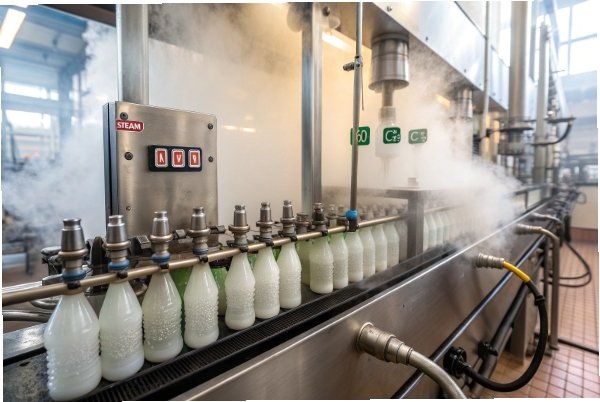
In my experience, switching to steam injection is the single best upgrade for a hot-fill line. Steam carries massive thermal energy. When it is injected into the inverted bottle, it does two things:
- Sanitization: The high temperature (100°C+) kills mold, yeast, and bacteria instantly.
- Conditioning: As the steam condenses, it transfers energy via steam sterilization principles 3, raising the bottle’s temperature to 60°C or higher.
This turns the "rinse" step from a cooling liability into a heating asset. The condensate volume is tiny, minimizing product dilution.
Ionized Air: The Dry Competitor
For non-carbonated, high-acid drinks where microbial risk is lower (due to pH), ionized air is a fantastic alternative. Standard air just blows dust around. Ionized air neutralizes the static charge that bonds dust to the glass, allowing a vacuum system to suck it away.
- Pros: Zero thermal shock (bottle stays at ambient temp), no water usage, no residual moisture.
- Cons: Does not sterilize the surface.
Water Options: Sterile vs. Ozonated
If you must use liquid (e.g., to wash out sticky residues), you have two main choices.
- Sterile Water: Filtered and treated. Effective, but if not heated, it causes thermal shock.
- Ozonated Water: Highly effective sanitizer. Ozone decomposes into oxygen, leaving no chemical residue. However, ozone degrades quickly in hot water. This creates a conflict: you need cold water for ozone stability, but hot water for glass safety. This makes ozonated water tricky for hot-fill applications.
Media Selection Matrix
| Media Type | Cleaning Efficacy | Thermal Effect | Moisture Residue | Suitability for Hot Fill |
|---|---|---|---|---|
| Steam | High (Sterile) | Heats Bottle (Good) | Low | Excellent |
| Ionized Air | Medium (Dust only) | Neutral | None | Good (If pre-heat tunnel used) |
| Hot Sterile Water | High | Heats Bottle (Good) | High | Good |
| Cold Ozonated Water | Very High | Cools Bottle (Bad) | High | Poor (High breakage risk) |
How should pre-rinse temperature, drain time, and residual moisture be controlled to protect fill accuracy and sealing?
Poor control of rinse parameters leads to watered-down product and vacuum failures. Precision in the rinsing tunnel ensures product integrity matches package integrity.
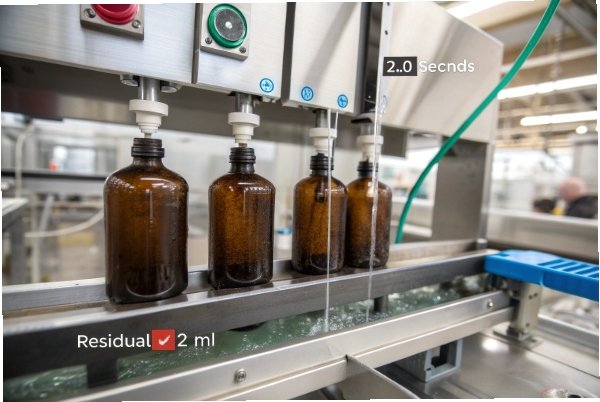
Rinse water must be heated to >50°C to act as a thermal buffer. Drain times must be calibrated to ensure less than 2ml of residual liquid remains, preventing product dilution, while air knives should be used to eliminate moisture on the finish that could compromise the cap seal.
Temperature Control: The 50°C Rule
To avoid the "Thermal Crash" we discussed, your rinse water heat exchanger is a critical control point (CCP). In practice, that CCP should be documented and verified under HACCP principles and monitoring 4. I advise all my clients to set a minimum rinse temperature of 50°C. This ensures the bottle exits the rinser at roughly 40°C-45°C. When 90°C liquid hits it, the $\Delta T$ is roughly 45°C—right on the edge of the safe zone for standard soda-lime glass, and well within the safety margin for FuSenglass quality ware.
The Physics of Draining
Gravity takes time. On a high-speed line running 20,000 bottles per hour, a bottle might only be inverted for 1.5 seconds. This is often not enough for all the water to sheet down the sides and exit the neck.
- Viscosity Factor: Water flows fast, but surface tension can trap droplets in the heel (the bottom corner) of the bottle.
- The Solution: An adjustable cam on the gripper to maximize the inversion angle and time.
Residual Moisture and Sealing
Water left on the "finish" (the top rim) is a disaster for sealing. When the cap is applied, trapped water turns to steam, creating false pressure. Or, it prevents the liner from making a hermetic seal, leading to vacuum loss and spoilage.
We rely on Air Knives—high-velocity blades of filtered air—positioned immediately after the drain station. They "wipe" the finish dry before the bottle flips back upright; many plants upgrade to a static-neutralizing ion air knife 5 to reduce dust re-attraction at the same time.
Critical Control Parameters
| Parameter | Target Setting | Consequence of Deviation |
|---|---|---|
| Water Temp | 55°C ± 5°C | < 50°C = Breakage; > 70°C = Scalding risk |
| Injection Time | 0.5 – 1.0 sec | Too short = Not clean; Too long = Waste |
| Drain Time | > 2.0 sec | Too short = Residual water (Dilution) |
| Air Knife Angle | 45° to Finish | Incorrect angle = Wet finish (Bad Seal) |
What in-line hygiene validation and contamination checks can replace rinsing to reduce breakage and improve efficiency?
Modern technology allows us to validate cleanliness rather than forcing a wash. Replacing water with vision systems eliminates thermal risks and boosts line speed.
Automated Empty Bottle Inspectors (EBIs) and vision systems can effectively replace water rinsing by detecting foreign particles, glass defects, and liquid residues. This "Dry Line" approach validates that the incoming glass is clean, removing the need for a risky thermal cycle before filling.
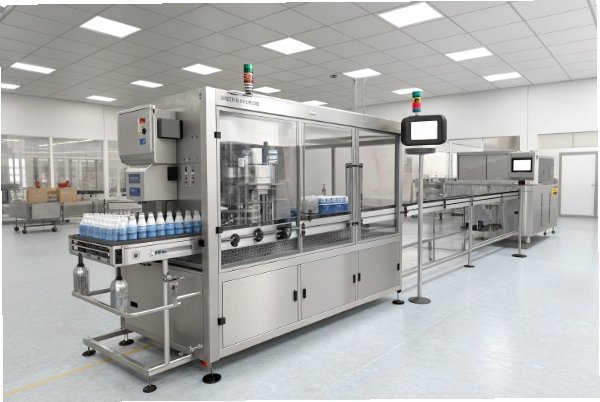
The Shift to "Dry Lines"
The most efficient factories I visit are moving away from rinsing entirely. They treat the glass manufacturing process as the cleaning step. At FuSenglass, we anneal bottles at 550°C—they are sterile when they leave the lehr. If we pack them correctly, they arrive clean.
The "Dry Line" relies on verification. Instead of washing every bottle "just in case," we inspect every bottle to prove it is clean.
Empty Bottle Inspectors (EBI)
These machines are marvels of engineering. Located just before the filler, they use multiple cameras and sensors to scan 100% of production. If you want a practical overview of capabilities and reject logic in empty bottle inspection (EBI) systems 6, it maps closely to what leading beverage lines deploy today.
- Base Inspection: A camera looks through the bottom for stones, dirt, or insects.
- Sidewall Inspection: checks for cardboard dust or foreign objects.
- Finish Inspection: Checks for chips or cracks that would prevent sealing.
- Residual Liquid Check: High-frequency or IR sensors detect if any liquid (oil, cleaner) is sitting in the bottom.
If the EBI detects a speck of dust >2mm, it rejects the bottle. This statistical guarantee is often superior to a blind water rinse which might not actually remove a sticky particle.
Validation Protocols
To run a dry line, you need robust SOPs (Standard Operating Procedures), ideally aligned with a food safety management standard like ISO 22000 7.
- Supplier Audit: You must audit us. Verify our clean room packing.
- Pallet Handling: Automated depalletizers that remove slip sheets without creating dust.
- Positive Pressure: The filling room should be pressurized with HEPA-filtered air so dust flows out, not in—this positive-pressure approach to keeping contaminants out 8 is a widely used facility control.
Comparison: Rinse vs. Validate
| Feature | Wet Rinsing | Vision Validation (EBI) |
|---|---|---|
| Thermal Shock | High Risk | Zero Risk |
| Water Usage | High (Costly) | None (Sustainable) |
| Detection | Blind (Hope it cleans) | Active (Sees defects) |
| Glass Defects | Cannot remove chips | Rejects chipped bottles |
| Maintenance | Plumbing/Nozzles | Optics/Calibration |
Conclusion
The necessity of pre-rinsing is a myth we must challenge. While hygiene is paramount, steam injection or dry air with EBI validation are superior methods to water rinsing. They protect the bottle from thermal shock while ensuring your product remains pure. Trust the physics, and protect your glass.
Footnotes
-
Explains why container glass fails under sudden temperature gradients and how to prevent breakage. ↩ ↩
-
Technical paper detailing measured temperature gradients and cracking behavior during soda-lime glass thermal shock tests. ↩ ↩
-
Clear explanation of steam sterilization and why condensation transfers large energy to surfaces. ↩ ↩
-
Official HACCP guidance for defining, monitoring, and verifying critical control points in food production. ↩ ↩
-
Reference for ion air knives that remove static and dust while aiding dry finishes on high-speed lines. ↩ ↩
-
Overview of EBI functions for detecting contaminants, defects, and residues before the filler. ↩ ↩
-
Official ISO overview of ISO 22000 and how it structures food-safety hazard control systems. ↩ ↩
-
Practical guide to positive-pressure rooms preventing dust infiltration in controlled production areas. ↩ ↩






