
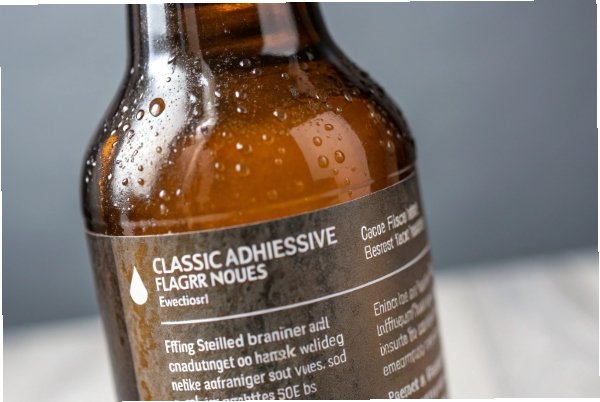
A label that slides, wrinkles, or falls off during thermal processing signals low quality to the consumer before they even open the bottle. The adhesive is the functional bridge between the paper/film and the glass, and it must withstand not just the peak temperature, but the combination of heat, moisture, and the expansion of the glass surface.
Label adhesives must possess high "Shear Resistance" at elevated temperatures to prevent sliding (flagging) and sufficient "Initial Tack" to grab hot glass. For hot-fill, the adhesive must resist softening up to 95°C. For pasteurization and sterilization, it must be chemically cross-linked to resist hydrolysis (water attack) at 65°C to 121°C.
The Thermal Spectrum of Adhesion
At FuSenglass, we advise clients that "sticky" is not a static property. Adhesives are viscoelastic polymers.
- Cold: They are hard and brittle.
- Room Temp: They are sticky (tacky).
- Hot: They become liquid and lubricious.
The danger in a hot-fill line is that the adhesive hits its Softening Point 1. Instead of holding the label firm, it turns into a lubricant. The label, which is under tension from the application machine, tries to shrink back to its original shape. If the glue is soft, the label edges curl up ("Flagging") or the label shifts position.
What temperature range and dwell time should be specified for label glue?
You must specify the Service Temperature Range 2 not just for the final use, but for the process.
Specify a Service Temperature of -20°C to +100°C for general Hot-Fill. For Pasteurization, specify "Wet adhesion > 60 minutes at 65°C". For Retort/Steam Sterilization, specify "Autoclave resistance at 121°C for 30 minutes".
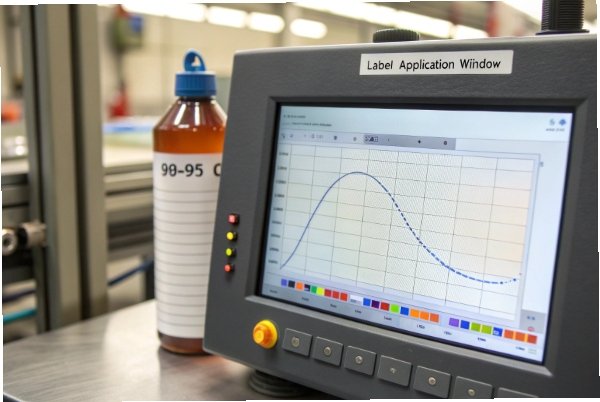
1. Hot-Fill (Juice, Tea, Isotonics)
- Temp: 85°C – 95°C.
- Dwell: ~5 minutes peak, then slow cooling.
- Requirement: The Shear Resistance 3 must ensure the adhesive does not flow at 95°C.
- Critical Spec: Shear Adhesion Failure Temperature (SAFT) > 105°C.
2. Tunnel Pasteurization (Beer, Sauces)
- Temp: 60°C – 65°C.
- Dwell: 45 – 60 minutes.
- Environment: 100% Humidity (Water Spray).
- Requirement: The adhesive must have enough Initial Tack 4 to grab the bottle and must not "re-emulsify" (turn milky or lose grip) when saturated with warm water.
3. Steam Sterilization / Retort (Dairy, Pharma, Canned Food)
- Temp: 121°C (250°F).
- Dwell: 15 – 60 minutes.
- Requirement: Specialized high-performance acrylics. Standard adhesives will melt and run down the bottle.
Which adhesive types perform best on glass under heat and humidity?
Not all glues are created equal. The chemistry dictates the survival.
Solvent-based or UV-Cured Acrylics are the gold standard for high heat and clarity. Water-based (Emulsion) Acrylics are suitable for moderate pasteurization but can "blush" (turn white). Rubber-based (Hot Melt) adhesives generally have poor heat resistance and should be avoided for hot-fill applications.
1. Acrylics (Emulsion & Solvent)
- Performance: Excellent UV stability, high clarity, and Solvent-based Acrylics 5 offer heat resistance up to 200°C.
- Best For: The "No-Label Look" (Clear-on-Clear) and almost all thermal applications.
- Watch Out: Standard Water-based Acrylics 6 can turn white (water whitening) in an ice bucket. You must specify "Water-Whitening Resistant" grades.
2. Rubber-Based (Hot Melt)
- Performance: Extremely aggressive initial tack. Cheap.
- Heat Resistance: Poor. Rubber-based adhesives 7 soften around 70°C and yellow with UV exposure.
- Best For: General warehousing. Do NOT use for hot-fill.
3. Wet Glue (Casein / Starch / Synthetic)
- Performance: Traditional "Cut & Stack" labels.
- Casein: Casein 8 is milk-protein based and provides excellent "Ice Bucket" resistance.
- Synthetic Resin: High tack, fast drying. Good for hot bottles.
| Adhesive Type | Heat Resistance | Water Resistance | Clarity | Application |
|---|---|---|---|---|
| Solvent Acrylic | Excellent | Excellent | High | Premium Vodka, Autoclave |
| Emulsion Acrylic | Good (<90°C) | Moderate (Risk of Whitening) | High | Standard Hot-Fill Bev |
| Rubber / Hot Melt | Poor (<70°C) | Poor | Low (Yellows) | Ambient Food, Logistics |
| Casein (Wet Glue) | Good | Excellent (Ice Bucket) | Opaque | Returnable Beer/Wine |
How can condensation, ice-bucket use, and rapid cooling affect adhesion?
The transition is often more dangerous than the peak heat.
Rapid cooling causes the glass to contract. If the label (film) contracts at a different rate, the label creates "tunnels" or bubbles. Condensation forms a water layer that can penetrate the label edge, leading to "edge lifting" or "flagging" if the adhesive bond is weak.
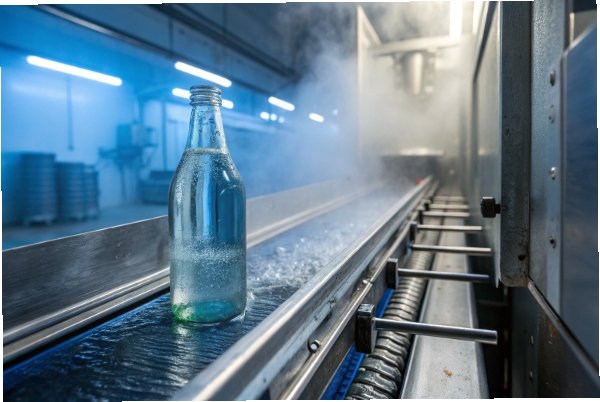
The "Tunneling" Phenomenon
- Scenario: A hot bottle is labeled with a Polypropylene label 9. The bottle enters a cooling tunnel.
- Physics: The glass shrinks. The PP label is rigid.
- Result: The label buckles outward, forming air tunnels.
- Prevention: Use a flexible film and an adhesive with high "shear" but enough elasticity.
The Ice Bucket Challenge
- Scenario: A wine/beer bottle sits in ice water for 4 hours.
- Failure: Water penetrates the fibers; the adhesive turns into slime, and the label floats away.
- Requirement: "Ice Bucket Resistant" specification. It must hold for >24 hours submerged.
What validation tests should be required to qualify label adhesives?
Data beats assumptions. Before ordering 10 million labels, run these three tests.
Mandate the "FINAT FTM 8" (Shear Resistance at Temp) to confirm heat stability. Perform the "Mandrel Hold" test at elevated temperatures to check for flagging, and the "24-Hour Soak" test for ice-bucket/pasteurization compliance.
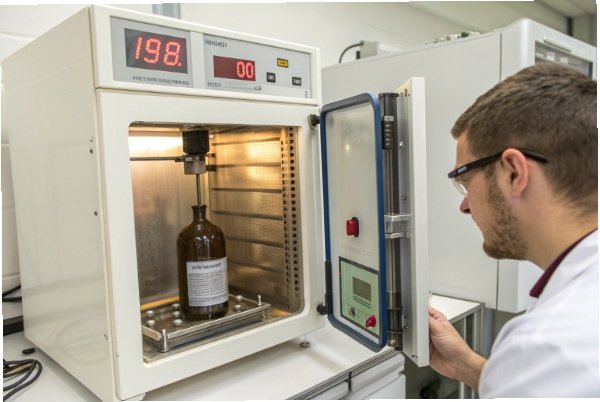
1. FINAT FTM 8 10 (Shear Resistance at High Temp)
- Test: A standard weight hangs from the label adhered to glass inside an oven.
- Metric: Time to failure (minutes) at specific temp (e.g., 90°C).
- Target: > 10,000 minutes.
2. Mandrel Retention (Flagging Test)
- Test: Apply label to a small diameter glass rod. Place in oven at 85°C for 1 hour.
- Check: Measure the "Lift" at the edge in millimeters.
- Target: < 2mm lift. Ideally 0mm.
3. SAFT (Shear Adhesion Failure Temperature)
- Test: Oven temp is ramped up slowly while the weight hangs.
- Result: The exact temperature where the glue fails.
- Target: Must be > 10°C higher than your maximum process temperature.
| Test Name | Purpose | Target Criteria | Relevance |
|---|---|---|---|
| SAFT | Find Melting Point | > 105°C | Hot-Fill Safety Margin |
| Mandrel Hold | Check Edge Lifting | < 2mm Lift | Flagging on Conveyor |
| Ice Bucket | Water Resistance | > 24 Hours | Wine / Beer |
| Whitening | Aesthetic Stability | No Haze (Delta Haze < 2%) | Clear-on-Clear Labels |
Conclusion
For thermal applications, Acrylic adhesives are the standard choice. Ensure you specify "High Shear" for hot-fill to prevent flagging, and "Water-Whitening Resistant" for any wet/pasteurization processes. Avoid Rubber/Hot-Melt adhesives entirely for these lines.
Footnotes
-
Scientific definition of the softening point where polymers lose structural rigidity and start to flow. ↩
-
Overview of the thermal properties of polymers and the functional limits of their service temperature range. ↩
-
Technical explanation of shear resistance in adhesives and its importance in preventing vertical label sliding. ↩
-
Industrial guide to understanding initial tack and its role in pressure-sensitive adhesive performance. ↩
-
Analysis of solvent-based acrylic adhesives and their superior performance in high-temperature industrial environments. ↩
-
Technical overview of water-based emulsion acrylic adhesives and their typical industrial applications. ↩
-
Exploration of rubber-based adhesive technologies, focusing on their high initial tack and thermal limitations. ↩
-
Detailed profile of casein-based adhesives and their specialized use in cold and wet environments. ↩
-
Technical properties of polypropylene films used in manufacturing durable, moisture-resistant labels for glass packaging. ↩
-
The official standard test method for determining the static shear resistance of self-adhesive label materials. ↩






