
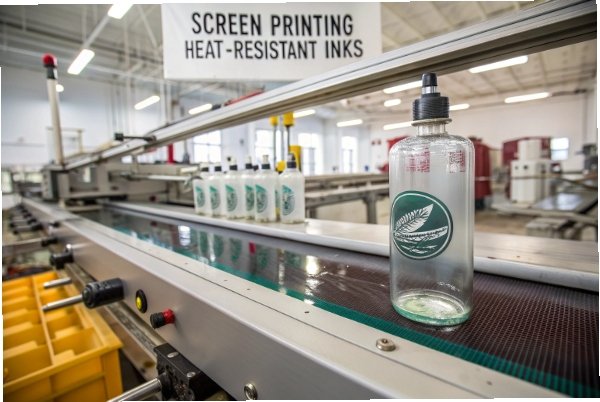
Are you struggling to choose the right screen-printing ink for your glass packaging, fearing that high-temperature processing might ruin your design? It’s a common headache for beverage and food brands—watching a beautiful logo peel or discolor during pasteurization or hot-filling can be a production nightmare. But don’t worry, understanding the specific heat resistance ratings of different ink systems is the key to ensuring your packaging survives the production line flawless and vibrant.
The heat resistance of screen-printed inks on glass bottles depends primarily on the ink system used: Ceramic frit inks offer the highest resistance (over 600°C), fusing permanently with the glass. Organic epoxy and solvent-based inks typically withstand temperatures up to 80-120°C, making them suitable for standard hot-filling but requiring specialized formulations for high-heat sterilization or retort processes.
Dive Deeper: Understanding Ink Thermal Stability
When we talk about heat resistance in glass packaging at FuSenglass, we aren’t just discussing the melting point of the ink. We are analyzing the complex relationship between the ink’s binder system, the adhesion mechanism, and the thermal stress applied during your filling and capping processes.
The Chemistry of Heat Resistance
The fundamental difference lies in how the ink bonds to the glass substrate. Glass is an inorganic, non-porous material, making adhesion chemically difficult.
-
Inorganic Bonding (Ceramic Inks): These inks contain ceramic frit 1 (ground glass) and inorganic pigments. During the firing process (often called "lehr firing"), the organic mediums burn off, and the frit melts, fusing effectively into the glass surface. This creates a bond that is as heat-resistant as the bottle itself.
-
Chemical Bonding (Organic Inks): These rely on resins (like epoxies or polyurethanes) and coupling agents (silanes) to create a chemical bridge with the glass surface. Their heat resistance is limited by the thermal degradation point of the resin matrix. Once the temperature exceeds this threshold (often around 150°C – 200°C for short periods), the carbon bonds break down, leading to discoloration (yellowing) or delamination.
Comparative Heat Resistance Data
To help you visualize the capabilities of different systems, we’ve compiled a comparison based on our production data here in China:
| Feature | Ceramic Frit Enamel | 2-Component Epoxy Ink | UV-Curable Ink | Thermoplastic Ink |
|---|---|---|---|---|
| Curing Temp | 580°C – 620°C | 150°C – 180°C (Baking) | UV Light (Instant) | 60°C – 80°C |
| Max Service Temp | > 500°C | ~120°C (Standard) / 140°C (Special) | ~80°C – 100°C | < 60°C |
| Adhesion Mechanism | Fusion (Mechanical/Chemical) | Chemical Cross-linking | Photo-polymerization | Physical Drying |
| Dishwasher Safe? | Yes (Permanent) | Yes (High Resistance) | Moderate | Low |
| Ideal Use Case | ACL, Returnable Bottles | Cosmetic, Single-use Beverage | Fast Turnaround, Multi-color | Decor Only |
Why This Matters for Your Brand
Choosing the wrong ink rating isn’t just a quality control issue; it’s a safety and liability issue. If an ink flakes off during a steam sterilization cycle, it could contaminate the processing water or, worse, the product itself if the exterior is compromised. For our clients exporting to strict markets like the EU or North America, we always recommend "over-specifying" adhesion requirements rather than risking a batch failure.
Now that we’ve established the baseline ratings, let’s look at which specific system you should choose if heat is your primary concern.
Which glass bottle screen-print ink system offers the highest heat resistance (UV-curable, epoxy/solvent-based, or ceramic frit enamel)?
Is your product destined for a retort chamber or an industrial dishwasher, and you need a print that is absolutely indestructible? If maximum durability and heat tolerance are your top priorities, relying on standard organic inks might be a costly mistake. The clear winner for extreme conditions is a system that has been used for decades but remains unbeaten in durability.
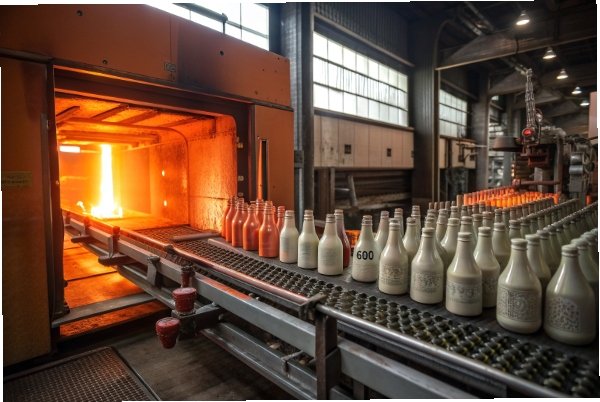
Ceramic frit enamel offers the highest heat resistance of all screen-printing systems, capable of withstanding temperatures exceeding 600°C without degradation. Unlike UV or epoxy inks which form a surface layer, ceramic inks fuse with the glass substrate during a high-temperature firing process, creating a permanent, scratch-proof, and heat-proof decoration ideal for returnable bottles and retort applications.
Dive Deeper: The Superiority of Ceramic Frit
At FuSenglass, when a client tells us their product is a returnable beer bottle or a medical-grade vial requiring autoclaving 2, we almost exclusively point them toward ceramic frit (often called ACL or Applied Ceramic Labeling).
The Mechanism of Fusion
Ceramic inks are essentially "glass on glass." The ink is composed of three main parts:
- Pigments: Usually metal oxides (like cobalt for blue, chromium for green) that are unaffected by high heat.
- Frit: Finely ground glass powder that acts as the flux.
- Medium: An oil or wax carrier that allows the ink to be printed through a screen.
When we pass these bottles through our lehr ovens at roughly 600°C, the medium burns away completely. The frit softens and melts, wetting the glass surface. As it cools, it becomes a solid, integral part of the bottle wall. This is why you can subject a ceramic-printed bottle to a blowtorch, and the glass will likely melt before the ink burns off.
Limitations of Organic Alternatives in High Heat
While we love UV-curable inks for their vibrant color range and eco-friendliness (no solvents), they are fundamentally plastics.
- Thermal Shock: UV-curable inks 3 cure instantly via light, forming a polymer network. Under high heat (above 100°C), this network can soften. If the bottle is then rapidly cooled, the difference in thermal expansion 4 between the glass and the ink can cause the ink to crack or pop off.
- Epoxy/Solvent-Based: These are excellent for chemical resistance (like perfume alcohol) and have better heat resistance than UV, especially when post-baked. However, prolonged exposure to temperatures above 140°C usually causes the organic resins to yellow or become brittle.
When to Choose Ceramic Frit
Use ceramic frit if your supply chain involves:
- Retort Sterilization 5: 121°C for 30-60 minutes.
- Pasteurization Tunnels: Extended exposure to hot water sprays.
- Returnable Systems: Bottles that will be washed with caustic soda and hot water (80°C+) dozens of times.
But knowing the "best" ink isn’t enough; you need to know the specific temperature targets for your specific process.
What temperature exposure should be targeted for hot-fill, pasteurization, or steam sterilization without ink discoloration or peeling?
Are you unsure if your current packaging specs match your co-packer’s thermal processing requirements? Mismatched temperature targets are a frequent cause of production delays and rejected batches. To avoid ink failure, you must align the ink’s thermal threshold with the specific "kill step" or filling method your beverage or food product requires.
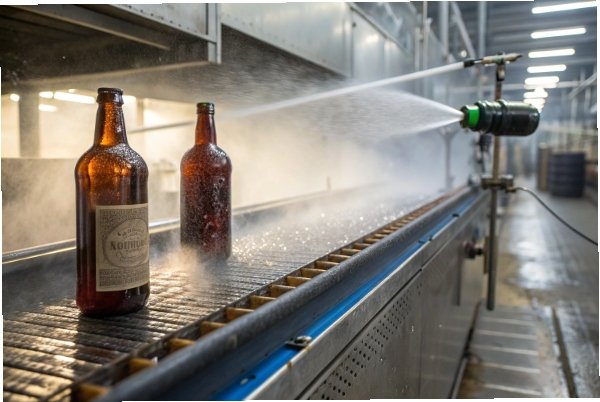
For hot-fill processes, target an ink resistance of 85°C–95°C for up to 10 minutes; for tunnel pasteurization, ensure resistance to 60°C–75°C for 20–40 minutes combined with high humidity. For steam sterilization (retort), the ink must withstand 121°C–134°C for 30–60 minutes without softening, requiring high-grade epoxy or ceramic frit systems.
Dive Deeper: Matching Ink to Process
In my experience working with beverage brands, the term "heat resistance" is too vague. We need to define the thermal profile—temperature over time, plus the environment (dry heat vs. wet steam). Here is how we categorize thermal targets at FuSenglass.
1. Hot-Fill (Juices, Teas, Sauces)
- Target Temperature: 85°C – 95°C (185°F – 203°F).
- Duration: Typically the bottle is filled hot-fill 6, capped, and then inverted. The heat exposure lasts until the bottle enters the cooling tunnel, usually 5–15 minutes.
- Risk Factor: The main risk here is thermal shock during cooling. If the ink is thermoplastic or low-quality UV, the rapid shift from 95°C to 25°C can cause micro-cracking.
- Recommended Ink: Standard 2-component Epoxy or Ceramic. UV inks must be high-adhesion grade.
2. Tunnel Pasteurization (Beer, Carbonated Drinks)
- Target Temperature: 60°C – 75°C (140°F – 165°F).
- Duration: Long exposure, often 20 to 60 minutes.
- Risk Factor: Humidity. This is a wet heat environment. Many inks that withstand 100°C dry heat will peel at 70°C in a tunnel pasteurization 7 steam tunnel because moisture penetrates the interface between the ink and glass.
- Recommended Ink: Cross-linked Epoxy (must be fully cured) or Ceramic.
3. Retort / Autoclave (Dairy, Cold Brew Coffee, Baby Food)
- Target Temperature: 121°C (250°F) is standard; up to 134°C for medical applications.
- Duration: 30 – 60 minutes under pressure.
- Risk Factor: Pressure changes + Moisture. The retort environment is aggressive. Organic pigments often discolor (reds turn brown, whites turn yellow) due to the chemical breakdown of the pigment binder at these temperatures.
- Recommended Ink: Ceramic Frit is the safest bet. Specialized "Retort-Grade" Epoxies exist but must be tested rigorously.
Summary Table of Thermal Targets
| Process | Typical Temp Range | Critical Factor | Safe Ink Choice |
|---|---|---|---|
| Hot Fill | 85°C – 95°C | Thermal Shock (Cooling) | Epoxy, UV (High Grade) |
| Pasteurization | 60°C – 75°C | Moisture/Steam Penetration | Epoxy (Baked), Ceramic |
| Retort | 121°C+ | Pressure + Pigment Stability | Ceramic Frit |
| Dry Sterilization | 180°C+ | Binder Degradation | Ceramic Frit ONLY |
Understanding these targets is half the battle; the other half is ensuring the ink is actually cured properly to meet these specs.
How do curing method, post-baking, and drying conditions change the ink’s real heat rating and adhesion on glass?
Did you know that even the most expensive heat-resistant ink will fail if it isn’t cured correctly? Many "ink failures" are actually "process failures" where the ink never achieved its full cross-linking density. Optimizing your curing and post-baking parameters is the most effective way to unlock the maximum thermal performance and adhesion of your chosen ink system.
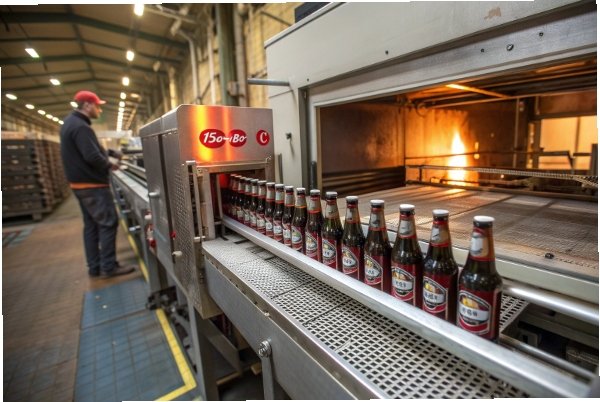
Proper curing transforms the ink from a liquid to a solid polymer network; increasing curing time and temperature (post-baking) significantly enhances cross-linking density, which directly boosts heat resistance and chemical inertness. For organic inks, a post-bake at 140°C–180°C for 20–30 minutes can increase thermal tolerance by 20–30% and is often mandatory for passing pasteurization tests.
Dive Deeper: The Science of Curing
At FuSenglass, we often see clients requesting "air dry" inks to save money on energy. We usually advise against this for premium products. Real heat resistance comes from energy input—you have to put heat in to get heat resistance out.
The Role of Cross-Linking
In 2-component epoxy inks, you mix a resin and a hardener. They react to form a grid-like structure (cross-linking 8 polymer network).
- Under-curing: If you only let it air dry or cure at low temps (e.g., 50°C), the grid is loose. Heat can easily penetrate, softening the ink and causing it to slide off the glass.
- Full-curing: By baking at 150°C, you force the molecules to form tighter, more numerous bonds. This "tight grid" resists thermal expansion and prevents water molecules from entering.
Post-Baking: The Secret Weapon
For organic inks (Epoxy/Screen), post-baking is not just about drying; it’s about adhesion promotion.
- Silane Activation: Glass printing inks often use silane adhesion promoters 9. These chemicals require heat (often >100°C) to fully activate and bond chemically with the silica in the glass. Without this heat spike, the silane remains dormant, and adhesion is weak.
- Solvent Evaporation: If solvents remain trapped inside the ink film (due to fast surface drying but wet interior), they will boil when the bottle is later heated (e.g., during pasteurization), causing blisters or bubbles. Slow, thorough baking prevents this.
Impact on UV Inks
UV inks cure by light, not heat. However, "thermal bumping" (heating the bottle before or after UV exposure) can improve adhesion.
- Pre-treatment (Flaming/Pyrosil): Heating the glass surface with a flame immediately before printing increases surface energy (dyne level), allowing the UV ink to wet out better. This doesn’t change the ink’s heat rating, but it drastically improves its ability to stay on the bottle when heated.
Optimization Strategy
If you are experiencing peeling during hot-fill:
- Check Oven Curve: Ensure the bottle surface reaches the target temp, not just the air in the oven.
- Increase Bake Time: 30 minutes at 140°C is often better than 10 minutes at 160°C for thorough cross-linking without yellowing.
- Wait for Maturation: Some epoxies continue to cure for 24-48 hours after printing. Do not test heat resistance immediately off the line.
Finally, how do you prove your bottles are ready? You need a standardized testing protocol.
Which test standards and pass/fail criteria should be required to verify ink heat resistance before placing a bulk order?
How can you be certain that the 50,000 bottles you just ordered won’t fail during your first production run? Relying on a supplier’s verbal promise isn’t enough; you need a rigorous, data-driven validation protocol. Implementing specific ASTM or ISO test standards and defining clear pass/fail criteria for heat resistance is crucial for protecting your investment and brand reputation.
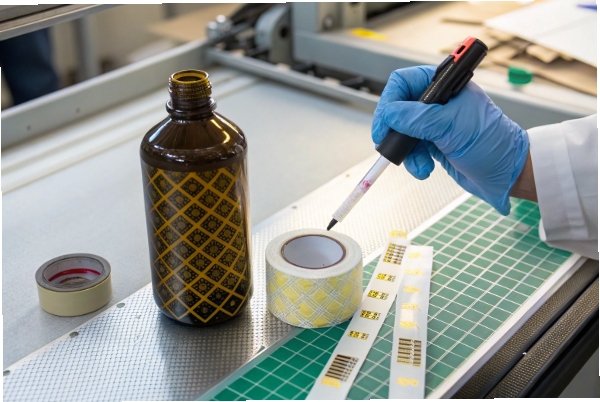
To verify heat resistance, require the "Pasteurization Test" (immersion in 60°C–80°C water for 30–60 mins) and the "Thermal Shock Test" (rapid transfer from hot to cold water). Pass/fail criteria should be based on ASTM D3359 (Cross-Hatch Tape Test) performed immediately after heat exposure; any rating below 4B (less than 5% peeling) constitutes a failure.
Dive Deeper: The Validation Protocol
At FuSenglass, we don’t ship a custom order until it passes our internal "Torture Test." We recommend our clients adopt a similar checklist for their Quality Assurance (QA).
1. The Pasteurization Simulation (The "Dunk" Test)
This is the industry standard for beverages.
- Procedure: Submerge the printed bottle in a water bath heated to your specific processing temp (e.g., 65°C for beer, 90°C for juice) for the duration of your process (e.g., 45 mins).
- The Check: While the bottle is still wet and hot, attempt to scratch the ink with a fingernail or a standardized coin.
- Fail Criteria: Ink softens significantly or peels off with light pressure. Note: Some slight softening is normal for organic inks when hot, but it must re-harden upon cooling without adhesion loss.
2. ASTM D3359 10: Cross-Hatch Adhesion Test
This is the gold standard for adhesion.
- Procedure: Use a specialized blade to cut a grid pattern (1mm x 1mm squares) into the ink, penetrating to the glass. Apply pressure-sensitive tape (ISO 2409 standard tape) over the grid and rip it off rapidly.
- Timing: Crucially, perform this after the thermal cycle tests (like the dunk test described above).
- Pass Criteria:
- 5B: 0% ink removed. (Perfect)
- 4B: <5% ink removed. (Acceptable for most)
- 3B or lower: >15% ink removed. (REJECT)
3. Thermal Shock Test
- Procedure: Heat the bottle to 80°C (or your target), then immediately plunge it into 20°C water.
- The Logic: This tests if the ink expands/contracts at a compatible rate with the glass.
- Fail Criteria: Cracking, crazing (spiderweb cracks), or delamination of the ink.
4. Product Resistance (The "Rub" Test)
Heat often makes ink susceptible to chemicals.
- Procedure: Rub the print with a cloth soaked in alcohol (or the actual product, e.g., perfume or alcohol) after the bottle has been heated.
- Pass Criteria: No color transfer to the cloth after 50 double rubs.
Table: Recommended QC Checklist for Buyers
| Test Name | Standard Ref | Condition | Pass Criteria |
|---|---|---|---|
| Dry Adhesion | ASTM D3359 | Ambient Temp | 4B or 5B rating |
| Hot Water Resistance | Internal / ISO | 60°C – 90°C / 30 mins | No blistering / No peel on wet scratch |
| Thermal Shock | ASTM C149 | 42°C delta T (typical) | No glass breakage / No ink cracking |
| Chemical Rub | ASTM D5402 | MEK or Ethanol | >50 Rubs without wear |
By enforcing these standards, you move from "hoping" the ink works to "knowing" it will withstand your manufacturing reality.
Conclusion
Selecting the right heat resistance for your glass packaging is a balance of aesthetics, process requirements, and budget. While Ceramic Frit remains the undisputed king of heat durability (600°C+), modern Epoxy and UV systems can perform brilliantly in standard hot-fill and pasteurization scenarios (up to 95°C) if properly cured and post-baked. Always validate your choice with rigorous testing like ASTM D3359 and thermal simulations before bulk production. At FuSenglass, we are ready to guide you through these technical specs to ensure your bottle looks as good on the shelf as it did on the design screen.
Footnotes
-
Technical overview of ceramic frit glass and its permanent bonding properties for container decoration and architecture. ↩
-
Official guidelines for steam sterilization and autoclaving protocols required for medical-grade and food-safe glass packaging. ↩
-
Understanding the chemical properties and industrial applications of UV-curable inks in modern high-speed printing lines. ↩
-
Reference table for thermal expansion coefficients of common materials used in packaging and industrial design. ↩
-
A scientific look at the retort sterilization process and its impact on heat-processed food containers. ↩
-
A comparison between hot-fill and other industrial filling methods for shelf-stable liquid product packaging. ↩
-
Insights into optimizing the thermal efficiency and operational safety of tunnel pasteurizers in beverage manufacturing. ↩
-
Scientific explanation of how cross-linking density determines the physical durability and thermal stability of polymer networks. ↩
-
Technical documentation on the role of silane coupling agents in enhancing interface adhesion between glass and ink. ↩
-
The global standard test method for evaluating coating adhesion strength through mechanical tape testing procedures. ↩






