
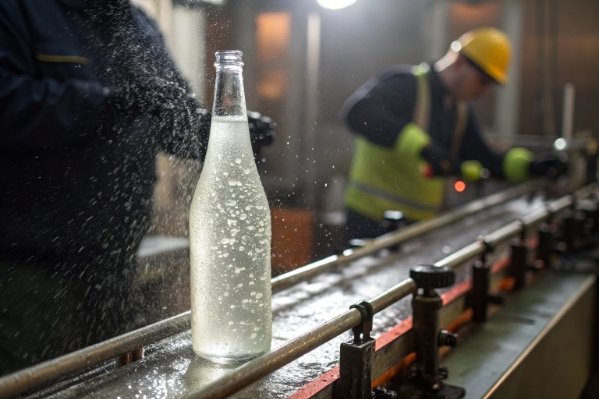
Shattered glass halts production lines, wasting product and endangering workers during thermal transitions. Ignoring thermal limits ruins margins and damages brand reputation instantly.
No, heating a frozen glass bottle directly usually causes immediate breakage due to thermal shock. The rapid expansion of the heated surface against the frozen core creates stress that exceeds the glass’s tensile strength, leading to catastrophic failure.
Understanding the Physics of Glass and Thermal Stress
At FuSenglass, I often explain to our partners in the beverage and pharmaceutical sectors that glass is a rigid, brittle material with poor thermal conductivity 1. When you have a frozen bottle—sitting perhaps at -10°C or lower—and you expose it to immediate heat, you are asking the material to defy physics. The "Delta T" (ΔT), or the temperature difference, is the critical metric here. Standard soda-lime glass, which makes up the vast majority of packaging for cosmetics, food, and spirits, generally creates a risk of breakage when the ΔT exceeds 42°C (approximately 107°F).
When heat is applied, the outer surface expands rapidly. However, because glass conducts heat slowly, the inner wall remains frozen and contracted. This tug-of-war creates immense tensile stress on the outer surface. Once that stress surpasses the tensile strength 2 of the glass matrix, cracks initiate instantly. This isn’t just a minor defect; it often results in the bottom falling out or the body shattering completely, contaminating the filling line.
In my 20 years of experience managing production lines and helping clients optimize their packaging, I have seen that "thermal shock" 3 is often misunderstood as just "getting too hot." It is actually about the speed of the change. A gradual increase in temperature allows the heat to conduct through the wall thickness, equalizing the expansion. A sudden jump does not.
Key Factors Influencing Thermal Resilience
The resilience of a bottle depends heavily on its design and manufacturing quality. A bottle with uneven wall thickness will have "hot spots" and "cold spots," exacerbating the stress differential. Similarly, surface scratches or micro-abrasions act as stress concentrators 4, providing a convenient starting point for a fracture.
Thermal Properties of Soda-Lime Glass vs. Borosilicate
While we primarily manufacture high-quality soda-lime glass, it is vital to understand where it stands compared to other materials. Borosilicate glass 5 (lab glass) has a much lower coefficient of thermal expansion, making it resistant to shock. However, for mass-market packaging (liquor, juices, sauces), soda-lime is the standard due to cost-effectiveness and clarity. The trade-off is the need for strict thermal management.
| Property | Soda-Lime Glass (Standard Packaging) | Borosilicate Glass (Lab/Premium) | Impact on Freeze-to-Heat |
|---|---|---|---|
| Thermal Expansion | High (~9.0 x 10⁻⁶ /K) | Low (~3.3 x 10⁻⁶ /K) | High expansion means higher risk of shock. |
| Thermal Shock Limit | ~40°C – 50°C (Safe Zone) | ~170°C | Requires staged heating; cannot direct heat. |
| Cost Basis | Low / Medium | High | Soda-lime requires process control, not material change. |
| Typical Usage | Beverage, Food, Cosmetics | Laboratory, Pyrex | Must validate processes for soda-lime. |
| Brittleness | High | Medium | Sudden temp spikes cause immediate shattering. |
Understanding these fundamental constraints is the first step. You cannot fight the material properties, but you can engineer your process around them to ensure safety and efficiency.
Why does heating a frozen glass bottle create the highest thermal-shock risk, and where does it usually crack first?
Ignoring the ΔT threshold turns your filling line into a hazard zone of flying shards. The cost of downtime and cleaning outweighs any time saved by rushing.
Thermal shock risk peaks here because the temperature differential is maximized, often exceeding 80°C in seconds. Cracks predominantly start at the base or the "baffle line" where the glass is thickest, creating the greatest disparity in expansion rates.
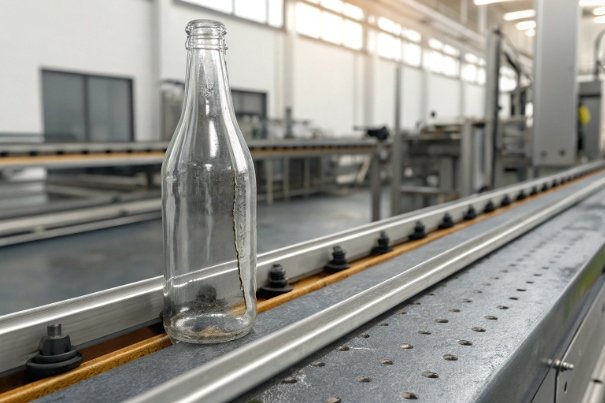
The Mechanics of the "Thermal Crash"
When a frozen bottle encounters hot water or steam, the surface temperature creates a massive gradient 6 relative to the core. We call this a "thermal crash." In our factory testing at FuSenglass, we observe that the stress is tensile on the cooler side and compressive on the hotter side. Since glass is significantly weaker in tension than in compression, the failure almost always originates from the side being cooled (or in this case, the cold side resisting the hot expansion).
However, in a freeze-to-heat scenario, the dynamic is slightly different. The outer skin expands, pulling away from the cold, contracted interior. This puts the interior surface in tension? Actually, if you heat the outside, the outside expands and goes into compression, putting the inside into tension. If the inside is frozen, it is brittle and already contracted. The shear force between these layers tears the structure apart.
Vulnerability of the Base and Heel
The most common failure point is the heel (the curve where the bottom meets the sidewall) and the base itself. Why? Because this is typically where the glass is thickest. Thicker glass requires more time for temperature to equalize. Therefore, the temperature gradient between the outer surface and the inner core is steepest in the thick base.
Conversely, the sidewalls are thinner and heat up faster, creating a differential expansion between the wall and the heavy base. This usually results in a circumferential crack around the bottom—literally causing the bottom of the bottle to drop off.
The Role of Micro-Fractures
No glass bottle is perfect. Microscopically, the surface has tiny Griffith flaws. When thermal stress is applied, it seeks out these weak points. The base of the bottle, which often has knurling (the textured pattern) or baffle marks from the mold, naturally has more stress concentrators.
| Failure Location | Cause of Failure | Visual Characteristic | Prevention Strategy |
|---|---|---|---|
| Heel / Base | Thickness differential; slow heat transfer. | Circumferential crack; bottom separation. | Uniform bottom plate design; slower heating. |
| Sidewall | Uneven wall distribution (wedging). | Vertical split or "zipper" crack. | Strict blow-mold control; rotation checks. |
| Finish (Neck) | Thermal shock during capping/washing. | C-cracks or chipped sealing surface. | Avoid hot steam on frozen necks. |
| Shoulder | Impact damage combined with thermal stress. | Butterfly crack. | Protect bottles during transit; minimize contact. |
| Mold Seams | Stress concentration at the seam line. | Split along the parting line. | High-quality mold maintenance. |
Identifying these failure modes allows us to adjust the mold design or the heating tunnel parameters to protect the most vulnerable areas.
What thawing and staged preheating process best prevents breakage before warming or hot filling?
Rushing the thaw process destroys inventory and risks product safety with glass inclusion. Controlled, staged heating is the only viable path to zero defects.
A staged "slacking" process is best, bringing bottles from frozen to ambient (0°C to 20°C) slowly, followed by a warm-water rinse (max 40°C) before any hot filling. Steps must not exceed a ΔT of 40°C.
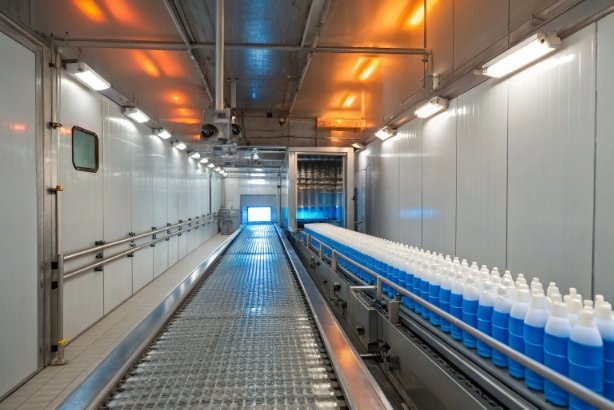
The "Slacking" or Tempering Strategy
In logistics and warehousing, "slacking" refers to the gradual thawing of frozen goods. For glass, this is non-negotiable. If you receive pallets of glass that have been sitting in a freezing unheated warehouse in winter (or a reefer truck), you cannot move them directly to a filler.
I recommend a 24-hour acclimatization period. Move the pallets into a "tempering zone" in the warehouse that is set to 10°C–15°C. This passive warming allows the glass to stabilize without any external thermal shock. It is the cheapest and safest method.
Active Staged Heating on the Line
If passive tempering isn’t possible due to JIT (Just-In-Time) constraints, you must implement an active staged heating tunnel. We design these for clients frequently. The bottle must pass through multiple zones.
-
Zone 1 (Mist): A lukewarm mist (20°C) removes surface frost and gently nudges the temperature up.
-
Zone 2 (Soak): A water bath or heavy spray at 35°C.
-
Zone 3 (Pre-heat): Water spray at 50°C.
-
Fill Station: Product at 85°C (Hot Fill).
Notice that no step jumps more than 30°C–35°C. This safety margin accounts for process variability.
Dry vs. Wet Preheating
Wet heating (water spray) is generally more effective than dry air heating because water transfers heat 25 times faster than air. However, dry air poses less risk of thermal shock if the air temperature is high, because the transfer is inefficient. For high-speed lines, wet staged heating is the industry standard.
| Process Step | Temperature Target | Max ΔT Allowed | Method |
|---|---|---|---|
| Frozen Storage | -10°C to -5°C | N/A | Pallet storage. |
| Tempering (Passive) | 10°C to 15°C | 20°C rise (slow) | Ambient warehouse staging (24hrs). |
| Zone 1 Rinse | 25°C to 30°C | ~15°C jump | Low-pressure water spray. |
| Zone 2 Pre-heat | 45°C to 50°C | ~20°C jump | Hot water tunnel / steam tunnel. |
| Hot Filling | 85°C to 90°C | ~40°C jump | Product filling. |
By breaking the large temperature gap into smaller, manageable steps, we keep the stress well below the glass’s breaking point.
Which bottle specifications (glass type, wall thickness uniformity, shoulder/finish design) are most suitable for freeze-to-heat scenarios?
Generic, lightweight bottles fail under thermal stress, causing line stoppages and financial loss. Selecting the right design is an investment in process reliability.
Bottles with high wall thickness uniformity (min/max ratio > 0.7), generous heel radii, and heavyweight "premium" designs perform best. Avoid sharp corners and thin-walled "eco" lightweight glass for extreme thermal cycling.
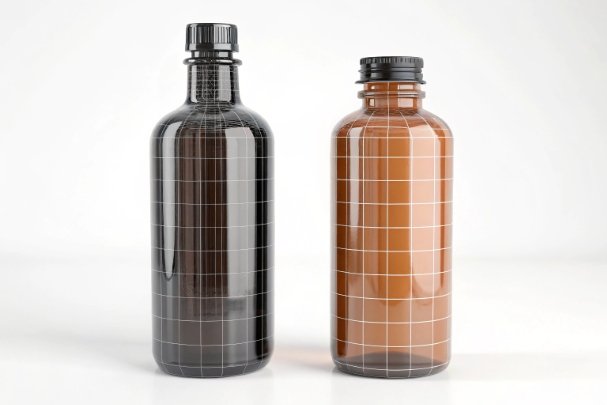
The Criticality of Uniformity
The enemy of thermal endurance is variation. If one side of the bottle is 2mm thick and the other is 4mm, they will expand at different rates. At FuSenglass, we use strict "Wall Thickness Inspection" (measured via Hall Effect sensors 7) to ensuring uniformity. For thermal cycling, I recommend a minimum wall thickness of 2.5mm, but more importantly, a uniformity ratio (Minimum Thickness / Maximum Thickness) of at least 0.7 or higher.
Geometric Design Features
Sharp angles are stress concentrators. A square bottle is inherently weaker than a round bottle during thermal shock. The corners accumulate stress.
-
Shoulders: Gentle, sloping shoulders dissipate stress better than severe, 90-degree shoulders.
-
Heel Radius: A larger radius at the bottom (where the wall meets the base) acts as a shock absorber for thermal expansion.
-
Base Design: Avoid heavy, uneven "push-ups" (punts 8) unless they are molded with extreme precision. A flat, even base often heats more uniformly than a complex, thick punt.
Glass Weight and Distribution
There is a trend toward "lightweighting" to save shipping costs and reduce emissions—something we support at FuSenglass. However, for freeze-to-heat applications, ultra-lightweight glass is risky. It lacks the thermal mass to buffer the change, although ironically, thin glass can sometimes survive shock better because there is less thickness for a gradient to form. The problem is that thin glass is fragile to handling impact. The "sweet spot" is a medium-to-heavy weight bottle where the glass distribution is perfectly even.
| Spec Category | Recommended Feature | Why it Helps |
|---|---|---|
| Shape | Cylindrical / Round | Distributes radial stress evenly; no corners. |
| Wall Thickness | Uniformity > 0.7 Ratio | Prevents hot/cold spots and differential expansion. |
| Glass Weight | Medium-Heavy | Provides structural integrity against handling + stress. |
| Base Radius | Large / Gentle Curve | Reduces stress concentration at the anchor point. |
| Surface Treatment | Hot/Cold End Coating | Prevents scratches which become crack initiation sites. |
Choosing the right mold is not just about aesthetics; it is about engineering survivability for your specific supply chain conditions.
What validation tests should be used to qualify glass bottles for freeze–thaw plus heating cycles in production?
Guessing your bottle’s limits leads to market recalls and dangerous failures in consumer hands. rigorous, standardized testing provides the data needed for safe operations.
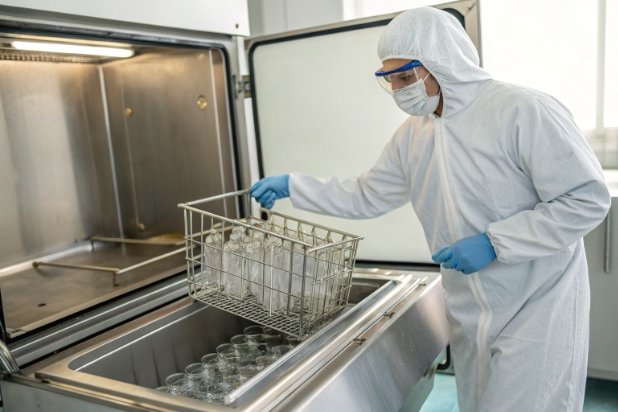
You must perform the ASTM C149 Thermal Shock Test, specifically modified to simulate your worst-case ΔT (e.g., -10°C to 50°C). Additionally, conduct Real-World Simulation cycling and Polariscopic examination for residual stress.
ASTM C149: The Gold Standard
The industry standard is ASTM C149 9 "Standard Test Method for Thermal Shock Resistance of Glass Containers." In this test, we submerge a basket of bottles in a hot water bath, then immediately transfer them to a cold water bath.
For your specific "freeze-to-heat" scenario, we invert this. We condition the bottles in a freezer to your supply chain low (e.g., -15°C). Then, we plunge them into water baths of increasing temperatures (20°C, 40°C, 60°C) to find the failure point (Delta T).
Pass Criteria: For a standard production run, we typically look for a survival rate of 100% at ΔT = 42°C. If your process requires a ΔT of 60°C, we need to design a custom mold or process.
Polariscopic Examination
Before any thermal testing, we check the "annealing" quality. A polariscope 10 shows the residual internal stress in the glass (appearing as colorful fringes). If the bottle was not properly annealed (cooled slowly) after manufacturing, it will have "frozen-in" stress. These bottles will explode the moment they are heated. We rate annealing on a scale of 1 to 5 (Temper Number). For thermal applications, you need Grade 1 or 2 (excellent annealing).
Validation Protocol for Buyers
When you ask us to validate a new bottle for a harsh environment, we follow this protocol:
-
Annealing Check: Confirm low residual stress.
-
Ramp Test: subject 30 samples to incremental ΔT increases until 50% failure (this finds the distinct limit).
-
Simulation: mimic the exact filling line conditions (spray nozzles, conveyor speeds) with the frozen bottles.
| Test Name | Purpose | Target Metric |
|---|---|---|
| ASTM C149 (Modified) | Determine max ΔT survival. | 100% Pass at ΔT 42°C. |
| Polariscope Analysis | Check internal residual stress. | Grade 2 or better (Low Stress). |
| Wall Thickness Scan | Ensure even distribution. | No spot < 1.5mm (depending on size). |
| Impact Test | Ensure handling strength. | Pass standard drop/impact thresholds. |
| Simulation Run | Replicate factory conditions. | Zero breakage in 500-unit trial. |
Testing is your insurance policy. Never assume a standard bottle can handle a frozen supply chain without validation.
Conclusion
Directly heating frozen glass is a guarantee of failure. To succeed, you must respect the ΔT limit of ~42°C, utilize rounder designs with uniform walls, and implement a rigorous staged thawing process validated by ASTM standards.
Footnotes
-
The rate at which heat passes through a specified material, expressed as W/(m·K). ↩
-
The maximum stress a material can withstand while being stretched or pulled before failing. ↩
-
Mechanical stress caused by a rapid change in temperature, often leading to fracture. ↩
-
A location in an object where the stress is significantly greater than the surrounding area. ↩
-
A type of glass with silica and boron trioxide, having very low coefficients of thermal expansion. ↩
-
The rate of change of temperature with respect to distance. ↩
-
A transducer that varies its output voltage in response to a magnetic field, used for thickness measurement. ↩
-
The indentation at the bottom of a bottle, increasing strength and stability. ↩
-
Standard test method for thermal shock resistance of glass containers. ↩
-
An optical instrument used to detect internal stresses in glass and other transparent materials. ↩






