
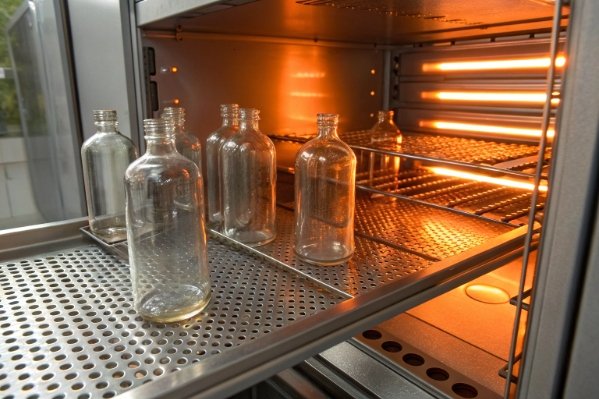
Using heat to sanitize bottles is a standard industry practice, but without understanding the material limits, it can quickly turn a batch of inventory into a pile of shards.
Yes, glass bottles can withstand high-temperature disinfection, but their survival depends entirely on the method used. While Borosilicate glass is virtually immune to heat stress, standard Soda-Lime glass requires strict "ramp-up" and "cool-down" controls to prevent thermal shock fracture during steam or dry-heat cycles.
The Three Heat Threats
At FuSenglass, we categorize disinfection into three tiers, each with its own risk profile for glass:
-
Boiling Water (100°C): The main risk is thermal shock 1 if bottles are dropped into already-boiling water.
-
Steam Autoclave (121°C): Adds pressure to the equation. The risk is bursting if internal pressure isn’t balanced.
-
Dry Heat / Depyrogenation (250°C+): Used for pharma vials. The risk is extreme thermal expansion 2 and potential deformation if close to the annealing point.
Standard glass is not "fireproof." It is a ceramic material that is strong in compression but weak in tension. Rapid heating puts the outside in compression (safe), but rapid cooling puts the outside in tension (danger). This is why bottles usually break after the disinfection cycle, during the cool-down.
Which glass types and bottle specifications are best suited for high-temperature disinfection (steam, boiling-water, or dry heat)?
Material selection is the first line of defense. You cannot force a standard cosmetic bottle to perform like a laboratory beaker.
Type I Borosilicate Glass is the gold standard for all high-temp methods due to its low expansion coefficient. However, standard Type III Soda-Lime glass is acceptable for boiling and autoclaving if specified as "Heavy Weight" or "Retort Grade" to ensure uniform heat distribution and pressure resistance.
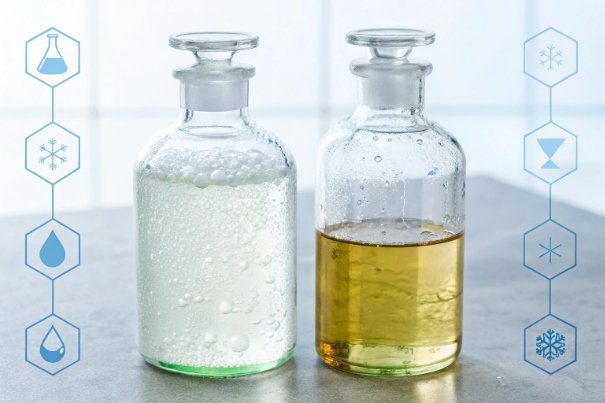
The Material Hierarchy
1. Type I Borosilicate (Neutral Glass):
-
Best For: Depyrogenation 3 ovens (300°C), rapid autoclaving, and repeated sterilization (reusable milk bottles).
-
Why: It expands very little when heated ($CTE \approx 3.3$). You can take it from 150°C to 20°C without it breaking. It is the only choice for extreme dry heat.
2. Type III Soda-Lime (Standard):
-
Best For: One-time pasteurization, hot-fill, and slow-cycle autoclaving.
-
Why: It has high expansion ($CTE \approx 9.0$). It cannot handle sudden changes ($\Delta T > 42^\circ C$).
-
Specification Requirement: If you must use Soda-Lime for disinfection, specify "Retort Grade" or "ISO 7459 Thermal Shock compliant." Avoid lightweight NNPB bottles for autoclaves, as thin walls may collapse under vacuum during cooling.
3. Type II (Treated):
-
Best For: Acidic medical solutions.
-
Note: Thermal properties are the same as Type III (Soda-Lime). The treatment only improves chemical resistance, not heat resistance.
What temperature ramp-up and cooling practices help prevent thermal shock cracking during high-temperature disinfection?
The "Delta T" ($\Delta T$) rule dictates the speed limit of your process. You cannot rush physics.
To prevent cracking in Soda-Lime glass, the temperature difference between the bottle and the heating/cooling medium must never exceed 42°C. This requires a "Stepped Ramp" approach: heating the water/oven at 5-10°C per minute and, crucially, cooling slowly with warm water sprays before final cold rinsing.
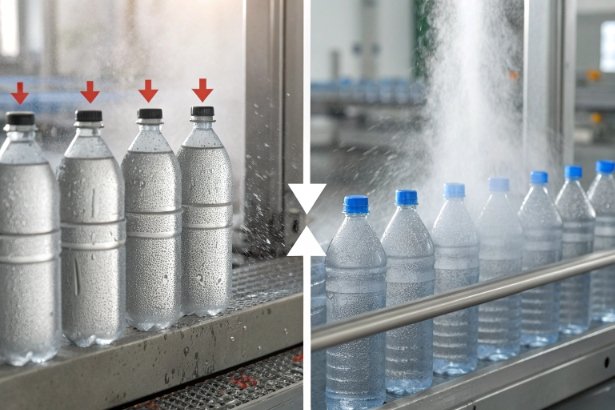
The Safe Cycle Strategy
For Boiling Water (100°C):
-
The Mistake: Dropping cold bottles into boiling water. ($\Delta T = 80^\circ C \to$ Crash).
-
The Fix: Place bottles in cold water and bring them to a boil together. This ensures the glass heats up evenly with the water. $\Delta T \approx 0$.
For Steam Autoclave (121°C):
-
Heating: Ramp up slowly (over 15-20 mins). Steam heats unevenly, so give the glass time to conduct the heat from the surface to the core.
-
Cooling (The Danger Zone): Do not vent steam instantly. Use Air Ballast (compressed air) to maintain pressure while introducing warm cooling water (80°C), then tepid (50°C), then cool (25°C).
For Dry Heat (250°C):
- The Limit: Soda-lime glass can withstand this static temp, but the ramp-down must be incredibly slow inside the lehr 4/oven to prevent "Thermal Stress Hysteresis" (permanent weakening). Borosilicate is preferred here to save time.
How can finish design and closure matching reduce mouth/neck cracking after high-temperature disinfection?
The neck is the most fragile part of the bottle during disinfection because it heats and cools faster than the body, and it is under mechanical stress from the cap.
A "Radiused" (Rounded) finish design prevents stress concentration at the lip. Furthermore, utilizing "Venting Closures" (like lug caps) is essential during steam disinfection to allow internal pressure to escape, preventing the "Hoop Stress" from splitting the neck threads.
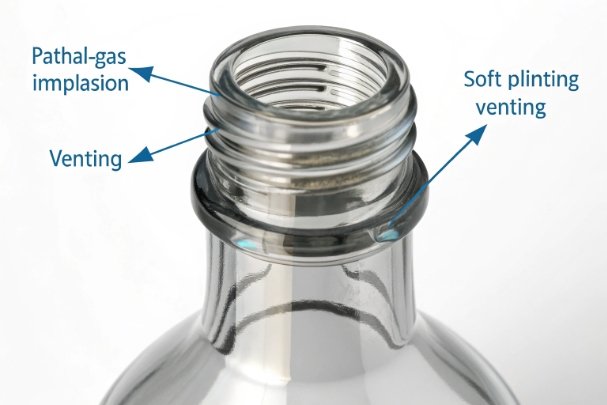
Protecting the Neck
1. The Thermal Mass Problem:
The finish is thin and sticks out. In an oven or autoclave, it changes temperature faster than the heavy base.
-
Result: The neck contracts while the body is still expanded. Tension forms at the neck-shoulder junction.
-
Design Fix: Use a Transfer Bead (Neck Ring) to act as a thermal buffer/stiffener between the neck and shoulder.
2. The Pressure Split:
If you disinfect a sealed bottle, the pressure inside pushes out against the neck wall.
-
The Risk: If the cap is screwed on tight (Continuous Thread), the expansion force can split the glass threads vertically.
-
The Fix: Use Lug Caps (Twist-Off) that are designed to lift and vent. Or, if using screw caps, apply them to "fingertip tightness" only, allowing slight back-off, and retorque after cooling (if sterility permits).
3. Finish Geometry:
Avoid "Flat Top" finishes. A fully rounded lip distributes thermal impact better and resists chipping if the bottles jostle during the process.
What validation trials and QC tests should be required from suppliers to confirm high-temperature disinfection compatibility?
Don’t guess—validate. A datasheet saying "Heat Resistant" is not enough.
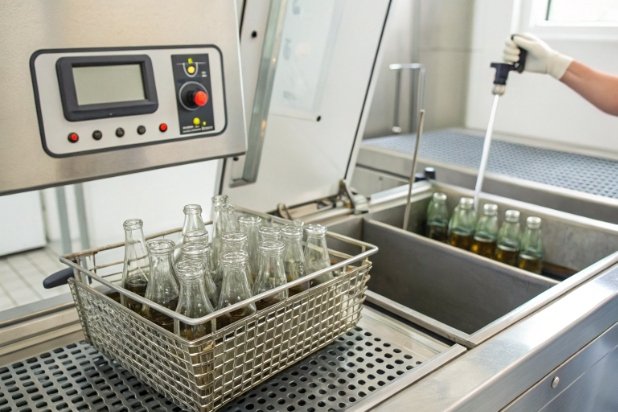
Suppliers must provide "ASTM C149 Thermal Shock" data ($\Delta T$ rating) and "ASTM C148 Annealing" grades (residual stress). Buyers should conduct a "Simulation Run" using water-filled bottles in their actual disinfection unit to check for delayed breakage (24-hour hold) and seal integrity.
The Verification Checklist
1. Thermal Shock Certification (Lab):
-
Ask For: The $\Delta T$ limit.
-
Standard: Soda-Lime $\ge 42^\circ C$; Borosilicate $\ge 120^\circ C$.
-
Action: Ensure your process ramp never exceeds this $\Delta T$.
2. Annealing Quality (Polariscope):
-
Ask For: Real Temper Number.
-
Standard: Grade 1 or 2.
-
Why: A bottle with Grade 3 residual stress will explode in an autoclave. Disinfection adds stress; you need a "clean slate" to start with.
3. The "Dummy Load" (Field Test):
-
Procedure: Load your autoclave/oven with 50 water-filled samples. Run your standard cycle.
-
Inspection:
-
Immediate Breakage: Thermal shock failure.
-
Delayed Breakage (24h): Micro-cracks growing from pressure stress.
-
Vacuum Check: Did the seals hold? (Listen for the "pop" when opening).
-
Testing Matrix
| Test | Lab / Field | Acceptance Criteria |
|---|---|---|
| Thermal Shock | Lab | 100% Pass @ $\Delta T$ 42°C. |
| Annealing | Lab | Grade $\le 2$. |
| Burst Pressure | Lab | > 14 Bar (if Autoclaving). |
| Simulation | Field | 0% Breakage in actual cycle. |
Conclusion
High-temperature disinfection is safe for glass, provided you respect the Time-Temperature relationship. By choosing Uniform Wall bottles and implementing Stepped Cooling, you can ensure sterility without sacrificing your packaging.
Footnotes
-
Stress induced in a body when some or all of its parts are not free to expand or contract in response to temperature changes. ↩
-
The tendency of matter to change in volume in response to a change in temperature. ↩
-
The removal of pyrogens (fever-inducing substances) from pharmaceutical containers using high heat. ↩
-
A long, tunnel-shaped oven used to anneal glass by slowly cooling it from a high temperature. ↩






