
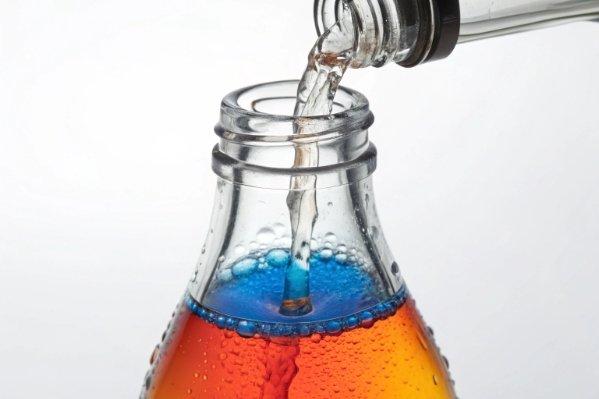
There is a widespread misconception in the packaging world that "heavy" equals "indestructible." While a thick, heavy base feels luxurious and resists physical impact well, it is often the first part to fail under thermal stress.
No, thick-bottom bottles are generally less resistant to thermal shock than standard bottles. The thick mass of glass acts as a thermal insulator, creating a severe temperature difference (gradient) between the inner surface and the core, generating massive internal tension that can snap the base off entirely.
The "Heavy Glass" Paradox
At FuSenglass, we produce premium "heavy-bottom" bottles for perfume and spirits clients who want that substantial, expensive feel. However, when a client asks to use these same bottles for a hot-fill candle or a pasteurized beverage, I have to hit the brakes.
Glass is a poor conductor of heat 1. When you pour hot liquid into a bottle:
-
Thin Glass: Heat transfers through the wall almost instantly. The inner and outer surfaces expand together. The stress is low.
-
Thick Glass: The inner surface (touching the liquid) heats up and tries to expand immediately. The core of the thick base, however, stays cold because the heat hasn’t traveled that far yet.
This "lag" creates a war inside the glass. The expanding interior pushes against the rigid, cold exterior. Since glass cannot stretch, this tension looks for the weakest point—usually the "Heel" (where the wall meets the bottom)—and cracks it.
Performance Comparison
| Feature | Standard Base (Uniform) | Heavy Base (Thick) |
|---|---|---|
| Physical Strength | Moderate | High (Impact resistant) |
| Thermal Conductivity | Fast | Slow (Insulating) |
| Thermal Gradient | Low | High (Dangerous) |
| Shock Risk | Low | High |
| Common Defect | Wall Breakage | Base Separation / Heel Crack |
Why can a thick base create higher thermal gradients and stress, and when does it reduce—not improve—thermal shock resistance?
A thick base acts like a heat sink that refuses to adjust to temperature changes, turning the bottle’s own geometry against itself.
A thick base reduces thermal shock resistance because it prevents uniform expansion. During hot-filling, the inner surface expands while the thick outer mass remains contracted, creating tensile stress at the interface. If this stress exceeds the glass’s tensile strength, the bottom will separate in a perfect circle (a "ringing" break).
The Mechanics of the "Bottom Drop"
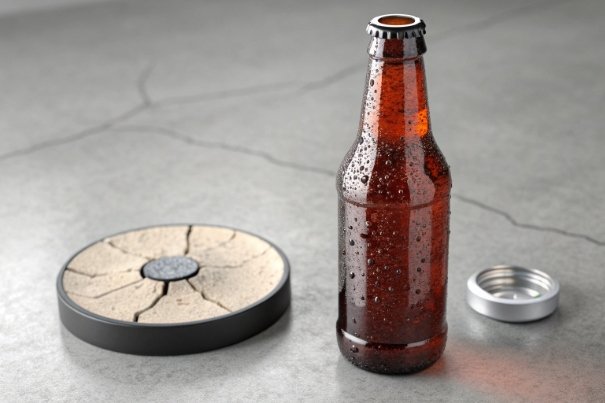
We see this failure mode in the lab frequently. It is distinctive. The bottle doesn’t shatter; the bottom just drops out cleanly, like it was cut with a laser.
1. The Insulator Effect:
Glass has low thermal conductivity. In a base that is 15mm thick (common for perfume), heat takes a long time to reach the outside.
-
Hot Fill (90°C): The top 1mm of the inner floor heats to 90°C instantly. The bottom 14mm is still at 20°C.
-
The Result: The top layer expands. The bottom block does not. The shear force between these layers rips the glass apart.
2. The Cooling Trap:
The reverse is also true. If a thick-bottom bottle is hot (after pasteurization) and enters a cooling tunnel, the thin sidewalls cool down fast. The thick base stays hot for minutes longer. The contracting walls pull against the still-expanded base, causing stress cracks at the heel.
When is thick glass worse?
It is always worse for rapid temperature changes ($\Delta T$). Thicker glass is only better for mechanical shock (like dropping the bottle on the floor), not thermal shock 2.
How do base design details (push-up shape, heel radius, thickness uniformity) affect thermal shock performance in thick-bottom bottles?
If you must use a heavy base for aesthetic reasons, you have to engineer the geometry to "cheat" the physics of thermal stress.
To mitigate the risks of a thick base, designers must use a high "Push-Up" (punt) to reduce the effective cross-sectional thickness, and a large "Heel Radius" to distribute stress. Avoiding sharp internal corners is critical, as these act as stress concentrators that initiate cracks.
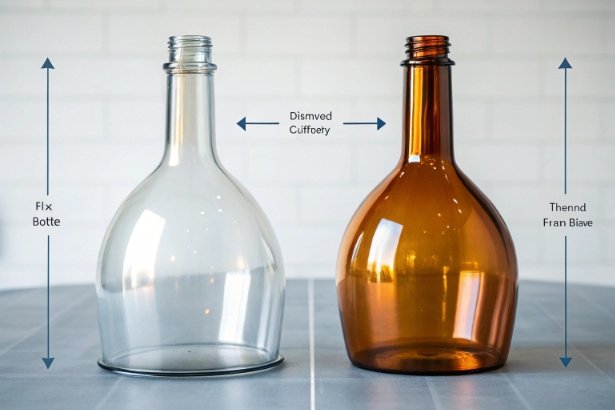
Engineering the Heavy Base
We can make a heavy bottle safe for moderate heat, but it requires specific design rules.
1. The "Push-Up" (Punt):
A flat, solid block of glass is the worst design. By pushing the center of the bottom up (creating a dome or punt 3), we do two things:
-
Reduce Thickness: We remove the "dead weight" in the center, making the effective glass thickness more uniform.
-
Allow Flex: The dome shape can flex slightly (like an arch) to absorb expansion pressure, whereas a flat plate cannot.
2. The Heel Radius:
The connection point between the wall and the base is the most stressed zone.
-
Bad Design: A sharp, square corner inside the bottle. Stress concentrations 4 accumulate here.
-
Good Design: A generous, sweeping curve (radius > 5mm). This spreads the tension over a wider area, preventing a crack from starting.
3. Uniformity vs. Weight:
We try to concentrate the weight in the center of the punt rather than at the edges. If the edges (heel) are too thick, they will pull on the sidewalls during cooling.
Design Checklist for Thermal Safety
| Feature | Risky Design | Safe Design |
|---|---|---|
| Base Shape | Flat / Solid Block | Domed / Punted |
| Internal Corner | Sharp ($90^\circ$) | Rounded (Large Radius) |
| Glass Distribution | Thick Heel / Thin Wall | Gradual Transition |
| Bottom Profile | Flat Contact | Stippled / Knurled (Reduces thermal contact) |
What annealing controls are required for thick-bottom bottles to prevent residual stress and cracking during temperature swings?
A thick bottle requires a "slow roast" in the annealing oven; standard settings will leave the core hot and stressed.
Thick-bottom bottles require significantly longer annealing cycles ("Soak Time") to allow heat to escape the dense core. The cooling curve must be extended to prevent the outer surface from hardening while the inner core is still soft, which would permanently lock in destructive tension.
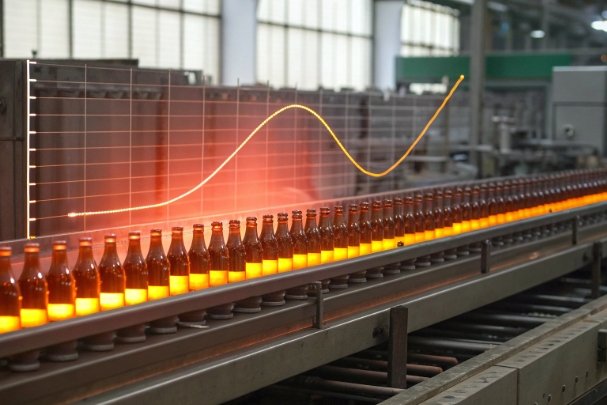
The "Thermal Inertia" Problem
In the glass factory, time is money. Running the annealing lehr slower reduces production speed. However, for heavy glass, there is no choice.
The Differential Cooling Risk:
In a standard cycle, the thin neck and walls of the bottle cool down to room temperature quickly. The 15mm thick base acts like a thermal battery 5—it holds heat.
If the bottle leaves the lehr while the base is still 100°C (but the walls are 40°C), the base will continue to cool and contract after the walls have set. This contraction pulls the walls inward, creating permanent "Tension" at the heel.
The Adjustment:
-
Longer Soak: We keep the bottles at 550°C (Annealing Point 6) for extra time to ensure the center of the base reaches the same temperature as the surface.
-
Slower Descent: We lower the cooling rate from 5°C/min to perhaps 2°C/min. This ensures the difference between the core temp and surface temp never gets large enough to create stress.
Polariscope Check:
We watch heavy bottles like hawks under the Polariscope. If we see a "white ring" at the bottom, it means the annealing was too fast. That bottle is a ticking time bomb.
What thermal shock and stress tests should buyers use to compare thick-bottom vs standard-base glass bottles for hot-fill or rapid cooling applications?
Don’t assume your luxury bottle can handle the heat. You must torture-test it to find its breaking point.
Buyers must perform the ASTM C149 Thermal Shock Test, specifically looking for "Heel Tap" failures. Additionally, cross-sectioning the bottle to measure the "Base-to-Wall Thickness Ratio" helps predict failure risks; a ratio greater than 3:1 is a major red flag for thermal applications.
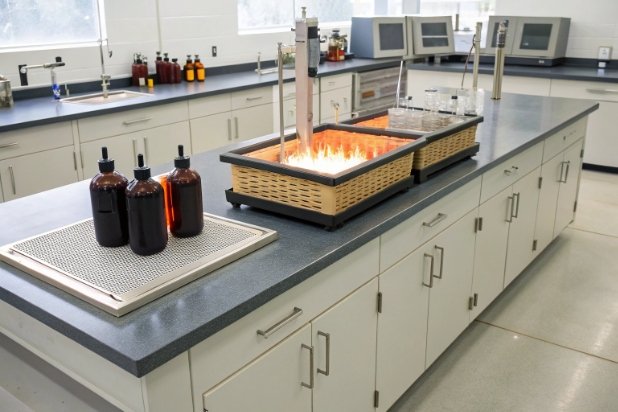
The Validation Protocol
1. The ASTM C149 Shock Test:
-
Standard: Heat to 65°C, plunge into 23°C ($\Delta T = 42^\circ C$).
-
Observation: For heavy bottles, look closely at the bottom. Did it separate? Did a crack appear just above the base?
-
Acceptance: Standard bottles usually pass easily. Heavy bottles often fail this standard test unless they are perfectly designed and annealed. You may need to lower your filling temp if they fail.
2. The "Saw & Measure" (Distribution Check):
We cut the bottle vertically with a diamond saw.
-
Measure: Thickness of the base vs. thickness of the sidewall just above the heel.
-
Ratio: If the base is 15mm and the wall is 2mm (Ratio 7.5:1), the thermal risk is extreme. Ideally, for heat applications, we want a ratio closer to 2:1 or 3:1.
3. Residual Stress Mapping:
Using a Polarimeter 7 (which gives a numerical stress value, not just colors), measure the stress at the Heel specifically.
- Limit: Real Temper Number < 2. Any higher stress in a thick base is unacceptable.
Test Strategy Matrix
| Test Method | Target | Warning Sign |
|---|---|---|
| Thermal Shock | Whole Bottle | separation of bottom ("Disk fracture"). |
| Cross-Section | Geometry | Wall-to-Base Ratio > 3:1. |
| Polarimeter | Heel Stress | Optical Path Difference > 250nm. |
| Hot Fill Sim | Production | Delayed breakage (24h after fill). |
Conclusion
While thick-bottom bottles offer a premium look and feel, they are inherently compromised when it comes to heat. By acknowledging this physical limitation and mitigating it through domed base designs and extended annealing, you can combine luxury aesthetics with safe performance.
Footnotes
-
The rate at which heat passes through a specified material, expressed as W/(m·K). ↩
-
Mechanical stress caused by a rapid change in temperature, often leading to fracture. ↩
-
The indentation at the bottom of a bottle, increasing strength and stability. ↩
-
A location in an object where the stress is significantly greater than the surrounding area. ↩
-
A material’s ability to store heat energy, releasing it slowly over time. ↩
-
The specific temperature at which internal stresses in glass are relieved within minutes. ↩
-
An optical instrument used to measure the polarization of light and detect stress. ↩






