
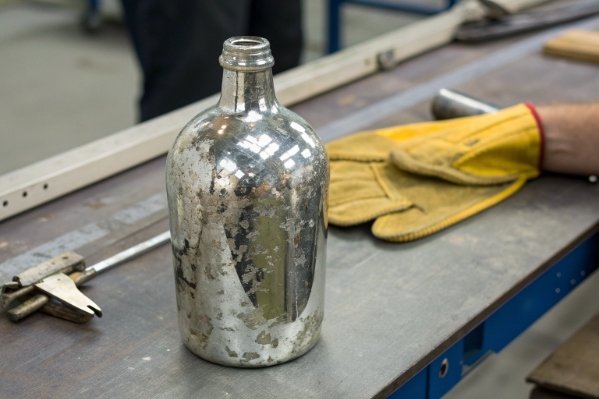
A dazzling metallic finish draws the eye, but invisible chemical reactions can strip away that luxury appeal, leaving a peeling, tarnished mess.
Yes, acid and alkali corrosion critically undermine the adhesion of electroplated coatings. By attacking the interface between the glass and the base coat, or by chemically degrading the metal layer itself, these corrosive agents cause blistering, delamination, and severe aesthetic failure.
The Fragile Bond: Glass vs. Metal
In the world of premium packaging—especially for perfumery and spirits—"electroplating" is often a misnomer. Since glass is non-conductive, what we usually call electroplating is actually UV Vacuum Metallization (PVD) or a multi-layer spray system. It’s a sandwich: a Base Coat (primer) to smooth the glass and provide grip, a microscopic Metal Layer (usually Aluminum) for the shine, and a Top Coat (lacquer) to protect it.
At FuSenglass, I often explain to clients that the weak link isn’t the glass, nor the metal—it’s the adhesion between these layers. Glass is hydrophilic (loves water) and chemically inert, making it notoriously difficult for coatings to stick to.
When acids or alkalis enter the equation, they don’t just sit on the surface. They migrate. They find microscopic pinholes in the top coat (the "barrier") and tunnel down. Once they reach the metal layer, oxidation occurs (tarnishing). Worse, if they reach the glass-coating interface, they disrupt the chemical bonds—often Van der Waals forces 1 or hydrogen bonds—that hold the primer to the bottle. The result is "underfilm corrosion," where the coating lifts off like a sticker that has lost its glue.
The Anatomy of Coating Failure
| Layer | Function | Vulnerability to Corrosion | Failure Mode |
|---|---|---|---|
| Top Coat (Lacquer) | Shield & Color | Permeable to solvents/acids over time. | Hazing, Softening, Pinholes. |
| Metal Layer (PVD) | Reflectivity (Shine) | Highly reactive to oxidation. | Black spots, Loss of mirror effect. |
| Base Coat (Primer) | Adhesion to Glass | Susceptible to hydrolysis 2 (water/alkali attack). | Delamination (Peeling). |
| Glass Surface | Substrate | Generally stable, but surface chemistry changes. | Moisture layer displaces primer. |
Which electroplated or metallized finishes on glass bottles are most vulnerable to acid/alkali exposure, and why?
While all coatings have limits, "fake" metallic finishes relying on organic dye systems are far more fragile than genuine noble metal applications.
Vacuum Metallized (PVD) Aluminum finishes colored with organic dyes are the most vulnerable. Unlike real gold or platinum fired onto glass, these "simulated" metallic looks rely on delicate organic lacquers which are easily compromised by chemical attack, leading to rapid oxidation of the underlying aluminum.
The Hierarchy of Durability
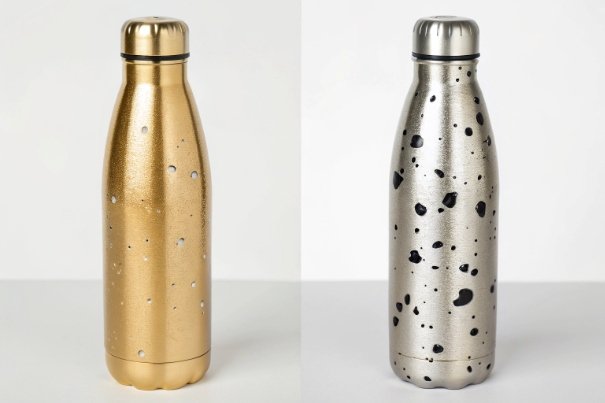
Not all "gold" bottles are created equal. In my 20 years of manufacturing, I’ve seen clients choose the cheaper option only to face a recall when the bottles started peeling in a humid warehouse.
1. UV Vacuum Metallization (The Most Common & Vulnerable):
This is the industry standard for mass-market "shiny" bottles. It uses a thin layer of Aluminum. Aluminum is highly reactive (amphoteric 3)—meaning it reacts with both acids and alkalis. The only thing stopping it from turning into white powder (Aluminum Oxide) is the thin Top Coat. If an alkali cleaner strips that top coat, the underlying aluminum dissolves instantly.
2. Water-Based Spray Metallization:
These are often eco-friendly options but typically have lower cross-linking density. They are highly susceptible to solvents and strong acids, which swell the polymer matrix, allowing chemicals to reach the glass surface.
3. Real Precious Metal Pastes (The Gold Standard):
This is traditional "fire plating." We print real liquid gold or platinum paste and fire it at 600°C. These are extremely resistant because the metal fuses into the glass surface. However, they are expensive. If you are seeing "peeling," you are almost certainly not using this method.
Vulnerability Matrix
| Finish Type | Composition | Acid Resistance | Alkali Resistance | Why it Fails |
|---|---|---|---|---|
| UV PVD (Gold/Silver) | Base + Al + Tinted Top | Moderate | Poor | Alkalis attack the organic base coat; Acids attack the Al layer. |
| Spray Gradient | Organic Paint | Moderate | Moderate | Solvents in contents can swell the paint, causing lifting. |
| Ceramic Firing | Real Metal Fused | High | High | Fused to glass; no organic layer to degrade. |
| Electro-Galvanized | True galvanic (Rare) | Low | Low | Zinc/Copper oxides form rapidly in humidity. |
What pH, concentration, temperature, and contact-time conditions typically cause electroplated coating peeling, blistering, or underfilm corrosion on glass?
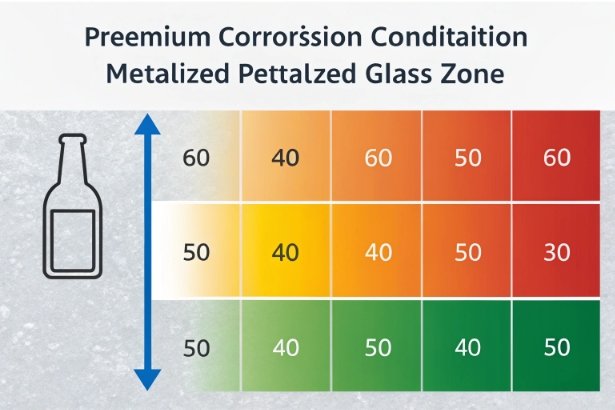
Extreme pH environments act as chemical strippers, while heat accelerates the permeation of these agents through the protective topcoat.
Caustic environments (pH > 11) combined with heat (>50°C) are the primary destroyers of electroplated adhesion, causing rapid base-coat hydrolysis. Conversely, acidic environments (pH < 3) tend to attack the metal layer itself through pinholes, causing "worm-track" corrosion under the lacquer.
The Parameters of Destruction
At FuSenglass, we warn our clients: the filling line is often more dangerous to the bottle than the consumer’s bathroom.
The "Caustic Wash" Danger (pH 12+):
Many bottling plants use hot caustic soda (Sodium Hydroxide) to clean filling nozzles or wash down the line. If a splashed droplet lands on a UV-plated bottle, it acts like a paint stripper. The high pH saponifies 4 the organic resins in the top coat and base coat. It essentially turns the hardened plastic coating back into soap. The result is large-scale peeling or "sheeting" of the finish.
The Acidic Permeation (pH < 4):
Acids (like those found in fruit-based cosmetics or cleaners) work differently. They are sneaky. They permeate the coating matrix over time. They might not destroy the coating immediately, but they migrate to the aluminum layer. There, they react to release hydrogen gas. This gas gets trapped under the top coat, creating blisters or bubbles.
Temperature as the Catalyst:
Temperature is the enemy of adhesion. High heat causes the coating to expand at a different rate than the glass (thermal mismatch). This mechanical stress puts the bond under tension. When you add chemical attack to this stressed state, the failure happens 10x faster.
Critical Failure Thresholds
| Parameter | "Safe" Zone | Danger Zone | Resulting Defect |
|---|---|---|---|
| pH Level | 5.0 – 9.0 | < 3.0 or > 11.0 | Top coat dissolving; Metal layer oxidation. |
| Temperature | 20°C – 40°C | > 60°C | Thermal expansion cracks; Accelerated permeation. |
| Contact Time | < 5 Minutes | > 24 Hours (Soak) | Swelling of organic layers; Loss of adhesion. |
| Concentration | Diluted (<5%) | Concentrated (>10%) | Immediate chemical burn; Spotting. |
What adhesion and chemical resistance tests should buyers require for electroplated glass bottles (cross-hatch, tape test, pull-off, immersion/spot tests)?
Rigorous testing protocols must simulate the harsh realities of the product’s lifecycle to ensure the coating stays put.
Buyers must enforce the ASTM D3359 Cross-Hatch Tape Test for baseline adhesion, combined with a 24-hour Bulk Immersion Test in the actual product (or simulant) to check for chemical resistance. Without these, you are flying blind regarding long-term durability.
Validating the Bond
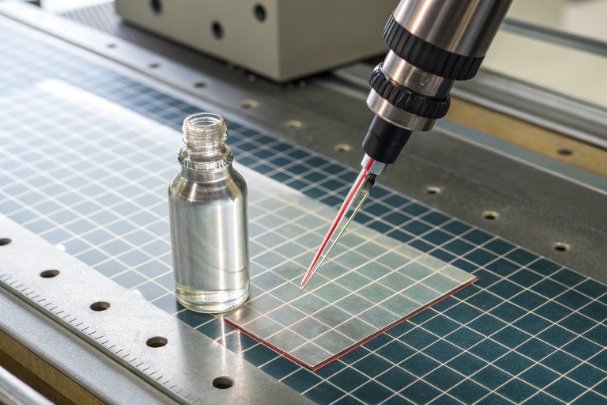
We never ship a plated order without QC. Visual inspection is useless for adhesion; you have to try to destroy the coating to know if it’s good.
1. Cross-Hatch Adhesion (The "Grid" Test):
We use a special blade to cut a grid pattern (usually 1mm x 1mm squares) through the coating down to the glass. We then apply aggressive pressure-sensitive tape (like 3M 610) over the grid and rip it off rapidly.
- Pass: The edges of the cuts are smooth; no squares detach (Class 5B).
- Fail: Flaking along the edges or whole squares peeling off (Class 0B-3B).
This tests mechanical adhesion. If it fails here, it will definitely fail with chemicals.
2. Chemical Immersion (The "Soak" Test):
This is critical. We submerge the bottle in three solutions:
- Standard: Water (48 hours).
- Acidic: Citric acid solution or the actual perfume bulk (24 hours).
- Alkaline: Dilute NaOH (simulating wash cycles) (1-2 hours).
After soaking, we repeat the Tape Test. Often, a bottle passes when dry but fails miserably when wet because the coating absorbs water and swells.
3. Alcohol Rub Test (MEK Test):
To test if the top coat is fully cured, we rub it with a cloth soaked in high-strength alcohol or MEK (Methyl Ethyl Ketone). If the color rubs onto the cloth, the curing was insufficient, meaning the chemical resistance is compromised.
Standard Testing Protocols
| Test Name | Method | Purpose | Acceptance Criteria |
|---|---|---|---|
| Cross-Hatch (Dry) | ASTM D3359 5 | Check physical bond strength. | Rating 4B or 5B ( < 5% removal). |
| Immersion + Tape | 24hr Soak | Check resistance to underfilm corrosion. | No blistering; Pass Tape Test after drying. |
| Pencil Hardness | ASTM D3363 6 | Check Top Coat scratch resistance. | Minimum ‘H’ or ‘2H’ hardness. |
| Dishwasher Cycle | 10 Cycles | Simulate household/industrial washing. | No gloss reduction; No peeling. |
How can suppliers improve electroplated coating adhesion and chemical durability on glass (pretreatment, basecoat/primer, topcoat sealing, curing and thickness control)?
Achieving a bulletproof finish requires chemical bridging agents and precise energy control to lock the coating onto the glass surface.
Suppliers must use Silane Coupling Agents (Flame/Pyrosil treatment) to chemically bond the organic base coat to the inorganic glass. Furthermore, increasing the cross-linking density of the top coat through precise UV curing energy ensures a hermetic seal against chemical ingress.
The Science of "Stickiness"
At FuSenglass, improving adhesion is about bridging the gap between two different worlds: the inorganic glass and the organic coating.
1. Surface Pre-treatment (The Anchor):
You cannot just spray paint onto slick glass. We use Flame Treatment or Pyrosil Treatment. This involves burning a silicon-based precursor onto the glass surface immediately before coating. This deposits active $Si-O$ groups that act as "chemical velcro." They bond to the glass on one side and react with the paint on the other. This increases adhesion strength by 300%.
2. The Base Coat Chemistry:
The base coat is the foundation. We use high-grade epoxy-acrylate hybrids. Epoxy 7 offers the best adhesion to glass, while acrylate offers fast UV curing. Cheap suppliers use pure acrylates, which are brittle and prone to peeling.
3. Top Coat Cross-Linking:
The top coat is the shield. To stop acids from permeating, the coating needs a "tight" molecular structure. We achieve this by controlling the UV Exposure (Joules/cm²). If the UV light is too weak, the coating is "under-cured" and soft (permeable). If it’s too strong, it becomes brittle. We monitor this daily.
4. Thickness Control:
Thicker isn’t always better. If the coating is too thick (>20 microns), internal stress builds up during curing, leading to spontaneous cracking. We aim for a "Goldilocks" zone—usually 10-15 microns—enough to protect, but thin enough to flex.
Optimization Checklist
| Process Step | Improvement Strategy | Mechanism | Benefit |
|---|---|---|---|
| Pre-Treatment | Silane / Pyrosil | Creates covalent bonds 8 ($Si-O-C$). | Prevents moisture from displacing the primer. |
| Base Coat | Epoxy-Modified | High-modulus resin selection. | Superior grip to the glass surface. |
| Curing | Mercury/Gallium Lamps | Multi-spectrum UV curing. | Ensures full depth cure (through to the glass). |
| Top Coat | Hydrophobic Additives | Wax/Teflon 9 additives. | Repels water/chemicals from surface. |
Conclusion
A peeling bottle is a brand disaster. By insisting on Silane pre-treatments and validating with immersion testing, you can ensure your beautiful metallic finish survives the harsh chemical reality of the real world.
Footnotes
-
Weak attractive forces between atoms or nonpolar molecules. ↩
-
A chemical reaction in which water is used to break down the bonds of a particular substance. ↩
-
A chemical species that can react as either an acid or a base. ↩
-
The process by which esters are hydrolyzed under basic conditions to form an alcohol and the salt of a carboxylic acid. ↩
-
Standard test methods for measuring adhesion by tape test. ↩
-
Standard test method for film hardness by pencil test. ↩
-
A class of reactive prepolymers and polymers which contain epoxide groups. ↩
-
A chemical bond that involves the sharing of electron pairs between atoms. ↩
-
Polytetrafluoroethylene, a synthetic fluoropolymer of tetrafluoroethylene. ↩






