
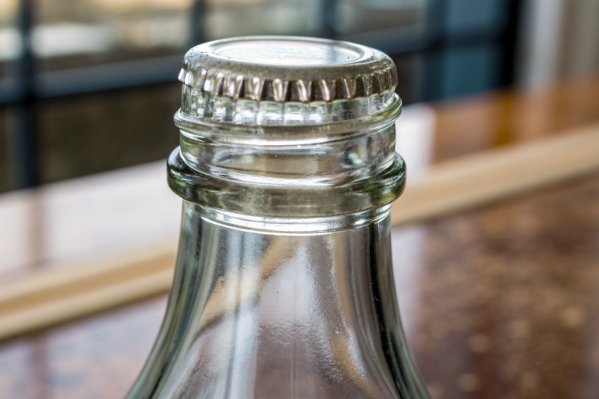
A secure seal is the guardian of product quality, but chemical aggression can silently erode the precise interface between the bottle and the cap.
Yes, acid and alkali corrosion can critically compromise sealing performance. By etching the glass finish (sealing land) and degrading closure liners, chemical exposure creates microscopic leak paths, causes torque loss, and ultimately destroys the hermetic seal needed to protect your product.
The Critical Interface: Where Glass Meets Closure
At FuSenglass, we tell our clients that a bottle is only as good as its seal. You can have the strongest glass body in the world, but if the finish—the top ring where the cap sits—is compromised, the package has failed. In my two decades of experience, I’ve seen countless cases where "leaking bottles" were actually victims of chemical incompatibility.
The sealing surface, or the "land," is precision-engineered. We manufacture it to strict flatness tolerances (often within 0.1mm). When you introduce corrosive acids or strong alkalis into the mix, you aren’t just storing a liquid; you are subjecting this precision interface to a constant chemical attack.
Unlike the body of the bottle, which has thick walls, the sealing surface relies on smoothness. Corrosion acts like sandpaper, increasing the roughness (Ra value) of the glass. Once that roughness exceeds the liner’s ability to compress and fill the voids, you have a leak. This is particularly insidious because it often happens after the product has been shipped, as time and temperature accelerate the chemical reaction during transport.
The Sealing Ecosystem Risks
| Component | Function | Corrosion Impact | Result |
|---|---|---|---|
| Sealing Land (Glass) | Primary contact area | Pitting, etching, erosion | uneven surface prevents airtight seal |
| Thread (Glass) | Holds closure force | Dimensional drift, chipping | Cap "backs off" or strips threads |
| Liner (Closure) | Gasket material | Swelling, hardening, dissolving | Loss of elasticity and compression |
| Cap Shell (Metal/Plastic) | Applies pressure | Rust, stress cracking | Loss of down-force (application torque) |
Let’s dive into the specific mechanisms of how this failure occurs.
Can acid/alkali exposure damage the bottle finish and sealing surface (rim/land), leading to micro-chips, roughness, or dimensional drift?
The "finish" is the most mechanically precise part of a bottle, and chemical erosion here destroys the geometry required for a tight seal.
Chemical corrosion attacks the glass matrix of the sealing land, creating a rough, pitted surface (high Ra value) that prevents the liner from making full contact. Severe alkali exposure can even dissolve enough material to alter the dimension of threads, causing caps to loosen.
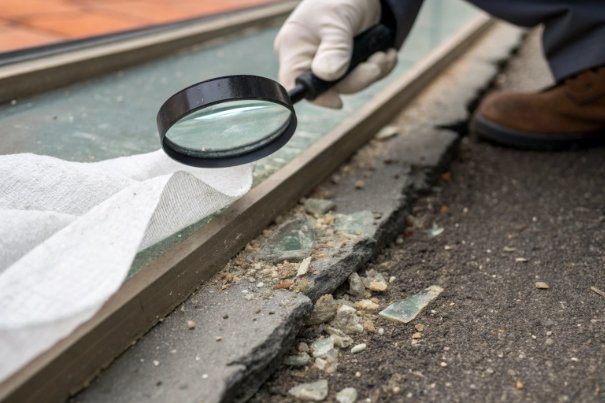
The Micro-Geography of a Leak
When we manufacture a bottle at FuSenglass, the sealing land (the very top rim) is inspected for absolute flatness. It must be a continuous, smooth ring. Corrosion changes this geography.
Acid Attack (Roughness):
Acids typically cause "leaching," leaving behind a silica-rich, porous layer. On the sealing surface, this manifests as increased roughness or "frosting." Standard cap liners (like PE foam) are designed to compress against a smooth surface. If the glass becomes sandpaper-rough due to acid etching, the liner cannot flow into every microscopic crevice. Gas molecules can then tunnel through these microscopic valleys, breaking the vacuum 1.
Alkali Attack (Dimensional Drift):
Alkalis are far more aggressive; they dissolve the glass network. We have seen cases in industrial settings where hot alkaline solutions literally "washed away" microns of glass from the thread profile. This leads to Dimensional Drift. If the thread geometry changes, the friction coefficient changes. The cap might feel tight initially, but as the glass dissolves, the physical engagement between the cap and bottle weakens. This can lead to "back-off," where the cap loosens on its own during vibration or thermal cycling.
Furthermore, a corroded surface is brittle. The down-force of a capping machine can crush the fragile, corroded silica layer on the rim, creating micro-chips. These tiny fractures act as highways for liquid to escape.
Surface Defect Classification
| Defect Type | Chemical Cause | Physical Manifestation | Sealing Consequence |
|---|---|---|---|
| Worming/Etching | Strong Alkalis | Snake-like channels on the rim | Direct liquid leak path under the liner. |
| Silica Haze | Acids | Rough, frosted texture | Gas permeation (loss of vacuum/carbonation). |
| Micro-Chipping | Chemical embrittlement | Tiny flakes breaking off the rim | Particles in product; liner puncture. |
| Thread Erosion | High pH + Heat | Thinning of thread profile | Cap stripping; inability to hold torque. |
How do acids and alkalis affect closures, liners, and coatings more than the glass itself, and how can this cause leaks?
Glass is chemically robust, but the organic or metallic materials used in closures are often the "weakest link" in the packaging system.
Closures and liners are far more susceptible to chemical attack than glass. Acids can embrittle plastic caps causing stress cracks, while alkalis can swell or dissolve liners, causing "Torque Loss" where the cap loses its grip on the bottle, leading to catastrophic leakage.
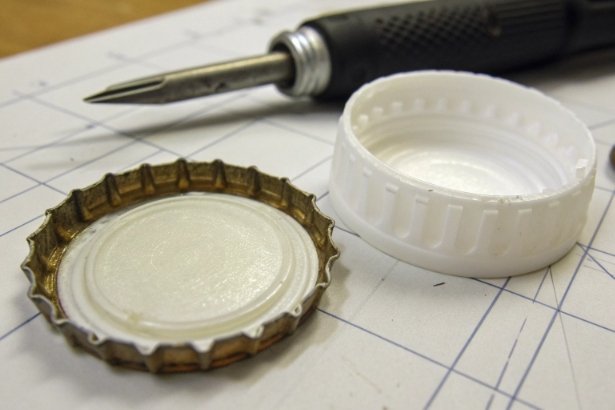
The Liner: The Achilles’ Heel
In my experience helping clients troubleshoot leakage, 90% of the time the failure isn’t the glass—it’s the interaction between the chemical and the liner. The liner acts as a gasket 2. It must remain elastic (springy) to maintain pressure against the glass rim.
Chemical Swelling and Softening:
Many solvents and alkalis can absorb into standard liners (like EPE or PVC). This causes the liner to swell. You might think swelling would create a tighter seal, but it actually distorts the cap. Eventually, the liner softens and loses its "memory." When the bottle cools down or experiences shock, the liner doesn’t spring back—it stays compressed. This phenomenon is called Compression Set. Once the liner takes a permanent set, the seal acts like a loose door; it’s closed, but not latched.
Stress Cracking (ESC):
Plastic caps (Polypropylene/PP) are prone to Environmental Stress Cracking 3 (ESC) when exposed to certain acids or surfactants. The stress of being screwed onto the bottle, combined with chemical exposure, causes the plastic to snap. You might find hairline cracks on the skirt of the cap. A cracked cap cannot maintain down-force.
Corrosion of Metal Closures:
For acidic food products (like pickles or vinegar), metal lug caps are common. If the internal coating of the cap is scratched or insufficient, the acid eats the metal. This not only ruins the seal but contaminates the product with rust.
Material Compatibility & Failure Modes
| Material | Vulnerability | Failure Mechanism | Visual Sign |
|---|---|---|---|
| Polypropylene (Cap) | Oxidizing Acids | Stress Cracking | Vertical cracks on cap skirt. |
| EPE Foam (Liner) | Solvents/Oils | Swelling / Dissolution | Liner looks "gummy" or deformed. |
| Plastisol (Liner) | High heat + Acid | Hardening / Embrittlement | Liner becomes rock hard; no seal. |
| Tinplate (Cap) | High Acid/Salt | Oxidation (Rust) | Brown stains; pinholes in metal. |
What leak-test methods (vacuum/pressure decay, torque retention, dye penetration) should buyers use after chemical exposure?
You cannot assume a bottle is sealed just because the cap looks tight; you must verify the integrity of the seal using both physical and vacuum-based testing.
To verify seal integrity after chemical exposure, buyers should prioritize Vacuum Decay for non-destructive testing and Torque Retention checks to detect liner relaxation. For failure analysis, Dye Penetration tests visually reveal exactly where the corrosion has opened a leak path.
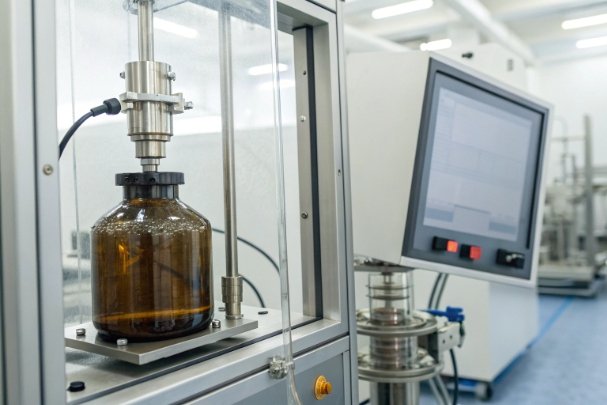
Validating the Seal
At FuSenglass, we recommend a "trust but verify" approach. If your product is chemically active, you need a stability testing protocol that includes seal integrity checks at 1, 3, and 6-month intervals.
1. Torque Retention (Removal Torque):
This is the simplest test. If you applied the cap with 15 inch-pounds of force, how much force does it take to open it after a month of storage? A healthy package retains 40-60% of application torque. If you can twist the cap off with near-zero effort, the liner has chemically degraded or "crept," or the glass threads have eroded. This "loose cap" syndrome is a major red flag for chemical incompatibility.
2. Vacuum Decay (CCIT):
This is a sophisticated, non-destructive method. The bottle is placed in a vacuum chamber. If there is even a microscopic path caused by acid etching on the rim, air will escape from the bottle into the chamber, causing a spike in pressure. This is essential for pharmaceutical or high-value cosmetic clients where even gas exchange is unacceptable.
3. Dye Penetration (The "Blue Bath"):
We submerge the bottles in a vacuum chamber filled with Methylene Blue dye 4. We pull a vacuum, then release it. If there is a leak, the blue dye is sucked into the bottle. By unscrewing the cap and looking at the white liner, we can see exactly where the dye crossed. If the dye tracks across the rim, it confirms the glass finish was too rough or the liner failed to compress.
Leak Detection Guide
| Test Method | Best For… | What it Detects | Pros/Cons |
|---|---|---|---|
| Torque Retention | Routine QA / Production | Liner relaxation / Back-off | Fast, cheap / Destructive (opens pack) |
| Vacuum Decay | Pharmaceuticals / High-end | Micro-leaks (gas tight) | Non-destructive, precise / Expensive equipment |
| Dye Penetration | Root Cause Analysis | Exact leak location | Visual proof / Destructive, messy |
| Secure Seal Test | Carbonated Drinks | Bubble point / Gross leaks | Good for pressure / Less sensitive |
What design and process controls (finish specs, annealing, protective coatings, compatible closure materials) prevent sealing failures in chemically exposed glass bottles?
Preventing leaks starts with engineering the interface—matching the right liner material to the chemical and ensuring the glass finish is manufactured to the tightest possible tolerances.
To prevent failure, specify "controlled flatness" finishes (GPI/SPI standards) and use chemically inert liners like PTFE (Teflon) or Butyl. Additionally, surface treatments on the glass land and proper torque application protocols ensure the seal remains robust despite chemical attack.
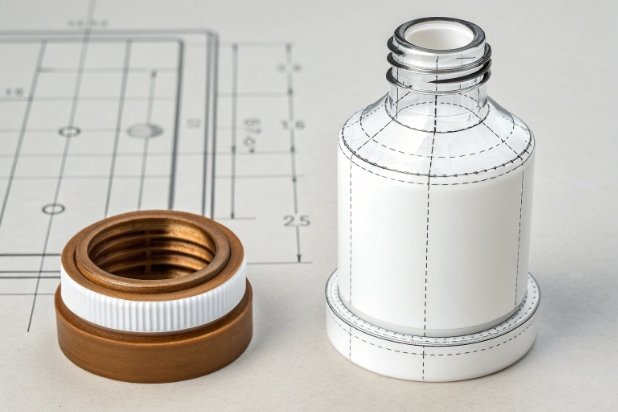
Designing for Durability
We help our clients design out failure risks before the mold is even made. Fighting chemical corrosion is about selection and precision.
Finish Specifications (The "T" and "E" dimensions):
For chemically aggressive products, we recommend finishes with a wider sealing land. A wider land provides more surface area for the liner to grip, offering a better barrier against migration. We also adhere to strict SPI 5 (Society of the Plastics Industry) and GPI 6 (Glass Packaging Institute) standards to ensure the "T" (Thread diameter) and "H" (Height) are compatible with the cap to prevent "bottoming out" (where the cap hits the shoulder before the seal is tight).
Liner Selection ( The First Line of Defense):
Standard PE foam liners fail against harsh solvents. We advise upgrading to PTFE (Teflon) faced liners. PTFE 7 is almost chemically inert. For alkalis, EPDM rubber 8 or Butyl liners offer superior resistance compared to natural rubber. The liner must be the shield that protects the less resistant cap shell.
Glass Treatment:
For extreme cases, we can apply a "hot end coating" solely to the body and mask the finish, or ensuring the finish is polished. However, typically the best defense for the glass land itself is simply using Type I Borosilicate glass, which resists the etching that causes roughness.
Prevention Strategy Matrix
| Strategy | Implementation | Mechanism of Protection | Recommended For |
|---|---|---|---|
| PTFE / Teflon Liners | Cap Specification | Inert barrier prevents chemical attack on the elastic wad. | Acids, Solvents, Oils. |
| Wider Sealing Land | Mold Design | Increases leak path length; larger seal area. | High-viscosity liquids, creepers. |
| Heat-Induction Seal (HIS) | Foil Liner | Fuses foil to glass; hermetic bond independent of torque. | Aggressive chemicals, powders. |
| Retorquing | Process Control | Re-applying torque after 24hrs (after liner settles). | Products prone to liner relaxation. |
Conclusion
A leak is rarely just a "loose cap." It is often a symptom of chemical warfare at the microscopic level. By matching inert liners (like PTFE) with precision-molded glass finishes, you can ensure your product remains contained, safe, and effective.
Footnotes
-
A space entirely devoid of matter, used in testing to detect leaks by pressure differentials. ↩
-
A mechanical seal which fills the space between two or more mating surfaces, generally to prevent leakage. ↩
-
The failure of a thermoplastic caused by the presence of surface-active agents and mechanical stress. ↩
-
A chemical compound often used as a dye and medication, effective for tracing leaks. ↩
-
A trade association representing the entire plastics industry supply chain in the US. ↩
-
The trade association representing the North American glass container industry. ↩
-
Polytetrafluoroethylene, a synthetic fluoropolymer known for its non-stick and chemical resistance properties. ↩
-
Ethylene propylene diene monomer rubber, a type of synthetic rubber used for its heat and chemical resistance. ↩






