
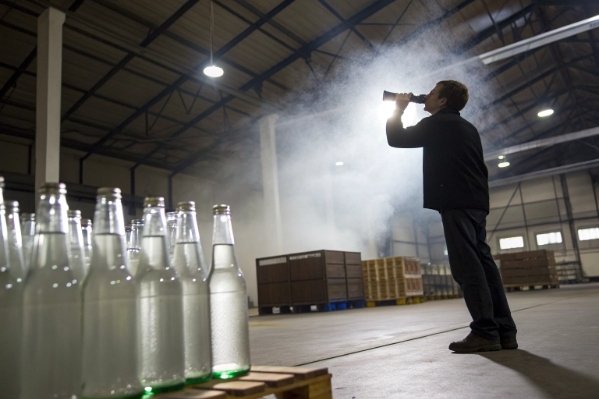
Opening a container of new glass bottles only to find them covered in a ghostly white fog is a production manager’s nightmare. This isn’t dust; it is a chemical reaction indicating the glass is weathering.
Alkali leaching, or "weathering," is evaluated by identifying a characteristic hazy, oily, or dusty white film on the glass surface. This is quantified using hydrolytic resistance tests (ISO 4802), surface pH measurements, and conductivity tests, ensuring the glass meets Type I, II, or III stability standards.
The "Glass Cancer": Understanding Weathering
As the face of FuSenglass, I have fielded panic calls from clients who believe their bottles arrived "dirty." They send photos of pallets where the glass looks foggy, dull, or covered in white dust. When they try to wipe it off with a dry cloth, it smears. When they wash it with water, it disappears, only to reappear once the bottle dries. This is Alkali Bloom.
Glass is not a static solid; it is a supercooled liquid. In standard soda-lime glass (the industry workhorse), sodium ions 1 ($Na^+$) are mobile. When glass is stored in humid environments—like a shipping container crossing the equator—water vapor condenses on the surface. This water draws the sodium out of the glass structure. The sodium reacts with the water to form Sodium Hydroxide 2 ($NaOH$), a strong alkali. This alkali then reacts with atmospheric Carbon Dioxide ($CO_2$) to form Sodium Carbonate ($Na_2CO_3$) crystals.
This cycle is destructive. The initial phase is just a surface deposit (washable). However, if left unchecked, the highly alkaline solution on the surface begins to dissolve the silica network itself, leading to permanent etching. For B2B buyers, detecting this early is critical. It is not just cosmetic; leached alkali can alter the pH of sensitive formulations, destabilize emulsions in creams, and ruin the flavor of spirits. Evaluating it requires a mix of forensic visual inspection and rigorous chemical lab testing.
The Physics of the Defect
The appearance of bloom depends on the stage of the reaction:
- Stage 1 (Filming): An invisible layer of moisture rich in alkali. The glass might feel slippery or "soapy."
- Stage 2 (Hazing): As the water evaporates, sodium carbonate crystals precipitate. This scatters light 3, creating a white haze or fog.
- Stage 3 (Etching): The concentrated alkali attacks the silica skin. The glass becomes permanently pitted and dull.
Why Evaluation Matters
If you bottle a product with a pH sensitivity (like certain serums or natural wines) in a bottle suffering from alkali leaching, the product will degrade. The "bloom" inside the bottle will dissolve into your product, raising its pH. This can cause precipitation, color changes, or spoilage. Therefore, evaluating leaching is effectively evaluating product safety.
| Stage | Visual Indicator | Tactile Feel | Removability |
|---|---|---|---|
| Incipient | Invisible or slight iridescence (Rainbow). | Slick / Greasy | Water rinse. |
| Moderate | White Haze / Fog. | Gritty / Dusty | Acid wash required. |
| Severe | Opaque / Frosted appearance. | Rough | Permanent damage (Cannot be removed). |
Distinguishing this chemical defect from simple dirt is the first step in the quality control process.
What are the typical visual signs of alkali leaching on glass bottles?
Misdiagnosing bloom as "dust" leads to ineffective cleaning attempts. You must recognize the specific visual and tactile signatures that separate chemical weathering from physical contaminants.
Alkali leaching appears as a uniform fog, patchy white haze, or "rainbow" iridescence that feels greasy or soapy to the touch. Unlike water spots which have distinct edges, or coating defects which peel, bloom often covers large areas and smears when wiped dry.
The Visual Fingerprint
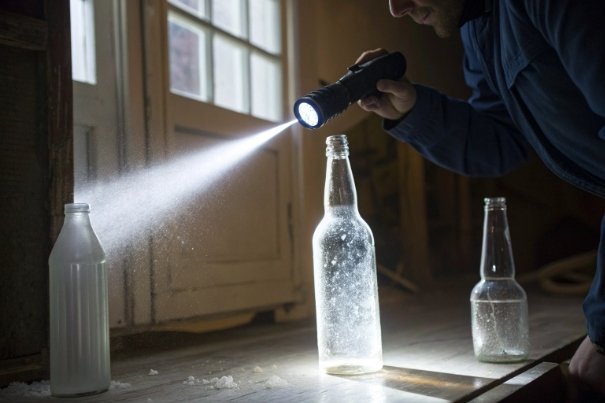
In the warehouse, I teach my team the "Flashlight Test." When you shine a strong beam through the bottle in a dark room:
- Dust appears as distinct, separate particles.
- Mold appears as web-like or circular colonies.
- Alkali Bloom appears as a diffuse, glowing fog. It doesn’t have sharp boundaries; it looks like the glass itself has lost transparency.
Another key sign is Iridescence. Before the white powder forms, the thin layer of silica gel on the surface interferes with light waves, creating an "oil slick" effect—faint rainbows of pink and green. This is a classic sign of early-stage leaching, often seen on the neck or shoulder of the bottle where condensation gathers.
The Tactile and Wipe Test
This is the most practical field evaluation.
- Touch it: Run your clean finger along the glass. Bloom often feels slippery or greasy due to the sodium hydroxide (lye) layer, whereas dust feels dry. Severe weathering feels rough, like fine sandpaper.
- The Dry Wipe: Wipe the haze with a dry cloth. Bloom will often smear or become transparent temporarily (as you spread the oils/salts), then cloud over again. Dust simply wipes away.
- The Wet Test: Wet the area. Sodium carbonate dissolves instantly in water, so the glass looks clear. If the haze remains even when wet, the glass is etched. The leaching has progressed to structural damage. If it clears up when wet but returns when dry, it is active surface salts.
Distinguishing from Other Defects
- Water Spots: These are mineral deposits (calcium/magnesium) from hard water drying on the glass. They have distinct "ring" edges. Bloom is usually structureless.
- Coating Defects: If a bottle is sprayed or treated, a defect looks like a scratch, peel, or bubble. Bloom looks like it is on top or part of the glass, not a failed layer.
- Mold: Usually has a specific odor and grows in colonies. Bloom is odorless (unless very severe, smelling faintly metallic/soapy) and covers the surface based on airflow patterns.
| Defect Type | Visual Characteristic | Reaction to Water | Reaction to Acid |
|---|---|---|---|
| Alkali Bloom | Foggy, Hazy, Rainbow | Disappears (if mild) | Dissolves instantly. |
| Silica Etching | Matte, Dull, Frosted | Remains visible | Unchanged (Permanent). |
| Hard Water Spot | White rings, sharp edges | Remains visible | Dissolves slowly. |
| Organic Haze (Oil) | Smears, Streaky | Repels water (Beads up) | Smears. |
Once identified visually, we must quantify the severity to see if the bottles are usable.
Which test methods can quantify surface alkali release on glass bottles?
Visual inspection is subjective; chemistry is absolute. Laboratory testing determines if the glass meets the hydrolytic resistance standards required for your specific product application.
Quantify alkali release using the ISO 4802 "Titration Method" (Grain or Surface test) to measure leached sodium oxide. For rapid QC, use surface pH meters or conductivity tests on rinse water. Gravimetric (weight-loss) methods are less common but useful for severe corrosion analysis.
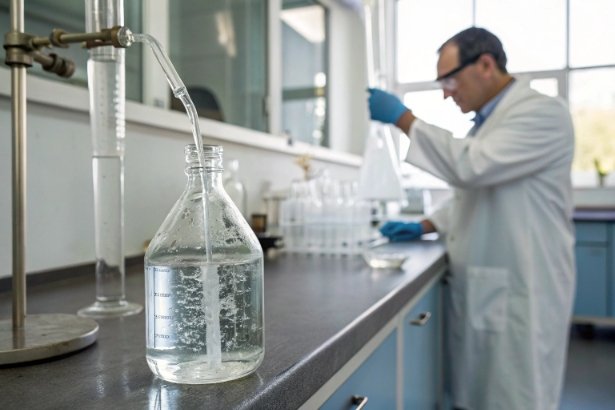
The Gold Standard: ISO 4802 / USP <660>
This is the test you will see on a FuSenglass Certificate of Analysis (COA). It categorizes the glass into Type I, II, or III.
- Surface Test: We fill the bottle with distilled water (pH 5.5) and heat it to 121°C for 60 minutes in an autoclave.
- Titration: We take the water and titrate it with a dilute acid (Hydrochloric Acid 4) to see how much alkali leached out. The result is expressed in milliliters of acid required to neutralize the solution.
- Lower number = Better resistance.
- Type I: Highly resistant (Borosilicate).
- Type II: Treated Soda-Lime (Sulfur treated).
- Type III: Standard Soda-Lime (Acceptable for most beverages, risky for sensitive pharma).
The "Surface pH" Test (ASTM C1223)
For a quick check on the production line without an autoclave:
- Method: A specific volume of distilled water is applied to the glass surface (often the flat bottom or side).
- Measurement: A flat-faced pH probe is pressed against the wet surface.
- Result: If the pH spikes rapidly (e.g., from 7.0 to 9.0+ within seconds), the surface has high free alkalinity. This correlates strongly with a risk of blooming.
Conductivity Testing
Conductivity measures the total dissolved solids (ions) in the water.
- Process: Rinse the inside of a "bloomed" bottle with ultrapure, low-conductivity water.
- Analysis: Measure the conductivity 5 of the rinse water. A significant increase indicates soluble salts (Sodium Carbonate) are present. This is faster than titration but less specific to alkali (it measures all ions).
The Wipe Test (Chemical Identification)
To confirm the haze is alkali and not oil:
- Apply a drop of Phenolphthalein indicator to the haze.
- If it turns vibrant Pink/Fuchsia, the residue is alkaline (pH > 8.2), confirming alkali bloom. If it stays clear, the haze is likely organic (oil/mold) or permanent etching.
| Test Method | Accuracy | Complexity | Best Application |
|---|---|---|---|
| Autoclave Titration | High (Official) | High (Lab required) | Certification (Type I/II/III). |
| Conductivity | Medium | Low (Handheld meter) | Production line spot check. |
| Surface pH | Medium | Low (Flat probe) | Evaluating older inventory. |
| Phenolphthalein | Qualitative (Yes/No) | Very Low | Confirming bloom vs. dirt. |
Testing tells you the current state. But how do you predict if a clean bottle will bloom in a month?
How do accelerated aging conditions help predict alkali leaching risk?
You cannot wait six months to see if a shipment will survive a warehouse in Singapore. Accelerated aging chambers simulate the worst-case scenarios of heat and humidity to stress-test the glass surface.
Accelerated aging uses "Humidity Chambers" set to 50°C – 60°C and 90% Relative Humidity. This creates a "tropical atmosphere" that speeds up the ion exchange reaction, allowing manufacturers to predict weathering susceptibility and shelf-life stability within days rather than months.
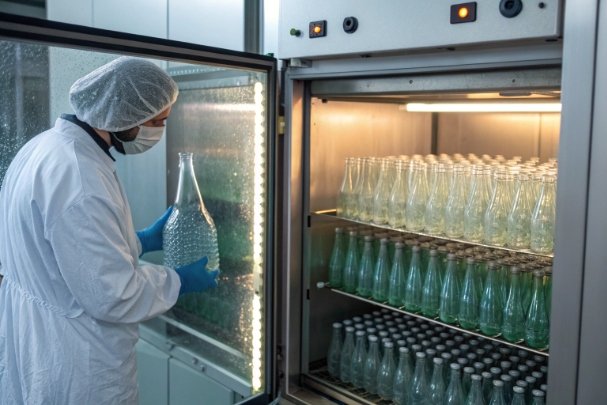
The "Tropical Simulation"
The primary enemy of glass is the Cyclic Condensation.
In our labs, we use a programmable environmental chamber 6. We don’t just keep it hot; we cycle the temperature.
- The Cycle: Ramp up to 50°C (122°F) at 90% RH, hold for 12 hours, then drop to 20°C.
- The Effect: The temperature drop forces the moisture in the air to condense onto the bottle. This liquid water extracts the sodium. The subsequent heat up evaporates the water, leaving the salt.
- Correlation: 1 week in these conditions roughly simulates 1 year of storage in a non-climate-controlled warehouse.
Container Rain
This testing mimics "Container Rain." When shipping from China to Europe or the US, containers experience massive temperature swings. During the day, the container heats up; at night, it cools. Water drips from the ceiling of the container onto the pallets. If the glass is reactive, these drips form permanent white streaks (runoff lines).
By subjecting sample pallets to cyclic humidity testing, we can determine if we need to use desiccants (silica gel packets) in the shipping cartons or if the glass formulation itself needs adjustment.
Acid/Alkaline Challenge
Sometimes we soak the glass in a slightly acidic solution (mimicking wine or juice) or alkaline solution (mimicking detergents) at elevated temperatures.
- Alkaline Attack: Soaking in NaOH at 80°C measures how fast the glass dissolves (weight loss). This predicts how the bottle will handle caustic washing lines.
- Acid Attack: Soaking in HCl measures ion exchange. If the glass releases too much alkali, it will neutralize the acid, predicting pH instability in the final product.
| Condition | Setting | Simulates | Warning Sign |
|---|---|---|---|
| High Humidity | 60°C @ 90% RH | Tropical Warehouse | Haze or rainbow bloom. |
| Cyclic Temp | 20°C $\leftrightarrow$ 50°C | Ocean Freight | Runoff streaks (Container rain). |
| Acid Soak | pH 3.0 @ 40°C | Product Interaction | pH drift of liquid. |
| Water Soak | 121°C Autoclave | Sterilization | Delamination / Flaking. |
Knowing the risks, what should a buyer explicitly ask for to ensure they are protected?
What acceptance criteria and QC reports should wholesale buyers require?
Contractual clarity prevents quality disputes. Defining specific limits for hydrolytic resistance and visual defects ensures you receive glass that is chemically stable and aesthetically pristine.
Buyers should require a Certificate of Analysis (COA) confirming USP Type III (or Type II) limits for hydrolytic resistance. Visual acceptance criteria should specify "No visible haze or bloom" under AQL 1.0. Palletization protocols must mandate plastic shrouds and desiccants to prevent moisture ingress.

The Certificate of Analysis (COA)
Never accept a shipment without a COA linked to the specific batch number. The key line item you are looking for is "Hydrolytic Resistance" or "Alkali Release."
- For Type III Glass (Soda-Lime): The limit is typically < 8.5 ml of 0.02N HCl per 100ml of glass capacity (depending on bottle size). If the report shows values near the limit (e.g., 8.0), the risk of blooming is high. You want to see values comfortably low.
- For Type II Glass (Treated): The limit is much tighter (e.g., < 0.7 ml). This proves the sulfur treatment was successful.
Visual AQL (Acceptable Quality Limit)
Alkali bloom is a "Major Defect" because it affects the product’s marketability and potentially its chemistry.
- Standard Specification:
- Critical Defects (Hazardous): AQL 0.01
- Major Defects (Haze/Bloom): AQL 1.0 or 0.65
- Minor Defects (Scratches): AQL 2.5
- Definition: "Glass shall be free from internal haze, weathering, or iridescent staining visible at arm’s length under standard lighting."
Packaging & Storage Protocols
You can buy the best glass in the world, but if it is packed in damp cardboard and shipped across the ocean, it will bloom.
Buyer Requirements:
- Desiccants: Mandate silica gel or calcium chloride poles in the shipping container.
- Plastic Shrouds: Pallets should be wrapped in PE film (shrink hood) to create a moisture barrier.
- Stock Rotation: Enforce FIFO (First In, First Out). Glass should ideally be filled within 6-12 months of manufacture. If you buy "aged stock" at a discount, demand a fresh surface pH test before shipping.
| QC Document | Key Data Point | Acceptance Criterion |
|---|---|---|
| COA (Chemical) | Hydrolytic Resistance (ISO 4802 7) | < Limit for Type III (based on volume). |
| QC Inspection Report | Visual Haze / Bloom | 0% in random sample (or within AQL 8). |
| Packaging Spec | Moisture Protection | PE Hood + Desiccant in container. |
| Re-Test Protocol | Surface pH (for stock >1 yr) | No significant spike vs. fresh glass. |
Conclusion
Evaluating alkali leaching is about protecting your brand’s integrity. It starts with recognizing the "ghostly fog" in the warehouse, quantifying the risk through titration and pH testing, and preventing it through strict shipping protocols. At FuSenglass, we treat glass stability as a science, ensuring that the only thing your customer sees is the purity of your product, not the chemistry of our bottle.
Footnotes
-
A positively charged ion of sodium, critical for many biological processes. ↩
-
A strong alkaline compound used in cleaning agents, also known as lye. ↩
-
The deflection of a ray of light from a straight path, creating haze or fog. ↩
-
A strong, corrosive acid used in laboratory testing for glass resistance. ↩
-
A measure of water’s ability to pass electrical flow, directly related to the concentration of dissolved ions. ↩
-
An enclosed space where environmental conditions such as temperature and humidity can be controlled. ↩
-
International standard specifying the hydrolytic resistance of the interior surfaces of glass containers. ↩
-
Acceptable Quality Limit, a statistical tool used in quality control to determine pass/fail criteria. ↩






