
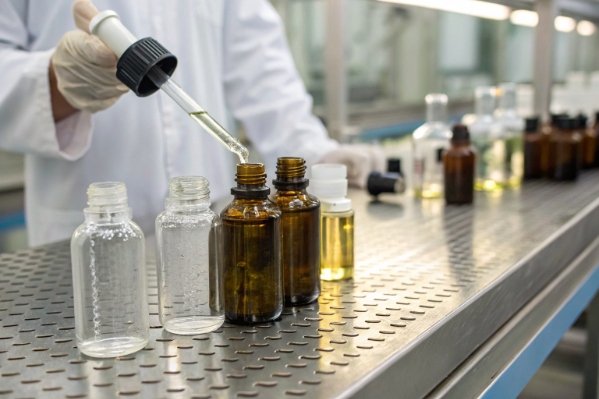
Concentrated botanical extracts are powerful solvents that test packaging limits. While glass is the gold standard, the wrong closures or coatings often fail catastrophically against potent oils.
Essential oils do not chemically corrode the silica structure of glass bottles, making glass the safest storage medium. However, these volatile oils aggressively attack plastic caps, rubber droppers, and external spray coatings, causing leaks, melting, and aesthetic destruction of the packaging system.
The Fortress of Glass vs. The Power of Nature
As the face of FuSenglass, I advise aromatherapy and cosmetic brands daily: Do not underestimate the chemical potency of nature. A drop of pure Lemon oil can eat through a Styrofoam cup in seconds. While we champion glass because it is impermeable and chemically inert, the "bottle" is more than just the glass container—it is a system comprising the vessel, the closure, and the decoration.
Glass itself (Type III Soda-Lime or Type I Borosilicate) is immune to the complex hydrocarbons 1 found in essential oils. Whether you are bottling aggressive Tea Tree oil or gentle Lavender, the silica network will not dissolve. This is why you never see high-end essential oils in plastic bottles; the oils would extract plasticizers (like phthalates 2) from the plastic, contaminating the product and eventually dissolving the container.
However, the "damage" I see is rarely the glass shattering from chemical attack. It is the collateral damage. Essential oils are low-viscosity, high-volatility fluids with low surface tension. They "creep." They wick up threads, seep under caps, and drip down the sides. When this happens, the solvent power of the oil interacts with the rest of your packaging.
The Real Points of Failure
In my experience, 90% of packaging failures in this sector are not the glass body, but the accessories.
- The Dropper Bulb: Natural rubber turns into a sticky black goo when exposed to certain terpenes 3.
- The Plastic Cap: Low-quality polypropylene can crack (stress cracking) under the vapor pressure of volatile oils.
- The Decoration: That beautiful matte frost or gold logo you paid for? One drip of eucalyptus oil can strip it instantly if the ink isn’t chemical-resistant.
Therefore, when we ask if essential oils "damage" glass bottles, we must look at the bottle as a complete, decorated retail unit.
| Component | Resistance to Essential Oils | Common Failure Mode |
|---|---|---|
| Glass Body | Impervious | None (Glass remains intact). |
| Plastic Cap | Variable | Stress cracking, swelling, stripping of threads. |
| Rubber Bulb | Poor | Melting, sticky disintegration, leaching. |
| Pump mechanism | Moderate | Spring corrosion, tube swelling. |
| Ext. Decoration | Variable | Paint peeling, gold stamping removal. |
Understanding this distinction is the first step to securing your product. Now, let’s explore where the chemical aggression is really directed.
Do essential oils chemically attack soda-lime glass, or mainly coatings and closures?
Brands often blame the glass for leaks or cloudiness, but the culprit is usually the interaction between aggressive oils and non-glass components.
Essential oils are chemically inert toward the silicate network of soda-lime glass, meaning they cannot etch or dissolve the bottle itself. The "corrosion" observed is almost exclusively the degradation of external organic coatings, labels, and the plastic or rubber polymers in the closure system.
The Inertness of Silicates
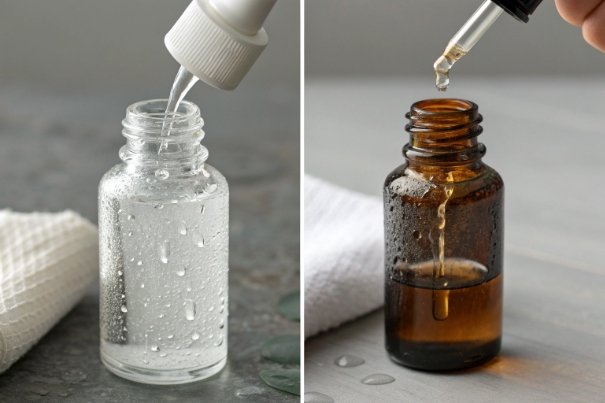
Chemically, essential oils are mixtures of terpenes, esters, aldehydes, ketones, and phenols. None of these organic functional groups have the power to break the silicon-oxygen bond 4 ($Si-O$) that forms the backbone of glass. You could store 100% pure Clove oil (high in eugenol, very aggressive) in a FuSenglass bottle for 50 years, and the glass wall thickness would remain unchanged.
The "Dissolving" Bottle Myth
I occasionally hear clients say, "The oil ate through the bottle!" Upon forensic inspection, we always find the same thing: the oil didn’t eat the glass; it ate the seal.
Essential oils have incredibly low surface tension 5. They can crawl through microscopic gaps between the bottle finish and the cap liner. Once the oil bypasses the liner, it attacks the plastic of the cap. If the cap cracks, the seal is lost, and the oil leaks out. To the consumer, it looks like the bottle failed.
The Attack on Coatings
This is the most painful failure for marketing teams. Many "colored" bottles in the market are actually clear glass painted with an organic spray (to save cost vs. true colored glass).
Essential oils act as paint strippers.
- Scenario: A consumer uses a dropper, and a single drop runs down the side of a matte black bottle.
- Result: The oil solvates the resin in the paint. The paint bubbles and wipes off, revealing clear glass underneath. The text on the label might smear or vanish.
This is not glass corrosion; it is decoration failure. True colored glass (Amber, Cobalt Blue, Green) is the only way to prevent this 100%, as the color is part of the molten glass, not a coating.
Rubber and Plastic Compatibility
The dropper bulb is the weakest link. Standard natural rubber (Latex) is incompatible with citrus and pine oils. It will swell, lose suction, and eventually turn into a tar-like substance that drips back into your oil, contaminating it. We always recommend NBR (Nitrile) or Silicone bulbs 6 for this reason.
| Material | Reaction to Essential Oils | Recommendation |
|---|---|---|
| Soda-Lime Glass | None (Inert). | Ideal for all oils. |
| Spray Coating (Paint) | Solvation (Peeling). | Avoid for pure oils; Use True Color Glass. |
| HDPE / PP Plastic | Swelling / Stress Cracking. | Test high-density plastics; Avoid Polystyrene. |
| Natural Rubber | Depolymerization (Melting). | BAN. Use Nitrile or TPE. |
| Paper Label | Oil Saturation (Staining). | Use BOPP (Plastic) or Oil-Resistant Varnish. |
So, if the glass is safe, which specific oils are the "terminators" for the rest of your package?
Which essential oil components are most likely to cause surface issues?
Not all oils are created equal. Identifying the chemical profile of your product helps predict which packaging elements are at risk of failure.
Terpenes (like d-Limonene and Pinene) and aldehydes (like Cinnamaldehyde) are the most aggressive solvents. They rapidly dissolve adhesives, strip external paints, and melt rubber. Phenols (like Eugenol) are also highly reactive, capable of causing stress cracking in rigid plastics.
The Terpene Threat: Citrus and Pine
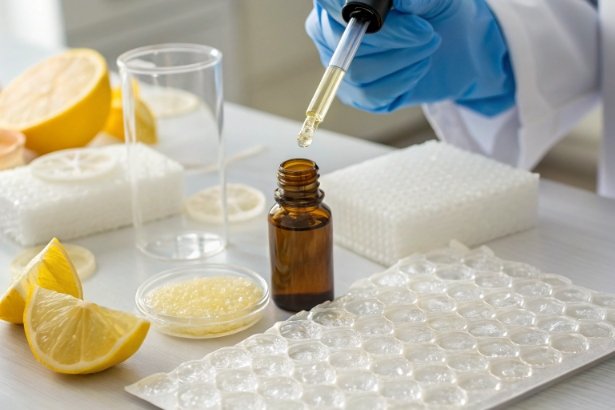
The most notorious destroyers of packaging are Citrus Oils (Lemon, Orange, Grapefruit) and Pine/Fir Oils.
- Active Agent: d-Limonene and Pinene.
- The Mechanism: Limonene is chemically very similar to turpentine 7 (paint thinner). It is an incredible solvent for non-polar materials. It attacks polystyrene (often used in cheap droppers) instantly, turning it cloudy and then liquid. It attacks adhesives, causing labels to fall off.
- Surface Issue: If your bottle has a "soft touch" coating, Limonene will turn it into a sticky, gummy mess that picks up fingerprints and dust.
The Aldehyde/Phenol Threat: Spice Oils
Oils like Cinnamon, Clove, Oregano, and Thyme are chemically "hot."
- Active Agent: Cinnamaldehyde 8, Eugenol, Carvacrol.
- The Mechanism: These compounds are aggressive oxidizers and solvents. They are particularly hard on rubber components. I have seen dropper bulbs that were used with Cinnamon oil swell to double their size and then crumble.
- Haze Risk: While they don’t haze the glass, they can leave a stubborn, resinous residue that looks like haze. If the oil oxidizes (ages) on the rim of the bottle, it polymerizes into a hard, amber-colored crust that prevents the cap from sealing properly next time.
The "Blue" Oils
Oils like Blue Tansy and German Chamomile contain Chamazulene. While they don’t corrode, they are intensely pigmented.
- Staining: If these drip onto a white silk-screened label or a porous cap, they cause permanent blue staining that migrates deep into the material.
| Chemical Family | Examples | Primary Packaging Risk | Aggressiveness |
|---|---|---|---|
| Monoterpenes | Lemon, Orange, Pine | Dissolves plastics, glues, and paints. | High |
| Aldehydes | Cinnamon, Cassia | Melts rubber; irritates skin (leaks). | High |
| Phenols | Clove, Oregano, Thyme | Stress cracking of caps; rubber damage. | High |
| Esters | Lavender, Bergamot | Generally mild, can soften some varnishes. | Moderate |
| Sesquiterpenes | Sandalwood, Patchouli | Low volatility; sticky residue on finish. | Low |
Knowing the chemistry is half the battle. The conditions of storage define the other half.
What factors increase compatibility risk and how should brands set specifications?
A package that passes a 24-hour test might fail after six months on a shelf. Time, temperature, and light transform oils into more aggressive compounds.
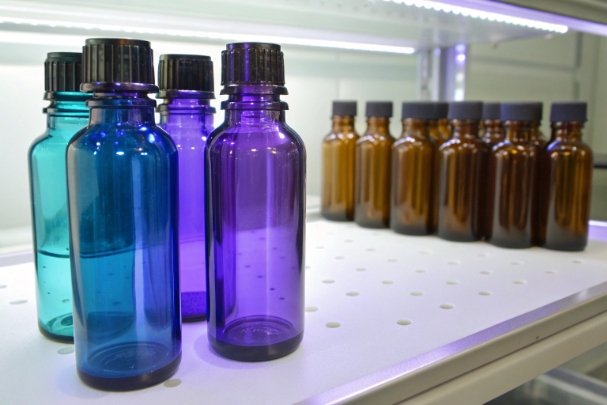
Risk increases with oil purity (100% vs. diluted), higher storage temperatures, and UV exposure. UV light oxidizes oils into peroxides, which are more reactive and skin-sensitizing. Brands must specify true amber/violet glass to block UV and mandate strict cap-liner compatibility.
The Concentration Factor
- Pure Essential Oils: These require the highest spec packaging. Glass is mandatory. Caps must be phenolic 9 (bakelite) or high-grade PP.
- Diluted (Face Oils/Serums): If the essential oil is < 5% in a carrier oil (Jojoba, Almond), the risk drops significantly. The carrier oil dilutes the solvent power. You might get away with painted bottles or softer plastics here, but testing is still required.
The UV Factor: Oxidation
Light is the enemy of essential oils. UV radiation triggers auto-oxidation.
- The Change: A stable monoterpene absorbs UV and turns into a hydroperoxide. These oxidized compounds are far more chemically reactive (and allergenic) than the fresh oil. They can attack cap liners more aggressively.
- The Solution: You must use light-blocking glass.
- Amber Glass: Blocks ~90% of UV. The industry standard.
- Violet/Black Glass: Blocks almost 100% of visible light, extending shelf life.
- Clear/Blue/Green Glass: Offers very poor UV protection. Only use these if the bottle will be in a secondary box (carton) at all times.
Temperature and Pressure
Essential oils are volatile. In a hot warehouse (40°C), the vapor pressure inside the bottle rises.
- The Leak: This pressure pushes vapor past the microscopic imperfections in the cap liner. If the liner material isn’t perfect, the vapor escapes (product loss) or condenses on the threads, initiating the "creep" that destroys the label.
- Headspace: Brands must specify the correct "fill level." Overfilling leaves no room for expansion, guaranteeing leaks in hot weather.
| Factor | High Risk Condition | Low Risk Condition | Action Required |
|---|---|---|---|
| Concentration | 100% Pure Oil | < 5% in Carrier Oil | Use Glass + Phenolic Caps for 100%. |
| UV Exposure | Clear/Frosted Glass | Amber / Violet Glass | Switch to darker glass or full cartoning. |
| Temperature | > 30°C Storage | < 20°C Storage | Ensure cap torque is sufficient for pressure. |
| Closure Material | Standard PE Foam | Teflon (PTFE) / F217 | Specify PTFE-faced liners. |
You have the specs, but you cannot guess. You must validate.
What tests and validation reports should buyers request?
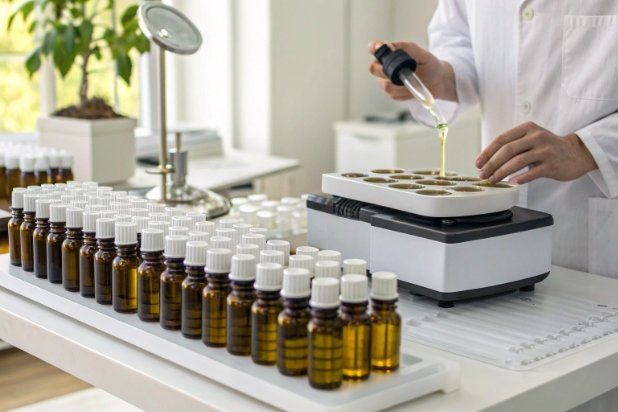
Don’t wait for a customer to send you a photo of a melted dropper. Rigorous pre-market testing validates that your "system" (glass + cap + oil) holds up over time.
Buyers must request and perform "Compatibility Soak Tests" (3 months at 45°C), Vacuum Leak Tests, and Torque Retention Tests. Additionally, Coating Cross-Hatch Adhesion tests after oil exposure verify that your branding won’t wipe off.
The Golden Rule: The Stability Test
You cannot rely on a supplier saying "it should work." You must test your specific oil in your specific package.
- Protocol: Fill bottles with the product. Store at elevated temperature (40-45°C) and ambient temperature.
- Duration: 1 month at 45°C roughly simulates 3-6 months at room temperature. Ideally, run for 3 months (12 weeks).
- Checkpoints:
- Weight Loss: Weigh the bottle weekly to check for evaporation (indicates seal failure).
- Visual: Is the bulb melting? Is the cap cracking? Is the liquid cloudy?
Vacuum Leak Test
This simulates air transport. Essential oils are often shipped by air freight.
- Method: Place filled, capped bottles in a vacuum chamber. Draw a vacuum to -0.5 bar.
- Result: If liquid leaks out, your cap fit is poor, or the liner is too hard. Limonene has very low surface tension and finds leaks water won’t.
Decoration Durability (The "Oil Rub")
If you use painted or printed bottles:
- The Test: Saturate a cloth with the essential oil itself (not just alcohol). Rub the printed area vigorously.
- Pass/Fail: If the ink smears or the paint dissolves, you have a problem. Consumers will get oil on the bottle. If your branding vanishes, your premium look is gone.
Torque Retention
Plastic caps "relax" over time (creep), especially when lubricated by oil vapor.
- Method: Torque the cap to spec (e.g., 15 in-lbs). Wait 24 hours. Measure the removal torque.
- Issue: If removal torque drops to near zero, the cap is backing off on its own. You may need a different thread profile or a "ratchet" style cap.
| Test Name | Purpose | Critical for | Success Criteria |
|---|---|---|---|
| Accelerated Stability | Check chemical interaction over time. | All New Products. | No weight loss; no component degradation. |
| Vacuum Leak | Simulate air freight/pressure changes. | Shipping Safety. | Zero visible leakage at -0.5 bar. |
| Product Resistance (Rub) | Verify paint/print durability. | Decorated/Painted Bottles. | No color transfer after 20 rubs with oil. |
| Cap Torque Retention | Ensure caps stay tight. | Threaded Closures. | Removal torque > 40% of application torque. |
Conclusion
Essential oils are nature’s solvents. While they cannot corrode the robust glass of a FuSenglass bottle, they will mercilessly find the weak points in your closures and decorations. By understanding the chemical aggression of terpenes and aldehydes, choosing true colored glass over painted options, and mandating rigorous compatibility testing, you ensure your customers experience the healing power of the oil, not the mess of a failed package.
Footnotes
-
Organic compounds consisting entirely of hydrogen and carbon, abundant in essential oils. ↩
-
A group of chemicals used to make plastics more durable, often found in PVC. ↩
-
A large and diverse class of organic compounds, produced by a variety of plants. ↩
-
A functional group with the connectivity Si–O–Si, forming the backbone of silicones and glass. ↩
-
The tendency of fluid surfaces to shrink into the minimum surface area possible. ↩
-
Elastomers composed of silicone, carbon, hydrogen, and oxygen, resistant to heat and chemicals. ↩
-
A fluid obtained by the distillation of resin from live trees, mainly pines. ↩
-
An organic compound that gives cinnamon its flavor and odor, a strong sensitizer. ↩
-
An early plastic, a thermosetting phenol formaldehyde resin, used for electrical insulators and casings. ↩






