
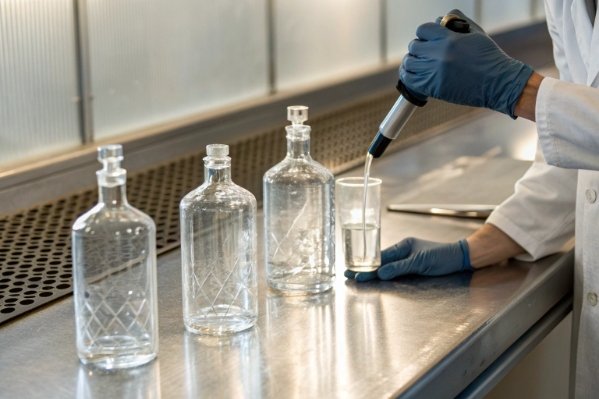
Storing premium spirits for years risks unseen chemical changes that compromise quality. Ignorance of glass chemistry leads to ruined flavors, hazy bottles, and dangerous sediment.
High-proof alcohol itself does not chemically digest the silica network of glass. However, the water content in spirits triggers ion exchange and hydrolysis over time, leading to "weathering" or alkali leaching. This manifests as surface clouding or sediment (flakes), rather than structural corrosion.
The Myth of "Strong Drink, Weak Glass"
As the face of FuSenglass, I often reassure distillery clients that their 120-proof absinthe isn’t going to dissolve our bottles like acid. Ethanol 1 ($C_2H_5OH$) is a solvent, but towards silicate glass, it is largely inert. You could store pure laboratory ethanol in a Type III soda-lime glass bottle for decades with virtually zero change to the glass structure.
The confusion arises because we use the word "corrosion" differently in the glass industry compared to metals. For glass, corrosion is not rusting; it is leaching and hydration. The "enemy" in your vodka, gin, or whiskey is not the alcohol—it is the water.
Most spirits are 40-60% water. Water molecules attack the glass surface through a process called hydrolysis 2. They swap hydrogen ions for the alkali ions (sodium and potassium) present in the glass matrix. Over time, this raises the pH of the liquid inside the bottle (making it more alkaline) and leaves behind a silica-rich layer on the glass surface.
If this silica-rich layer becomes too thick or hydrated, it can fracture and peel off. This is what the industry calls "glass flakes" or "lamellae." It looks like tiny glittering shards floating in your expensive cognac. It is a nightmare for brand reputation.
The Mechanism: Ion Exchange
In soda-lime glass (the standard for beverages), sodium is added to lower the melting point. But sodium is loosely held in the network.
- Ion Exchange: $H^+$ ions from water enter the glass; $Na^+$ ions leach out.
- pH Rise: The release of $Na^+$ forms Sodium Hydroxide ($NaOH$), increasing the alkalinity of the spirit.
- Network Breakdown: If the pH gets too high, the hydroxide ions start attacking the silica network itself, accelerating the corrosion.
This is why old bottles of cheap spirits sometimes taste "soapy" or flat—the glass has chemically altered the liquid.
| Feature | Role in Corrosion | Impact on Quality |
|---|---|---|
| Ethanol | Solvent / Carrier | Minimal direct chemical attack on silica. |
| Water | Active Reactant | Triggers hydrolysis and ion leaching. |
| Sodium (in Glass) | Leaching Target | Increases liquid pH; alters flavor. |
| Silica Gel Layer | Reaction Byproduct | Can flake off as visible sediment. |
Understanding that water is the driver helps us look at how concentration and storage conditions accelerate this aging process.
Does ethanol chemically attack soda-lime glass?
Distillers worry that high-ABV products act like acid. In reality, the corrosion mechanism is a subtle interaction between water and the glass surface components.
Ethanol does not chemically dissolve the silica matrix. "Corrosion" in spirits bottles is actually water-induced hydrolysis (Type II corrosion), where alkali ions leach out, potentially causing surface staining, pH shifts, and delamination (flakes) over prolonged storage.
It’s Not the Alcohol, It’s the Water
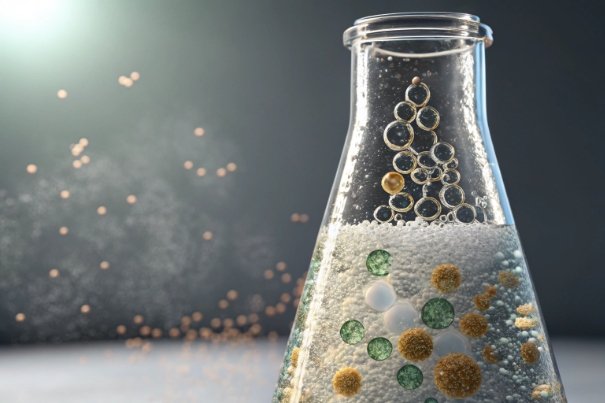
I cannot stress this enough: Ethanol is not the aggressor. In fact, pure ethanol is often used to preserve glass surfaces because it dehydrates them. The issue is strictly related to the hydrolytic resistance 3 of the glass surface interacting with the water component of the beverage.
When we see "etching" or "staining" inside a spirit bottle, it is usually a ring at the filling line. This is where evaporation concentrates salts and the interactions between the liquid, the glass, and the headspace air are most active.
The "Flaking" Phenomenon
This is the specific defect that keeps quality managers awake. In certain spirits (especially those with specific pH levels or additives), the leached layer of silica becomes hydrated and swells. Eventually, it detaches.
These flakes are extremely thin (microns thick) and often invisible until you shake the bottle in bright light. While generally non-toxic (it’s just silica), it looks like broken glass. Consumers will return the bottle, thinking it is dangerous.
This is most common in:
- Inexpensive soda-lime bottles (high alkali content).
- Spirits stored for 2+ years.
- Spirits with high pH.
Type I vs. Type II vs. Type III Glass
- Type I (Borosilicate): Practically immune to this. Used for pharma, but too expensive for most liquor.
- Type II (Treated Soda-Lime): Standard soda-lime glass that has been "sulfur treated" inside. This treatment removes surface sodium before filling, drastically reducing leaching. This is what FuSenglass recommends for premium spirits intended for long aging.
- Type III (Standard Soda-Lime): Standard glass. Acceptable for fast-turnover products (beer, wine) but risky for 10-year-old whiskey unless the glass composition is high quality.
| Corrosion Type | Cause | Visual Appearance |
|---|---|---|
| Ion Leaching | Water/Glass interaction | Invisible initially; soapy taste. |
| Weathering | Humidity during storage | White bloom on empty bottles. |
| Delamination | Silica layer detachment | Glittering flakes/needles in liquid. |
| Pitting | High pH attack | Micro-roughness (rare in spirits). |
So, how do your storage environment and formulation tweak these risks?
How do alcohol concentration, temperature, and storage time change glass durability?
A bottle of gin on a cool shelf lasts forever. That same bottle in a hot warehouse for five years can degrade chemically, altering the liquid inside.
Higher temperatures exponentially accelerate alkali leaching. While lower alcohol concentrations (higher water content) theoretically increase hydrolysis, long-term storage is the critical factor; older bottles accumulate leached ions, risking sediment formation and flavor degradation.
The Accelerator: Temperature
Arrhenius’ law 4 applies here: for every 10°C increase in storage temperature, the rate of chemical reaction (leaching) roughly doubles.
If you export your spirits to tropical climates or store them in uninsulated warehouses, you are "aging" the glass much faster. A vodka stored at 35°C for 6 months might show the same glass interaction as one stored at 15°C for 2 years. This heat drives the sodium out of the glass and into your drink.
The Alcohol/Water Balance
This is counter-intuitive. Since water is the corrosive agent:
- Low ABV (e.g., Liqueurs, 20%): Higher water content means more aggressive potential for hydrolysis.
- High ABV (e.g., Cask Strength, 60%): Lower water content implies less hydrolysis.
- However, ethanol changes the solubility of the leached compounds. Some silicates are less soluble in high-alcohol solutions, meaning they might precipitate out as flakes sooner in high-proof spirits even if the total leaching is lower. It’s a complex balance.
Storage Time: The Cumulative Effect
Glass corrosion is not instantaneous; it is cumulative.
- 0-6 Months: Negligible change.
- 1-2 Years: Detectable pH shift in unbuffered spirits (e.g., vodka).
- 5+ Years: Significant risk of flaking in standard Type III glass.
For "Ultra-Premium" spirits meant to sit in a collector’s cabinet for decades, you cannot use standard glass. You need high-quality flint glass with controlled alkali content or Type II surface treatment.
| Variable | High Risk Condition | Low Risk Condition |
|---|---|---|
| Temperature | > 30°C (Tropical) | < 15°C (Cellar) |
| Time | > 3 Years | < 1 Year |
| Glass Type | High-Alkali Soda Lime | Treated Soda Lime (Type II) |
| Liquid pH | Alkaline (>8) | Slightly Acidic/Neutral |
Beyond the glass structure breaking down, we must worry about what is actually entering the liquid.
Can alcohol increase migration and leaching risks?
Regulatory compliance is strict regarding heavy metals. Alcohol’s solvent properties can pull unwanted elements from low-quality glass or decorations into the beverage.
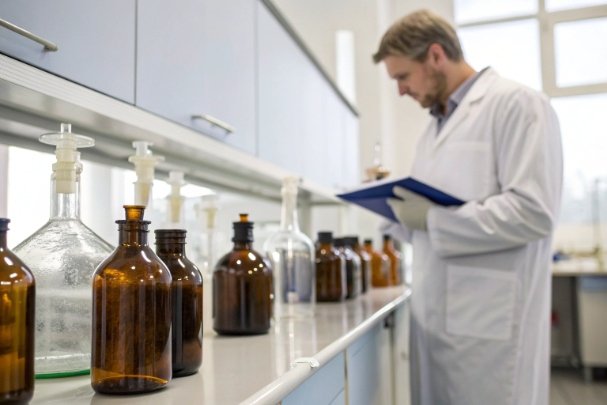
Alcoholic solutions can facilitate the migration of alkali ions and trace metals (Lead, Cadmium) from inferior glass or improper decorations. Buyers must demand ISO 7086 (migration) and USP Type III (hydrolytic resistance) test reports to ensure safety and compliance.
The Lead and Cadmium Concern
In clear flint glass, lead is rarely an issue today. But in colored glass, or more importantly, in decorated glass (screen printing, decals) near the rim, lead and cadmium can be present in the pigments.
Alcohol is a better solvent than water for some of these organometallic compounds. If you print a logo too close to the "lip" (the top 20mm) of the bottle, the alcohol pouring over it can leach heavy metals into the glass.
- Rule: FuSenglass strictly prohibits heavy-metal inks in the "lip zone."
Alkali Release (pH Shift)
As mentioned, sodium leaching raises pH. For neutral spirits like vodka, a pH shift from 7.0 to 8.5 changes the mouthfeel and character. It can make a crisp vodka taste "flabby" or soapy.
- The Test: USP <660> / ISO 4802 Hydrolytic Resistance. This measures how much alkali releases into water. You want Type III or better.
What Reports to Request?
Don’t just take a supplier’s word. Ask for these specific documents:
- ISO 7086 / ASTM C927: "Lip and Rim" test. Checks for Lead/Cadmium leaching from the mouth area. Critical for decorated bottles.
- USP <660> Surface Glass Test: Verifies the hydrolytic resistance class (Type I, II, or III).
- California Prop 65 Compliance: Essential for the US market, ensuring lead levels are below strict limits (often < 100 ppm in the substrate).
| Leached Substance | Source | Consequence | Test Standard |
|---|---|---|---|
| Sodium ($Na^+$) | Glass Matrix | pH rise, flavor change, flakes. | USP <660> / ISO 4802 |
| Lead (Pb) | Ext. Decoration | Neurotoxin 5 compliance failure. | ISO 7086 / Prop 65 |
| Cadmium (Cd) | Red/Yellow Pigments | Carcinogen compliance failure. | ISO 7086 6 / Prop 65 |
| Calcium ($Ca^{2+}$) | Glass Matrix | Calcium oxalate precipitates (haze). | ICP-MS Analysis 7 |
While the inside needs to be safe, the outside needs to be durable. Alcohol spills are inevitable.
How do coatings and decorations perform in alcohol contact?
A spilled drink shouldn’t ruin your brand’s look. Alcohol is a solvent that attacks paints, glues, and coatings, demanding rigorous compatibility testing for exterior finishes.
High-proof alcohol acts as a solvent that can dissolve organic paints, soften UV coatings, and tarnish low-quality electroplating. Ceramic decals and fire-fused decorations offer the highest resistance, while spray coatings require cross-hatch alcohol rub testing for validation.
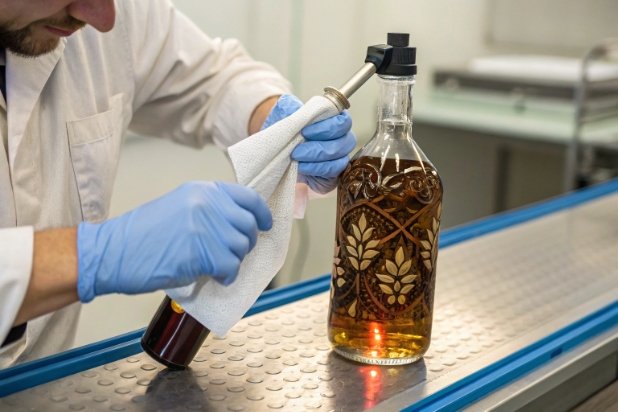
The "Bar Top" Reality
Imagine a bartender pouring your gin. A few drops run down the side. If your bottle is spray-coated (painted) with a cheap organic lacquer, those drops will act like paint thinner. I have seen matte black bottles turn into a sticky mess after one night at a busy bar. This is unacceptable for a premium brand.
Coating Vulnerabilities
- Spray Coatings (Organic): These are polymers. Ethanol can swell the polymer matrix, causing it to lose adhesion or become tacky. You must use "epoxy-based" or "cross-linked" thermal cure paints to resist alcohol.
- UV Printing: generally good, but prolonged soaking in alcohol (e.g., a bottle sitting in a puddle on a bar mat) can cause delamination.
- Electroplating: Generally resistant to alcohol, but sensitive to the acids in fruit juices or mixers that might also be spilled.
- Paper Labels: If not varnished, alcohol soaks them instantly, causing graying and peeling.
The Gold Standard: Ceramic & Firing
The only decoration that is 100% impervious to alcohol is Ceramic Screen Printing or High-Fire Decals. These use glass frit 8 (powdered glass) fused onto the bottle at 600°C. They are essentially part of the glass. Alcohol has zero effect on them. If durability is your #1 concern, choose ceramic.
Validation: The Rub Test
At FuSenglass, we perform the "Alcohol Rub Test" for all organic decorations.
- Method: A cloth soaked in 95% Ethanol.
- Action: Rub the decoration with 1kg force back and forth.
- Pass Criteria: No color transfer or surface change after 50 cycles.
- Immersion Test: Soaking the decorated part in vodka for 24 hours to check for softening.
| Decoration Method | Alcohol Resistance | Durability Risk | Best Application |
|---|---|---|---|
| Ceramic Screen Print | Excellent | None. | High-volume, permanent branding. |
| High-Fire Decal | Excellent | None. | Complex multi-color designs. |
| Organic Spray (Epoxy) | Good | Softening with prolonged contact. | Full-color custom bottles. |
| Organic Spray (Acrylic) | Poor | Dissolves/becomes sticky. | Avoid for spirits. |
| Paper Label (Uncoated) | Very Poor | Staining, peeling. | Single-use, low cost. |
Conclusion
Alcohol itself is not the enemy of glass, but the water it carries and the solvents it acts as pose real challenges. From internal leaching that alters flavor to external spills that ruin designs, the chemistry matters. By choosing high-quality Type II or well-sourced Type III glass and validating decorations with alcohol rub tests, FuSenglass ensures your bottle looks and tastes as premium as the spirit inside.
Footnotes
-
A volatile, flammable, colorless liquid with a slight characteristic odor, used in beverages. ↩
-
A chemical reaction in which a molecule of water ruptures one or more chemical bonds. ↩
-
The ability of glass to withstand the leaching of alkali ions by water. ↩
-
A formula that describes the temperature dependence of reaction rates. ↩
-
A poison that acts on the nervous system. ↩
-
Standard test method for lead and cadmium release from hollow ware in contact with food. ↩
-
A type of mass spectrometry capable of detecting metals at very low concentrations. ↩
-
A ceramic composition that has been fused, quenched, and granulated. ↩






