
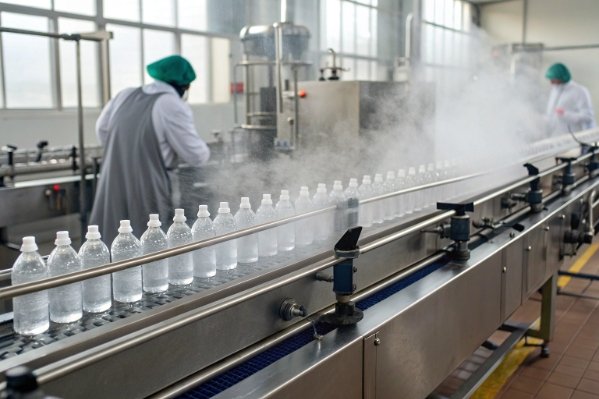
Industrial hygiene demands powerful cleaning agents to remove organic residues and adhesives, but using harsh chemicals carries the risk of damaging the glass surface itself. You must balance cleaning power with substrate preservation.
Yes, cleaning glass bottles with Sodium Hydroxide (Caustic Soda) is highly feasible and is the industry standard for removing mold, grease, and labels; however, it requires strict control of concentration and temperature to prevent permanent surface etching.
Is it Feasible to Clean Glass Bottles with Sodium Hydroxide (NaOH)?
The Heavy Lifter of Industrial Cleaning
In my role at FuSenglass, I oversee the production and processing of millions of bottles. When it comes to cleaning—whether it’s preparing recycled cullet or washing returnable bottles—Sodium Hydroxide (NaOH), commonly known as Caustic Soda or Lye, is the undisputed king.
Its feasibility is not just "possible"; it is essential. Water alone cannot dissolve protein residues, fatty oils, or the stubborn casein glues used for labeling. NaOH works via two primary chemical mechanisms:
- Saponification: It converts water-insoluble fats and oils into soap, which is water-soluble and rinses away.
- Hydrolysis: It breaks down proteins and carbohydrates (like dried beverage residue or glue) into smaller, soluble molecules.
The Feasibility Boundary
However, "feasible" does not mean "foolproof." Glass is chemically defined as a silicate network. While it is resistant to acids, it is vulnerable to strong alkalis. Sodium Hydroxide attacks the Silicon-Oxygen ($Si-O-Si$) bonds. If you leave a glass bottle in a concentrated hot lye bath for too long, the glass will lose weight. It literally dissolves.
Therefore, the feasibility relies entirely on the process window. We operate in a specific zone where the chemical cleans the dirt faster than it dissolves the glass. If you step outside this zone, you ruin the bottle’s finish, creating a hazy, frosted appearance known as "scuffing" or "etching."
NaOH vs. Other Cleaning Agents
| Cleaning Agent | Primary Target | Efficacy | Risk to Glass | Cost |
|---|---|---|---|---|
| Sodium Hydroxide | Organics, Fats, Glue. | High | Moderate (Etching). | Low. |
| Acid (Nitric/Phosphoric) | Mineral Scale, Rust. | Moderate | Low. | Medium. |
| Surfactants | Light Dust, Oils. | Low/Med | None. | High. |
| Solvents | Inks, Adhesives. | High | None. | Very High. |
| Enzymatic | Biofilms. | Medium | None. | High. |
For heavy-duty B2B washing, NaOH offers the best performance-to-cost ratio, provided you respect the chemistry.
What NaOH Concentration, Temperature, and Contact Time Are Used?
The difference between a sterile bottle and a ruined one lies in the specific combination of heat, time, and chemical strength. You must dial in these parameters based on the soil load.
The standard operating window for glass bottles is a 1% to 3% NaOH concentration at 60°C to 80°C for 5 to 20 minutes; exceeding 4% concentration or 85°C significantly accelerates silica dissolution, leading to irreversible etching.
The "Sinner’s Circle" Equation
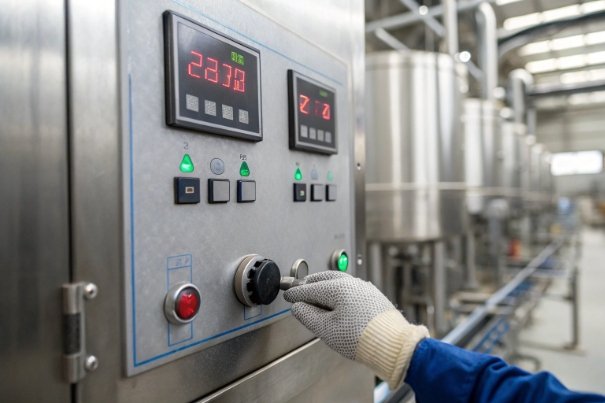
In industrial cleaning, we follow the Sinner’s Circle 1 principle: Cleaning efficiency is the sum of Chemicals + Temperature + Time + Mechanics.
If you want to lower the temperature to save energy, you must increase the concentration or time. However, with glass, we have a hard ceiling on concentration and temperature due to etching risks.
The Danger Zone: Etching
Etching occurs when the NaOH strips away the silica network faster than the rinsing step can remove it.
- Temperature Impact: For every $10^{\circ}C$ increase, the reaction rate (etching) roughly doubles. Operating at $90^{\circ}C$ is extremely risky for clear flint glass and practically guarantees damage to colored glass over repeated cycles.
- Concentration Threshold: We rarely exceed 2.5% to 3.0% caustic. Above 3%, the solution becomes viscous and difficult to rinse, and the aggression toward the glass spikes.
Additives: The Secret Weapon
Pure NaOH is rarely used alone. We use commercial blends containing Chelating Agents (like EDTA 2 or Gluconates).
These additives prevent the dissolved glass (silicates) and hard water minerals from redepositing on the bottle surface. They allow us to use lower concentrations of NaOH (e.g., 1.5%) while achieving the cleaning power of a 3% pure solution, effectively expanding our safety margin against etching.
Recommended Parameter Matrix
| Soil Type | Concentration (NaOH) | Temperature | Contact Time | Etching Risk |
|---|---|---|---|---|
| New Glass (Dust) | 0.5% – 1.0% | $50^{\circ}C – 60^{\circ}C$ | 2 – 5 min | Negligible. |
| Oily Residue | 1.5% – 2.0% | $65^{\circ}C – 75^{\circ}C$ | 5 – 10 min | Low. |
| Paper Labels (Glue) | 2.0% – 3.0% | $75^{\circ}C – 80^{\circ}C$ | 10 – 20 min | Moderate. |
| Mold / Dried Yeast | 2.5% – 3.5% | $80^{\circ}C$ | 15 – 25 min | High. |
| Sterilization | > 4.0% | > $85^{\circ}C$ | N/A | Critical (Avoid). |
Staying within the "Green Zone" (1-2% @ 70°C) ensures clean glass that remains glossy.
How Can NaOH Washing Damage Coatings or Decorations?
Treating a decorated bottle like a plain flint bottle is a recipe for disaster. You must recognize that organic inks and metallic finishes are chemically incompatible with strong alkalis.
NaOH washing causes catastrophic failure in decorated bottles; it chemically dissolves aluminum metallization (creating hydrogen gas), swells and peels organic UV inks, and dulls the finish of acid-etched frostings.
Electroplating (Vacuum Metallization) Destruction
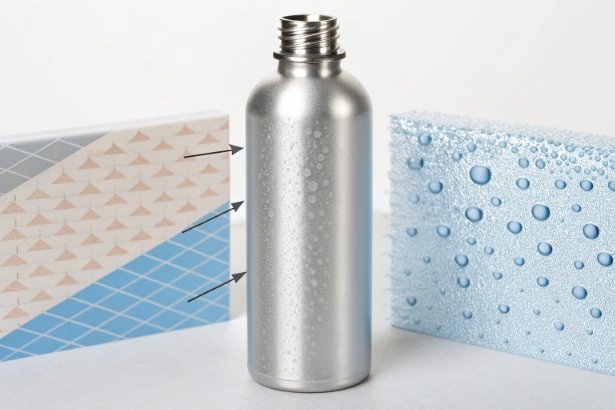
This is the most violent reaction. "Electroplated" glass usually relies on a thin layer of Aluminum.
Aluminum is amphoteric 3—it dissolves in acid and alkali.
$$2Al + 2NaOH + 6H_2O \rightarrow 2Na[Al(OH)_4] + 3H_2 (gas)$$
If you put a metallized silver bottle into a caustic wash:
- The NaOH eats the protective topcoat.
- It attacks the aluminum layer.
- Hydrogen gas is generated rapidly, literally blowing the coating off the glass.
- The bottle comes out clear (glass) with floating metallic flakes in the washer.
Organic Screen Printing and Spray Coatings
Modern eco-friendly inks (UV cured, Epoxy, Water-based) are organic polymers.
- Mechanism: NaOH acts as a paint stripper 4. It permeates the polymer matrix, causing it to swell and lose adhesion to the glass.
- Result: The logo peels off in sheets or flakes.
- Spray Coatings: Soft-touch or matte sprays will turn into a sticky, gummy mess as the alkali hydrolyzes 5 the resin.
The ACL Exception
Applied Ceramic Labeling (ACL) is the only decoration that survives NaOH. This is because ACL is glass frit fused to the bottle at $600^{\circ}C$. However, even ACL will fade after 20-30 wash cycles in caustic, as the lead/cadmium fluxes (in older prints) or the glass matrix itself is slowly eroded.
Prevention Strategies
- Switch Chemistries: For decorated ware, NEVER use NaOH. Use Neutral pH detergents (pH 7-8) based on enzymes or surfactants.
- Lower Temperature: Keep wash temps below $50^{\circ}C$ to reduce chemical aggression.
- Mechanical Action: Rely on high-pressure water jets rather than chemical dissolution.
Coating Compatibility Guide
| Decoration Type | Reaction to NaOH Wash | Compatibility | Recommended Cleaner |
|---|---|---|---|
| Plain Glass | Inert (mostly). | High | NaOH (1-3%). |
| Ceramic (ACL) | Slow erosion over time. | Moderate | NaOH (1-2%) + Inhibitors. |
| UV Screen Print | Peeling / Swelling. | None | Neutral Detergent. |
| Electroplating | Dissolution ($H_2$ Gas). | None | Mild Surfactant. |
| Spray (Organic) | Softening / Gumming. | None | Warm Water + Soap. |
| Acid Frosting | Smoothing (Loss of matte). | Low | Mild Acidic Wash. |
If the bottle has a logo that isn’t ceramic, keep the caustic soda away.
Do Glass Bottles Need Neutralization After NaOH Cleaning?
A bottle that looks clean can still carry invisible, high-pH chemical residues. You must neutralize the surface to prevent product spoilage and "blooming."
Yes, neutralization is mandatory after NaOH cleaning; a dilute acid rinse (typically Citric or Phosphoric acid) prevents alkaline residues from altering the beverage pH or reacting with atmospheric moisture to cause salt blooming.
The "Alkali Bloom" Phenomenon
If you simply rinse a caustic-washed bottle with water, a microscopic film of Sodium Hydroxide may remain. Upon drying, this sodium reacts with Carbon Dioxide in the air:
$$2NaOH + CO_2 \rightarrow Na_2CO_3 + H_2O$$
This forms Sodium Carbonate, a white, hazy powder on the glass surface known as "bloom" 6 or "weathering." It makes the glass look old and dirty before it’s even filled.
The Neutralization Step
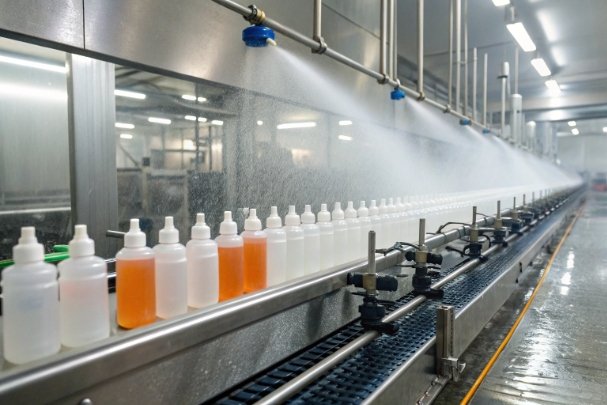
To prevent this, we introduce an acid rinse immediately after the caustic zone and before the final fresh water rinse.
- Chemicals: Phosphoric Acid (most common for industrial) or Citric Acid (food safe).
- Mechanism: Acid + Base $\rightarrow$ Salt + Water. The salt is highly soluble and washes away instantly.
QC Checks for Residue
How do we confirm the NaOH is gone?
- Conductivity: We measure the conductivity 7 of the final rinse water. If it is significantly higher than the input fresh water, there are still dissolved salts/alkali present.
- Phenolphthalein Drop Test: A classic spot check. A drop of phenolphthalein indicator is placed in the wet bottle.
- Clear: Clean (pH < 8).
- Pink/Fuchsia: Contaminated (pH > 8). The line must stop.
- pH Meter: For critical pharma applications, we rinse the bottle with distilled water and measure the pH of the runoff. It must be neutral (7.0 ± 0.5).
Post-Wash Protocol
| Step | Action | QC Requirement |
|---|---|---|
| 1. Caustic Wash | 2% NaOH @ $70^{\circ}C$. | Monitor Concentration. |
| 2. Warm Rinse | Water @ $40^{\circ}C$. | Remove bulk foam. |
| 3. Neutralization | 0.5% Phosphoric Acid spray. | pH of drain water ~7. |
| 4. Final Rinse | Fresh Water (Cold). | Conductivity Check. |
| 5. QC Check | Phenolphthalein Test 8. | NO COLOR CHANGE. |
Skipping neutralization is the primary cause of "soapy" tasting beverages and white-stained glass.
What Worker-Safety and Wastewater Controls Should Factories Follow?
Sodium Hydroxide is classified as a corrosive material that causes severe thermal and chemical burns. You must enforce strict EHS (Environmental, Health, and Safety) protocols to protect your workforce and the local ecosystem.
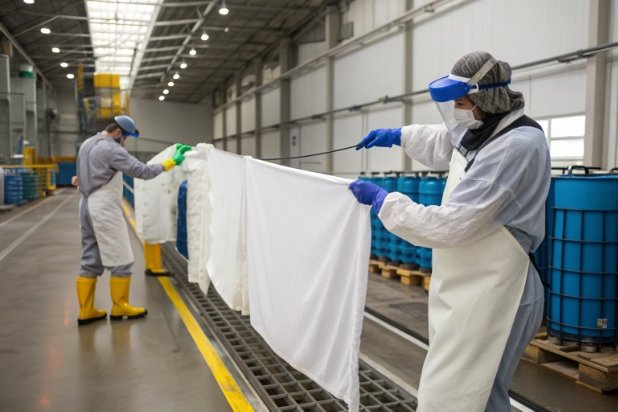
Factories must implement strict PPE mandates (splash goggles, chemical-resistant gloves), install emergency showers near wash lines, and treat alkaline wastewater with acid neutralization and solids settling before environmental discharge.
Worker Safety: The Exothermic Threat
NaOH is hygroscopic 9 and exothermic. When dry flakes hit water, they generate massive heat.
- Mixing Protocol: Always add caustic to water, never water to caustic (risk of eruption).
- PPE: Operators must wear full-face shields (not just glasses), rubber aprons, and nitrile/neoprene gloves. NaOH saponifies human skin instantly—the "slippery" feeling is your skin dissolving.
- First Aid: Emergency eyewash stations and deluge showers must be within 10 seconds of the charging station.
Wastewater Compliance
You cannot dump pH 12 water down the drain. It kills aquatic life and damages municipal pipes.
- Neutralization Tank: Effluent from the washer goes to a holding tank. We dose it with Sulfuric or Hydrochloric acid to bring the pH down to the legal limit (typically pH 6.0 – 9.0).
- Suspended Solids: The wash water contains dissolved glue and label pulp. This forms "sludge." We use flocculants 10 to settle the sludge, which is then pressed and disposed of as solid waste.
- COD (Chemical Oxygen Demand): The dissolved organics (sugars, glues) raise the COD. Biological treatment (aeration) is often required before discharge.
EHS Control Checklist
| Hazard Area | Control Measure | Regulatory Goal |
|---|---|---|
| Chemical Handling | PPE (Face shield, Apron). | OSHA / Local Labor Law. |
| Spill Containment | Bunding/Dikes around tanks. | Prevent soil contamination. |
| Wastewater pH | Auto-dosing Acid Neutralization. | Discharge pH 6.0 – 9.0. |
| Vapors/Mists | Exhaust extraction hoods. | Air Quality Standards. |
| Heat | Insulated tanks ("Hot Surfaces"). | Prevent thermal burns. |
Operating a caustic wash line requires treating the chemical with the respect a hazardous material demands.
Conclusion
Cleaning glass bottles with Sodium Hydroxide (NaOH) is the industry standard for a reason: it is effective, economical, and scalable. However, it requires a "Goldilocks" approach—1-3% concentration, temperatures under 80°C, and mandatory acid neutralization—to ensure the glass remains pristine. For decorated ware, avoid NaOH entirely to prevent catastrophic coating failure.
Footnotes
-
A model for effective cleaning involving four interdependent factors: time, temperature, chemistry, and mechanical action. ↩
-
A chemical that binds to metal ions, preventing them from reacting with other substances. ↩
-
A substance that can react as either an acid or a base. ↩
-
Chemical agents used to remove paint and other coatings from surfaces. ↩
-
A chemical reaction in which water is used to break down the bonds of a particular substance. ↩
-
A hazy white appearance on glass caused by the reaction of alkali ions with atmospheric moisture. ↩
-
A measure of water’s ability to pass electrical flow, directly related to the concentration of ions. ↩
-
A chemical compound often used as a pH indicator, turning pink in basic solutions. ↩
-
The ability of a substance to attract and hold water molecules from the surrounding environment. ↩
-
Chemicals that promote the clumping of fine particles into larger flocs so they can be removed from water. ↩






