
Assuming all glass is equally safe for any food product is a compliance risk that can lead to contamination and recalls. You must navigate the complex web of global standards to ensure packaging safety.
Food-contact glass must primarily meet ISO 4802 hydrolytic resistance standards and heavy metal migration limits set by FDA CPG 7117.06 or EU Directive 84/500/EEC; it effectively resists acidic foods indefinitely but requires specific testing for high-pH alkaline products.
What Are the Acid and Alkali Resistance Requirements for Food-Contact Glass Bottles?
The Regulatory Landscape
In the global B2B glass market, "requirements" are a mix of mandatory safety laws and voluntary quality standards. As the face of FuSenglass, I often explain to brand owners that glass is designated GRAS (Generally Recognized As Safe) by the US FDA 1. However, this does not grant immunity from physics or chemistry.
The core requirement for food-contact glass is Chemical Inertness. The bottle must not react with the food to produce harmful substances or alter the food’s composition (taste/smell). While there isn’t a single global "Acid Resistance Certificate," there are strict classifications based on Hydrolytic Resistance (resistance to water leaching ions from the glass).
Most standard food jars and beverage bottles fall under Type III Soda-Lime Glass. This glass is chemically formulated to resist the weak acids found in 99% of food products (tomatoes, vinegar, citrus). However, for infant formula or specific medical foods, the requirements tighten, often necessitating Type II (Treated) or Type I (Borosilicate) glass to prevent even microscopic alkali leaching.
Understanding the Classifications
Regulatory bodies classify glass based on its hydrolytic resistance—essentially, how much alkali it releases when boiled.
| Glass Class | ISO 4802 Limit (ml 0.01N HCl) | Typical Use Case | Acid/Alkali Suitability |
|---|---|---|---|
| Type I | < 1.0 ml | Pharma, Lab, Premium Spirits. | Extreme Acid & Alkali Resistance. |
| Type II | < 0.85 ml (Surface Treated) | IV Fluids, Acidic/Neutral Aqueous. | High Acid; Mod. Alkali Resistance. |
| Type III | < 15.0 ml | Soda, Wine, Pickles, Jam. | Good Acid; Poor Alkali Resistance. |
| NP (Non-Parenteral) | N/A | Cosmetic, Decorative. | Low Resistance (Not for Food). |
For general wholesale food packaging, Type III is the standard requirement. If you are packaging something chemically aggressive, you need to move up the chart.
Which Standards Regulate Acid and Alkali Resistance in Food-Contact Glass Bottles?
Navigating between FDA, EFSA, and ISO guidelines can be confusing, but missing a standard can block market entry. You need to know which specific regulation applies to your target region.
The FDA regulates heavy metal leaching under CPG 7117.06/07, while the EU relies on Framework Regulation (EC) 1935/2004 and Directive 84/500/EEC; ISO 4802 is the universal technical standard for testing hydrolytic resistance.
United States: FDA & CPG
In the US, the FDA focuses heavily on Migration.
- 21 CFR 170.30: Establishes Glass as GRAS.
- CPG 7117.06 & 7117.07: These Compliance Policy Guides specifically target Lead and Cadmium leaching. While they don’t explicitly mandate an "acid resistance" level for the glass structure, the test method involves leaching with 4% Acetic Acid. If your glass has poor acid resistance, it will leach metals and fail this standard.
European Union: The Framework
The EU approach is broader, focusing on "Good Manufacturing Practice" (GMP).
- Regulation (EC) No 1935/2004: The overarching law stating packaging must not endanger health or change food composition.
- Directive 84/500/EEC: Specific to ceramic and glass articles, setting limits for Lead and Cadmium migration.
- ISO Compliance: EU suppliers typically demand proof of ISO 4802 compliance to verify the glass quality (Type III).
ISO Standards: The Technical Benchmark
For B2B contracts, we use ISO standards to define physical quality.
- ISO 4802: Hydrolytic Resistance (Water).
- ISO 7086: Migration of Lead and Cadmium.
- DIN 12116: Acid Resistance (Specific to Germany/Industrial, but used globally for technical evaluation).
- ISO 695: Alkali Resistance (Boiling Caustic test).
Key Regulatory Comparison
| Region | Primary Regulation | Key Test Focus | Acceptance Criteria |
|---|---|---|---|
| USA | FDA CPG 7117.06 | Lead/Cadmium Migration. | Pb < 0.5 ppm (Large Hollowware). |
| EU | EC 1935/2004 | Chemical Inertness & GMP. | No organoleptic changes. |
| China | GB 4806.5-2016 2 | Heavy Metals & Migration. | Strict internal migration limits. |
| Global | ISO 4802 3 | Hydrolytic Stability. | Matches Glass Type (I, II, III). |
Compliance isn’t just about the bottle; it’s about the interaction between the bottle and the specific food inside.
What Is the Acceptable pH Range and Contact Time for Glass Bottles?
Glass is not invincible; extreme pH levels can erode the surface over time. You must match the container’s durability to your product’s shelf life and acidity.
Standard Type III soda-lime glass is safe for acidic foods (pH 2.5–6.0) for indefinite periods; however, highly alkaline products (pH > 9.0) can etch the glass surface, limiting shelf life and requiring Type I glass or specialized barrier coatings.
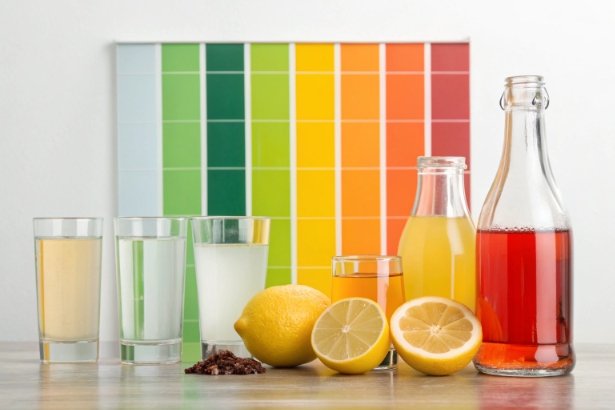
The Acidic Safety Zone
The vast majority of food products are acidic.
- pH 2.5 – 4.5: Vinegar, Lemon Juice, Carbonated Soda, Pickles.
- Performance: Soda-lime glass is exceptionally resistant here. The hydrogen ions ($H^+$) exchange with surface sodium, creating a silica-rich layer that actually protects the glass from further attack. We have seen pickled vegetables stored for 5+ years with zero glass degradation.
The Alkaline Danger Zone
Foods are rarely highly alkaline, but some mineral waters and functional beverages are.
- pH > 8.5: "Alkaline Water" or specific additives.
- Performance: At this pH, the mechanism changes from ion exchange to network dissolution. The silica bonds break.
- Risk: Extended storage (> 1 year) of high pH liquids in Type III glass can lead to "flaking" (delamination 4), where microscopic glass scales float in the drink. This is a critical quality failure.
Neutral Foods (Oils, Dry Goods)
For pH-neutral products (Olive Oil, Spices, Honey), chemical attack is negligible. The main concern here is not glass corrosion, but protecting the contents from UV light (using Amber/Green glass).
Shelf-Life Guidelines based on pH
| Product Type | Typical pH | Glass Type Rec. | Max Contact Time | Risk Factors |
|---|---|---|---|---|
| Vinegar / Lemon | 2.0 – 3.0 | Type III | Indefinite | Cap corrosion (acid vapors). |
| Wine / Beer | 3.0 – 4.5 | Type III | Indefinite | Tartrate precipitation 5. |
| Milk / Dairy | 6.5 – 6.8 | Type III | Indefinite | Light sensitivity. |
| Alkaline Water | 8.0 – 9.5 | Type II / I | 1 – 2 Years | Silica leaching / Flaking. |
| Caustic Cleaning | 12.0+ | Not Recommended | Hours (Wash only) | Rapid etching/frosting. |
If you are launching a new "High Alkaline" beverage, do not assume a standard beer bottle will work. Test it.
How Is Acid/Alkali Resistance Tested for Food-Contact Glass?
You cannot determine chemical resistance by looking at a bottle. You must employ destructive laboratory testing to measure the rate of ionic release under accelerated stress conditions.
Resistance is measured via ISO 4802 for hydrolytic stability (autoclaving), ISO 695 for alkali resistance (boiling in sodium carbonate), and DIN 12116 for acid resistance (boiling in hydrochloric acid), with results quantified by weight loss or titrated alkali release.
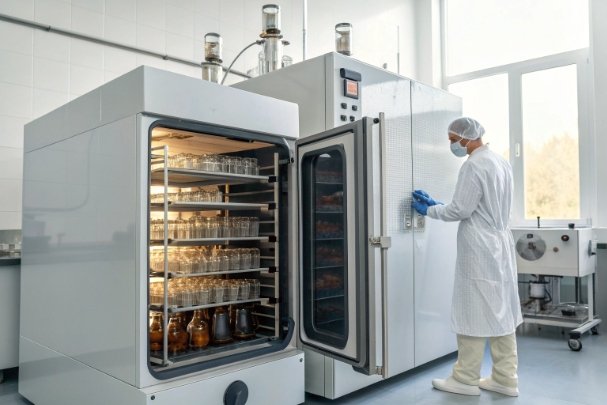
The Workhorse: ISO 4802 (Hydrolytic)
This is the standard certificate you should ask for.
- Method: We fill the bottle with distilled water and bake it in an autoclave at $121^{\circ}C$ for 60 minutes.
- Measurement: We titrate the water to see how much alkali (Sodium) leached out.
- Result: The volume of acid needed to neutralize the water determines if it is Type I, II, or III.
The Acid Test: DIN 12116
Used when a client is concerned about very acidic contents.
- Method: A sample of glass is boiled in 6N Hydrochloric Acid 6 (HCl) for 6 hours.
- Measurement: We measure the weight loss of the glass sample per surface area ($mg/dm^2$).
- Classes:
- Class S1: Highly Resistant (Borosilicate).
- Class S2: Resistant (Treated Soda-Lime).
- Class S3/S4: Susceptible.
The Alkali Test: ISO 695
Crucial for returnable bottles that undergo caustic washing.
- Method: Glass is boiled in a mixture of Sodium Carbonate and Sodium Hydroxide.
- Measurement: Weight loss. Since alkali dissolves silica, we measure how much of the bottle wall effectively disappeared.
- Classes: A1 (Best) to A3 (Worst). Most soda-lime bottles are A2.
Heavy Metal Migration (ISO 7086)
As discussed previously, this is a safety must.
- Method: 24-hour soak in 4% Acetic Acid at $22^{\circ}C$.
- Analysis: ICP-MS 7 detection of Lead and Cadmium.
Testing Protocol Matrix
| Test Standard | Target Condition | Key Metric | Passing Criteria (Type III) |
|---|---|---|---|
| ISO 4802-1/2 | Water Leaching | Alkali Release | < 15 ml 0.01N HCl (per 100ml). |
| ISO 7086 | Acidic Food | Pb/Cd Migration | Pb < 0.5 mg/L. |
| DIN 12116 | Strong Acid | Weight Loss | Class S3/S4 acceptable for food. |
| ISO 695 | Strong Alkali | Weight Loss | Class A2 typical. |
These tests mimic years of storage in just a few hours.
What Factors Should Manufacturers Consider to Ensure Safe Food Packaging?
Meeting the bare minimum standard protects you from fines; optimizing the glass protects your brand reputation. You must tune the glass composition and processing to minimize interaction with the food.
Manufacturers must control the silica-to-alkali ratio in the raw batch, utilize surface treatments like de-alkalization (sulfuring) for sensitive products, and ensure consistent annealing to maximize the chemical stability of the glass surface.
Glass Composition Balance
The resistance comes from the chemistry.
- Silica ($SiO_2$): The skeleton. More is better for resistance, but makes it harder to melt (higher energy cost).
- Alkali ($Na_2O$): The flux. Makes melting easy but reduces resistance (increases leaching).
- Stabilizers ($CaO, Al_2O_3$): Alumina is the magic ingredient. Adding just 1-2% Alumina 8 significantly boosts the structural integrity against chemical attack.
Surface Treatment (De-alkalization)
For "Type II" glass, we change the surface without changing the bulk glass.
- Process: Injecting sulfur or fluorine gas into the hot bottle.
- Result: It scavenges the surface sodium ions.
- Benefit: The inner surface becomes enriched in silica, acting almost like borosilicate glass. This is the most cost-effective way to package sensitive, slightly alkaline, or high-purity aqueous foods without paying for Type I glass.
Annealing Quality
A stressed surface is a reactive surface.
- If the bottle is cooled unevenly, the surface density varies. Chemical attack will focus on the low-density (high volume) areas, leading to pitting.
- Solution: Precise annealing 9 schedules ensure a uniform, dense surface skin that resists hydrolysis.
Manufacturer’s Checklist for Safety
| Factor | Control Measure | Impact on Food Safety |
|---|---|---|
| Batch Formula | Optimize Alumina/Silica levels. | Increases overall chemical durability. |
| Refining | Use Sulfate fining (No Arsenic). | Eliminates toxic heavy metal sources. |
| Surface | Sulfur Treatment (Type II). | Prevents alkali blooming/pH shift. |
| Coating | External Cold End Coating 10. | Prevents scratches (which weaken resistance). |
| Quality | Hydrolytic Testing per Batch. | Verifies compliance before shipping. |
By managing these inputs, we ensure the glass remains a neutral, silent partner in the packaging, letting the food speak for itself.
Conclusion
Acid and alkali resistance are the pillars of glass food safety. By adhering to ISO 4802 standards, understanding the limits of Type III glass in alkaline environments, and enforcing rigorous migration testing, you ensure your packaging remains compliant, safe, and chemically invisible.
Footnotes
-
US Food and Drug Administration designation for substances that are considered safe for their intended use. ↩
-
Chinese national standard for glassware used in food contact materials. ↩
-
International standard specifying the hydrolytic resistance of the interior surfaces of glass containers. ↩
-
The flaking of glass surfaces in pharmaceutical vials, causing potential contamination. ↩
-
The formation of potassium bitartrate crystals in wine, often confused with glass fragments. ↩
-
A strong mineral acid used in industrial processing and chemical analysis. ↩
-
A highly sensitive analytical technique used to detect metals and non-metals at very low concentrations. ↩
-
A chemical compound of aluminium and oxygen, used to improve the hardness and chemical resistance of glass. ↩
-
The process of slowly cooling hot glass to relieve internal stresses. ↩
-
Protective coatings applied to glass containers after annealing to prevent scratching and improve handling. ↩






