
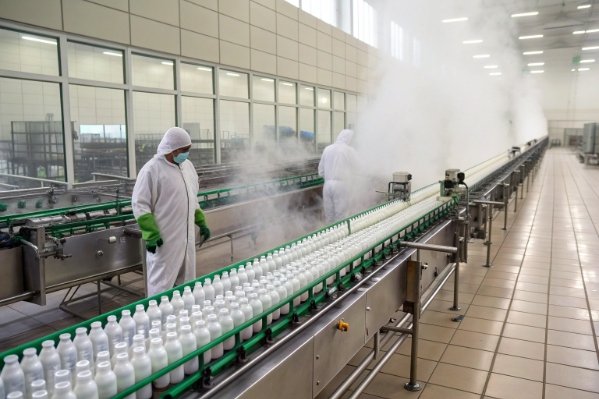
Residual contaminants and stubborn adhesives can ruin a production run, yet aggressive cleaning risks permanent glass damage. Finding the precise chemical balance is essential for hygiene and container integrity.
For standard industrial washing, a Sodium Hydroxide (NaOH) concentration of 1% to 3% is ideal for heavy-duty cleaning and sterilization. For milder cleaning or delicate glassware, Sodium Carbonate is typically used at 5% to 10% concentrations to prevent surface etching.
What Alkaline Solution Concentration Should Be Used to Wash Glass Bottles?
The Chemistry of Cleanliness
In my twenty years at FuSenglass, I have seen thousands of tons of glass pass through our washing lines. The "washing" process is not just about water; it is a chemical battle against organic residues, mold, oils, and adhesives. Alkaline solutions are the weapon of choice because they excel at two things: saponification (turning fats into soap so they wash away) and hydrolysis (breaking down proteins and carbohydrates like label glue).
However, the concentration is critical. Glass is primarily silica, and silica is susceptible to attack by strong alkalis, especially at high temperatures. This is known as "alkali attack" or etching 1, where the glass surface physically dissolves, becoming cloudy or rough. This is irreversible damage. Therefore, the goal is to use the minimum concentration required to clean the soil without attacking the substrate.
The "Sinner’s Circle" in Bottle Washing
We follow the principle of the Sinner’s Circle 2, which balances four factors: Chemical Concentration, Mechanical Action, Temperature, and Time. If you reduce the chemical concentration (to save money or protect the glass), you must increase the temperature or the contact time.
For B2B wholesale recycling or manufacturing, we generally operate in a "sweet spot." We want a fast line speed (short time), so we often lean on higher temperatures ($60^{\circ}C – 85^{\circ}C$) and optimized alkalinity.
General Concentration Guidelines
| Cleaning Agent | Target Concentration | pH Level | Application Scenarios | Risk to Glass |
|---|---|---|---|---|
| Caustic Soda (NaOH) | 1.0% – 3.0% | 13 – 14 | Heavy soil, mold, glue removal. | High (if >3% or >85°C). |
| Soda Ash (Na₂CO₃) | 5.0% – 10.0% | 11 – 12 | Light soil, dust, general wash. | Low. |
| Potassium Hydroxide | 1.0% – 3.0% | 13 – 14 | Specific specialized cleaning. | High. |
| Alkaline Detergents | 0.5% – 2.0% | 10 – 12 | Surfactant 3 blends for wetting. | Low to Moderate. |
Understanding the base chemical is the first step in setting your concentration parameters.
Which Alkaline Cleaners Are Used for Glass Bottle Washing, and How Do They Change the Target Concentration?
Choosing between aggressive caustic soda and milder soda ash determines your cleaning efficiency and safety protocols. You must match the chemical strength to the severity of the contamination.
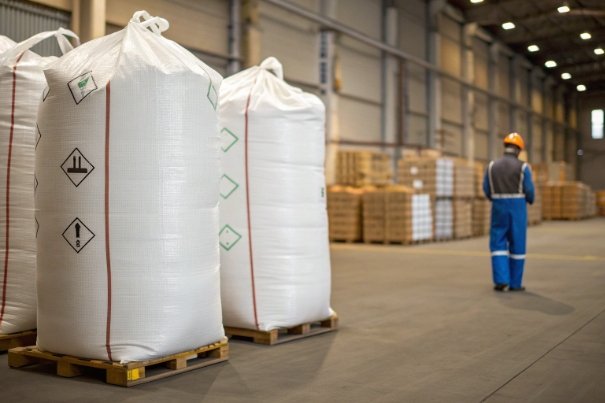
Sodium Hydroxide (Caustic Soda) is the industry standard for heavy-duty washing, requiring low concentrations (1–3%) due to its high pH; Sodium Carbonate (Soda Ash) is a milder alternative requiring higher concentrations (5–10%) for effective cleaning.
Sodium Hydroxide (Caustic Soda / Lye)
Sodium Hydroxide (NaOH) is the heavy hitter. In 90% of industrial bottle washers, especially for returnable bottles or post-mold cleaning, this is what we use.
- Why: It provides a very high pH 4 (alkalinity) even at low concentrations. It aggressively dissolves organic matter.
- Concentration: Because it is so potent, we rarely need to exceed 2% to 3%. Going higher than 4% yields diminishing returns on cleaning but spikes the risk of glass etching and makes rinsing significantly harder.
- Additives: We almost never use pure NaOH. We add chelating agents 5 (EDTA) to prevent limescale scale build-up from hard water and surfactants to help the solution penetrate soil.
Sodium Carbonate (Soda Ash)
Sodium Carbonate ($Na_2CO_3$) is a "buffer" alkali. It is far less aggressive.
- Why: It is safer for operators and safer for the glass. It rinses away easier than caustic soda.
- Concentration: To get anywhere near the cleaning power of caustic soda, you need much more mass. We typically run soda ash baths at 5% to 10%.
- Usage: We prefer this for "new glass" washing where we are just removing dust and cardboard fibers, rather than old mold or dried soda residue.
Operational Differences
| Feature | Sodium Hydroxide (NaOH) | Sodium Carbonate ($Na_2CO_3$) |
|---|---|---|
| Alkalinity Source | Strong Base (Dissociates fully). | Weak Base (Hydrolysis). |
| Cleaning Power | Excellent (Saponifies fats). | Good (Emulsifies). |
| Rinsability | Difficult (Clings to glass). | Easy. |
| Glass Etching | High risk (requires additives). | Minimal risk. |
| Cost Efficiency | High (Low dose needed). | Moderate (High dose needed). |
Selecting the right cleaner allows you to optimize your chemical spend while ensuring cleanliness.
What Concentration, Temperature, and Contact Time Are Used to Remove Label Glue, Oils, and Residues?
Different contaminants require specific energy levels to dislodge without damaging the container. You need to dial in the process parameters based on the toughest soil you expect to encounter.
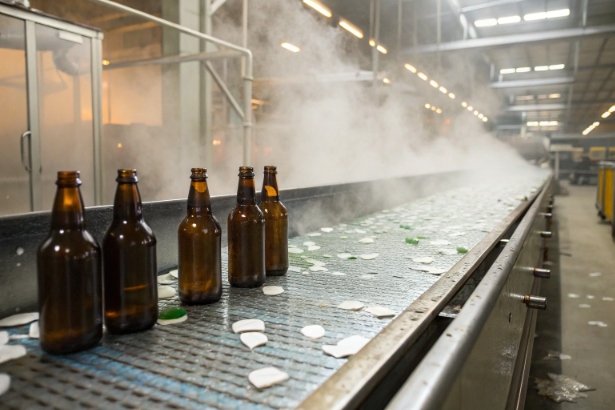
For glue and heavy oils, a 2–3% NaOH solution at 80°C with a 7–10 minute contact time is standard; lighter residues typically require only 1–1.5% concentration at 60°C for 3–5 minutes.
Removing Labels and Glue
This is the hardest task in bottle washing. Casein glues, starch glues, and modern synthetics require heat and caustic to swell and dissolve.
- Temperature: Heat is the engine here. We need $80^{\circ}C$ to $85^{\circ}C$. Below $70^{\circ}C$, the glue just softens but doesn’t dissolve.
- Concentration: We bump the caustic (NaOH) to 2.5% – 3.0%.
- Time: It takes time for the solution to penetrate the paper label. A soak time of 7 to 15 minutes is common in large soaker washers 6.
Removing Oils and Fats
For bottles that held olive oil or oily sauces, saponification 7 is key.
- Temperature: Oils can be removed at slightly lower temperatures, around $65^{\circ}C$ to $75^{\circ}C$, provided the alkalinity is sufficient.
- Concentration: 1.5% to 2.0% NaOH is usually sufficient.
- Surfactant Role: Here, the additive (surfactant) is more important than the raw caustic concentration. It helps lift the oil so the caustic can attack it.
Avoiding Glass Etching
This is the critical upper limit. If you run 3% NaOH at $90^{\circ}C$ for 20 minutes, you will etch the glass. The bottles will come out looking clean but with a scuffed, hazy surface (scuffing rings).
- The Rule: If you increase temperature, decrease concentration.
- Additives: Using silicate-based inhibitors can help protect the glass surface during aggressive washing.
Parameter Guide by Soil Type
| Soil / Contaminant | Alkali Conc. (NaOH) | Temperature | Contact Time | Mechanism |
|---|---|---|---|---|
| Paper Labels/Glue | 2.5% – 3.5% | $80^{\circ}C – 85^{\circ}C$ | 10 – 15 mins | Swelling + Hydrolysis. |
| Vegetable Oils | 1.5% – 2.5% | $70^{\circ}C – 80^{\circ}C$ | 5 – 8 mins | Saponification. |
| Mold / Dried Yeast | 2.0% – 3.0% | $75^{\circ}C – 85^{\circ}C$ | 10 – 20 mins | Chemical Breakdown. |
| Light Dust (New) | 0.5% – 1.0% | $50^{\circ}C – 60^{\circ}C$ | 2 – 3 mins | Physical flushing. |
Balancing these factors ensures the bottle is pristine without sacrificing its structural or visual quality.
How Should Alkali Concentration Be Adjusted for Decorated Bottles?
Standard industrial washing will strip paint and corrode metallic finishes on decorated bottles. You must radically lower chemical aggression to preserve value-added decorations.
Decorated bottles (UV, electroplated, organic screen print) are highly sensitive to high pH; alkali concentration should be kept below 0.5% (pH < 10) or replaced with neutral enzymatic detergents, and temperatures reduced to below 50°C.
The Fragility of Organic Inks and Coatings
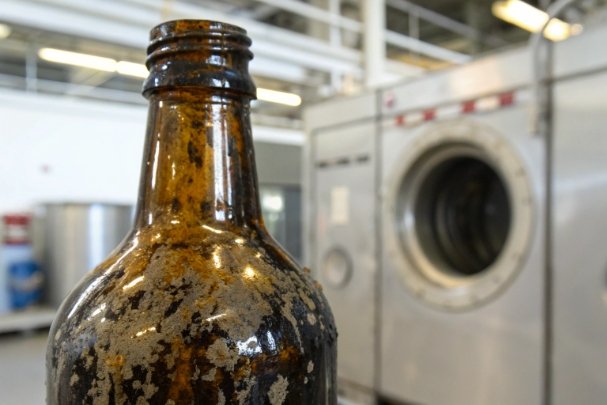
As I mentioned in previous articles, modern decorations like UV screen printing and vacuum metallization rely on organic polymer bonds. These bonds are easily hydrolyzed 8 by the same high-pH solutions used to wash plain glass.
- The Failure: If you put an electroplated bottle through a standard 3% caustic soda wash at $80^{\circ}C$, the metal layer will disappear or turn black within minutes. Organic screen printing inks will peel off.
Ceramic (ACL) vs. Organic Decoration
You must know what you are washing.
- Ceramic Decoration (ACL): This is fused glass frit fired at $600^{\circ}C$. It is very durable. It can withstand standard caustic washing (1-2% NaOH), although repeated washing over years will eventually fade the colors (lead release issues).
- Organic/UV Decoration: These must be treated like delicate crystal.
Adjusted Washing Parameters for Decorated Ware
For these sensitive bottles, we abandon standard caustic soda.
- Chemistry: Switch to Neutral Detergents (pH 7-9) or very mild alkaline blends based on Sodium Metasilicate rather than Hydroxide.
- Temperature: Cap the temperature at $50^{\circ}C$. High heat softens the decorative coating, making it vulnerable to the mechanical force of the water jets.
- Mechanical Action: Rely more on spray pressure (carefully) and less on chemical dissolution.
Safe Washing Thresholds
| Decoration Type | Max Alkali (NaOH Eq.) | Max pH | Max Temp | Recommended Cleaner |
|---|---|---|---|---|
| Plain Flint Glass | 3.0% – 4.0% | 14 | $90^{\circ}C$ | Caustic Soda. |
| Ceramic (ACL) | 1.5% – 2.0% | 13 | $80^{\circ}C$ | Caustic + Inhibitors. |
| Organic Screen Print | < 0.2% | < 11 | $60^{\circ}C$ | Mild Alkaline / Soda Ash. |
| Electroplated / UV | 0% | < 9 | $50^{\circ}C$ | Neutral Surfactant. |
| Acid Etched (Frost) | 1.0% | 12 | $70^{\circ}C$ | Mild Caustic (Rinse well). |
Preserving the decoration is just as important as cleaning the interior; a clean but peeled bottle is unsellable.
What Rinsing, Neutralization, and QC Checks Should Buyers Specify?
Leaving alkaline residue inside a bottle is a safety hazard and a beverage stability risk. You must implement rigorous rinsing and verification steps to ensure total chemical removal.
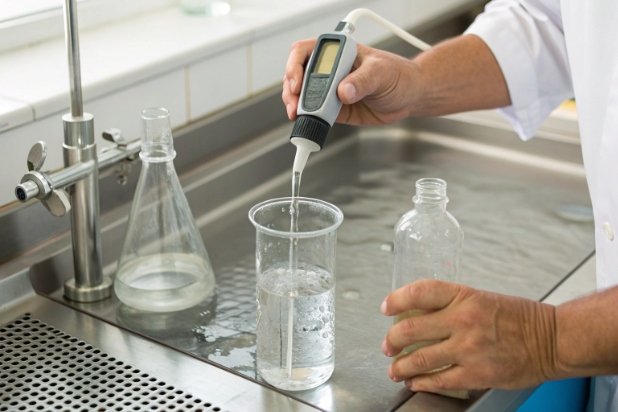
Buyers should specify a three-stage rinse (hot-warm-cold/DI), potentially a mild acid neutralization step, and QC checks using pH indicators (Phenolphthalein) or conductivity meters to ensure the final rinse water matches the input water quality.
The Importance of Rinsing Zones
You cannot go from a $80^{\circ}C$ caustic bath straight to cold water; the thermal shock 9 will shatter the glass. Rinsing must be stepped.
- Hot Rinse ($60^{\circ}C$): Uses recovered water. Removes the bulk of the detergent foam.
- Warm Rinse ($40^{\circ}C$): Further dilution.
- Fresh/Final Rinse (Cold): Uses fresh, potable (or DI) water to remove the last traces.
Neutralization
For pharmaceutical bottles or sensitive beverages (like high-end spirits), even trace alkalinity affects the product’s taste or stability.
- The Fix: We sometimes introduce a mild acid rinse (Phosphoric or Citric Acid) in the second rinse stage to chemically neutralize any remaining base on the glass surface. This ensures the bottle surface is pH neutral (pH 7.0).
QC Checks: Proving Cleanliness
How do you know the alkali is gone?
- Phenolphthalein Test: The classic spot check. We drop a phenolphthalein [^10] solution into a washed bottle. If it turns pink, there is residual alkali. The bottle fails.
- Conductivity Testing: This is the automated industrial method. We measure the electrical conductivity of the final rinse water coming out of the bottle. It should match the conductivity of the fresh water going in. If it’s higher, salts (cleaner) are still present.
- pH Meter: Direct measurement of the rinse water. We look for a pH equal to the source water (typically 7.0 – 7.5).
Buyer’s QC Protocol
| QC Method | Target / Tolerance | Frequency | Purpose |
|---|---|---|---|
| Phenolphthalein | Colorless (No Pink) | Hourly / Random | Visual proof of no caustic residue. |
| Conductivity | < Input Water + 50µS | Continuous | Automated rinse verification. |
| pH Check | Input pH ± 0.5 | Batch Start/End | Chemical neutrality. |
| Methylene Blue | Even blue coating | Daily | Verifies no residual oils (wetting test). |
| Turbidity | Clear | Continuous | Verifies no particulate matter left. |
By enforcing these final checks, you guarantee that the powerful chemicals used to clean the bottle do not become a contaminant themselves.
Conclusion
Optimizing alkaline washing requires a scientific approach to concentration and temperature. By maintaining 2-3% NaOH for standard washing and switching to neutral detergents for decorated ware, coupled with rigorous pH and conductivity testing, you ensure every bottle is sterile, safe, and visually pristine.
Footnotes
-
A technique used to create art or functional surfaces on glass using acidic, caustic, or abrasive substances. ↩
-
A theoretical model describing the four factors necessary for effective cleaning: chemistry, mechanics, temperature, and time. ↩
-
Compounds that lower the surface tension between two liquids, acting as detergents, wetting agents, emulsifiers, foaming agents, and dispersants. ↩
-
A scale used to specify the acidity or basicity of an aqueous solution. ↩
-
A type of bonding of ions and molecules to metal ions, often used to prevent scale in water treatment. ↩
-
Industrial machines designed to clean and sterilize glass bottles through soaking and spraying cycles. ↩
-
The chemical reaction that converts fats, oils, and lipids into soap and alcohol. ↩
-
A chemical reaction in which water is used to break down the bonds of a particular substance. ↩
-
The stress produced in a body or in a material as a result of a sudden change in temperature. ↩






