
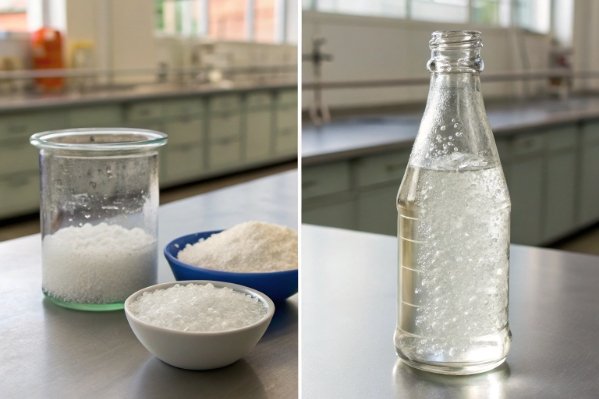
Glass that dissolves in your drink is a manufacturer’s nightmare. We must understand how Calcium Oxide (Quicklime) transforms soluble sand into the durable, inert packaging material we rely on.
Calcium Oxide (CaO) serves as the primary "stabilizer" in soda-lime glass. Without it, glass would be water-soluble (like sodium silicate). By integrating into the silica network, Calcium ions block the migration of alkali ions and solidify the matrix, rendering the bottle insoluble in water and significantly improving its resistance to atmospheric weathering and chemical attack.
The Critical Role of Lime in "Soda-Lime" Glass
At FuSenglass, we produce "Soda-Lime" glass. The name itself tells you that Lime (Calcium Oxide) is one of the three pillars of our material, alongside Silica (Sand) and Soda Ash. But why is it there?
If you melt Silica and Soda Ash together without Calcium, you get "Water Glass" (Sodium Silicate 1). It looks like glass, but if you pour water into it, the container will eventually dissolve into a sticky gel. It is chemically useless for packaging.
Calcium Oxide is the magic ingredient that imparts insolubility. When we add limestone to the furnace, the Calcium ions (Ca²⁺) enter the glass network. Unlike the Sodium ions (Na⁺) which act as "modifiers 2" that break the network to lower the melting point, Calcium acts as a stabilizer. It sits in the interstitial holes of the silica network. Because it carries a double positive charge (divalent), it binds more tightly to the oxygen atoms than the singly charged sodium does.
This tighter binding effectively "locks" the network structure. It prevents the water molecules from penetrating the surface and stops the sodium ions from leaching out. In my years of troubleshooting glass defects, I have found that "weathering"—that white, foggy haze you sometimes see on old bottles—is almost always a symptom of a formulation that lacked sufficient stabilization or was stored in humid conditions that overcame the stabilizer’s capacity.
Functions of Calcium Oxide in Glass Production
| Function | Role in Glass Matrix | Operational Impact |
|---|---|---|
| Insolubility | Transforms soluble sodium silicate into insoluble glass. | The fundamental reason glass can hold liquid. |
| Viscosity Modifier | Increases viscosity at high temperatures (shorter working range 3). | Allows the glass to set quickly in the mold (fast production speeds). |
| Network Stabilization | Divalent Ca²⁺ ions bridge non-bridging oxygens. | Increases mechanical hardness and chemical durability. |
| Devitrification Risk | Promotes crystallization if concentration is too high. | Limits the maximum amount we can add (usually ~10-12%). |
| Cost Efficiency | Sourced from abundant Limestone/Dolomite. | keeps raw material costs low compared to lead or boron. |
Now that we know Calcium makes the glass water-resistant, we need to understand exactly how it fights off chemical aggression.
What role does CaO play in stabilizing soda-lime glass and improving chemical durability?
A stable glass surface acts as a fortress against chemical interaction. CaO reinforces the molecular walls, specifically targeting the mobility of alkali ions that cause corrosion.
CaO improves chemical durability by obstructing the diffusion channels within the glass network. The large, divalent Calcium ions physically block the movement of smaller Sodium ions, preventing them from exchanging with Hydrogen ions in acidic solutions. This "blocking effect" drastically reduces the rate of ion leaching and surface corrosion.
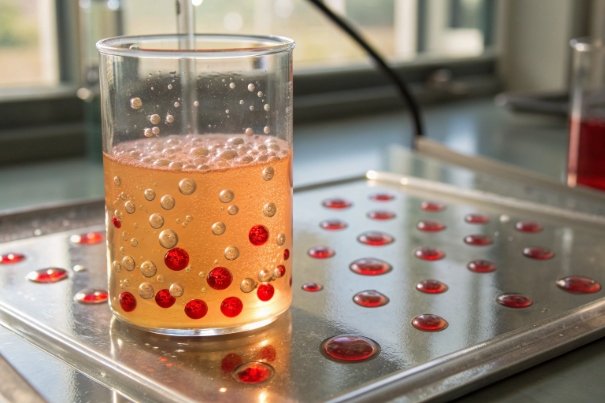
The "Blocking Effect" Mechanism
To understand chemical durability, you have to think about movement. Corrosion happens when things move: Sodium moves out, Hydrogen moves in (acid attack), or the network itself breaks apart (alkali attack).
Calcium plays the role of the heavy security guard. In the atomic structure of glass, the Sodium ions are flighty; they want to move. The Silica network has open channels or "pathways" through which these Sodium ions can travel. When we introduce Calcium Oxide:
-
Space Occupation: The Calcium ion is relatively large. It sits in these interstitial spaces (the "holes" in the net).
-
Charge Bonding: Being divalent (2+ charge), it holds onto the surrounding Oxygen atoms much harder than Sodium (1+ charge) does.
This combination creates a physical and electrical blockade. The Calcium ions essentially clog the pathways. This makes it much harder for the Sodium ions to migrate to the surface to react with your product. This is why increasing Lime content (up to a point) generally lowers the "Hydrolytic Class" (improves water resistance) of the glass.
In our laboratory at FuSenglass, we see this correlation clearly. Bottles with optimized Calcium levels show significantly less pH shift when filled with distilled water. This is crucial for products like mineral water or vodka, where you don’t want the glass to alter the taste or chemical balance of the liquid.
CaO Impact on Durability Types
| Durability Type | Mechanism of Protection | Relative Impact of CaO |
|---|---|---|
| Hydrolytic Resistance | Prevents water from hydrating the modifier ions. | High. Essential for preventing weathering/blooming. |
| Acid Resistance | Blocks H+ ions from swapping with Na+ ions (Ion Exchange 4). | Moderate. improves resistance, but too much Ca can be leached by strong acids. |
| Alkali Resistance | Strengthens the Si-O network against OH- attack. | Moderate. Better than pure silica/soda, but less effective than Alumina or Zirconia. |
| Weathering Resistance | Reduces surface reactivity to atmospheric moisture. | Very High. The primary defense against storage humidity damage. |
However, glass chemistry is a game of balances. If Calcium is so good, why don’t we just add more?
Can too much or too little CaO increase leaching or surface haze in acidic or alkaline exposure?
Glass formulation is a strict recipe; deviating in either direction invites failure. An imbalance in Calcium leads to two very different, but equally destructive, types of defects.
Too little CaO results in "soft" glass with poor water resistance, leading to rapid weathering (white haze) and high alkali leaching. Conversely, too much CaO destabilizes the vitreous state, causing devitrification (crystallization) and making the glass susceptible to acid attack, where the Calcium itself becomes the leachable component.
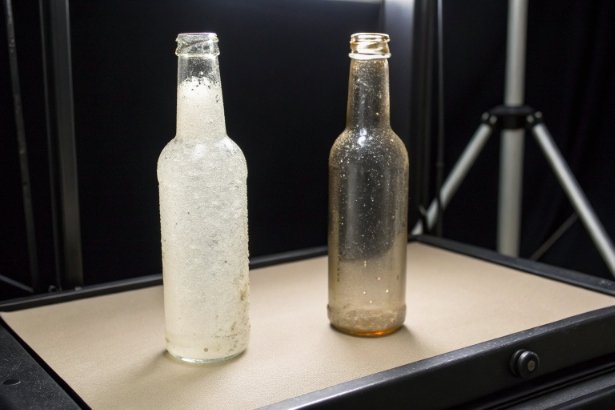
The Dangers of Imbalance
I always tell my procurement clients: "Don’t just ask for ‘standard’ glass; ask for ‘balanced’ glass." Here is what happens when the Calcium balance is off:
1. The "Soft" Glass Scenario (Low CaO < 8%):
If a manufacturer tries to save money or energy by reducing Lime (and usually increasing Soda Ash to melt it faster), the glass becomes chemically "soft."
-
The Defect: Weathering (Blooming) 5.
-
The Mechanism: Without enough Calcium stabilizers, the Sodium ions on the surface react instantly with humidity in the air. They form Sodium Hydroxide (NaOH) and Sodium Carbonate crystals. This looks like a greasy film or a white dust on the bottle.
-
The Consequence: If you fill acidic juice into this bottle, the weak network will release a flood of alkali ions, neutralizing the acidity and potentially spoiling the juice.
2. The "Short" Glass Scenario (High CaO > 14%):
If we add too much Lime, the glass wants to become a rock (Limestone) again.
-
The Defect: Devitrification 6. Microscopic crystals (Wollastonite) form in the glass. These are brittle stress points that lead to spontaneous breakage.
-
The Chemical Flaw: Paradoxically, while Calcium stops Sodium leaching, Calcium itself is soluble in strong acids. If the CaO content is too high, a strong acidic solution (like a pickling brine or a specific lab reagent) can actually attack the Calcium ions, leaching them out. This leaves a porous, silica-rich layer that causes the glass to look iridescent or flaky.
At FuSenglass, we maintain a sweet spot—typically between 10% and 12% (combined CaO + MgO)—to maximize durability without risking crystallization.
Failure Modes by Calcium Level
| CaO Content | Physical State | Chemical Behavior | Visible Defect |
|---|---|---|---|
| Low (< 8%) | "Soft" Glass | High Alkali Mobility. Rapid reaction with water/humidity. | Weathering: White haze, greasy surface, "blooming." |
| Optimal (10-12%) | Stable Glass | Low Ion Mobility. Balanced resistance. | Clear: No defects, passes ISO 719. |
| High (> 14%) | "Short" Glass | Prone to Crystallization. Calcium susceptible to acid leaching. | Devitrification: Stones, cords, iridescent etching in acids. |
We rarely use Calcium alone. It almost always comes with a partner: Magnesium. Why is this partnership vital?
How does the CaO–MgO balance affect alkali resistance and long-term corrosion stability?
In modern glass making, we don’t just use Limestone; we use Dolomite. The blend of Calcium and Magnesium is the secret to a container that is both easy to form and hard to corrode.
Substituting a portion of CaO with Magnesium Oxide (MgO) creates a "mixed-earth effect" that lowers the liquidus temperature, reducing the risk of crystallization. Chemically, MgO further enhances resistance to water and alkaline washing processes, making the glass more durable during repeated sterilization cycles than pure Calcium-stabilized glass.
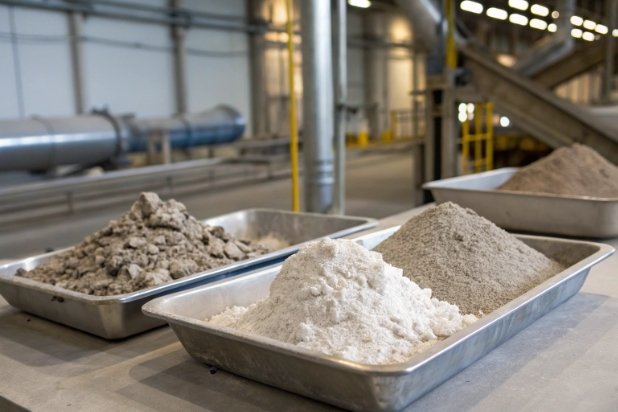
The Power of Dolomite (CaO + MgO)
In the early days of glass making, pure Limestone (CaCO₃) was the standard. Today, at FuSenglass and most advanced factories, we utilize Dolomite 7 (CaCO₃·MgCO₃). This introduces Magnesium Oxide (MgO) into the mix, typically aiming for a ratio where MgO is about 0.5% to 4.0% of the total weight.
Why replace CaO with MgO?
-
Manufacturing Stability: MgO inhibits the crystallization (devitrification) of the Calcium silicates. It lowers the temperature at which crystals start to form. This gives us a wider safety margin in the furnace. We can run the machine slower or cooler without the glass turning into stone.
-
Chemical Durability Upgrade: While CaO is good, a mix of CaO and MgO is better. MgO improves the acid resistance slightly more than CaO does because the Mg-O bond is very strong.
-
Alkali Resistance: This is the big win. For bottles that go through caustic wash lines (returnable beer/soda bottles), MgO offers better resistance to the alkaline detergents than pure CaO. It slows down the rate at which the glass surface dissolves.
This "stabilizer blend" is crucial for the long-term life of the bottle. A bottle made with Dolomite will stay clear and glossy for more refill cycles than one made with pure Limestone.
CaO vs. MgO: A Comparison
| Feature | Calcium Oxide (CaO) | Magnesium Oxide (MgO) | The Synergistic Effect |
|---|---|---|---|
| Source | Limestone | Dolomite / Magnesite | Lowers raw material cost. |
| Melting Role | Flux/Stabilizer | Stabilizer | Lowers devitrification temp. |
| Acid Resistance | Good | Very Good | improved overall acid stability. |
| Alkali Resistance | Moderate | Good | Best resistance to caustic washing. |
| Thermal Expansion | High increase | Lower increase | slightly lower expansion (less breakage). |
You know the theory. Now, how do you verify that your supplier is actually hitting these targets?
Trust is good, but data is better. To ensure your bottles won’t bloom in the warehouse or leach into your product, you must implement a rigorous testing protocol.
Utilize X-Ray Fluorescence (XRF) to confirm the CaO+MgO total is between 10-13%. Mandate ISO 719 (Hydrolytic Resistance) testing to verify the glass class (HGB3 or better). Crucially, perform climatic chamber aging tests (simulated weathering) to confirm the stabilizer content is sufficient to prevent surface blooming during storage.
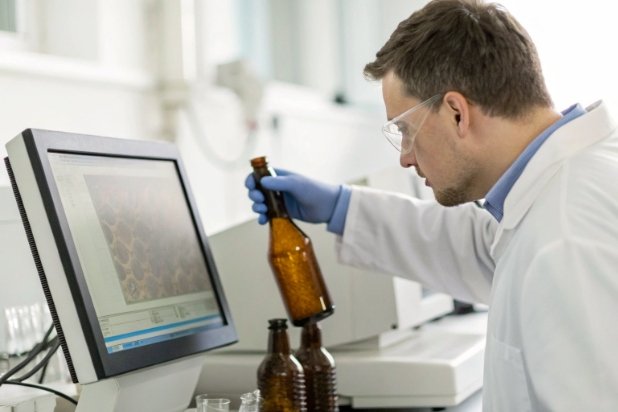
Essential Quality Assurance Tests
As a buyer, you cannot see Calcium content with your eyes. You need instruments. Here is the protocol I recommend to my clients to ensure they are getting a chemically durable bottle:
1. XRF Composition Analysis:
This is the "DNA test" for your glass. Send a sample to a lab.
-
Target: Look for CaO + MgO to be in the 10% to 13% range.
-
Red Flag: If the total stabilizer (CaO+MgO+Al2O3) drops below 10%, the glass is "under-stabilized." It will be prone to weathering.
-
Red Flag: If Na₂O (Soda) is > 15%, the manufacturer is trying to melt cheap/fast, sacrificing durability.
2. Climatic Chamber (Weathering Simulation):
This is the most practical test for supply chain safety. We place empty bottles in a chamber at 40°C – 50°C with 90% humidity for 1 to 4 weeks.
- The Check: If the bottles come out looking hazy, greasy, or have white spots, the Calcium content (stabilization) is insufficient. These bottles will likely bloom in your warehouse before you even fill them.
3. ISO Hydrolytic Tests:
-
ISO 719 8 (Grains Test): This confirms the basic quality of the glass material. You want HGB 3 (Hydrolytic Class 3) for standard soda-lime.
-
ISO 4802 9 (Surface Alkalinity): This measures how much alkali releases from the inner surface of the bottle. This is critical if you are not washing the bottles before filling (though you always should!).
Procurement Specification Sheet
| Test / Spec | Method | Target Value | What it Protects Against |
|---|---|---|---|
| Composition | XRF 10 | CaO + MgO: 10-13% | "Soft" glass; ensuring basic insolubility. |
| Hydrolytic Class | ISO 719 | Class HGB 3 | General chemical instability. |
| Acid Resistance | DIN 12116 | Class S 3 or S 4 | Leaching in acidic juices/sauces. |
| Weathering | Climatic Chamber | No Haze after 2 weeks @ 50°C/90%RH. | Warehouse spoilage; "blooming" defects. |
| Surface Alkalinity | ISO 4802 | Limit depends on volume (e.g., < 1.0ml HCl). | Product pH shift; taste alteration. |
Conclusion
Calcium Oxide is the backbone of glass stability. It is the difference between a durable container and a soluble silicate mess. By understanding the balance of Lime and Magnesia, and enforcing strict composition and weathering tests, you ensure that your FuSenglass bottles remain pristine, protecting your product from the factory floor to the customer’s table.
Footnotes
-
A water-soluble compound used in cements and adhesives, formed by melting silica and soda ash without calcium. ↩
-
Oxides that disrupt the glass network structure, lowering the melting point but potentially weakening the glass. ↩
-
The temperature range in which glass can be shaped without breaking or becoming too fluid. ↩
-
A chemical process where ions from a liquid replace ions in a solid, critical in glass weathering. ↩
-
The formation of a hazy white film on glass surfaces due to alkali leaching and humidity reaction. ↩
-
The process where glass crystallizes, losing its transparency and mechanical strength. ↩
-
A mineral composed of calcium and magnesium carbonate, used to stabilize glass durability. ↩
-
International standard specifying the test method for hydrolytic resistance of glass grains at 98°C. ↩
-
Standard for determining the hydrolytic resistance of the interior surfaces of glass containers. ↩
-
X-ray Fluorescence, a non-destructive analytical technique used to determine elemental composition. ↩






