
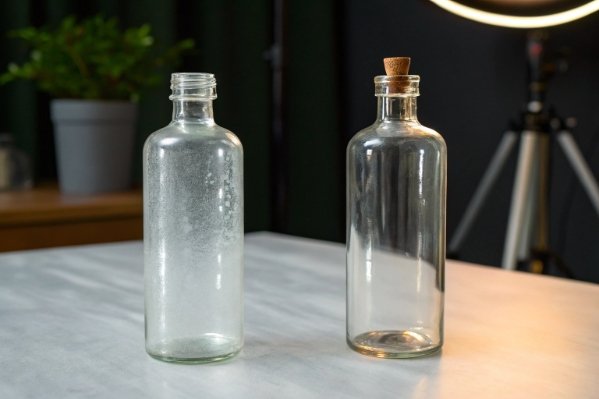
Acidic products look safe in glass, but a few months later the bottle can turn dull, cloudy, or “dirty” even after washing.
Acids can corrode glass by pulling out mobile ions like sodium and calcium, changing the surface into a silica-rich layer that can turn hazy, weakened, or lightly etched over time.
Acid corrosion is slower than alkali corrosion, but it is still real
Glass bottles feel “inert” because the main structure is silica. Silica does not dissolve fast in most food acids. That is why glass is still the best choice for many acidic foods and drinks. Still, the surface is not perfectly stable.
Most container glass is soda-lime-silica glass 1. It contains network formers (mostly SiO₂) and also network modifiers (like Na₂O, K₂O, CaO, and MgO). Acids usually attack the modifiers first. Hydrogen ions move in, and sodium, potassium, and some calcium move out. This is called selective leaching 2. The surface layer becomes more silica-rich and more hydrated.
That silica-rich layer can behave in two different ways. Sometimes it acts like a thin “passivation” film that slows more attack. Other times it becomes porous and uneven. If the product contains organic acids like citric acid, the story can shift. Citric acid can bind (chelate 3) calcium and keep pulling ions out. That makes the altered layer less stable. Over long storage or high heat, the surface can lose gloss, develop micro-roughness, or show a faint haze.
The key difference from alkaline corrosion is speed and target. Alkali tends to break the silica network directly and can etch fast. Acid tends to leach modifiers first and etches slowly, unless the acid is very strong, very hot, or contains special species that attack silica.
Acid vs alkali in one look
| Item | Acid attack (typical food acids) | Alkali attack (high pH cleaners) |
|---|---|---|
| First reaction | Ion exchange and selective leaching | Ion exchange, then rapid network break |
| Main species leaving glass | Na⁺, K⁺, Ca²⁺ (small Si release) | Na⁺, K⁺, then lots of dissolved silicate |
| Visual symptom | Dull gloss, light haze, “aged” look | Strong haze, frosting, rough etch |
| Time scale | Weeks to months (usually) | Minutes to days (can be fast) |
| Biggest accelerators | Heat + time + complexing acids | High pH + heat + dwell + residues |
A brand does not need to fear every acidic product. What matters is knowing which acids, at what temperature, and for how long. That is where corrosion risk becomes predictable.
Most problems can be prevented with the right glass choice and a simple validation plan.
How does acid attack glass compared with alkaline attack, and what actually dissolves or leaches out?
A customer may blame “acid” when a bottle looks cloudy, but the mechanism is not the same as classic caustic etching.
Acids mainly leach sodium, potassium, and calcium from soda-lime glass, while alkalis can dissolve the silica network; acid haze is often a surface-chemistry change more than deep etching.
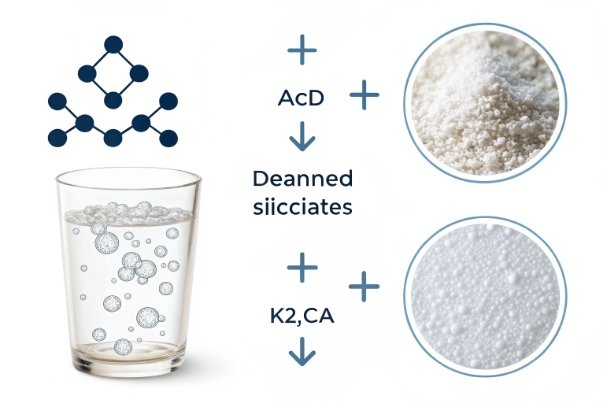
What acids remove first: modifiers, not silica
In soda-lime glass, Na⁺ and K⁺ are the most mobile ions. Ca²⁺ and Mg²⁺ are less mobile, but they can still be extracted. Under acidic conditions, H⁺ (or H₃O⁺) replaces these ions near the surface. The liquid becomes slightly enriched in those ions. The glass surface becomes depleted and shifts toward a silica-rich chemistry.
This is why a bottle can keep its shape but still “age.” The surface layer changes its refractive behavior. It can also change how water wets the surface. That leads to more visible spotting after rinsing. In many real cases, the complaint is not a deep chemical pit. It is a dull, uneven surface that traps residues or reflects light in a different way.
What alkali does differently: it attacks the network
In alkaline attack, OH⁻ can break Si–O–Si bonds and dissolve the glass network. This creates micro-pits and roughness quickly. It is the classic “frosted” look after dishwasher abuse or hot caustic CIP 4.
Acid is usually slower because it does not break Si–O–Si bonds as efficiently. Still, acids can create roughness if the altered layer keeps dissolving or peeling away, especially when organic acids keep complexing the stabilizing ions.
What actually leaves the glass in acid exposure
| Glass component | Likely behavior in acid exposure | Why it matters to brands |
|---|---|---|
| Na₂O / K₂O | Leaches out first | Can shift taste or ionic load in sensitive formulas |
| CaO / MgO | Can leach, more slowly | Loss can weaken surface and increase haze tendency |
| Al₂O₃ | Usually improves resistance | Higher alumina often slows surface change |
| SiO₂ | Low release in mild acids | Release rises with heat, long time, extreme acidity |
| B₂O₃ (if used) | Depends on recipe | Many borosilicates show strong durability in foods |
For most foods, acid corrosion is a surface durability topic, not a structural failure topic. Still, for premium brands that sell “crystal clear” visuals, even mild haze is a big problem. That is why acid corrosion deserves a prevention plan, even if it looks slower than alkali attack.
Which acidic products are most likely to cause glass corrosion (vinegar, citrus juice, kombucha, acidic sauces) and under what conditions?
Many acidic foods live safely in glass for years. The risky cases share one trait: they keep the surface under stress for a long time.
Highest risk comes from low pH products plus heat or long storage, especially when organic acids like citric or acetic acid stay in contact for months, or when residues dry on the surface.
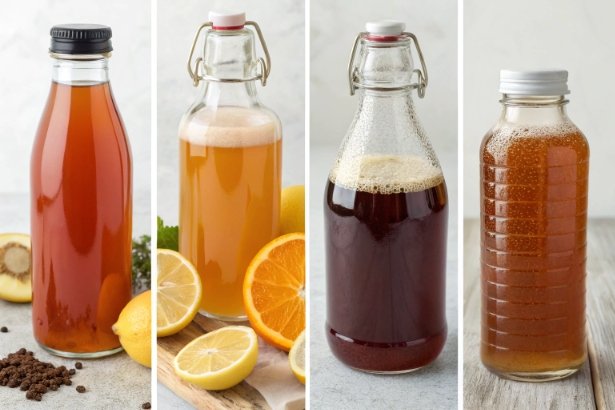
Acidic foods are not equal
pH alone is not enough. Two products can have similar pH but different corrosion behavior because the acid type matters.
-
Vinegar (acetic acid): Often low pH and stable. Corrosion risk rises when the vinegar is hot-filled, stored warm, or concentrated. If the bottle is reused and not rinsed well, dried vinegar residue can stay acidic and keep reacting.
-
Citrus juice (citric acid): Citric acid can bind calcium. This can keep pulling stabilizers out of the surface. Citrus concentrates and products with added citric acid can be more aggressive than their pH suggests.
-
Kombucha (mixed organic acids): Kombucha is acidic and can continue changing during storage if fermentation 5 is active. It can also contain dissolved CO₂. That combination can push a surface layer to behave less predictably, especially in warm distribution.
-
Acidic sauces (tomato-based, pickled, hot sauces): Many sauces are in the pH zone where corrosion is slow but not zero. Sauce viscosity also matters. Thick sauces can hold a boundary layer at the glass wall. That layer can keep ions near the surface and slow “fresh” liquid exchange, which can make localized changes look worse.
Conditions that turn “safe” into “risky”
The most common real-world trigger is not the recipe. It is the process and storage conditions:
-
Hot-fill and pasteurization: Heat speeds ion exchange and diffusion.
-
Long warehouse storage in summer: Warm months act like an accelerator.
-
Headspace condensation: If acidic vapor condenses at the shoulder, it can create a “haze ring.”
-
Residue drying on the inside surface: A thin acidic film can stay active longer than expected.
Practical risk map by product style
| Product type | Typical corrosion risk in glass | When the risk spikes |
|---|---|---|
| Standard vinegar | Medium | Hot fill + warm storage + long shelf life |
| Citrus juice / citrus concentrate | Medium to High | Added citric acid + high temp + long contact |
| Kombucha | Medium | Warm distribution + active fermentation + long storage |
| Tomato paste / acidic sauces | Low to Medium | Hot fill 6 + extended warm storage |
| Pickled brines | Medium | High salt + low pH + warm storage |
| Very strong specialty acids (not foods) | Very High | Any heat or long contact |
This is why brands should validate on the real SKU mix. A sauce line may be fine, while a citrus-based functional drink on the same glass bottle can show haze sooner.
How do temperature, storage time, and acid concentration accelerate glass surface etching or haze?
Most corrosion stories are “slow chemistry plus one accelerator.” Usually that accelerator is heat.
Higher temperature, longer storage, and stronger acid push acid leaching faster, making the silica-rich surface layer thicker and more uneven, which increases haze and loss of gloss.

Temperature: the fastest accelerator in real supply chains
Chemical reaction rates and ion diffusion both rise with temperature. A bottle that looks perfect at 20°C can look dull after months at 35–40°C. Heat also changes the product itself. Some beverages become more reactive as acids evolve or as dissolved gases change. For kombucha, a warmer chain can mean a more active system.
Heat also increases the risk of localized effects:
-
Condensation patterns at the shoulder
-
Partial wetting lines
-
Repeated warm/cool cycles during transport
Those zones often create “bands” of haze that look like a production defect, even when the cause is storage.
Storage time: slow does not mean harmless
Selective leaching does not stop instantly. Over long periods, ions continue to move. The altered layer can become thicker. If the product contains complexing acids, the altered layer can keep dissolving and rebuilding. This can create a very fine micro-roughness. That is enough to scatter light.
When brands hear “it was fine at filling,” that is normal. Acid corrosion often appears later, after time does its work.
Acid concentration: stronger acids and added acidifiers matter
Products are often adjusted with citric acid for flavor or safety. A small recipe change can shift corrosion behavior. Concentrates, syrups, and highly acidified drinks have higher ionic strength and more total acid. That gives more driving force for extraction of modifiers.
Simple acceleration view
| Factor | What changes on the glass | How it shows up |
|---|---|---|
| Higher temperature | Faster ion exchange and layer growth | Faster haze, dull gloss, shoulder rings |
| Longer time | Thicker, more altered surface layer | Slow haze growth, “aged” surface |
| Higher acid concentration | More extraction of Na/K/Ca | Faster dulling, possible taste/ion shift |
| Complexing acids (like citric) | Keeps pulling stabilizers | More persistent surface change |
| Dry/wet cycles | Concentrates acid residues | Spotting that becomes permanent-looking |
A practical approach is to define a “worst realistic case” for the distribution chain and test against that. If the product can survive warm storage simulation without haze, field risk drops fast.
What glass choices and validation tests help prevent acid corrosion (glass type, internal coatings, and compliance reports)?
Brands often focus on strength tests. For acidic products, chemical durability deserves the same attention.
Prevention starts with choosing glass with strong chemical durability, then validating with acid resistance tests and realistic shelf simulations; internal coatings can add margin when the product or process is aggressive.
Glass choices that reduce acid corrosion risk
Most food packaging uses soda-lime glass because it is cost-effective and stable for most products. For acid durability, the best improvements often come from recipe control and quality control:
-
Controlled alkali level (Na₂O/K₂O): Less mobile alkali can reduce leaching rate.
-
Good stabilizer balance (CaO/MgO): Helps surface stability.
-
Higher Al₂O₃ content (when feasible): Often improves chemical durability.
-
Borosilicate options (for high-demand cases): Often used when chemical durability and thermal performance must be stronger.
Also, surface quality matters. Scratches and scuffs create high-energy sites where chemistry starts faster. So abrasion control in packing, conveying, and washing reduces corrosion complaints even when the root cause is chemical.
Internal coatings: when they help
Internal coatings are not always needed for food, but they can help when a product is aggressive or when a brand wants a perfect “premium clear” look for long shelf life.
A coating can:
-
Reduce direct contact between acid and glass surface
-
Reduce ion migration and surface change
-
Improve cleaning behavior by keeping the surface smoother
The coating choice must match filling temperature, pasteurization, and decoration. A mismatch can cause peeling, flavor interaction, or appearance defects. So coating projects need validation, not only a supplier brochure.
Validation tests and reports that build confidence
A useful validation plan has two layers:
1) Standard chemical durability tests that give comparable numbers across batches and suppliers
2) Application simulation tests that match the real product, real temperature, and real time
For acid durability, common tools include acid resistance standards (like boiling acid exposure methods 7) and container durability methods that use autoclave conditions. On top of that, a shelf simulation can check visual haze, gloss, and ionic release.
A simple validation matrix for brand teams
| Goal | Test idea | What it prevents |
|---|---|---|
| Compare glass recipes or suppliers | Standard acid resistance method | Buying a “weaker” glass by accident |
| Check worst-case filling heat | Hot-fill / pasteurization simulation | Shoulder rings and early dulling |
| Validate long shelf life | Accelerated warm storage | Late-stage haze complaints |
| Verify no taste impact | Elemental migration check (Na, Ca, etc.) | Flavor drift in sensitive products |
| Confirm coating safety | Coating adhesion + migration + sensory | Coating failure and consumer complaints |
Compliance reports should match the market and product category. Many buyers ask for FDA/REACH/SGS style documentation and food-contact statements. Those are important, but they do not replace durability testing. A bottle can be compliant and still haze under a specific acidic formula. The best supplier packages compliance documents with durability data and clear acceptance limits.
In our packaging work, the most reliable strategy is simple: select the right glass family for the acidity and heat profile, then run one realistic accelerated test before scaling. That single step saves months of complaint handling later.
Conclusion
Acid corrosion is usually slow selective leaching, but heat and time can turn it visible. Choose durable glass, control processes, and validate with acid tests plus real shelf simulations.
Footnotes
-
The most common type of glass used for containers, generally durable but not immune to corrosion. ↩
-
The extraction of certain materials from a solid into a liquid, often referring to chemicals leaving glass. ↩
-
Compounds that bind to metal ions, potentially accelerating corrosion in glass surfaces. ↩
-
Clean-in-place systems used in industrial settings to clean pipes and vessels without disassembly. ↩
-
A metabolic process that produces chemical changes in organic substrates through the action of enzymes. ↩
-
A filling method where hot liquid sterilizes the container, requiring high thermal resilience. ↩
-
Standard test methods for determining the acid resistance of glass surfaces. ↩






