
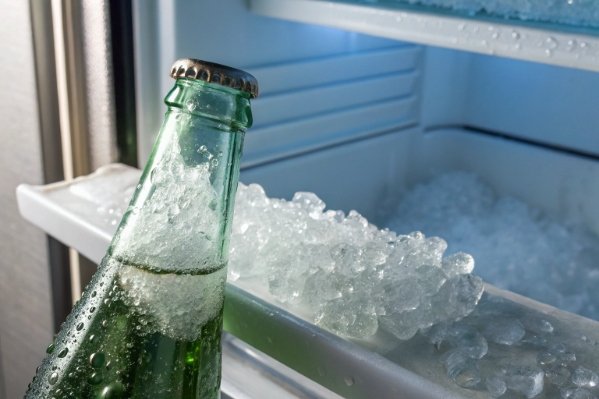
Placing a glass bottle in the freezer to "quick chill" a drink is a common habit, but often ends in a mess of shattered glass and frozen liquid. Is this a flaw in the material, or a violation of physics?
Standard soda-lime glass bottles are generally NOT safe for freezer storage if they contain water-based liquids, because water expands by 9% when freezing, exerting hydraulic pressure that exceeds the glass’s tensile strength. However, high-proof spirits and specific borosilicate containers designed with adequate headspace can be frozen safely.
Dive Deeper: The Hydraulic Press Effect
At FuSenglass, we emphasize that glass is a rigid container. It has zero elasticity. When you freeze a liquid inside it, you are essentially running a slow-motion hydraulic press experiment.
The culprit is the Anomalous Expansion of Water. Unlike most substances that shrink when they freeze, water crystallizes into a hexagonal structure that takes up more space than its liquid form.
-
The Force: As ice forms, it pushes outward with immense force (up to 30,000 psi in a confined space).
-
The Resistance: A standard glass bottle can withstand internal pressure, but it cannot expand to accommodate volume growth.
-
The Failure: Once the liquid volume exceeds the internal volume of the bottle, the glass must break to relieve the pressure.
While Thermal Shock 1 (rapid temperature change) is a secondary risk if you take a hot bottle and put it in a freezer, the primary cause of freezer breakage is simple Volume Displacement.
Freezer Risk Factors
| Factor | Condition | Risk Level |
|---|---|---|
| Content Type | Water / Juice / Beer | Critical (Expands ~9%) |
| Content Type | Spirits (>40% ABV) | Safe (Does not freeze) |
| Fill Level | Full to brim | 100% Breakage |
| Fill Level | High Headspace (>15%) | Manageable Risk |
| Glass Type | Soda-Lime 2 | High Risk (Brittle) |
| Glass Type | Borosilicate 3 | Low Risk (High strength/shock resistance) |
Now, let’s look at the specific formulas and designs that determine survival in the sub-zero zone.
What causes glass bottles to crack in the freezer (liquid expansion, headspace, and thermal shock)?
Understanding the mechanism of failure is the first step to preventing it. It is rarely the cold that breaks the glass; it is the ice.
The primary cause of failure is the hydraulic pressure generated by the 9% volumetric expansion of freezing water, which consumes the headspace and presses against the rigid walls. A secondary cause is thermal shock, where rapid cooling creates tensile stress on the outer surface, snapping already-weakened bottles.
1. Volumetric Expansion (The Main Killer)
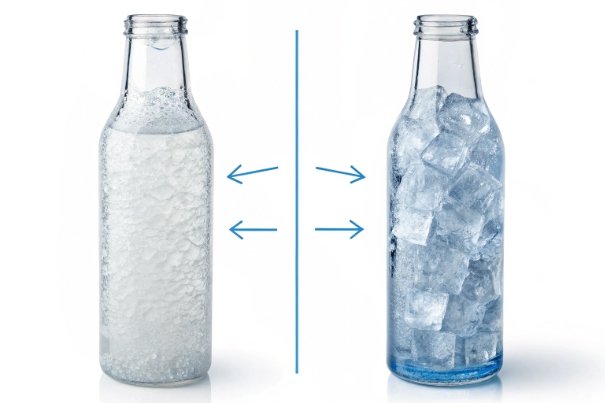
Imagine a bottle filled with 330ml of water.
-
Upon freezing, that 330ml becomes ~360ml of ice.
-
If the bottle only has 340ml of total capacity, the extra 20ml of ice has nowhere to go. It presses outward on the neck and shoulder.
-
Result: The bottle shatters, typically vertically along the seam or popping the bottom off.
2. The "Plug" Effect
In narrow-neck bottles, the liquid in the neck often freezes first (because it has less mass and is surrounded by cold air).
-
The Trap: This creates an ice plug that seals the bottle.
-
The Pressure: As the liquid in the center of the bottle freezes later, it expands but is trapped by the plug above. The pressure builds up until the bottle explodes.
3. Thermal Shock
Glass contracts as it cools.
- If a bottle is warm (e.g., just washed or hot-filled) and placed in a -18°C freezer, the rapid contraction of the outer skin can cause breakage, especially in soda-lime glass.
Which beverages or formulas are risky to freeze in glass (carbonated drinks, high-sugar juice, dairy, sauces, alcohol mixes)?
Not all liquids freeze at the same point or expand with the same aggression. The chemical composition dictates the risk.
Carbonated beverages are the highest risk due to dissolved gas pressure adding to ice expansion. Low-ABV alcohol (beer, wine) and water-based juices are also high risk. High-proof spirits and high-oil content sauces are generally safe as they resist freezing or expand minimally.
1. Carbonated Drinks (Beer, Soda, Sparkling Water)
DANGER ZONE.
-
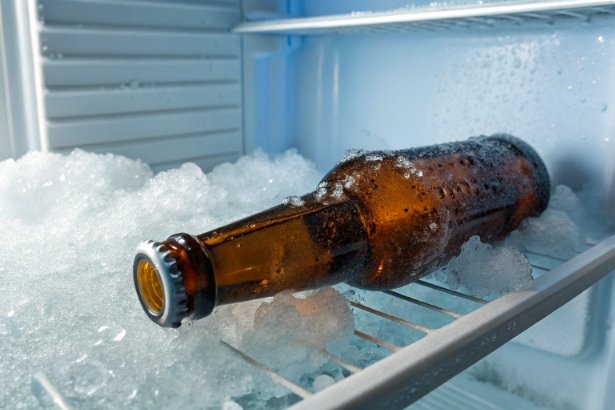
Double Threat: You have the expansion of the ice plus the release of CO2 gas as the ice forms (gas is less soluble in ice).
-
Outcome: These bottles almost always explode violently. Never freeze beer or champagne.
2. Water, Juice, Dairy, Tea
HIGH RISK.
-
These are >85% water. They will expand the full 9%.
-
Mitigation: Only safe if the bottle has a very large headspace 4 (vacuity) or a wide mouth to allow the ice to push upwards.
3. High-Sugar Syrups / High-Salt Brines
MODERATE RISK.
- Sugar and salt lower the freezing point (Freezing Point Depression 5). A thick syrup might act like a slush rather than a solid block, exerting less pressure.
4. Spirits (Vodka, Gin, Whiskey >40% ABV)
SAFE.
-
Ethanol freezes at -114°C. Standard home freezers are -18°C.
-
High-proof alcohol will thicken but will not freeze solid. There is no expansion pressure.
-
Note: Liqueurs (15-20% ABV) can slush or freeze, so be careful with cream liqueurs or schnapps.
Freezing Risk by Category
| Product | Freezing Point | Expansion Risk | Recommendation |
|---|---|---|---|
| Soda / Beer | ~ -2°C | Extreme (Gas + Ice) | NEVER FREEZE |
| Water / Juice | ~ 0°C | High (Ice) | Only with 15% headspace |
| Wine (12%) | ~ -5°C | Medium | Cork may push out; glass may break. |
| Liquor (40%) | ~ -27°C | None | Freezer Safe. |
| Oil / Sauces | Varies | Low | Oil shrinks/waxes; safe. |
What bottle designs and glass types are safer for freezing (borosilicate vs. soda-lime, wall thickness, base design)?
If you must create a freezer-safe glass product (like premium broth or baby food), you cannot use a standard beer bottle mold.
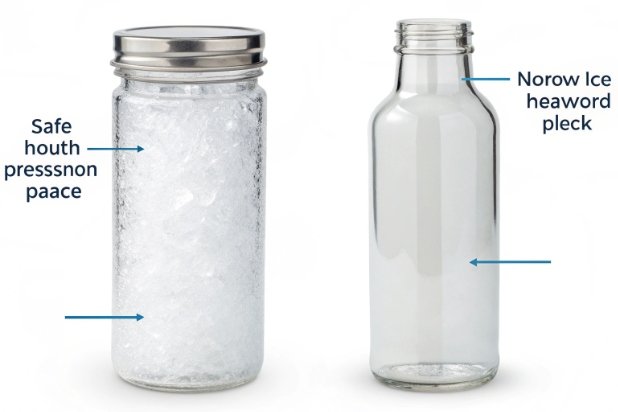
Borosilicate glass (e.g., Pyrex) is the gold standard for freezer-to-oven safety due to its thermal shock resistance. For design, wide-mouth jars with straight walls (no shoulders) allow ice to expand upward rather than outward, preventing breakage.
1. Glass Material
-
Soda-Lime (Standard): High expansion, brittle. Risky for freezing.
-
Borosilicate (3.3): Low expansion, high strength. Used for labware and premium food storage. It handles the temperature change easily, though it can still break from pressure if overfilled.
-
Tempered Glass: Stronger than annealed, but if it breaks, it shatters into thousands of pieces.
2. Bottle Geometry
-
The Neck Problem: Narrow necks (like wine bottles) create the "plug" effect mentioned earlier.
-
The Solution: Wide Mouth / Straight Sided Jars. Ideally, the opening should be the same diameter as the body (cylindrical).
- Why: When the liquid freezes, the ice can push the entire "puck" upwards like a piston, displacing the air in the headspace, rather than pushing against the side walls.
3. Wall Thickness
- Uniformity is Key. Thick bottoms connected to thin walls create stress points 6. A freezer-safe jar needs even distribution.
What storage and filling guidelines should brands follow to reduce freezer breakage (fill level, cooling steps, closures, and testing)?
For brands launching a "frozen" product line in glass (e.g., frozen soups), operational discipline is critical.
You must strictly control the "Fill Line" to ensure 10–15% vacuity (headspace), chill the product before freezing to reduce shock, and validate the package with "Freeze-Thaw Cycling" tests.
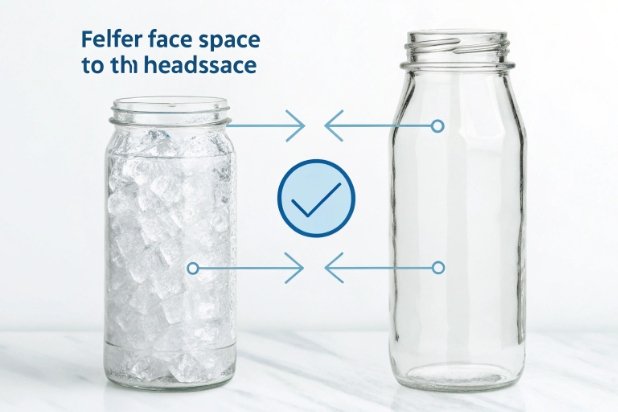
1. The 15% Rule (Headspace)
Standard headspace is 5-6%. For freezer products, you need 10-15%.
- Marking: Many freezer-safe jars have a visible "Freeze Fill Line" molded into the glass to guide the consumer.
2. Cap Selection
-
Liner: Use liners that remain flexible at -20°C. Rigid liners may crack and lose seal.
-
Torque: Do not over-torque. Freezing can shrink the cap (metal contracts more than glass), making it incredibly tight or stripping the threads.
3. Operational Cooling
-
Step-Down: Do not go from Hot Fill 7 (90°C) -> Blast Freezer (-20°C).
-
Protocol: Hot Fill -> Water Cool to 30°C -> Retort/Pasteurize -> Air Cool -> Fridge -> Freezer. Gradual steps reduce stress.
4. Validation Testing
Before marketing "Freezer Safe":
-
Freeze/Thaw Cycle Test:
-
Fill to recommended level.
-
Freeze at -20°C for 24 hours.
-
Thaw at room temp (20°C) for 24 hours.
-
Repeat 5 times.
-
Pass: 0% breakage.
-
Brand Safety Checklist
| Action | Specification | Purpose |
|---|---|---|
| Set Fill Height | Max 85% of overflow capacity 8 | Accommodate 9% expansion. |
| Select Shape | Wide Mouth / Tapered Up | Allow ice to move up, not out. |
| Material | Borosilicate or Heavy Soda-Lime | Thermal durability. |
| Labeling | "Leave 1 inch space" | Consumer instruction. |
| QC Test | 5-Cycle Freeze/Thaw 9 | Validate real-world survival. |
Conclusion
Glass bottles can be stored in the freezer, but only if the laws of physics are respected. For standard water-based beverages in narrow-neck bottles, the freezer is a destruction chamber. However, by utilizing wide-mouth designs, ensuring substantial headspace (15%), or sticking to high-proof spirits, brands can utilize glass in the cold chain 10. When in doubt, choose Borosilicate glass for the ultimate safety margin.
Footnotes
-
Failure of a material caused by sudden temperature changes, leading to stress. ↩
-
The most common type of glass used for containers, generally not suitable for freezing. ↩
-
A durable glass type with low thermal expansion, safe for extreme temperatures. ↩
-
The empty space between the product surface and the lid, critical for expansion. ↩
-
The physical phenomenon where solutes like sugar or salt lower the freezing point of water. ↩
-
Localized areas in a material where stress is higher, increasing breakage risk. ↩
-
A filling method using hot liquid to sterilize the container, requiring gradual cooling. ↩
-
The total volume of a container when filled to the very top rim. ↩
-
Standard test method for determining container resistance to freeze-thaw cycles. ↩
-
The temperature-controlled supply chain for transporting perishable goods. ↩






