
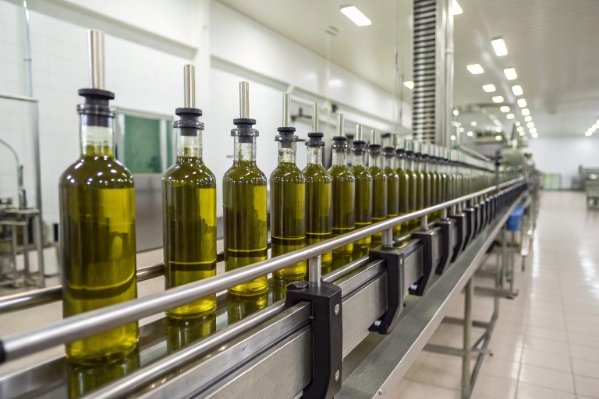
From gourmet olive oils and CBD tinctures to hot-poured candle wax, oil-based products behave fundamentally differently than water-based beverages inside a glass container. Does this viscosity and thermal density compromise the glass?
Oil content does not alter the glass’s Coefficient of Thermal Expansion (CTE), but it drastically changes the thermodynamics of the filling process. Oil has a lower specific heat capacity and thermal conductivity than water, meaning it retains heat differently and creates steeper temperature gradients across the glass wall, increasing the risk of thermal shock during cooling.
Dive Deeper: The Thermal Inertia of Oil
At FuSenglass, we often troubleshoot breakage issues for clients moving from beverages to cosmetic oils or candles. They assume that if the glass handles 90°C water, it will handle 90°C oil. This assumption is dangerous.
Water is an excellent conductor of heat (for a liquid) and has a high specific heat capacity 1. It absorbs and releases energy readily. Oils (hydrocarbons, lipids) act more like insulators.
-
Heating: Oil heats up faster than water (lower specific heat), but…
-
Cooling: Oil releases heat slower from the center but transfers it poorly to the glass interface initially. However, once the glass is hot, the oil keeps it hot.
The Danger Zone: The "Cool Down."
When you hot-fill a jam (water-based) at 90°C and spray it with 20°C water, the turbulence inside the jar helps transfer heat away. When you hot-fill a candle or heavy oil at 90°C and cool it, the oil near the center stays hot for a long time, while the oil touching the glass cools and potentially solidifies (waxes).
This creates a complex "Thermal Lag." The inner glass wall is kept hot by the insulating oil mass, while the outer wall is shocked by cooling air or water. This creates a sustained temperature differential ($\Delta T$) across the glass thickness (Thermal Gradient 2) that lasts longer than with water, prolonging the window of risk for breakage.
Thermal Property Comparison
| Property | Water | Typical Oil (Olive/Mineral) | Impact on Glass |
|---|---|---|---|
| Specific Heat | 4.18 J/g°C | ~2.0 J/g°C | Oil changes temp with less energy input. |
| Thermal Conductivity | High (0.6 W/mK) | Low (0.15 W/mK) | Oil acts as an insulator; heat is trapped in the core. |
| Viscosity | Low | High | Poor convection; hot spots remain longer. |
| Surface Tension | High | Very Low | Creeps through threads; leaks easier. |
Now, let’s analyze how these thermal properties dictate your production line settings.
Does oil content change a glass bottle’s thermal expansion (CTE), or does it mainly affect heat transfer and temperature gradients?
We must separate the container’s physics from the liquid’s thermodynamics.
Oil has absolutely no effect on the glass’s Coefficient of Thermal Expansion (CTE). The glass expands at its fixed rate ($9.0 \times 10^{-6}/K$). However, oil’s insulating properties create severe "Thermal Gradients" (temperature differences) between the inner and outer glass surfaces, which generates higher localized stress than water at the same temperature.
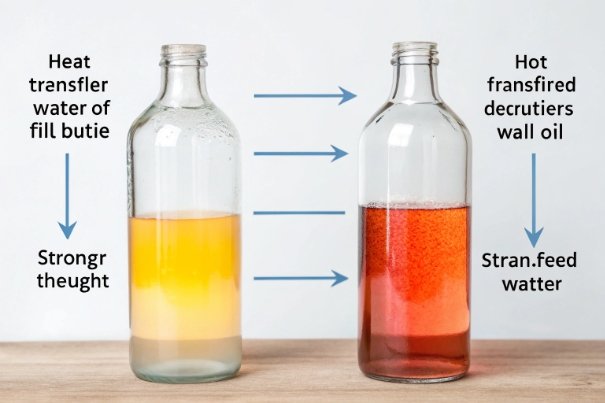
The "Insulator" Effect
Glass breaks from tension. Tension is caused by one part of the bottle being cold (contracted) while another is hot (expanded).
-
Water Fill: Water circulates (convection) inside the bottle. If you cool the outside, the water mixes, and the inner glass wall cools relatively quickly. The $\Delta T$ across the wall thickness (Inner Surface vs Outer Surface) equalizes fast.
-
Oil/Wax Fill: Oil does not circulate well (high viscosity 3).
-
If you pour hot oil (80°C), the inner glass heats up.
-
If you then cool the outside to 20°C, the outer skin contracts.
-
The Trap: The oil layer touching the inside wall acts as an insulating blanket. It keeps the inner glass at 80°C while the outside is 20°C.
-
Result: A massive $\Delta T$ through the thickness of the glass wall. The outer skin pulls violently against the hot inner core. This leads to "Shear Cracks" or separation of the bottom plate.
-
CTE is Constant, Stress is Variable
| Factor | Glass Property | Oil Influence | Result |
|---|---|---|---|
| Linear Expansion | Fixed | None | Glass grows same amount. |
| Gradient Duration | N/A | Lengthens | Stress remains critical for minutes, not seconds. |
| Convection | N/A | Inhibits | Hot core prevents inner wall cooling. |
Which oil filling and heating scenarios create the highest thermal shock risk (warm fill, hot-fill, pasteurization, rapid cooling)?
Oil products range from room-temperature olive oil to hot-poured candle wax. The risk profile shifts dramatically based on the viscosity and pour temperature.
Hot-filling of viscous oils (balms, candles, solid perfumes) creates the highest risk, not just from the initial thermal shock, but from the "solidification phase" where the product shrinks and pulls on the glass surface. Rapid water cooling of hot oil bottles is extremely dangerous due to the thermal lag.
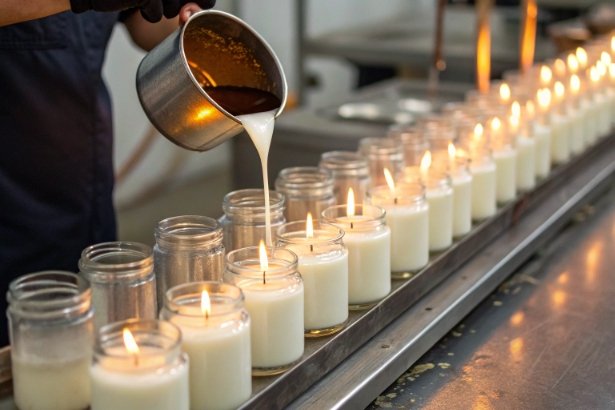
1. The Candle / Balm Scenario (Extreme Risk)
-
Process: Wax is melted to 70°C–90°C and poured.
-
The Shock: Hitting a 20°C jar with 90°C wax is a $\Delta T$ of 70°C.
-
The Phase Change: As wax cools, it shrinks (some waxes shrink by 10-15%).
-
If the wax adheres to the glass, this shrinkage pulls the glass inward (tension).
-
Combined with thermal stress 4, this can snap the glass, typically at the neck or just above the base.
-
-
Cooling: Must be done by air (fans), never water spray, to allow the gradient to dissipate slowly.
2. Edible Oil "Warm Fill" (Moderate Risk)
-
Process: Some oils (Coconut, Ghee) are filled warm (40°C–50°C) to be liquid.
-
Risk: Low. The $\Delta T$ is usually within safe limits ($<42^\circ C$).
-
Caution: Do not cap immediately if the product will solidify, as a vacuum 5 will form, potentially sucking in the paneling.
3. Sterilization / Pasteurization (Specialized)
-
Process: Rare for pure oils (which don’t support bacterial growth easily), but common for oil-in-water emulsions (dressings).
-
Risk: If the emulsion breaks (oil separates), the oil layer on top insulates the headspace 6. This can mess up heat penetration calculations, leading to under-processing or glass overheating in the steam zone.
Scenario Risk Matrix
| Product | Fill Temp | Cooling Method | Risk Level | Primary Failure Mode |
|---|---|---|---|---|
| Olive Oil | Ambient (20°C) | None | Zero | None |
| Coconut Oil | Warm (45°C) | Ambient Air | Low | Vacuum Paneling |
| Hot Sauce (Oily) | Hot (90°C) | Water Tunnel | High | Thermal Shock (Lag) |
| Candle Wax | Hot (85°C) | Air Cooling | High | Stress + Adhesion Pull |
| Essential Oil | Ambient | N/A | Low | Chemical Leaking |
Can oil-based products weaken coatings, printing, or labels after heat exposure and repeated thermal cycling?
The chemical aggressiveness of oils is often underestimated. While water beads up, oil spreads.
Yes. Oils have very low surface tension, allowing them to "creep" under labels and coatings. Combined with heat, oils act as solvents that can dissolve adhesives (delamination), soften organic spray coatings, and cause "lift-off" of decoration.
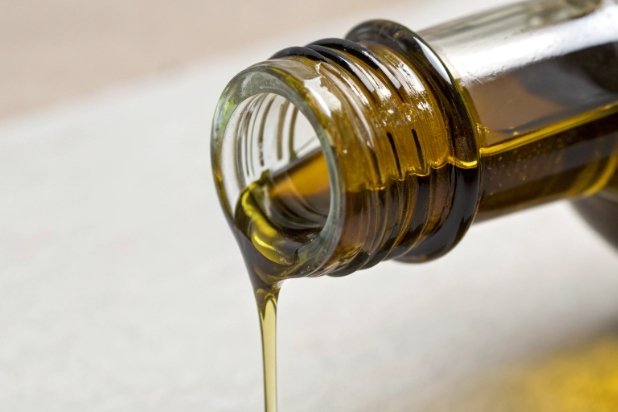
The "Creep" Factor (Wetting)
Water has high surface tension; it tends to stay where it is put. Oils have low surface tension; they want to wet everything.
-
The Cap Interface: Oil will climb up the threads of a bottle neck (capillary action 7) much more aggressively than water.
-
The Leak: Even a microscopic gap in the liner will allow oil to seep out. Once out, it travels down the neck.
Impact on Decoration
-
Paper Labels (PSL/Wet Glue): Oil turns paper translucent ("staining"). It dissolves the rubber-based adhesives used in many stickers. The label flags or falls off.
-
Soft-Touch / Spray Coatings: Many cosmetic bottles use organic "soft touch" sprays. Essential oils (especially citrus or eucalyptus) are potent solvents. If a drop spills during filling, it can eat a hole in the coating or make it sticky.
-
Hot Stamping: Heat + Oil can weaken the bond of the foil to the glass, causing it to flake off.
Defensive Strategies
-
Label Material: Use Polypropylene (PP) or Polyethylene (PE) film labels, never paper. Use "High Aggression" acrylic adhesives designed for oleophilic surfaces.
-
Glass Decoration: For essential oils, use Ceramic Screen Printing or Acid Etching. These are inorganic and impervious to oil solvents. Avoid organic sprays for high-concentration oils.
What bottle specifications and validation tests should B2B buyers require for oil-based products?
Because oils leak easier and retain heat longer, the validation protocols must be stricter than for water-based drinks.
Buyers must demand "Wetting" leak tests (using dyed oil), compatibility testing for all packaging components (liner/pump/glass), and thermal shock testing that simulates air-cooling lag rather than just water quench.
1. Leak Testing (The Oil Standard)
A standard water-bath vacuum test is insufficient.
-
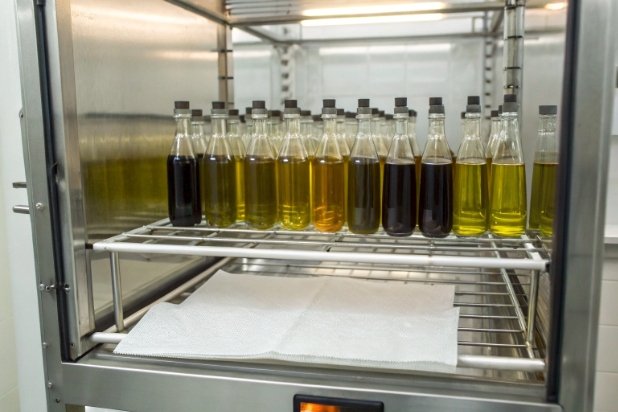
The Test: Fill bottles with dyed vegetable oil. Place them on their side or inverted in a warm oven (45°C) for 24 hours.
-
Why: Heat thins the oil (lower viscosity) and builds pressure. This simulates the worst-case shipping scenario.
-
Pass: Zero staining on the white paper underneath.
2. Thermal Shock (Modified)
If you are hot-filling wax or balm:
-
Test: Fill with the actual hot product at the target temperature. Allow to air cool.
-
Inspect: Check for "checking" (cracks) at the neck or base using a polariscope 8. The stress often appears during the cooling shrinkage.
3. Chemical Compatibility (Immersion)
-
Test: Submerge the decorated glass and the closure (liner/pump) in the oil product at 45°C for 30 days.
-
Check: Did the pump swell? Did the liner dissolve? Did the external paint peel?
-
Critical: Essential oils dissolve many standard plastics (polystyrene, etc.). Use Phenolic caps or specific PP blends.
Buyer’s Checklist
| Specification | Requirement | Why? |
|---|---|---|
| Closure Liner | Pulp/Poly or HS Induction | prevent "wicking" or capillary leakage. |
| Glass Quality | Even Distribution | Prevents hot spots during cooling. |
| Decoration | Ceramic / Etch | Immune to solvent attack. |
| Label Adhesive | Acrylic (Solvent Based) | Resists oil degradation. |
| Leak Test | 24hr Warm Inversion | Proves seal integrity against low surface tension. |
Conclusion
Oil-based products challenge the thermal performance of glass not by changing the material, but by altering the heat transfer equation. The insulating nature of oil creates prolonged thermal gradients that water does not, turning the cooling tunnel into a high-risk zone. Furthermore, the chemical ability of oil to creep and dissolve organics threatens the external packaging integrity. For FuSenglass clients, the secret to success with oils is managing the cooling curve to be slow and gentle, and selecting inorganic decorations that can survive the solvent nature of the product.
Footnotes
-
The amount of heat energy required to raise the temperature of a substance by one degree Celsius. ↩
-
The rate at which temperature changes over a specific distance or across a material thickness. ↩
-
A measure of a fluid’s resistance to flow; thicker liquids like oil have higher viscosity. ↩
-
Structural failure caused by rapid temperature changes, leading to expansion/contraction stress. ↩
-
A pressure lower than atmospheric pressure, created when hot liquid cools inside a sealed container. ↩
-
The empty space between the product surface and the cap, allowing for thermal expansion. ↩
-
The ability of a liquid to flow in narrow spaces without the assistance of external forces. ↩
-
An optical instrument used to detect internal stress patterns in transparent materials like glass. ↩






