
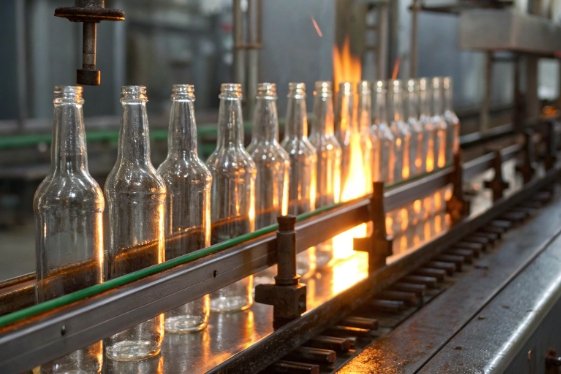
Visible mold seams and microscopic surface flaws compromise the structural integrity of glass, leading to costly breakage during hot-fill or sterilization processes. Can a simple flame treatment heal these defects and boost thermal endurance?
Fire polishing significantly improves thermal performance by melting and sealing microscopic "Griffith flaws" and mold seams that act as stress concentrators. However, it requires precise post-process annealing to ensure no new residual stresses are locked into the glass.
Dive Deeper: The Surface Integrity Factor
At FuSenglass, we often explain to our clients that glass strength is almost entirely a surface phenomenon. Unlike metals, which yield before breaking, glass is a brittle material that fails catastrophically from surface imperfections under tension. A bottle is only as strong as its largest surface flaw.
Fire polishing is often misunderstood as purely an aesthetic "glossing" process. While it undeniably creates a premium, liquid-smooth look, its engineering function is far more critical. By briefly exposing specific areas of the bottle (usually the rim, seams, or body) to intense, focused oxygen-gas flames, we momentarily liquify the outer skin of the glass.
This liquefaction allows surface tension to smooth out irregularities. But more importantly from a thermal performance standpoint, it fuses microscopic cracks shut. In the context of thermal shock 1—where the glass surface is pulled into tension—these micro-cracks are the usual starting points for failure. By removing them, we raise the threshold of abuse the bottle can take.
However, this is a double-edged sword. Applying intense localized heat to a formed bottle creates steep temperature gradients. If not managed correctly, this can induce more stress than it removes.
Surface Treatment Comparison
| Feature | Standard Molded Surface | Fire Polished Surface | Mechanically Polished Surface |
|---|---|---|---|
| Surface Topography | Rough (Micro-scale), Mold marks visible | Smooth, fused, rounded edges | Smooth but may have micro-abrasions |
| Flaw Density | High (Griffith flaws present) | Low (Flaws healed/melted) | Moderate (Scratches possible) |
| Thermal Shock Risk | Moderate (Flaws open under tension) | Low (Resists tension better) | Moderate |
| Stress State | Neutral (after annealing) | Risk of Tension (needs re-annealing) | Neutral |
| Primary Use | Standard Beverage/Food | Premium Spirits, Perfume, Heavy Glass | Optical Glass, Crystal |
Now, let’s analyze the specific mechanisms of how fire polishing alters the glass’s ability to handle thermal stress and the controls required to ensure safety.
How can fire polishing change surface microcracks and influence thermal shock resistance?
Standard glass manufacturing leaves behind microscopic imperfections known as Griffith flaws 2, particularly along mold seams. These invisible defects are the weakest links when a bottle undergoes rapid temperature changes.
Fire polishing melts the outer few microns of the glass skin, effectively fusing these microcracks shut and rounding off sharp mold seams. This eliminates the stress concentrators that typically initiate failure during thermal shock, thereby increasing the bottle’s overall thermal endurance.
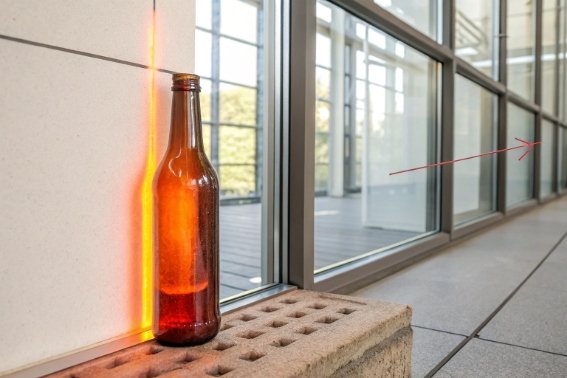
The Physics of Flaw Healing
To understand why fire polishing helps, we must look at how glass breaks. Glass is incredibly strong in compression but weak in tension. When you pour hot liquid into a bottle, the inner wall expands while the outer wall remains cool, putting the outer surface in tension.
If that outer surface has a jagged microscopic scratch (a Griffith flaw) or a sharp mold seam, the tensile force concentrates at the tip of that crack. The stress at that tip can be 100 times higher than the average stress on the rest of the bottle. It acts like a lever prying the glass apart.
Fire polishing acts as a "healer." The flame temperature (often exceeding 1000°C locally) drops the viscosity of the surface glass enough for surface tension to pull it smooth.
-
Blunting the Tip: Even if a crack isn’t perfectly sealed, the flame rounds out the sharp tip. A rounded void distributes stress far better than a sharp crack.
-
Sealing the Seam: The "parting line" where mold halves meet is a notorious stress raiser. Fire polishing melts this ridge down, blending it into the body.
Impact on Thermal Shock Performance
By removing these initiation points, the bottle behaves more like a theoretical "pristine" glass vessel. In our internal testing at FuSenglass, we have observed that heavy fire polishing on parting lines can increase the thermal shock differential ($\Delta T$) survival rate by 15-20% in specific heavy-bottomed designs.
Mechanism Breakdown
| Defect Type | Before Polishing | Thermal Impact | After Fire Polishing | Result |
|---|---|---|---|---|
| Griffith Flaw | Sharp, deep micro-crack | Stress focuses at tip -> Propagation | Fused / Rounded | Stress distributed |
| Mold Seam | Sharp ridge / Discontinuity | "Notch effect" weakens wall | Smooth transition | "Notch effect" removed |
| Surface Roughness | Micro-peaks and valleys | Uneven heat transfer | Uniform surface | Consistent expansion |
Could fire polishing introduce new residual stress if heating/cooling is uneven, and how is it controlled?
While healing cracks is beneficial, applying a 1000°C flame to a specific spot on a 50°C bottle creates a massive thermal gradient. This is the single biggest risk in the fire polishing process.
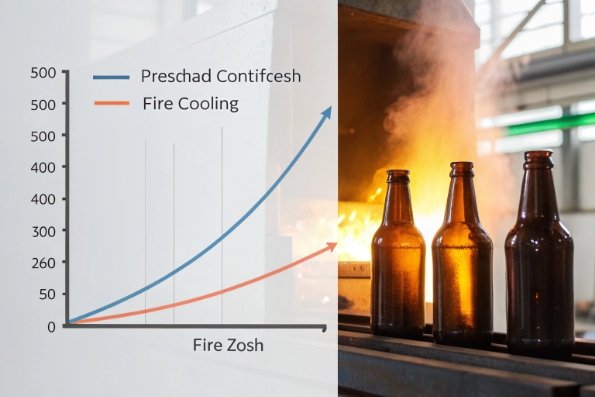
Improper fire polishing creates dangerous localized tension zones because the treated area cools and contracts at a different rate than the surrounding glass. This is controlled by passing the bottles through a secondary annealing lehr immediately after polishing to equalize temperatures and relieve stress.
The Threat of "Thermal Memory"
If you fire polish a bottle and let it cool in ambient air, you have essentially destroyed the bottle. The polished area was molten; as it cools, it tries to shrink. The surrounding cooler glass restricts this shrinkage, locking the polished spot into a state of permanent tension.
A bottle with "locked-in" tension from fire polishing is a time bomb. It might not break immediately, but the moment it hits a hot-filling 3 line or even experiences a minor impact, it will shatter spontaneously. This is why "spot polishing" without re-annealing is forbidden in high-quality manufacturing.
The Solution: The Annealing Lehr
The only way to utilize fire polishing safely is to integrate it into the hot end of the production line before the annealing lehr 4, or to re-anneal the bottles if done offline.
-
Pre-heating: Ideally, the bottle should be hot (but stable) before the flame hits it to reduce the shock.
-
The Polish: The flame does its work quickly.
-
Soak Zone (Annealing): The bottle enters the lehr, where it is brought to a uniform temperature (approx 550°C-580°C). This allows the atomic structure to relax. The stress differences between the hot polished spot and the rest of the bottle are erased.
-
Controlled Cooling: The bottle is slowly cooled to prevent new stresses from forming.
Control Parameters for Buyers
| Process Step | Risk Factor | Control Measure |
|---|---|---|
| Flame Application | Overheating causes deformation (slump) | Precise timing & burner positioning |
| Cooling Transition | Rapid air cooling locks in stress | Minimize time between flame and lehr |
| Annealing | Inadequate time/temp fails to relieve stress | Standard ASTM C148 Polariscope check |
| Cold End Spray | Thermal shock on hot polished glass | Ensure correct lehr exit temperature |
Which bottle areas benefit most from fire polishing (rim, seams, embossing) for hot-fill or thermal cycling use?
Not all areas of a bottle are under equal stress during thermal cycling. Targeting the fire polishing application can provide maximum durability benefits where they are needed most.
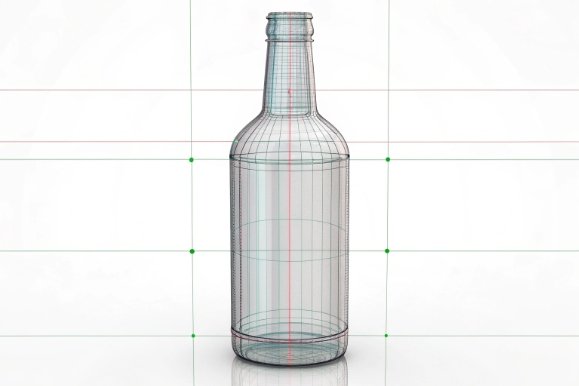
The container finish (rim) and the vertical mold seams are the critical areas. Polishing the rim prevents "checking" during capping and sealing, while polishing seams strengthens the bottle against the hoop stress generated by internal pressure and thermal expansion.
1. The Finish (Rim/Mouth)
This is the most common application of fire polishing.
-
Thermal Benefit: The rim is often subjected to direct thermal shock during the sealing process (e.g., induction sealing 5 or hot capping). A polished rim has no micro-cracks to propagate under this heat load.
-
Functional Benefit: It ensures a perfect hermetic seal, which is critical for food safety in hot-fill applications. A rough rim can lead to vacuum leakage as the product cools.
2. Vertical Mold Seams (Parting Lines)
-
The Problem: When a bottle is hot-filled, the internal pressure pushes outward. The vertical seams are often the "zipper" where the bottle splits open.
-
The Fix: "Body fire polishing" creates a seamless-like surface. This significantly improves the Bursting Pressure and Thermal Shock resistance because the wall acts as a continuous unit rather than two halves joined at a weak seam.
3. Embossing and Decorations
-
The Risk: Sharp corners in embossed logos act as stress risers 6.
-
The Fix: Light fire polishing softens these edges. However, too much heat will melt the definition of the logo, so this requires a delicate balance.
Strategic Application Table
| Zone | Vulnerability | Fire Polishing Benefit | Application Method |
|---|---|---|---|
| Rim / Lip | Chips, Checking, Bad Seal | Smooth sealing surface, crack removal | Standard on most lines |
| Mold Seams | Bursting, Thermal Splitting | Homogenized wall strength | Premium / Heavy glass only |
| Base / Push-up | Thermal Shock cracks (Baffle marks) | Heals baffle checks | Bottom polishing burners |
| Shoulder | Impact damage | Smooths contact points | Body polish |
What tests should buyers require after fire polishing (stress inspection, thermal shock testing, and dimensional checks)?
Because fire polishing involves remelting the glass, it introduces variables that standard molding does not. Verification is mandatory to ensure the "fix" didn’t cause a "failure."
Buyers must mandate Polariscopic Examination (ASTM C148) to confirm residual stress removal, rigorous Dimensional Inspection to ensure the heat didn’t warp the finish, and Thermal Shock Testing (ASTM C147) to validate the durability improvement.

1. Residual Stress Inspection (The Polariscope)
This is non-negotiable. You cannot see residual stress with the naked eye.
-
The Test: Viewing the bottle under polarized light 7.
-
What to look for: A "temper rating" or stress number. For annealed ware (which fire polished glass should be), you want a low number (typically Temper Grade 2 or lower).
-
Red Flag: Bright, colorful bands of light around the rim or seams indicate "bad annealing." These bottles will shatter in a hot-fill line.
2. Dimensional Stability (Go/No-Go)
Glass softens when fire polished. If the flame is too hot or dwells too long, the critical dimensions can "slump."
-
The Risk: The neck bore ("I" dimension) might shrink, or the sealing surface ("T" dimension) might warp, causing capping machine jams or leakers.
-
The Test: Plug gauges 8 and optical profiling to ensure the finish still meets GPI/SPI specifications.
3. Thermal Shock Verification
To prove the value of the process.
-
The Test: Subject the fire-polished bottles to a $\Delta T$ of 42°C (standard) and then push to 60°C or higher (ASTM C147 9).
-
Expectation: The fire-polished batch should show fewer failures at higher differentials than the non-polished control group.
QC Protocol Summary
| Test | Objective | Standard | Criticality |
|---|---|---|---|
| Polariscope | Detect un-annealed stress | ASTM C148 10 | Critical (Safety) |
| Plug Gauge | Check for bore shrinkage | GPI Specs | High (Function) |
| Thermal Shock | Verify durability gains | ASTM C147 | High (Performance) |
| Visual | Check for optical distortion | Visual Defects | Medium (Aesthetic) |
Conclusion
Fire polishing is more than a cosmetic upgrade; it is a surface engineering technique that, when executed correctly, heals the microscopic wounds of the manufacturing process. By sealing Griffith flaws and smoothing mold seams, it enhances the bottle’s ability to withstand the rigors of thermal expansion. However, this performance boost is entirely dependent on the subsequent annealing process. Without relieving the stress caused by the flame, fire polishing transforms a durable bottle into a fragile one.
Footnotes
-
Failure of glass due to rapid temperature changes creating expansion and contraction stress. ↩
-
Microscopic surface cracks that concentrate stress and significantly lower the strength of glass. ↩
-
A filling method where hot liquid sterilizes the bottle, creating high thermal stress. ↩
-
A continuous oven used to reheat and slowly cool glass to remove internal stress. ↩
-
A non-contact heating process that seals a foil liner to the bottle rim for freshness. ↩
-
A geometric feature like a notch or corner where stress concentrates, leading to failure. ↩
-
An optical tool used to visualize stress patterns in transparent materials like glass. ↩
-
Precision tools used to verify the internal diameter of bottle necks for cap fit. ↩
-
Standard test methods for internal pressure strength of glass containers. ↩
-
Standard test method for examining glass containers for residual stress via polariscope. ↩






