
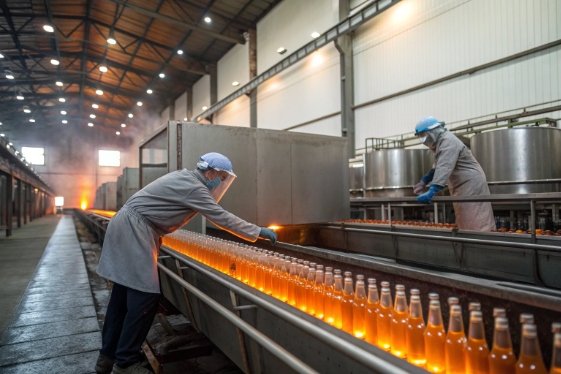
Product loss during hot-fill processes or sterilization tunnels drains profitability and disrupts supply chains, forcing brands to question their packaging durability. Is the solution changing the glass material itself, or can surface treatments provide the necessary resilience?
Chemical strengthening does not change the glass’s Coefficient of Thermal Expansion (CTE), but it significantly improves thermal shock resistance by creating a deep compressive surface layer that counteracts the tensile stresses generated during rapid temperature changes.
Understanding the Distinction: Material Property vs. Mechanical State
At FuSenglass, we frequently encounter misconceptions regarding how glass behaves under thermal load. Many brand owners assume that "strengthening" glass implies modifying its molecular reaction to heat. To make informed procurement decisions, it is critical to separate inherent material properties from induced mechanical states.
Chemical strengthening is a post-production process, often called ion exchange 1. By submerging glass bottles in a molten potassium salt bath (typically at temperatures around 400°C–450°C), we trigger a specific atomic swap. Smaller sodium ions (Na+) leave the glass surface, and larger potassium ions (K+) take their place. These larger ions wedge themselves into the gaps left by the sodium, creating a state of "crowding" or high compression on the surface.
However, this does not alter the silica network’s fundamental bond structure in the bulk of the glass. The glass will still expand and contract with heat at the exact same rate it did before. The "improvement" in performance comes not from expanding less, but from the glass’s new ability to tolerate the tension caused by that expansion. A standard soda-lime glass bottle usually fails under tension; the chemically induced compression layer acts as a pre-load that must be overcome before dangerous tension levels can crack the surface.
Key Concepts in Glass Thermal Dynamics
| Concept | Definition | Effect of Chemical Strengthening |
|---|---|---|
| CTE (Coefficient of Thermal Expansion) | The rate at which a material expands as it warms. | Unchanged. The glass expands at the same rate ($\sim9 \times 10^{-6}/K$ for soda-lime). |
| Thermal Shock Resistance | The maximum temperature difference ($\Delta T$) glass survives. | Significantly Improved. Increases the threshold before failure occurs. |
| Surface Compression | Force pushing atoms together on the glass skin. | Drastically Increased. Creates a "shield" against tensile failure. |
| Tensile Strength | The resistance of a material to breaking under tension. | Effectively Increased. The compression layer offsets applied tension. |
Now that we have distinguished between the material’s expansion rate and its resistance to stress, let’s explore exactly how this surface modification alters the stress profile to protect your product.
Does chemical strengthening change a glass bottle’s coefficient of thermal expansion, or only its stress profile?
Engineers and procurement officers often seek "low expansion" glass when they actually need "high thermal endurance," leading to confusion between borosilicate properties and treated soda-lime capabilities.
Chemical strengthening alters the internal stress profile of the bottle without modifying the bulk Coefficient of Thermal Expansion (CTE). The glass expands exactly as before, but the surface compression prevents this expansion from initiating fractures.
The Physics of the Stress Profile
When we manufacture a standard soda-lime glass 2 bottle at FuSenglass, its CTE is dictated by its chemical composition—primarily silica, soda ash, and lime. Modifying the CTE would require changing this "recipe" (e.g., adding boron to create borosilicate glass), which fundamentally changes the manufacturing process and cost structure. Chemical strengthening is a surface treatment, not a reformulation.
Therefore, a chemically strengthened bottle will physically grow in size by the exact same amount as an untreated bottle when heated from 20°C to 80°C. The volume change is identical.
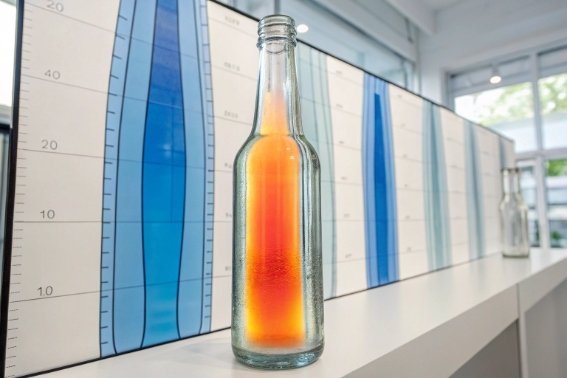
The difference lies entirely in the Stress Profile. In an untreated annealed bottle, the internal stresses are near zero. When that bottle is heated, the surface expands. If it is cooled rapidly, the surface contracts while the core remains hot. This differential creates immediate tensile stress on the surface. Since glass is inherently weak in tension, it cracks.
In a chemically strengthened bottle, the profile is engineered. The surface is in a state of deep compression (often 400–800 MPa), while the core is in compensating tension. When this bottle expands or undergoes thermal shock 3, the generated tensile forces must first "cancel out" the massive compressive forces sitting on the surface.
For example, if a thermal shock event generates 100 MPa of tensile stress:
-
Untreated Bottle: 0 MPa (Start) + 100 MPa (Load) = 100 MPa Tension -> FAILURE
-
Strengthened Bottle: -400 MPa (Start) + 100 MPa (Load) = -300 MPa Compression -> SURVIVAL
Comparative Material Behavior
| Property | Standard Soda-Lime | Chemically Strengthened Soda-Lime | Borosilicate (Reference) |
|---|---|---|---|
| Expansion Rate (CTE) | High ($\sim9.0 \times 10^{-6}/^\circ C$) | High ($\sim9.0 \times 10^{-6}/^\circ C$) | Low ($\sim3.3 \times 10^{-6}/^\circ C$) |
| Surface State | Neutral / Low Compression | High Compression (>400 MPa) | Neutral |
| Mechanism of Survival | N/A (Prone to shock) | Resists Tension via Compression | Reduces Tension via Low Expansion |
| Cost Implication | Base | Moderate (Process cost) | High (Material cost) |
How can a chemically strengthened compression layer improve thermal shock resistance during hot-fill or rapid cooling?
Hot-filling beverages or food products puts immense strain on packaging, and standard glass often requires thick walls or slow cooling tunnels to survive, reducing production efficiency.
The compression layer acts as a mechanical buffer; during rapid cooling, the surface tries to contract and enters tension, but the chemically induced compression neutralizes this force, effectively raising the thermal shock limit ($\Delta T$) by 2-3 times.
The Mechanics of Thermal Shock Defense
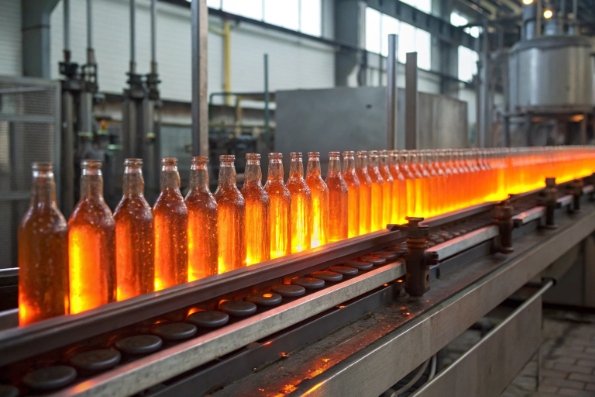
Thermal shock usually occurs during the "cool down" phase or when cold glass meets hot liquid. Let’s look at the hot-fill 4 scenario, which is a staple for many of our clients in the juice and sauce sectors.
When hot liquid (say, 90°C) hits a room-temperature bottle (20°C), the inner surface tries to expand instantly while the outer surface remains cool. This puts the outer surface in tension. Conversely, after capping, if the bottle is sprayed with cold water to cool the product, the outer surface contracts rapidly while the core remains hot, again putting the skin in tension.
Glass almost always fails from surface flaws—micro-scratches or checks—opening up under tension. The chemically strengthened layer (Case Depth or DOL – Depth of Layer) buries these flaws inside a zone of high pressure.
-
Closing the Micro-cracks: The crowding of potassium ions actively pushes the sides of any microscopic surface fissures together.
-
The Tensile Buffer: As explained previously, the thermal load must overcome the compressive stress. For a standard bottle, a $\Delta T$ (temperature difference) of 40°C might be the limit. With chemical strengthening, the surface compression is so high that the glass can often withstand a $\Delta T$ of 120°C or more.
This allows brands to use lighter-weight glass (lightweighting) without sacrificing thermal performance. A thinner bottle naturally handles thermal shock better (less thermal gradient across the wall), and when combined with chemical strengthening, it becomes a robust solution for aggressive filling lines.
Operational Benefits in Filling Lines
| Filling Stage | Stress Factor | Benefit of Strengthened Layer |
|---|---|---|
| Washing/Rinsing | Sudden heat/cold spikes | Prevents "crizzle" or checking from thermal cycling. |
| Hot Filling (>85°C) | Inner wall expansion | Mitigates breakage from immediate thermal impact. |
| Pasteurization Tunnel | Sustained heat & cooling | Reduces breakage rates, allowing faster throughput speed. |
| Rapid Cooling | Outer wall contraction | Highest risk area; Compression layer directly counteracts the primary failure mode. |
What temperature limits can reduce the benefits of chemical strengthening by relaxing surface stress?
Investments in premium strengthening treatments can be completely nullified if downstream processing inadvertently exposes the glass to temperatures that reverse the ion exchange.
Exceeding 350°C–400°C for sustained periods allows the potassium ions to migrate back out of position, causing "stress relaxation" which permanently degrades the compressive layer and returns the glass to its weaker state.
The Phenomenon of Stress Relaxation
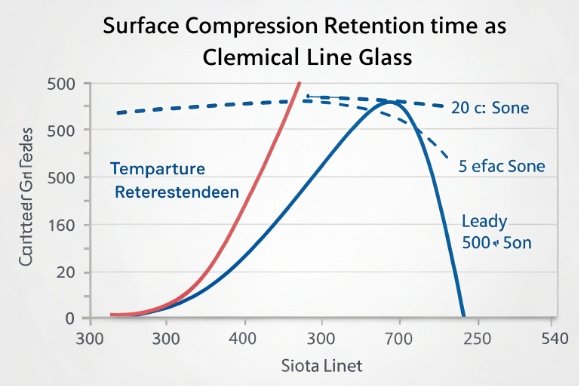
Chemical strengthening is a kinetic state, not a permanent equilibrium. The potassium ions are "trapped" in a tight lattice only because the glass is cool enough to prevent them from moving. As you heat glass, its viscosity drops and atomic mobility increases.
For chemically strengthened soda-lime glass, the "danger zone" typically begins around 300°C depending on time exposure, with rapid degradation occurring above 400°C. This is significantly lower than the glass’s actual softening point 5 (approx. 720°C).
-
Below 250°C: The stress profile is generally stable. Standard autoclaving (121°C) or pasteurization 6 (60-90°C) is perfectly safe.
-
300°C – 400°C: Stress relaxation begins. If a bottle is held here for hours (e.g., in a depyrogenation tunnel for pharma), the potassium ions will diffuse deeper or sodium ions will return, relieving the "crowding" effect. The compressive stress value (CS) drops.
-
Above 450°C: The benefits of chemical strengthening can be wiped out in minutes. The glass effectively "anneals" itself, erasing the stress profile you paid for.
This is a critical consideration for clients in the pharmaceutical sector or those using applied ceramic labeling (ACL) or decals after strengthening. If you strengthen the glass and then fire a decal at 600°C, you have destroyed the strengthening. (This is why decals must be applied before chemical strengthening, or low-temperature organic inks must be used).
Safe Operating Windows
| Process | Typical Temp | Risk to Strength | Recommendation |
|---|---|---|---|
| Pasteurization | 60°C – 85°C | None | Safe for all strengthened glass. |
| Autoclave | 121°C – 134°C | None | Safe; standard for medical/lab glass. |
| Oven Baking (Food) | 180°C – 220°C | Negligible | Generally safe for single use. |
| Depyrogenation | 300°C – 350°C | Moderate | Time-dependent. Consult FuSenglass technical team. |
| Decal Firing (Ceramic) | 550°C – 600°C | CRITICAL | Will remove strengthening. Do not use. |
What validation tests should B2B buyers require to prove heat-cycle durability after chemical strengthening?
A certificate stating "Chemically Strengthened" is insufficient for quality assurance. To ensure the glass will perform on the line, rigorous physical and optical testing protocols must be mandated.
Buyers should require ASTM C147 compliance for thermal shock, optical validation of Surface Compression (CS) and Depth of Layer (DOL), and specific fragmentation or impact tests to verify the consistency of the ion-exchange process.
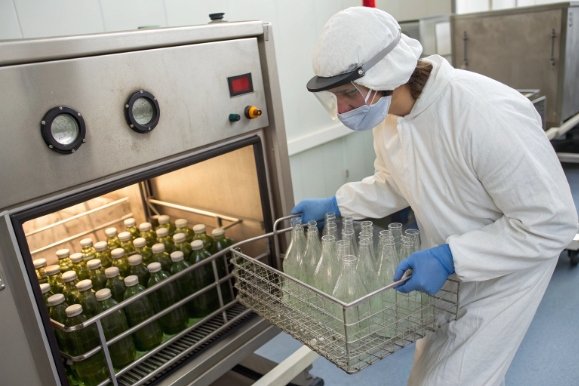
Essential Validation Protocols
At FuSenglass, we believe in data-driven quality control. When sourcing chemically strengthened ware, you should request a Quality Assurance Plan (QAP) 7 that includes the following methodologies. Relying on "standard" values is dangerous because the efficiency of the salt bath degrades over time; if the manufacturer doesn’t monitor bath purity, your bottles might look strengthened but act weak.
1. Thermal Shock Testing (ASTM C147)
This is the "gold standard" for real-world performance.
-
Method: A progressive test where bottles are heated in a water bath and then instantly plunged into a cold bath.
-
Metric: The $\Delta T$ (temperature difference) at which breakage occurs.
-
Requirement: While standard glass might pass $\Delta T$ 42°C, strengthened glass should be tested at $\Delta T$ 80°C, 100°C, or higher depending on the specification.
2. Optical Stress Measurement
Since you cannot "see" the stress with the naked eye, non-destructive optical tools (like a scattered light polariscope 8) are used.
-
Surface Compression (CS): Measured in MegaPascals (MPa). Verifies how "tight" the skin is.
-
Depth of Layer (DOL): Measured in microns ($\mu m$). Verifies how deep the protection goes. A high CS with a shallow DOL is prone to scratching failure.
3. Abraded Thermal Shock
Pristine glass is strong; scratched glass is weak. A robust test involves intentionally abrading the contact surfaces of the bottle (simulating line friction) before the thermal shock test.
- Why: This proves that the Depth of Layer (DOL) is sufficient to protect against normal handling scratches. If the strengthening is too shallow, a minor scratch will penetrate the compression layer and the bottle will fail like untreated glass.
Recommended Testing Checklist for Buyers
| Test Type | Standard/Method | Target Metric (Example) | Frequency |
|---|---|---|---|
| Thermal Shock | ASTM C147 9 | Pass $\Delta T$ 90°C (0% failure) | Every Batch |
| Surface Compression | ASTM C1279 / Optical | > 450 MPa | Every 4 Hours (Process Control) |
| Depth of Layer | Optical Analysis | > 30 $\mu m$ | Every 4 Hours |
| Impact Resistance | Drop Test / Pendulum | 2x Standard Energy | Random Sampling |
| Bath Purity | Chemical Analysis | < 1% Ca contamination | Weekly |
Conclusion
Chemical strengthening does not rewrite the laws of physics regarding thermal expansion, but it provides a critical safety margin that allows standard glass to perform in extreme thermal environments. By effectively managing the stress profile, we can transform a fragile vessel into a durable industrial asset. However, this performance is bound by temperature limits and must be validated through rigorous optical and destructive testing to ensure your investment holds up under pressure.
Footnotes
-
A chemical process that replaces smaller ions on the glass surface with larger ones to create compressive stress. ↩
-
The most common type of glass used for containers, known for its clarity and cost-effectiveness. ↩
-
Failure of a material caused by sudden temperature changes, leading to stress and breakage. ↩
-
A filling method where hot liquid sterilizes the container, requiring high thermal resilience. ↩
-
The temperature at which glass becomes soft enough to deform under its own weight. ↩
-
A heat treatment process used to kill pathogens in food and beverages, often involving thermal stress. ↩
-
A systematic plan ensuring that products meet defined quality standards and customer requirements. ↩
-
An optical instrument used to measure residual stress in transparent materials like glass. ↩
-
Standard test methods for internal pressure strength of glass containers. ↩






