
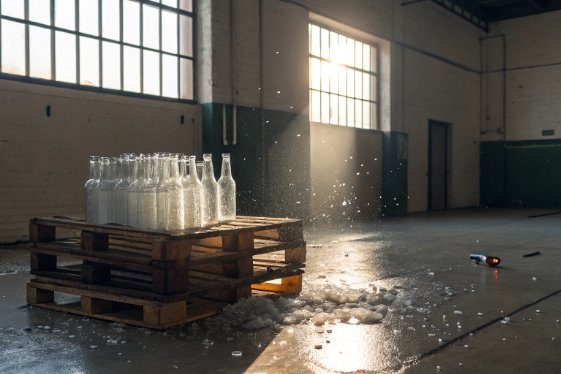
Imagine a warehouse where bottles suddenly shatter on the pallet with a loud "pop," with no one touching them. It sounds like a ghost story, but for manufacturers, it is a terrifying reality of physics gone wrong.
Yes, thermal expansion can trigger what looks like a spontaneous explosion, but true "spontaneity" is a myth. These failures are actually "Delayed Breakage" events caused by high residual stress (poor annealing) or hidden damage being triggered by a temperature change, releasing stored energy violently.
The Myth of "Spontaneous" vs. The Physics of Stress
In my years at FuSenglass, I have fielded frantic calls from clients claiming their bottles are "self-destructing." To the naked eye, it looks random. To an engineer, it is a calculated failure. "Dive Deeper" into the material science reveals that glass behaves like a battery. It stores energy in the form of Tension.
When a bottle is formed, if it is cooled unevenly (poor annealing 1), tension is locked inside the glass structure. This is potential energy waiting to get out. A perfectly annealed bottle has no stored energy; it is "dead." A poorly annealed bottle is "live."
Thermal expansion acts as the trigger. A rise in warehouse temperature or the heat from a filling line adds more stress to this already loaded system. When the total stress (Residual + Thermal) exceeds the glass’s tensile strength, it releases that energy instantly. The bottle doesn’t just crack; it flies apart. This is what people call an "explosion," but it is really just the sudden release of pent-up tension.
Breakage Classification
To solve the problem, we must identify the enemy.
| Failure Type | Description | Root Cause | "Spontaneous" Factor |
|---|---|---|---|
| Thermal Shock | Clean, sharp cracks. | Rapid temperature change ($\Delta$T). | No. Immediate reaction to heat/cold. |
| Delayed Breakage | Shattering, fragmentation. | High Residual Stress (Bad Annealing). | Yes. Can happen hours/days after production. |
| Impact Breakage | Cone or star cracks. | Physical blow. | No. Immediate reaction to force. |
| Pressure Burst | Vertical split / origin at base. | Carbonation or fermentation. | No. Reaction to internal PSI. |
Now, let’s explore the specific scenarios where heat pulls the trigger.
What’s the difference between true “spontaneous breakage” and thermal shock?
It is crucial to distinguish between a bottle that breaks because of temperature and a bottle that breaks during temperature changes due to internal flaws.
Thermal shock is an immediate mechanical failure caused by rapid expansion or contraction overcoming the glass strength. "Spontaneous" breakage is usually the release of long-standing residual stress (from manufacturing), where a minor thermal shift is merely the final straw that breaks the camel’s back.
Thermal Shock: The Immediate Reaction
Thermal shock 2 is simple cause-and-effect.
-
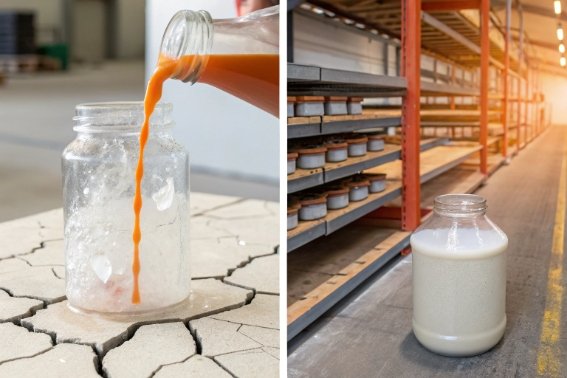
The Event: You pour boiling jam (90°C) into a room-temp jar (20°C).
-
The Physics: The inside wall expands instantly. The outside wall stays cold and rigid. The inside pushes against the outside.
-
The Result: If the tension exceeds the glass limit, it cracks. This happens now, on the line.
"Spontaneous" Breakage: The Time Bomb
This is insidious. It involves Static Fatigue.
-
The Setup: The bottle was cooled too fast in the factory. It has high internal tension (Grade 4 or 5 annealing). It is holding together, but barely.
-
The Trigger: The bottle sits in a warehouse. The sun hits the pallet, raising the glass temp by 10°C.
-
The Explosion: That tiny expansion adds just enough extra stress to tip the scale. The molecular bonds snap. Because the entire bottle was under tension, the crack propagates at the speed of sound in multiple directions. The bottle "explodes" without being touched.
Identifying the Difference
| Feature | Thermal Shock Failure | "Spontaneous" (Stress) Failure |
|---|---|---|
| Timing | Immediate (during filling/washing). | Delayed (storage, shelf, transit). |
| Sound | "Tink" or crack. | Loud "Pop" or "Bang." |
| Fragmentation | Usually 2-3 large pieces. | Many small shards (high energy release). |
| Origin | Base or thick/thin transition. | Often difficult to find (shattered). |
Which real-world scenarios trigger thermal-stress failures most often?
Your production line is a minefield of thermal events. Identifying the danger zones allows you to armor your process.
The most frequent triggers are the Cooling Tunnel (rapid contraction) and Pasteurization (sustained expansion). However, the Cold Chain is also a hidden killer, where freezing contents expand and burst the glass from the inside out.
1. The Cooling Tunnel (The #1 Killer)
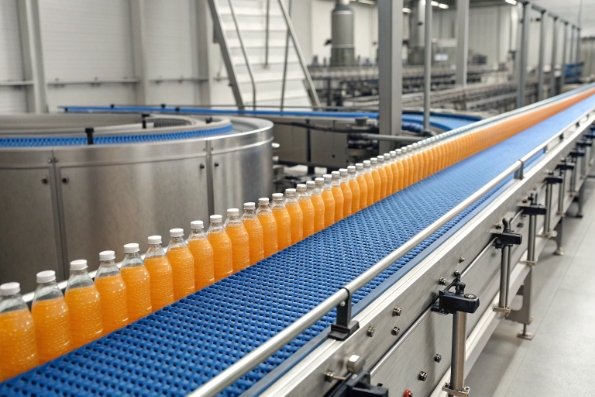
After hot-filling or pasteurization, bottles are sprayed with cold water to cool them down.
- The Stress: This is "Down-Shock." The outside of the bottle contracts rapidly while the inside is still hot. Glass is much weaker in tension (pulling apart) than compression. The contracting outer skin pulls apart, seeking any scratch to start a crack.
2. Pasteurization / Retort
-
The Stress: This involves both heat and internal pressure. As the contents heat up, the liquid and headspace gas expand, pressurizing the bottle.
-
The Risk: If the bottle has a "leaner" (thin wall) or a scratch, the combination of thermal expansion + pressure (PSI) will blow it open.
3. Hot-Fill (Up-Shock)
-
The Stress: Hot liquid hits cold glass base. The base expands.
-
The Risk: Usually lower than down-shock, but fatal if the bottom is thick and the walls are thin (uneven expansion).
4. The "Cold Chain" Explosion
This is not glass expansion, but content expansion.
-
The Scenario: A beer or soda is left in a freezer or frozen in a truck.
-
The Physics: Water expands when it turns to ice. Glass does not stretch.
-
The Result: The ice pushes the glass outward until it bursts. This is a containment failure, not a thermal shock failure.
Danger Zone Matrix
| Scenario | Thermal Action | Stress Type | Primary Risk |
|---|---|---|---|
| Hot Fill | Rapid Heating | Tensile (Outer Surface) | Base Cracks (Bottom falls out). |
| Pasteurizer | Sustained Heat | Pressure + Expansion | Vertical splits (Pressure burst). |
| Cooling Tunnel | Rapid Cooling | Tensile (Surface) | Crazing / Shattering. |
| Warehousing | Diurnal Cycle | Low Expansion | Triggers "Time Bomb" stress. |
How do residual stress, scratches, and impact damage combine to cause breakage?
A bottle rarely breaks for just one reason. It is usually a "Perfect Storm" of three factors converging to overcome the material’s strength.
It is the "Triangle of Failure": Residual Stress acts as the pre-load (the battery), Scratches weaken the defense (the open door), and Thermal Expansion provides the final push (the trigger). When these three align, breakage is guaranteed.
The Cumulative Damage Theory
Think of a glass bottle as having a "Strength Budget."
-
Minus Poor Annealing: -10,000 PSI (Pre-loaded tension).
-
Minus Scratches (Handling): -20,000 PSI (Surface weakness).
-
Remaining Strength: 10,000 PSI.
-
Thermal Shock Stress (60°C $\Delta$T): +15,000 PSI load.
-
Result: Failure. The load exceeds the remaining budget.
The Role of Impact (Bruises)
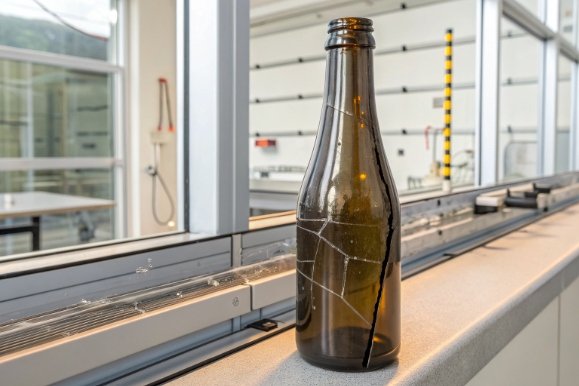
Impact damage (banging bottles together) creates deep "cone cracks" or bruises. These are much deeper than surface scratches. They penetrate into the tensile zone of the glass wall. When thermal expansion occurs, it levers these deep cracks open. A bruised bottle might survive sitting on a shelf, but the moment hot water touches it, it splits through the bruise.
Why "Spontaneous" Looks Random
Because you cannot see the stress or the microscopic scratch, the failure looks random.
-
Bottle A has high stress but no scratch. Survives.
-
Bottle B has a scratch but low stress. Survives.
-
Bottle C has high stress AND a scratch. Explodes.
What specifications and tests should B2B buyers require?
You cannot rely on luck. You must police the "Strength Budget" of your bottles before they reach your filling line.
Buyers must enforce Grade 2 Annealing limits (checked via Polariscope) to eliminate the "battery" effect. Additionally, mandate ASTM C149 Thermal Shock testing on abraded samples to ensure the bottle retains strength even after handling, and set strict impact resistance standards.

1. Annealing Control (The Non-Negotiable)
This is the only way to prevent true "spontaneous" explosions.
-
Tool: Polariscope 4.
-
Spec: ASTM C148.
-
Limit: Maximum Temper Number 2. Any batch showing Grade 3 or higher must be re-annealed or rejected. Grade 4 is a ticking time bomb.
2. Thermal Shock Testing (The Reality Check)
-
Tool: Dual water bath.
-
Limit: Pass $\Delta$T of 42°C (Standard) or 60°C (High Performance).
-
Crucial Detail: Ask for Abraded Thermal Shock data. This tests the bottle after it has been scratched (simulating 5 minutes on a conveyor). This tells you the real-world safety margin.
3. Impact Testing
-
Tool: Pendulum Impact Tester 6.
-
Spec: No breakage at a defined energy level (e.g., 0.6 Joules) on the contact points (shoulder/heel).
Buyer’s QC Checklist
Add these requirements to your purchasing agreement.
| Test / Requirement | Standard | Passing Criteria | Purpose |
|---|---|---|---|
| Residual Stress | ASTM C148 7 | Grade < 3 (Gray/Purple color). | Prevents spontaneous explosion. |
| Thermal Shock | ASTM C149 | Survival at $\Delta$T 42°C. | Validates hot-fill 8 safety. |
| Fracture Analysis | Visual | No "Butterfly" or "Origin" defects. | Identifies mold/process issues. |
| Coating Check | Slip Angle 9 | < 15 degrees. | Prevents scratches (Preserves strength). |
| Wall Thickness | Caliper 10 | Min 1.2 ratio (Thin/Thick). | Prevents uneven expansion. |
Conclusion
Glass bottles do not just "decide" to explode. They fail because physics demands it. By controlling the annealing quality to remove stored energy and protecting the surface from scratches, you defuse the bomb before thermal expansion can light the fuse.
Footnotes
-
The process of cooling glass slowly to relieve internal stresses that can cause breakage. ↩
-
The structural failure of glass due to rapid temperature changes, creating stress. ↩
-
Pounds per square inch, a unit of pressure used to measure glass strength. ↩
-
An instrument used to view internal stress patterns in glass using polarized light. ↩
-
Standard test method for determining the thermal shock resistance of glass containers. ↩
-
A device used to measure the impact resistance of materials by swinging a hammer. ↩
-
Standard test method for examining glass containers for residual stress via polariscope. ↩
-
A filling process where hot liquid sterilizes the container, requiring high thermal resilience. ↩
-
A test measuring the friction of a surface, critical for assessing bottle coating effectiveness. ↩
-
A precision tool used to measure the thickness of glass walls to ensure uniformity. ↩






