
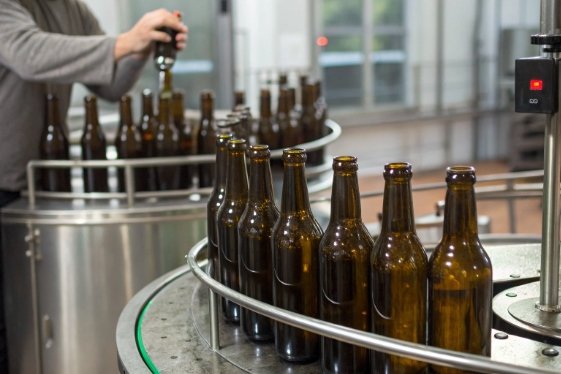
A crooked bottle on a high-speed filling line is not just an aesthetic flaw; it causes jams, breaks, and labeling disasters. Why do some bottles come out looking like bananas?
Yes, thermal expansion is a primary driver of body straightness issues. While glass is rigid when cold, uneven cooling and thermal expansion during the forming process cause the bottle to contract asymmetrically, locking in a "bent" or "out-of-round" shape known as the "Banana Effect."
The Physics of Verticality and Thermal Memory
In the glass industry, we don’t just shape molten material; we manage heat. At FuSenglass, I often explain to clients that a glass bottle is essentially a "frozen liquid." When it leaves the mold, it is solid enough to hold its shape but hot enough to be pliable. This is where the battle for straightness—technically called Verticality—is won or lost.
"Dive Deeper" into the production floor reality reveals that glass does not cool instantly. It shrinks as it cools. If one side of the bottle is hotter than the other, that side will shrink more and for longer than the cooler side. This differential contraction pulls the bottle towards the hotter side, creating a curve. By the time the glass reaches room temperature, this curve is permanent. This is not a defect of the mold (which is perfectly straight); it is a defect of thermal management. The coefficient of thermal expansion (CTE) 1 of soda-lime glass dictates that for every degree of temperature drop, the glass volume decreases. If the temperature drop is not uniform across the entire circumference of the bottle, the geometry distorts to accommodate the physics.
Defining Deformation Types
Understanding the specific type of non-straightness helps in diagnosing the thermal root cause.
| Defect Term | Visual Description | Thermal Root Cause |
|---|---|---|
| Banana (Bowed) | The entire body curves to one side. | One side of the mold was hotter; uneven cooling in the blank mold. |
| Bent Neck | The finish is not parallel to the base. | Parison 2 (pre-form) was reheated unevenly before final blow. |
| Leaner | The bottle stands at an angle. | Bottom plate thermal shock or uneven conveyor cooling. |
| Out-of-Round | Body is oval instead of circular. | Uneven gob temperature distribution; "settling" while still soft. |
Now, let’s analyze exactly where in the process these thermal errors occur.
Can uneven heating/cooling during production cause bowing or “banana” deformation?
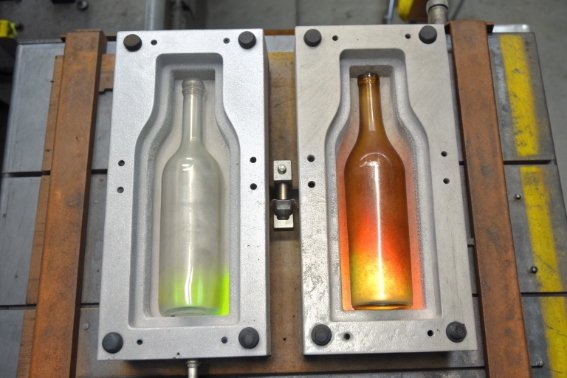
The molding machine is a violent environment of heat transfer. If the thermal balance is off by even a few degrees between the left and right mold halves, the bottle will not stand straight.
Uneven cooling is the single most common cause of "banana" deformation. If the mold cooling wind is blocked on one side, or if the glass gob flows preferentially to one wall making it thicker (and thus hotter), the bottle will contract unevenly as it cools, physically warping into a curve.
The Mechanics of the "Banana Effect"
Imagine the glass forming process. The "Gob" (molten glass) drops into the blank mold, then transfers to the blow mold.
-
Wall Thickness Variance: If the glass distribution is poor, one wall becomes thick, and the opposite wall becomes thin. Thick glass holds heat longer. Thin glass freezes faster.
-
The Tug-of-War: As the bottle travels from the mold to the annealing lehr 3, the thick (hot) side continues to contract as it slowly cools. The thin (cold) side is already rigid. The contracting hot side "pulls" the bottle, bowing it.
-
Mold Equipment: Sometimes, the mold hangers or the cooling channels inside the metal mold get clogged with mineral deposits (scale). This creates "hot spots" on the mold face. The glass touching the hot spot stays soft longer, leading to a lean.
Conveyor Thermal Shock
Even after the bottle leaves the mold, it is susceptible. It lands on a "dead plate" and then a conveyor belt. If the wind from the cooling fans hits only one side of the bottle (the "windward" side), that side freezes instantly. The "leeward" side remains hot. The result? The bottle bows towards the wind.
Production Variable Impact Table
Here is how specific machine variables influence the straightness via thermodynamics.
| Variable | Condition | Resulting Deviation |
|---|---|---|
| Mold Cooling Air | Blocked on Left Side. | Left mold gets hot -> Left wall stays soft -> Bottle bows Left. |
| Gob Temperature | Too hot / Low viscosity. | Glass sags under its own weight before freezing (Slump). |
| Take-Out Tongs | Cold contact on neck. | Thermal shock freezes neck; body swings, creating a bent neck. |
| Machine Speed | Too fast. | Bottle leaves mold too hot; deforms on the conveyor belt. |
How do annealing conditions and residual stress relate to straightness problems?
The annealing lehr is supposed to be a place of relaxation for the glass. But if the temperature curve is aggressive, it can lock in stress that distorts the shape.
While annealing primarily removes internal stress to prevent breakage, improper annealing profiles can cause "slumping" if the entry temperature is too high, or lock in thermal tension that subtly warps the bottle’s vertical axis, causing it to fail gauge tests.
The Lehr Entry: The Danger Zone
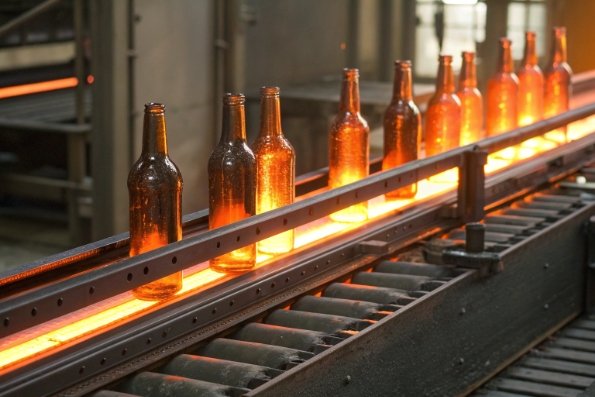
When bottles enter the annealing lehr, they are often reheated slightly to equalize the temperature before being slowly cooled.
-
Too Hot: If the lehr entry is too hot (above the softening point, ~550°C), the glass becomes plastic again. Gravity takes over. If the conveyor belt is slightly uneven or jerky, the soft bottles will "slump" or lean.
-
Too Cold: If they enter too cold, the stress is locked in permanently. While this doesn’t visually bend the bottle more, it means the "banana" shape created at the molding machine is now permanent and cannot be relaxed out.
Residual Stress and Dimensional Stability
People often ask me, "Fei, can stress make a bottle bend later?"
Once glass is cooled to room temperature, it is a brittle solid. It does not warp; it breaks. However, Residual Stress (measured in birefringence 4) indicates that the glass wants to move but can’t.
If a bottle has high internal tension due to poor annealing, and you then heat it (pasteurization), that stress seeks a release. Usually, this results in a crack (failure), not a bend. However, in rare cases with very thick glass, relief of high tension can cause minor dimensional shifts, though usually imperceptible to the eye.
Annealing Profile Factors
The control of the lehr curve is critical for maintaining the geometry set by the mold.
| Lehr Zone | Function | Risk to Straightness |
|---|---|---|
| Heating Zone | Equalize Temp (550°C). | High. Overheating causes slumping/leaning. |
| Annealing Point | Stress Relief (Strain Point). | Low. Critical for strength, not shape. |
| Cooling Zone | Slow cooling to 200°C. | Moderate. Uneven airflow can cause "cold side" drag. |
| Cold End | Exit to room temp. | None. Shape is set. Breakage risk only. |
Could hot-fill or warehouse temperature swings make a bottle look less straight?
There is a misconception that glass behaves like plastic in a hot warehouse. We need to distinguish between the glass warping and the system appearing warped.
No, glass will not warp or bend in a warehouse or during hot-fill; it is too rigid. However, thermal expansion during hot-filling can cause labels to buckle or wrinkle if the glass expands against a rigid label, creating the visual illusion of a distorted bottle.
The Myth of the "Melting" Glass Bottle
I have had customers call me saying, "My bottles warped in the container crossing the equator."
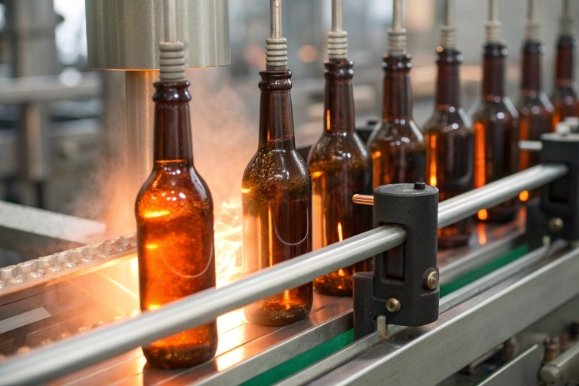
This is physically impossible. The softening point 5 of soda-lime glass is over 500°C. A shipping container gets to 60°C. The glass did not move.
If the bottle looks crooked, it was manufactured crooked. The heat just made you inspect it more closely.
The Hot-Fill Expansion Reality
However, Thermal Expansion is real during filling.
When you pour 90°C liquid into a bottle, the glass expands volumetrically.
- The Label Issue: If you use a rigid pressure-sensitive label (PSL) 6 or a full-body sleeve before filling (rare, but happens), the glass expands, stretching the label. When the bottle cools, the glass shrinks. The label might bunch up, wrinkle, or peel. A wrinkled vertical label line creates a strong optical illusion that the bottle itself is twisted or bent.
The "Wobbly" Bottom Effect
There is one specific instance where hot-fill affects stability. If the bottom of the bottle ("push-up") was molded with excessive stress, the thermal shock of hot-filling can sometimes cause a "push-out"—where the bottom cracks or separates. It doesn’t bend the body, but it makes the bottle unstable (a "rocker"), which mimics the wobbling of a bent bottle.
Scenario Analysis: Post-Production Thermal Effects
Here is what actually happens vs. what people think happens.
| Scenario | Myth (What buyers fear) | Reality (Physics) |
|---|---|---|
| Hot Warehouse (60°C) | Bottle softens and leans. | Impossible. Glass is rigid. No change. |
| Hot Fill (90°C) | Neck bends sideways. | Impossible. Neck breakage possible, not bending. |
| Pasteurization (Tunnel) | Body becomes oval. | Unlikely. Internal pressure rises; cap may fail. |
| Labeling | Bottle looks twisted. | Possible. Label wrinkling mimics distortion. |
What inspection methods and tolerances should B2B buyers use to control straightness?
You cannot fix a bent bottle; you can only reject it. Implementing strict dimensional checks at the incoming quality control (IQC) stage is non-negotiable.
Buyers must specify "Verticality" tolerances (typically 0.5% – 1.0% of height) and enforce them using Total Indicated Runout (TIR) gauges. Stress testing with a polariscope is also vital to ensure that any straightness deviation isn’t hiding dangerous internal tension.
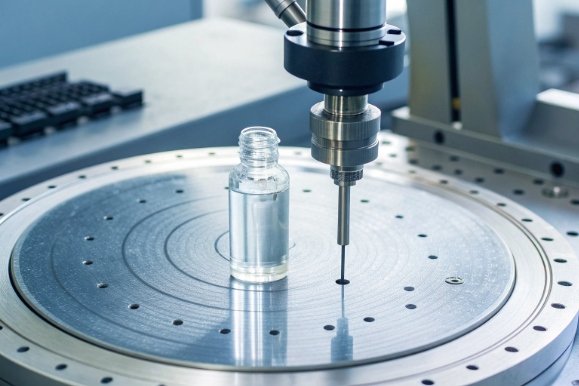
The Standard: Total Indicated Runout (TIR)
This is the industry standard test.
-
The Setup: The bottle is placed on a rotating turntable. A dial indicator touches the finish (neck) or the shoulder.
-
The Action: The bottle is rotated 360 degrees.
-
The Reading: The gauge measures the difference between the minimum and maximum deflection.
- The Tolerance: For a standard 300mm wine bottle, a typical tolerance is max 1.5mm to 3.0mm deviation (depending on premium vs. standard grade). If the needle swings more than the limit, it’s a reject.
Verticality vs. Ovality
-
Verticality: Measures how much the neck deviates from the center axis of the base (The "Lean").
-
Ovality: Measures how "out of round" the body is. A bottle can be perfectly vertical but oval. Both are caused by thermal issues in molding. You need to check both.
The Stress Check (Polariscope)
If you find a batch of bottles that are slightly bent (borderline spec), checking them with a polariscope 7 is crucial.
-
Why? A bent bottle implies uneven cooling. Uneven cooling implies residual stress.
-
The Risk: If you see bright colors (high stress) and the bottle is bent, that bottle is a grenade. It will likely explode on your filling line. If the bottle is bent but shows low stress (good annealing), it is just ugly, not dangerous.
Recommended Inspection Protocol
Add these checks to your purchase contract.
| Test Method | Tool | What it Detects | Standard Tolerance |
|---|---|---|---|
| TIR (Verticality) | Height Gauge + Turntable | Leaning/Bent Neck. | Max 1.0% of Total Height. |
| Ovality Check | Caliper / Rotary Gauge | Body flattening. | +/- 1.5mm (varies by dia). |
| Visual Spin | Manual Spin on Table | Visible wobble ("Dancing"). | Visual Standard (Limit Samples). |
| Polariscope | Polarized Light Box | Uneven cooling stress. | ASTM C148 8 Grade < 4. |
Conclusion
Straightness is not just about mold precision; it is a record of the bottle’s thermal history. By understanding how uneven cooling creates the "banana effect," you can better distinguish between a harmless aesthetic variance and a structural defect waiting to shatter.
Footnotes
-
A material property that describes how its size changes with temperature, critical for glass forming. ↩
-
A partially formed tube of hot glass that is blown into the final bottle shape. ↩
-
A temperature-controlled kiln for annealing glass, essential for relieving internal stress. ↩
-
An optical property used to detect stress in transparent materials like glass. ↩
-
The temperature at which a material softens and becomes deformable, around 500°C for glass. ↩
-
Self-adhesive labels that require pressure to bond, susceptible to wrinkling if the bottle expands. ↩
-
An instrument used to view internal stress patterns in glass using polarized light. ↩
-
Standard test method for examining glass containers for residual stress. ↩






