
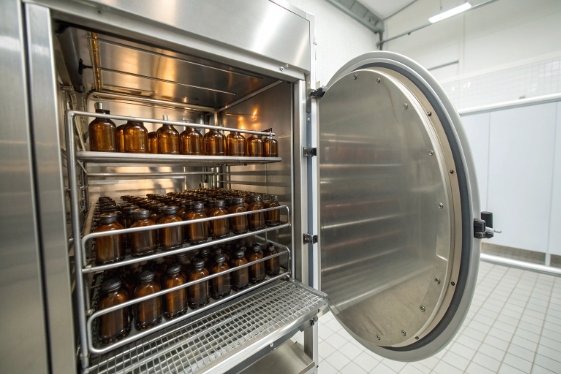
Many clients ask if high-heat sterilization warps our glass. The short answer is no—glass doesn’t melt at autoclave temperatures—but the reality of thermal shock and pressure dynamics is far more complex.
Steam sterilization (autoclaving) typically occurs at 121°C to 134°C, well below the ~500°C glass transition temperature of soda-lime glass. Therefore, true physical deformation of the glass container itself is scientifically impossible during standard cycles. However, "apparent" deformation usually stems from component failure, thermal shock breakage, or liner warping.
The Physics of Glass vs. Steam
When we talk about deformation, we have to look at the material science. I often have to correct the misconception that glass behaves like plastic in a steamer. It simply doesn’t.
However, just because it doesn’t melt doesn’t mean it survives. The danger isn’t changing shape; it’s shattering. In my years at FuSenglass, I’ve seen pallets of poorly annealed bottles crack not because the glass got soft, but because the temperature changed too fast (Thermal Shock).
To understand why "deformation" is a myth but failure is a reality, we need to break down the critical thresholds.
| Parameter | Standard Autoclave Range | Soda-Lime Glass Limit | Borosilicate Glass Limit | Risk Factor |
|---|---|---|---|---|
| Temperature | 121°C – 134°C | Softening pt: ~700°C | Softening pt: ~820°C | Zero (for melting) |
| Thermal Shock | ΔT > 40°C (rapid cooling) | Max ΔT: ~42°C | Max ΔT: ~120°C | High (Breakage) |
| Pressure | 15 – 30 psi | High compressive strength | Extremely high | Low (unless vacuum collapse) |
| Time | 15 – 60 mins | Indefinite | Indefinite | None |
Glass is an amorphous solid 1. Unlike plastic, which has a relatively low melting point, glass requires temperatures exceeding 500°C just to enter its glass transition temperature 2 where stress relaxation might begin. At 121°C, the glass structure is rigid. If you see a "deformed" bottle, it likely wasn’t glass to begin with, or it was subjected to heat far beyond a steam sterilizer’s capability.
Now that we’ve established that the glass won’t turn into a Dali painting, let’s look at the specific conditions that do matter.
Under what autoclave conditions could glass bottle dimensions shift, and which glass types handle it best?
Choosing the right cycle parameters is less about preventing warping and more about preventing explosion.
Standard autoclave cycles (121°C for 15-20 mins) will not shift glass dimensions. Dimensional shifts only occur if the glass is heated near its annealing point (>500°C). Borosilicate glass (Type I) handles aggressive thermal cycling best, while treated Soda-Lime (Type II) is sufficient for standard single-cycle sterilization.
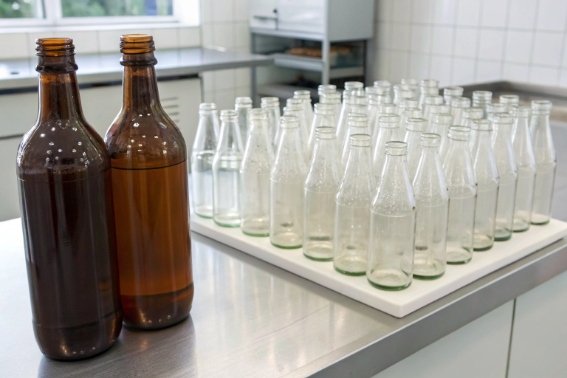
The Danger Zone: Thermal Shock, Not Heat
In our factory, we emphasize that "heat" isn’t the enemy—speed is. A soda-lime glass 3 bottle can sit happily at 200°C. But if you take it from 121°C steam and rinse it with 20°C water, it will snap.
When clients insist on aggressive cooling cycles to speed up production, I have to steer them toward Type I glass or modify their ramp-down times.
Material Selection Guide
-
Type I (Borosilicate): The gold standard. It has a low coefficient of expansion ($3.3 \times 10^{-6}/K$). You can practically abuse this borosilicate glass 4 in an autoclave, and it won’t change dimensions or crack.
-
Type II (Treated Soda-Lime): Standard soda-lime glass with a sulfur treatment to neutralize surface alkalinity. Good for sterilization but requires controlled heating/cooling curves ($ \Delta T < 42^{\circ}C $).
-
Type III (Soda-Lime): Standard flint glass. It is risky for autoclaving unless the cycle is very gentle.
| Glass Type | Recommended Usage | Autoclave Risk Profile | Dimensional Stability |
|---|---|---|---|
| Borosilicate | Injectables, Labware | Low (Resists Shock) | Absolute |
| Treated Soda-Lime | IV Fluids, Pharma | Moderate (Watch Cooling) | Absolute |
| Standard Flint | Cosmetic, Beverage | High (Crack Prone) | Absolute |
Is “deformation” after steam sterilization usually real glass warping, or is it stress cracking and closure/liner distortion?
If your bottle looks different after autoclaving, stop blaming the glass. Look at what’s attached to it.
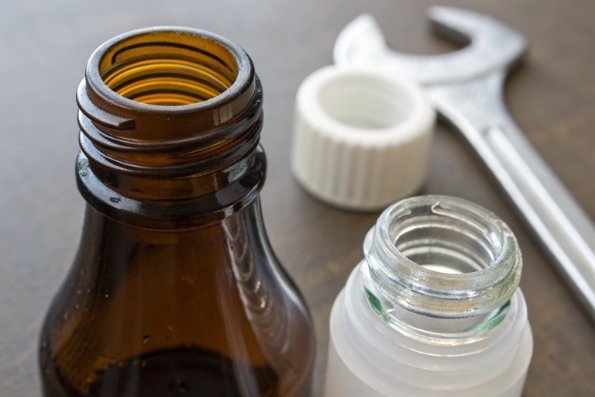
"Deformation" generally refers to the failure of plastic closures, melting of liners, or the collapse of thinner synthetic components. In the glass itself, visual anomalies are almost always stress cracks (crazing) or surface erosion, not physical warping of the container’s geometry.
Diagnosing the "Warp"
I recall a project with a client in Mexico (let’s call her Maria) who claimed our bottles were shrinking. We flew in, ran tests, and found the glass was perfect. The issue? Her PP (Polypropylene) caps were shrinking by 2% under heat, creating a vacuum that made the bottle look like the neck had distorted when it was actually the liner getting sucked in.
The Real Culprits
-
Liner Compression Set: At 121°C, many PE foam liners lose their elasticity. They flatten out, causing the cap to sit lower. This looks like the bottle neck shortened. It didn’t.
-
Polymer Relaxation: Plastic caps relieve stress in the autoclave, often turning oval.
-
Hydrolytic Attack: While not deformation, low-quality glass can suffer surface flaking (delamination) 5 in steam, making the surface look rough or "melted."
| Component | Reaction to 121°C Steam | Visual Result |
|---|---|---|
| Glass Body | None | No change |
| PP Cap | Softening/Shrinkage | Ovalization, loose fit |
| PE Liner | Compression/Melting | Leakage, "shrunken" look |
| Decal/Label | Peeling/Discoloration | Aesthetic ruin |
How do bottle design and annealing quality affect autoclave performance?
You can’t autoclave a poor design. Even the best glass will fail if the geometry creates stress concentrators.
Uniform wall thickness and proper annealing are critical; thin spots cool faster than thick spots, creating tension that snaps bottles during autoclave cooling. Sharp corners in the base design act as stress risers, while a robust neck finish is required to maintain seal integrity under pressure variances.
Design for Sterilization
When I work with clients like JEmma on custom molds, I always ask: "Will this be retorted or autoclaved?" If the answer is yes, we have to change the design rules.
A fancy, angular perfume bottle shape will likely explode in an autoclave. The sharp internal corners concentrate stress. For sterilization, round is sound.
The Role of Annealing
Annealing 6 is the process of slowly cooling the bottle after forming to remove internal stress. If we rush this in the factory, the bottle holds "memory" of that tension. The autoclave acts as a trigger.
-
Wall Uniformity: If one side is 2mm and the other is 5mm, they expand at different rates. Snap.
-
Base Push-up: A deep push-up (punt) needs to be carefully radiused.
-
Neck Finish: The finish must be perfectly flat. If the mold parting line is rough, the steam pressure will bypass the seal, causing the contents to boil off or contaminate.
| Design Feature | Bad Practice | Good Practice |
|---|---|---|
| Shape | Square, Sharp Corners | Stress concentrators 7 |
| Bottom | Flat, Thick Heavy Base | Stippled, Even Push-up |
| Shoulder | 90° Right Angle | Sloped, Gentle Curve |
| Glass Distribution | Uneven (Thick/Thin) | Uniform (>1.5mm everywhere) |
What validation tests should you run before mass orders?
Never assume a stock bottle can handle your specific autoclave cycle. Validation is the only insurance you have.
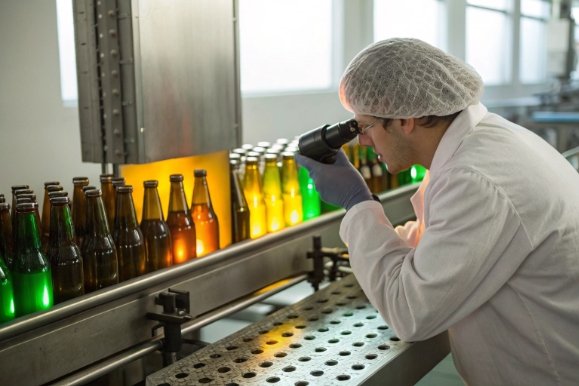
Before mass production, you must validate Thermal Shock Resistance ($\Delta T$), Internal Pressure Resistance, and Annealing quality (Polariscope). Additionally, perform a simulation with filled product to check for closure back-off and vacuum retention during the sterilization cooldown phase.
My Recommended Protocol
For any B2B client planning to steam sterilize, I refuse to ship without these four specific checks. It saves us both a fortune in claims later.
1. The Thermal Shock Test (ASTM C149)
We heat the bottles to 60°C and plunge them into 20°C water. If they survive, we go to 80°C. For autoclaving, your bottles must survive a $\Delta T$ of at least 42°C (for soda lime), verified by ASTM C149 8.
2. Polariscope Stress Check (ASTM C148)
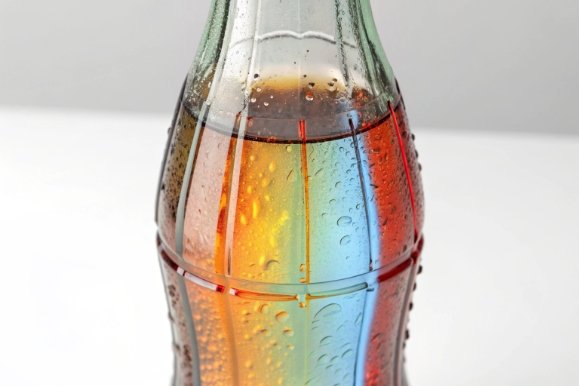
We look at the bottle under polarized light using a Polariscope 9. Stress shows up as colorful fringes.
-
Grade 1-2: Excellent annealing. Safe.
-
Grade 4-5: High stress. Will explode in autoclave, often failing ASTM C148 10.
3. Vertical Load & Pressure
During the autoclave cycle, if the pressure isn’t balanced, the bottle might be subjected to external crushing force or internal bursting force (if the liquid inside expands). We need to test the bottle’s burst pressure limits.
4. Cap/Liner Compatibility Trial
Fill the bottle with your liquid, cap it, and run a full cycle.
-
Does the cap loosen? (Torque retention test)
-
Did the liner melt?
-
Did water get in? (Dye ingress test)
| Test Name | Purpose | Acceptance Criteria |
|---|---|---|
| Thermal Shock | Simulate cooling phase | No breakage at $\Delta T=42^{\circ}C$ |
| Polariscope | Check annealing quality | Temper Number < 3 |
| Dye Ingress | Check seal integrity | Zero dye inside after vacuum |
| Dimensions | Check for cap fit | Go/No-Go Gauge pass |
Conclusion
Glass doesn’t deform in an autoclave; it breaks or seals fail. By choosing the right material (Borosilicate or Treated Soda-Lime), ensuring uniform design, and validating thermal shock limits, you ensure safety.
Footnotes
-
Defines the non-crystalline atomic structure that gives glass its unique rigidity and heat resistance. ↩ ↩
-
The specific temperature range where glass transitions from a hard state to a malleable state. ↩ ↩
-
The most common type of commercial glass, known for its clarity but moderate thermal shock resistance. ↩ ↩
-
A type of glass with very low thermal expansion, making it ideal for high-heat sterilization. ↩ ↩
-
A defect where the inner glass surface flakes off due to chemical attack from steam or aggressive liquids. ↩ ↩
-
The manufacturing process of slowly cooling glass to relieve internal stresses that cause breakage. ↩ ↩
-
Geometric features like sharp corners that amplify force and increase the likelihood of cracks. ↩ ↩
-
Standard Test Method for Thermal Shock Resistance of Glass Containers. ↩ ↩
-
An optical instrument used to visualize and measure residual stress patterns in transparent materials. ↩ ↩
-
Standard Practice for Polariscopic Examination of Glass Containers for Residual Stress. ↩ ↩






