
Production lines halt when bottles burst, destroying efficiency and profits. Misunderstanding glass physics leads to costly, ineffective adjustments. We must clarify the true relationship between heat and glass properties to stop breakage.
No, pasteurization does not change the Coefficient of Thermal Expansion (CTE). CTE is a constant material property. Breakage results entirely from thermal shock—stress caused when rapid temperature changes (Delta T) exceed the glass’s tensile strength.
The Core Physics: CTE vs. Thermal Stress
Understanding the Immutable CTE
At FuSenglass, I frequently correct the misconception that pasteurization temperatures "stretch" or "weaken" the glass matrix permanently. This is scientifically impossible at standard processing temperatures. The Coefficient of Thermal Expansion 1 (CTE) for soda-lime glass is fixed by its chemical composition—specifically the silica, soda, and lime ratios. For our standard flint and amber glass, this value remains steady at approximately 8.5 to 9.0 x 10⁻⁶ K⁻¹.
Glass does not experience any structural phase transitions until it reaches the transformation range, which begins around 520°C. Pasteurization, which peaks at 60°C – 75°C, is thermally insignificant to the material’s molecular bond structure. The glass expands during heating and contracts during cooling, but it always returns to its original dimensions. The material itself does not degrade, fatigue, or change its expansion rate due to these cycles.
The Real Culprit: Thermal Conductivity and Stress
If the CTE doesn’t change, why do bottles explode? The failure mechanism is Thermal Shock 2, driven by glass’s poor thermal conductivity. Unlike metal, which distributes heat instantly, glass insulates. When a temperature change is applied to the surface, the core lags behind.
-
Heating (Compression): As the bottle enters the tunnel, the skin heats and tries to expand, while the core remains cold and static. This forces the outer skin into compression. Since glass is incredibly strong in compressive strength 3 (approx. 1000 MPa), breakage during the heating phase is statistically rare unless the bottle is already deeply scratched.
-
Cooling (Tension): This is the danger zone. When cold water hits a hot bottle, the skin contracts rapidly while the core stays expanded. This pulls the surface tight, creating tensile stress. Glass is inherently weak in tension (approx. 40-80 MPa). If this "pull" exceeds the limit, the bottle fails.
| Physical Property | Value / Characteristic | Role in Pasteurization Failure |
|---|---|---|
| CTE (Expansion) | ~9.0 x 10⁻⁶ K⁻¹ | Neutral. Defines how much it moves, but doesn’t change. |
| Thermal Conductivity | Very Low (Insulator) | Critical. Causes the temperature gradient (Delta T). |
| Tensile Strength | ~40 – 80 MPa | The Weak Link. The limit that gets exceeded during cooling. |
| Elastic Modulus | ~70 – 73 GPa | Stiffness factor. Determines how much stress builds per degree of strain. |
The key takeaway is that we are not fighting the material changing; we are fighting the speed of the process.
Now that we have established the physics, we must move to the practical application on your production line.
Does Pasteurization Change the Bottle’s CTE or Just Create Stress?
Blaming the material for line breakage is a distraction. Focusing on the thermal cycle reveals the actual stress points that crush production efficiency.
Pasteurization creates temporary thermal stress due to heating and cooling cycles; it never changes the CTE. The risk is strictly a function of the temperature differential (Delta T) applied over time.
The Mechanics of the Stress Cycle
When we analyze the lifecycle of a bottle through a tunnel pasteurizer, we are essentially mapping a stress wave. The bottle undergoes a "hoop stress" expansion and then a rapid contraction. The CTE dictates the magnitude of this expansion (how many microns the glass moves), but the stress is determined by the gradient.
In my twenty years at FuSenglass, I have never seen a bottle return a different CTE value after pasteurization. However, I have seen thousands break because the operator assumed the glass could "handle" a faster cool-down. The stress is cumulative in the short term—meaning if a bottle is shocked by a 50°C drop, micro-flaws on the surface (scuffs from the filling line) act as stress concentrators 4. The stress intensity factor ($K_{IC}$) at the tip of a scratch can amplify the thermal tension by 100x, causing instant propagation.
Why "Heating" vs "Cooling" Matters
It is vital to distinguish the type of stress.
-
Heating Phase: The bottle surface is pushing against itself (Compression). This actually closes micro-cracks and makes the bottle temporarily stronger.
-
Cooling Phase: The bottle surface is pulling apart (Tension). This opens micro-cracks.
Therefore, a bottle can survive a massive thermal shock during heating (e.g., Delta T of 60°C) but will shatter with a much smaller shock during cooling (e.g., Delta T of 45°C).
| Cycle Phase | Surface State | Core State | Stress Type | Failure Probability |
|---|---|---|---|---|
| Pre-Heat | Hot / Expanding | Cold / Static | Compression | < 1% |
| Pasteurization | Hot | Hot | Neutral | ~ 0% |
| Cooling | Cold / Contracting | Hot / Expanded | Tension | > 99% |
What Pasteurization Profiles Create the Highest Cracking Risk?
Aggressive production targets often force operators to compress cooling times. This speed kills glass by violating thermodynamic limits.
The highest risk profile is a "Shock Cooling" curve where the Delta T between the glass surface and the spray water exceeds 42°C (107°F), typically occurring in the first cooling zone.
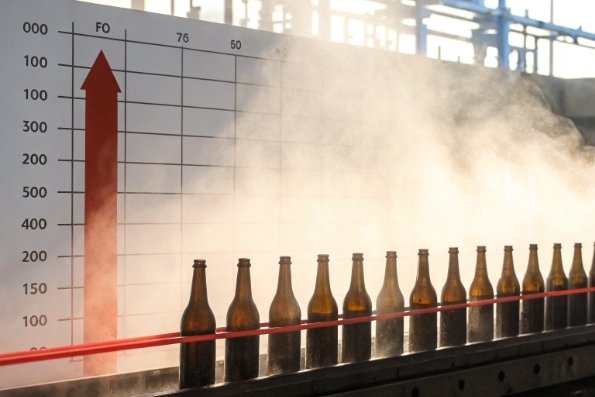
The "Death Zone": Transition from Hold to Cool 1
The single most critical moment in your tunnel is the transition from the Pasteurization Zone to Cooling Zone 1.
Imagine a standard profile: The bottle has been holding at 62°C for 20 minutes. The core is fully saturated at 62°C. If the first spray nozzle in Cooling Zone 1 delivers water at 18°C, the immediate Delta T is 44°C.
While a pristine, lab-quality bottle might survive a 44°C shock, a production bottle that has banged against guide rails will not. The industry safety margin for soda-lime glass is a Delta T of 42°C. Any profile that exceeds this gap is a high-risk profile.
Dangerous Profile Characteristics
We see three common errors in client profiles that lead to breakage:
-
The Step-Down Cliff: Dropping temperatures too sharply. For example, going from 60°C to 20°C in one step. You must "step down" the temperature.
-
The Cold Water Inlet Error: Using fresh city water (often 10-15°C in winter) directly in the final cooling zone without mixing. If the bottle exits the previous zone at 45°C, this 10°C water creates a lethal 35°C shock on the heel.
-
The Dry Zone: If there is a gap between spray headers, the bottle surface air-cools slightly, but then is hit by a high-velocity spray. The uneven cooling creates circumferential hoop stress 5 bands.
Optimal Safe Profile Construction
To maximize survivability, the cooling curve must be gradual. We recommend a maximum drop of 30-35°C per zone.
| Zone | Bottle Entry Temp | Recommended Spray Temp | resulting Delta T | Risk Status |
|---|---|---|---|---|
| Zone 1 (Pre-Heat) | 25°C | 40°C | +15°C | Safe (Compression) |
| Zone 2 (Soak) | 40°C | 62°C | +22°C | Safe (Compression) |
| Zone 3 (Cool 1) | 62°C | 35°C – 40°C | -25°C | Safe (Tension) |
| Zone 4 (Cool 2) | 35°C | 20°C | -15°C | Safe (Tension) |
By ensuring the first cooling spray is warm (around 35-40°C), you cushion the shock.
How Do Bottle Design Factors Influence Survivability?
A beautiful bottle that breaks in the tunnel is a failed product. Geometry dictates how stress flows through the glass container.
Uniform wall thickness is the primary design factor for survival; thick bases or sharp corners create "heat sinks" and stress concentrators that tear the bottle apart during cooling.
1. Wall Thickness Uniformity
The golden rule of glass engineering is uniformity.
If a bottle has a thick heel (4mm) and a thin sidewall (2mm), they will cool at different rates. The thin wall cools and contracts instantly. The thick heel retains heat and stays expanded. This differential contraction creates a shear force at the junction, leading to a "bottom separation" or circumferential crack.
At FuSenglass, we aim for a wall thickness ratio of no more than 2:1 between the thickest and thinnest points. Ideally, a consistent 2.8mm to 3.2mm thickness provides the best balance of strength and thermal performance 6.
2. Base Design and Push-up (Punt)
The base is the hardest part to cool.
-
The Heat Sink Effect: A heavy "champagne-style" push-up concentrates mass in the base. This area stays hot long after the sidewalls have cooled.
-
Knurling (Stippling): The series of ridges on the bottom of the bottle are not just for grip; they reduce the contact surface area with the conveyor belt. Without knurling, the entire hot glass bottom touches the cold metal belt, causing immediate thermal checking.
-
Base Radius: The transition from the base to the sidewall (the insweep) must be a smooth curve. A sharp angle here is a prime location for thermal stress cracks.
3. Shoulder Geometry
The shoulder is a fulcrum for stress.
-
Square Shoulders: A 90-degree shoulder acts as a "stop" for the vertical tension lines. Stress accumulates here until it snaps the neck off.
-
Sloped Shoulders: A generous radius (e.g., >20mm) allows the stress to distribute evenly down the body of the bottle.
| Design Feature | High Risk Configuration | Optimized FuSenglass Configuration |
|---|---|---|
| Wall Thickness | Variable (Wedge bottom) | Uniform (Even distribution) |
| Base Contact | Flat (100% Contact) | Knurled (Reduced Contact) |
| Shoulder Radius | Sharp / Square | Soft / Sloped |
| Glass Distribution | Heavy Bottom / Thin Neck | Balanced / Lightweight |
What Validation Tests and Simulations Should You Run?
Theoretical design is useless without empirical data. You must rigorously test both the container capabilities and the actual line conditions.
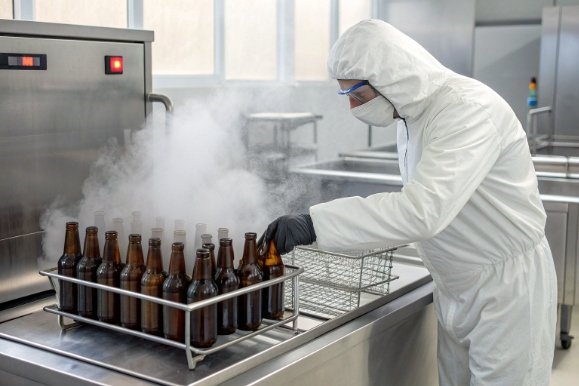
You must validate performance using the ASTM C149 Thermal Shock Test for the glass itself, and use an instrumented "Data Logger" bottle to map the real-time thermal profile of your tunnel.
1. Laboratory Validation: ASTM C149
Before a single bottle is filled, the glass must be certified. The industry standard is ASTM C149 7.
-
The Procedure: Bottles are soaked in a hot water bath (typically 65°C) until equilibrium is reached. They are then rapidly transferred (within 15 seconds) to a cold water bath (23°C).
-
The Pass Standard: For pasteurizable ware, FuSenglass requires a Delta T of 42°C. This means the bottle must survive a 42-degree instantaneous drop. High-performance ware can be tested to Delta T 50°C.
-
The Insight: If the glass fails here, it is an annealing issue (manufacturing defect). If it passes here but breaks on the line, it is a process issue.
2. Line Simulation: The Data Logger
You cannot optimize what you cannot measure. A "Data Logger" is a dummy bottle fitted with a thermal probe that travels through the tunnel with the production run.
-
Core vs. Spray: The logger records the temperature of the liquid inside. You must overlay this data with the known spray temperatures of your tunnel zones.
-
Calculating the Delta: At every second of the process, calculate: $T{bottle} – T{spray}$.
-
The Red Flag: If this value exceeds 35°C at any point, you are operating in a danger zone. You need to adjust the spray temperatures to "bridge" the gap.
3. Fracture Analysis (The Autopsy)
When things go wrong, the glass fragments tell the truth.
-
Thermal Breaks: Look for a single, wavy crack that often circles the base or runs up the side. It usually has a smooth, mirror-like surface on the crack edge.
-
Mechanical Breaks: Look for a "star" or "butterfly" origin point with radiating cracks. This indicates impact, not heat.
-
Pressure Breaks: Originates at the neck or base with a vertical lance.
| Test / Tool | Objective | Passing Criteria |
|---|---|---|
| ASTM C149 | Material Strength | Survive Delta T = 42°C |
| Data Logger | Process Safety | Max Process Delta T < 35°C |
| Polariscope 8 | Residual Stress | Temper Number < 2 |
| Fracture Analysis | Root Cause ID | Distinguish Thermal vs. Impact |
Conclusion
Pasteurization is a battle against thermal shock, not a chemical change in the glass. The CTE remains constant; it is the management of the Delta T that determines survival. By prioritizing uniform bottle design, maintaining a cooling gradient below 42°C, and validating with ASTM C149, you can safeguard your product.
Is your current glass supplier failing the thermal shock test? Contact FuSenglass today for a technical audit of your packaging.
Footnotes
-
A measure of how much a material’s shape changes with temperature, which is constant for glass. ↩ ↩
-
Sudden stress caused by rapid temperature changes, often leading to fracture in brittle materials. ↩ ↩
-
The capacity of a material to withstand loads tending to reduce size, where glass excels. ↩ ↩
-
Flaws like scratches where stress gathers, making glass much weaker under tension. ↩ ↩
-
Stress exerted circumferentially (like a belt), often causing horizontal cracks in bottles. ↩ ↩
-
How well the container design manages heat transfer and stress distribution to prevent breakage. ↩ ↩
-
Standard Test Method for Thermal Shock Resistance of Glass Containers. ↩ ↩
-
An optical instrument used to detect internal stress patterns within transparent materials like glass. ↩ ↩






