
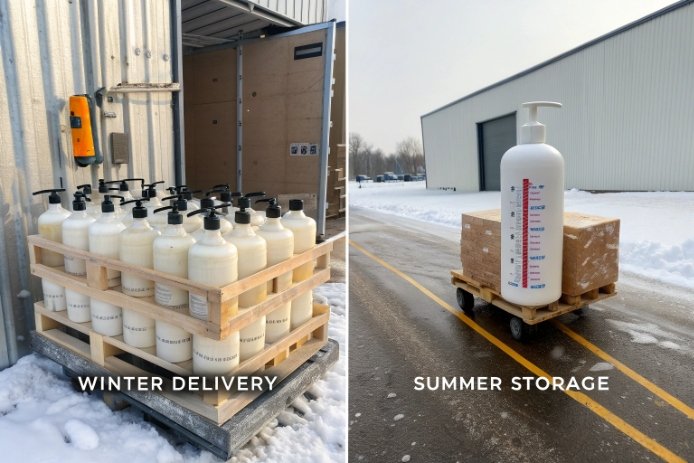
A pump can feel perfect at room temperature and start leaking after a hot warehouse week or a cold-to-hot delivery route. That is not rare. Pump systems have more parts, more interfaces, and more ways for temperature to change the fit.
Yes. Thermal expansion affects pump-to-bottle fit because the glass finish, plastic pump shell, and gasket materials expand and relax differently. That changes gasket compression, thread engagement, and lock-ring retention, which can lead to loosening, leakage, or pump misalignment after thermal cycling.
Pumps are the most temperature-sensitive closure family because they are multi-interface systems
A typical screw pump or sprayer closure does not seal in one place. It seals in several places:
- between the bottle top land and the sealing land 1 gasket contact
- through the thread system that creates axial compression
- sometimes through an inner plug or cone feature
- around a dip-tube path and housing interfaces
Temperature change impacts each interface differently. Glass expansion is modest. Plastic housings expand more. Gaskets soften at heat and can take compression set characteristics 2. When those effects stack, the seal load can drop below the safe level. A small drop can create micro-leaks. Micro-leaks are enough to cause sticky product, corrosion, and customer complaints.
A pump system is also sensitive to tilt and mis-seating. If the finish is not perpendicular or is oval, one side of the gasket compresses more than the other. Temperature cycling makes that uneven compression worse because the gasket loses stiffness.
A good engineering view is: pump sealing is a controlled compression system. Thermal expansion changes both geometry and compression force. So pump matching must be validated at the same thermal profile the product will see.
| What changes with temperature | What moves the most | Pump risk created | Most common symptom |
|---|---|---|---|
| Glass finish expands | small | contact ring shifts slightly | leaks only at one side |
| Plastic pump shell expands | larger | thread clamp relaxes | torque loss, pump loosening |
| Gasket softens/creeps | large effect on force | compression drops | weeping after heat soak |
| Cooling creates vacuum | loads the seal | air ingress or suck-back | loss of vacuum, product pull-in |
Now the four detailed questions.
How do temperature changes alter neck finish dimensions and gasket compression for pump/sprayer closures?
The finish does expand, but the gasket behavior is the bigger story. Pumps depend on stable compression at the land, and heat changes that stability.
Temperature change slightly expands the glass neck finish, but it can significantly change gasket compression because gaskets soften and creep at heat. During heating, the pump shell may expand more than glass, reducing clamp load. During cooling, vacuum can pull on the seal and reveal any loss of compression as leakage.

How much the glass finish moves (order of magnitude)
A finish OD expansion estimate:
- ΔD = D₀ × α × ΔT
For a 28 mm finish, soda-lime coefficient of thermal expansion 3 α ≈ 9×10⁻⁶/K, and ΔT = 60°C:
- ΔD ≈ 0.015 mm (15 µm)
That is small. But sealing margins can also be small when:
- the land is narrow,
- the gasket is thin,
- the finish is oval,
- the pump is over-toleranced.
What really changes gasket compression
A pump gasket is a polymer. At higher temperature:
- modulus drops (less spring force),
- creep increases (compression set),
- recovery after cool-down may be incomplete.
A practical way to communicate this to non-materials teams is the standard definition of compression set 4 (per time and temperature).
So even if geometry returns after cooling, compression force can remain lower.
Where pumps leak first under cycling
- at the top land where gasket contact is uneven
- at the thread seating position where clamp load is lost
- at interfaces inside the pump that become misaligned when the closure loosens
| Temperature stage | Geometry effect | Gasket/force effect | Likely failure mode |
|---|---|---|---|
| Heat-in | pump shell expands | gasket softens | short-term weeping |
| Warm hold | seating relaxes | creep reduces load | micro-leaks, sticky neck |
| Cool-down | shrink + vacuum | recovery incomplete | air ingress, drip or seep |
| Storage | set continues | long-term load drop | delayed leaks |
Pumps tolerate cycling well only when the finish and gasket system provide enough compression margin to handle predictable load loss.
Why does CTE mismatch between glass, plastic pumps, and liners increase leakage or loosening after thermal cycling?
The mismatch does not only create “movement.” It creates differential movement and that changes clamp load. That is how leaks and loosening begin.
CTE mismatch increases leakage because the plastic pump shell typically expands and creeps more than the glass, reducing thread retention and axial gasket load at elevated temperature. When cooling creates vacuum or pressure swings, the weakened seal opens micro-channels. Mismatch also increases loosening because differential expansion changes friction and can allow small rotational back-off under vibration.

Why pumps are more sensitive than simple caps
A simple cap often has one main seal and a relatively stiff shell. Pumps have:
- longer plastic skirt structures,
- lock rings and overcaps in many designs,
- more internal part fits,
- sometimes vent paths or valves.
Plastic’s higher expansion and creep mean:
- thread engagement can relax at heat,
- gasket load can drop,
- the whole assembly can become more sensitive to vibration and handling.
If the product goes through a hot-fill-hold process 5 or a hot warehouse soak, these effects are amplified.
How mismatch creates loosening
At heat, friction at the threads can drop due to:
- reduced clamp load,
- softened gasket contact behavior,
- plastic deformation.
Then vibration in conveyors or shipping can rotate the pump slightly. That small rotation reduces gasket compression further.
Why vacuum/pressure makes it worse
After hot-fill, cooling creates vacuum. Vacuum pulls on the seal and tests any micro-path. If the pump has a venting feature, it may behave differently under vacuum. If the gasket load is already low from creep, vacuum can pull air in and create loss of integrity.
| Mismatch effect | Why it happens | What it causes | How to reduce it |
|---|---|---|---|
| Clamp load drops at heat | plastic expands/creeps | leaks and torque loss | stronger thread design + gasket selection |
| Uneven compression grows | finish ovality + soft gasket | one-side leaks | tighter finish roundness |
| Back-off under vibration | lower friction/load | loosening | lock features + torque band |
| Recovery incomplete | compression set | delayed leakage | low compression set gasket material |
The best mitigation is not only “more torque.” Over-torque can damage finishes and does not stop creep. The best mitigation is correct gasket choice plus a finish designed for stable seating. For harsh cycling, suppliers often specify low-set TPE compounds engineered for seals 6 rather than general-purpose materials.
Which neck finish specs (thread profile, land/sealing surface, top load) matter most for pump compatibility?
Pumps can fit on many finishes, but only some finishes hold seal load through cycling. The finish must seat the gasket consistently and resist tilt.
The most important finish specs for pump compatibility are the top sealing land geometry (flatness, width, finish), thread profile and lead for repeatable seating, finish roundness/ovality, and top load performance to prevent finish damage and creep under pump compression. Perpendicularity of the finish to the bottle axis is also critical to avoid one-side gasket overload.

1) Sealing land: flatness and width decide gasket reliability
Most pumps seal on the top land with a gasket. If the land is:
- narrow, small waviness creates channels
- not flat, gasket contact becomes uneven
- rough or damaged, micro-leaks form when gasket softens
Land quality often controls leak performance more than thread dimensions.
2) Thread profile: controls seating depth and load transfer
Thread height, pitch, and lead-in affect how consistently the pump seats. Pumps often have a longer skirt, and any inconsistency creates tilt and uneven gasket compression.
If you’re using standard finishes like 28-410 neck finish 7, confirm the thread series and seating expectations early, because “28 mm” alone is not enough.
3) Roundness and perpendicularity: stop one-side leaks
Finish ovality creates a local low-pressure zone. Lack of perpendicularity creates a tilt. Both can cause “leaks only on one side,” which become worse under heat.
A practical shop-floor check is to standardize how you measure bottle openings 8 and then correlate leakage to ovality bands and cavity IDs.
4) Top load and finish strength: prevent damage and long-term set
Pump systems can apply higher continuous load than a simple cap, especially in torque-down plus overcap assemblies. If the finish is fragile or has high residual stress, it can chip. That creates leak paths immediately.
| Finish spec | Why it matters for pumps | Most common defect if weak | Best measurement |
|---|---|---|---|
| Land flatness/width | gasket contact integrity | micro-leaks | optical gauge + reference standard |
| Roundness/ovality | uniform compression | one-side seep | roundness gauge/CMM |
| Thread profile | repeatable seating | tilt, inconsistent torque | thread gauges/CMM |
| Perpendicularity | prevents gasket tilt | leaks after cycling | vision + CMM |
| Top load strength | avoids finish damage | chips, cracks | top load test + inspection |
A pump-friendly finish is usually one with a wide, flat land and tight control of roundness. That design is more tolerant to thermal cycling and gasket softening.
How can you validate pump-to-bottle matching with hot/cold cycling, leak tests, and torque/removal torque audits?
Pump matching must be proven under the same thermal profile the product will see. Room-temperature trials are not enough.
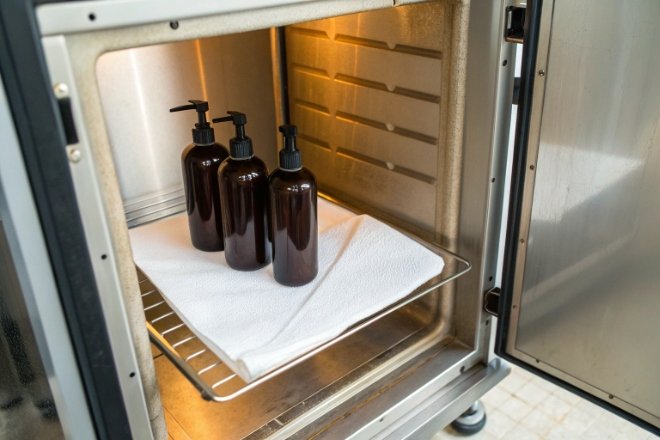
Validate pump-to-bottle matching by combining hot/cold thermal cycling with leak testing at heat and after cool-down, plus time-based torque and removal torque audits. Include vacuum or pressure testing if the product creates those loads, and sample across cavities and worst-case finish geometry.
A practical validation plan that catches real failures
1) Build a worst-case sample set
- multiple cavities
- bottles with worst-case ovality within spec
- bottles from start and end of production run
- pumps from multiple lots
2) Run thermal cycles that reflect reality
Choose cycles based on your distribution and use case:
- cold start (for winter shipping)
- warm/hot soak (for summer pallets)
- repeated cycles (for fatigue behavior)
- include humidity/condensation if that is expected
3) Torque and removal torque audits (time-based)
Measure:
- application torque at capping
- immediate back-off torque
- back-off torque after hot soak
- back-off torque after cool-down
- removal torque after 24–72 hours
Also record any visual back-off marks or pump tilt.
A standardized reference for trending these measurements is ASTM D2063 torque retention 9 (adapt the time points to your thermal profile).
4) Leak tests at the right time points
- leak test while warm (gasket soft, clamp load low)
- leak test after cool-down (vacuum stage if applicable)
- dye ingress for micro-channels
- bubble test for quick screen where appropriate
- vacuum/pressure decay tests if the product system requires it
For sensitive, quantitative detection of micro-leaks, many plants align with the ASTM F2338 vacuum decay method 10.
5) Functional pump checks
- prime and spray function after cycling
- check for drips at nozzle and collar
- check dip-tube fit and seal
| Validation step | What it proves | Best timing | Pass signal |
|---|---|---|---|
| Thermal cycling | interface stability under mismatch | qualification | no loosening or leaks |
| Torque audit (multi-time) | load retention | routine + changes | torque stays within band |
| Removal torque after aging | consumer usability + retention | qualification | within range, no back-off |
| Leak tests (warm/cold) | seal integrity across cycle | per lot sampling | no decay, no dye ingress |
| Vacuum/pressure test | load tolerance | as required by product | stable retention |
| Stress/finish inspection | prevents one-side leaks | every shift (subset) | geometry and stress within limits |
The most important rule
Testing must be done after the pump has seen temperature and time. Many systems pass at T0 and fail at T+24 hours. That is where most real-world complaints live.
Conclusion
Thermal expansion affects pump fit because plastic and gaskets move and relax more than glass. Tight finish control, heat-stable gaskets, and hot/cold cycling with leak and torque audits prevent leakage and loosening before shipment.
Footnotes
-
Explains neck-finish sealing features and why land geometry drives gasket contact integrity. ↩ ↩
-
ISO method for measuring compression set at elevated temperature—critical for predicting gasket force loss. ↩ ↩
-
Reference properties for soda–lime glass, including typical thermal expansion used in finish movement estimates. ↩ ↩
-
Plain-language definition of compression set and why time/temperature drive permanent deformation in elastomers. ↩ ↩
-
Hot-fill-hold temperature/time profile reference to align pump validation with real thermal exposure. ↩ ↩
-
Example of seal-focused TPE compounds designed for improved compression set performance under heat. ↩ ↩
-
Quick reference explaining common neck finishes (including 28-410) and how finish series affects closure fit. ↩ ↩
-
Practical guide to measuring openings/finishes so ovality and seating issues can be tied to leak results. ↩ ↩
-
ASTM standard describing how to measure torque retention in continuous-thread closure systems over time. ↩ ↩
-
ASTM standard for nondestructive vacuum decay leak detection, useful for finding temperature-driven micro-leaks. ↩ ↩






