
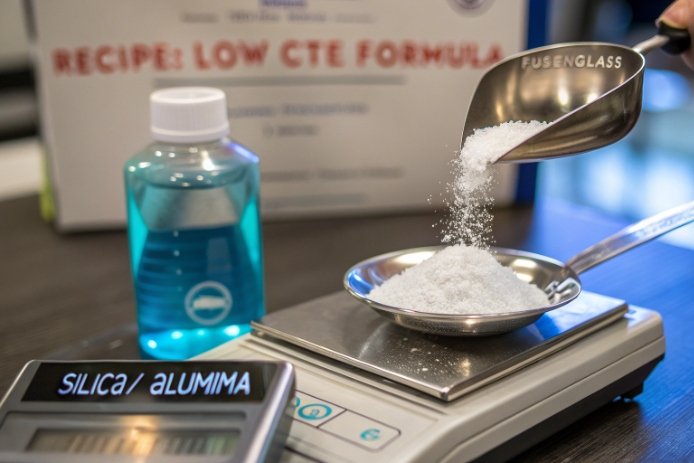
Thermal cracks can wipe out a launch. The bottle looks perfect, then hot-fill or pasteurization turns it into returns and rework.
Reduce thermal expansion by tightening the glass network: lower total alkali, raise SiO₂ and Al₂O₃, and use B₂O₃ only when the process needs it and the furnace can handle it.
A low-CTE recipe strategy that still runs on a container line
Lowering CTE is not a single-oxide trick. It is a balance between network strength 1, meltability, and forming stability. The best approach starts with the customer’s thermal profile. A mild hot-fill only needs a small CTE improvement plus better thickness control. A harsh sterilization cycle may require a different glass family. That decision matters because soda-lime container 2 furnaces are optimized for a narrow viscosity window 3, stable fining, and long campaign life. A recipe that lowers CTE but drives viscosity too high will cause cords, seeds, and weight variation. That is not a win.
A workable plan uses a “ladder” strategy. First, reduce the biggest CTE driver in soda-lime systems: total alkali. Next, add structure with Al₂O₃ and SiO₂, but keep liquidus 4 and devit risk under control in the forehearth. Only after those steps should B₂O₃ be considered, because boron changes volatility, refractory attack, and batch cost. The goal is to reduce CTE without forcing a large temperature increase or a major throughput loss.
Start from the process, then set a target CTE band
A bottle does not crack because CTE is “high.” It cracks because thermal stress 5 rises faster than the glass strength and annealing quality can tolerate. The best starting point is a target band such as “CTE reduced by 5–10% versus current glass over 20–300°C,” then confirm if that reduction meaningfully lowers failures in your real cycle.
Keep the system stable: composition, cullet, and redox
A low-CTE recipe becomes fragile if cullet chemistry drifts or redox swings. A stable recipe needs stable inputs. That means cullet blending rules, raw material impurity control, and a simple composition control chart.
| Step | Recipe lever | What it does to CTE | What it can break if pushed |
|---|---|---|---|
| 1 | Reduce total alkali (Na₂O+K₂O) | lowers CTE strongly | higher melting temp, higher viscosity |
| 2 | Increase SiO₂ and/or Al₂O₃ | lowers CTE and stabilizes | melting difficulty, cords if unmelted |
| 3 | Tune CaO/MgO window | protects liquidus and devit | forehearth stones if TL rises |
| 4 | Consider B₂O₃ (only if needed) | lowers CTE a lot | volatility, corrosion, cost |
| 5 | Lock cullet and raw material specs | keeps CTE consistent | supply flexibility decreases |
If the target and the “do-not-break” limits are defined early, the whole project becomes faster. The next sections go deeper into the exact composition moves, the trade-offs, how to hold consistency with cullet, and how to validate the formula before mass production.
Which composition changes most effectively lower CTE in bottle glass (e.g., increasing SiO2, adding B2O3/Al2O3, reducing alkalis)?
A recipe change that looks small can still shift thermal behavior. Without a clear plan, the team may chase CTE and create new defects.
The most effective CTE reducers in bottle glass are lowering total alkali and increasing network formers and intermediates like SiO₂ and Al₂O₃. B₂O₃ lowers CTE strongly, but it behaves like a glass-family change, not a small tuning move.
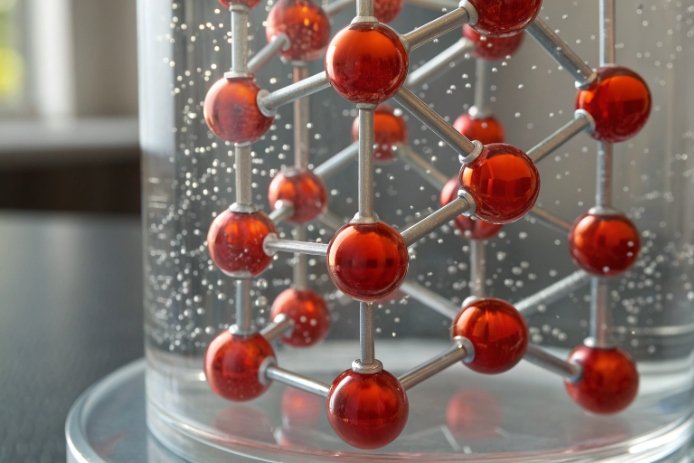
Reduce alkalis first because they drive expansion
Alkalis (Na₂O, K₂O) loosen the network. That improves meltability and lowers viscosity at a given temperature, which is why soda-lime melts easily. The same network loosening usually increases CTE. So reducing alkalis is often the most direct way to reduce CTE. The limitation is practical: the furnace must still melt and fine the batch at target pull.
A stable move is to reduce total alkali slightly, then compensate with a controlled increase in SiO₂ and Al₂O₃, while monitoring viscosity and liquidus. It is safer to avoid big single-step drops in alkali. A small drop can already change gob temperature needs and shear behavior.
Increase SiO₂ and Al₂O₃ to tighten the network
SiO₂ is the backbone of container glass. Higher SiO₂ generally strengthens the network and can reduce expansion. The risk is that higher SiO₂ demands more melting energy 6 and better batch mixing. If sand does not dissolve cleanly, cords and stones can rise.
Al₂O₃ is a strong stabilizer. It often reduces CTE and improves durability. It also raises viscosity, so the forehearth setpoints may need adjustment. In my experience, Al₂O₃ is a “quality first” lever when the plant has good melting capacity and strong mixing.
Use B₂O₃ only when the process truly needs lower CTE
B₂O₃ is the key reason borosilicate glasses 7 have low expansion. It can reduce CTE dramatically. It can also raise volatility and change refractory corrosion 8 behavior. In a standard container furnace, boron can be a campaign-life issue if the furnace was not designed for it. So B₂O₃ is best treated as a special project, not a casual batch tweak.
| Composition change | CTE impact (direction) | Why it works | Primary operational constraint |
|---|---|---|---|
| Na₂O/K₂O ↓ | strong decrease | tighter network | higher melting temperature |
| SiO₂ ↑ | moderate decrease | stronger network former | slower melting, cords risk |
| Al₂O₃ ↑ | moderate decrease | tighter structure, higher Tg | higher viscosity, melt load |
| B₂O₃ ↑ | strong decrease | borate network reduces expansion | volatility, furnace compatibility |
| CaO/MgO tuning | small to moderate | changes structure and stability | liquidus and devit window |
A strong recipe plan picks two “main levers” and one “safety lever.” For soda-lime bottles, the main levers are usually lower alkali and higher Al₂O₃/SiO₂, while the safety lever is a CaO/MgO window that protects liquidus and forming.
What are the trade-offs between lower CTE and melting temperature, viscosity, forming stability, and production cost?
Lower CTE sounds like a pure upgrade, but the furnace and IS machine will charge a price if the melt becomes too stiff or too slow to refine.
Lower CTE often means a tighter network, which raises melting temperature, increases viscosity, and can narrow the forming window. Costs can rise through higher energy use, lower pull, more refractory wear, or higher raw material cost, especially if B₂O₃ is added.
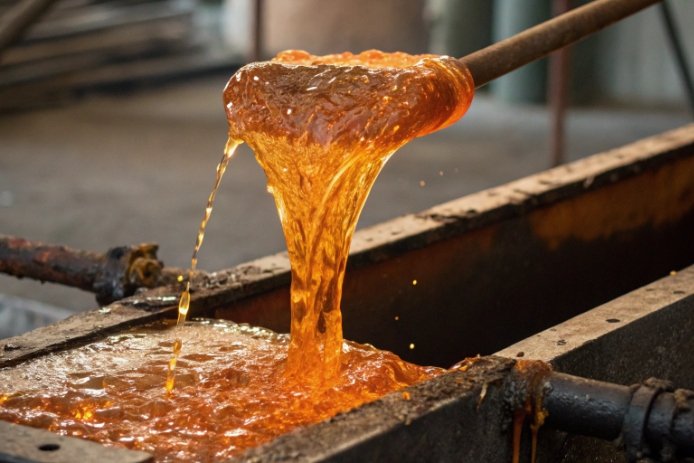
Melting and refining: higher network strength needs more heat and time
When alkalis drop and SiO₂/Al₂O₃ rise, the batch needs more energy to reach full dissolution. The melt can become more viscous in the refining zone, which slows bubble rise. If the plant keeps the same furnace temperature, seeds can increase. If the plant raises temperature to maintain fining, fuel cost and volatility can increase. This is why a low-CTE recipe must be paired with melting and fining adjustments, not only with a batch sheet.
Forehearth and forming: the viscosity window becomes tighter
Bottle forming needs a stable viscosity at gob temperature. A stiffer glass can improve shape stability in some designs, but it can also cause:
-
poor gob cutting and tailing
-
higher shear marks
-
more weight variation if temperature control is not tight
-
higher risk of cords if mixing is not strong
If the plant compensates by running hotter, the CTE benefit remains, but thermal gradients in hot-fill can rise because the bottle leaves the forming line with a different thermal history. So it is better to stabilize viscosity by recipe tuning plus tighter forehearth zoning, not only by heating.
Lower CTE can increase total cost through:
-
more energy per ton
-
lower pull rate or higher reject
-
increased maintenance due to corrosion or deposits
-
higher QA cost due to tighter control
B₂O₃ can add direct raw material cost and indirect cost through volatility and corrosion. Al₂O₃ and higher SiO₂ can add cost through melting load, but they can also improve durability and reduce complaints in some markets.
| Goal | Recipe move | Benefit | Trade-off to plan for |
|---|---|---|---|
| Lower CTE | alkali ↓ | largest CTE reduction per % | higher melting temp and viscosity |
| Improve durability + lower CTE | Al₂O₃ ↑ | better chemical resistance | tighter forming window |
| Lower CTE without big alkali drop | SiO₂ ↑ | stable chemistry | slow melt, more cords risk |
| Maximum thermal shock margin | B₂O₃ ↑ | very low CTE possible | cost, volatility, furnace fit |
The best way to manage trade-offs is to decide early which constraint is non-negotiable. If the line cannot run hotter, then alkali reduction must be modest and mixing must improve. If the customer needs sterilization, then a borosilicate route may be cheaper than endless process band-aids.
How can you optimize cullet ratio and raw material selection to keep low-CTE glass consistent batch to batch?
A low-CTE recipe can fail not because the idea is wrong, but because the cullet stream keeps pulling the chemistry back toward the old glass.
Keep low-CTE glass consistent by locking cullet sources, blending by lot, and controlling raw material impurities that change alkali and Al₂O₃ behavior. The highest stability comes from closed-loop internal cullet, plus strict acceptance specs for any external cullet.
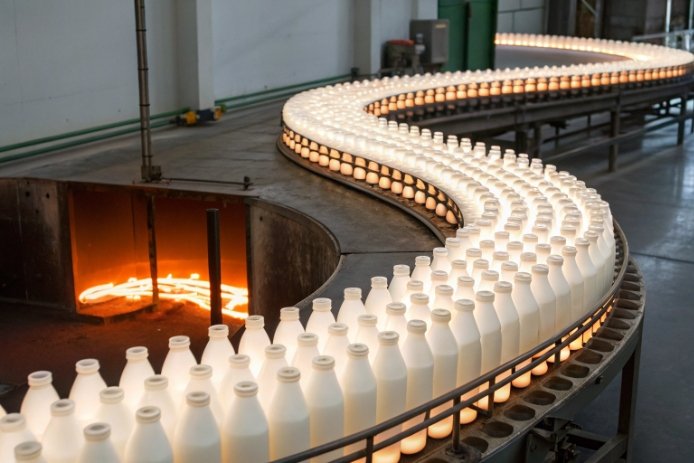
Treat cullet as a controlled ingredient, not a recycled bonus
Cullet 9 is the biggest “hidden recipe.” If external cullet is not the same chemistry as the target low-CTE glass, the furnace becomes a mixing tank between two recipes. That creates drift. The cleanest path is to ramp low-CTE production with the highest share of internal cullet, because it is chemically matched.
If external cullet must be used, it needs a chemistry profile that supports your target. For example, if the low-CTE recipe reduces Na₂O, then external cullet with higher alkali will fight the target. In that case, blending rules and correction models are needed.
Use blending to smooth daily variation
The most effective stability tool is blending. A simple method is:
-
define two cullet grades (primary, secondary)
-
blend to a fixed ratio per day
-
only change the blend when control charts show drift
-
keep retention samples and lot IDs for traceability
This approach prevents operators from chasing “one bad load” with furnace settings.
Choose raw materials to reduce drift and melt defects
Low-CTE recipes often use higher SiO₂ and Al₂O₃, so raw material quality becomes more important:
-
stable sand grain size and low refractory-like contaminants
-
alumina sources with low iron and stable chemistry
-
limestone/dolomite with stable MgO/CaO ratio
-
low-sulfur inputs if sulfur stability is a known risk
Small impurity swings can also change redox and fining behavior, which can change the thermal history of the bottle and influence cracking risk.
| Input | What must be stable | Why it matters for low CTE | Practical control |
|---|---|---|---|
| Internal cullet | same recipe, low contamination | keeps chemistry locked | closed-loop handling |
| External cullet | alkali, Al₂O₃, Fe, SO₃ | prevents recipe drift | incoming XRF + blend rules |
| Sand | grain size, Al/Fe trace | avoids cords and stones | supplier control + sieving |
| Alumina source | chemistry and meltability | supports Al₂O₃ target | CoA + melt trial |
| Carbonates | CaO/MgO consistency | protects liquidus window | lot tracking |
A stable low-CTE program usually sets a “composition correction limit.” If batch corrections exceed that limit too often, the cullet stream is not compatible. That is the moment to change cullet sourcing, not to push more corrective batch.
What lab tests and pilot runs should you use to validate a low-CTE formula before mass production?
A low-CTE recipe is easy to prove in a lab beaker. The real risk is whether it melts clean, fines well, and forms stable gobs at production speed.
Validate low-CTE glass with a staged plan: lab dilatometry for CTE, viscosity and liquidus screening, devit and fining checks, then pilot furnace trials with real forming, annealing, and thermal cycling tests that match customer processes.
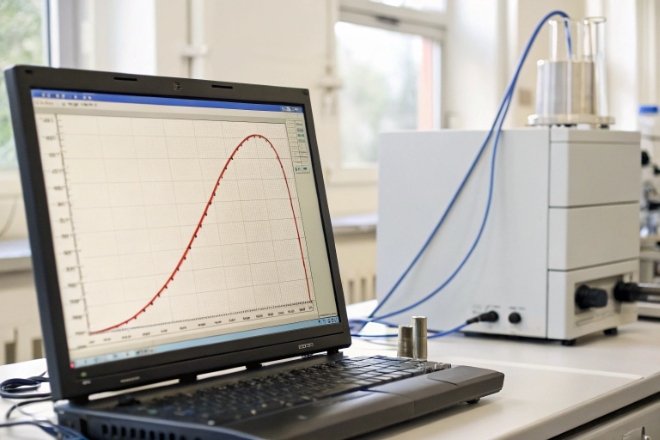
Lab phase: confirm the target CTE and the melt window
The lab should measure mean linear CTE over a defined range using a recognized dilatometry 10 method. The key is to use the same range that will be used later for comparison, such as 20–300°C, plus an application range if needed.
At the same time, the lab must screen:
-
viscosity curve points near working and refining temperatures
-
liquidus temperature and devitrification tendency
-
fining response and bubble removal behavior
-
chemical durability if the market demands it
A low-CTE recipe that increases liquidus too much can look fine in CTE testing and then create forehearth stones. That is why liquidus and devit hold tests are mandatory.
Pilot phase: run the glass like a bottle plant runs glass
A pilot run should include:
-
stable pull and realistic residence time
-
real forehearth conditioning targets
-
standard gob and shear settings
-
molding trials on target bottle designs
-
annealing settings that match production intent
During pilot, the team should collect cavity-level data because thickness variation and residual stress can hide recipe problems. A low-CTE bottle can still fail thermal cycling if thickness is uneven or if annealing is off.
Qualification tests: tie the glass to the customer’s thermal cycle
The final proof must simulate the real process:
-
hot-fill thermal shock tests with worst-case stop/start
-
pasteurization or sterilization cycle replication
-
stress inspection (polariscope) before and after cycles
-
crack origin mapping to link failures to geometry
| Validation gate | What you test | Pass criteria example | Why it matters |
|---|---|---|---|
| Lab CTE | dilatometry (fixed range) | meets target band | confirms the main goal |
| Melt behavior | viscosity + fining | stable seeds and flow | avoids forming instability |
| Devit risk | liquidus + devit hold | no crystals in window | prevents stones |
| Forming trial | gob stability + weight | stable Cp/Cpk | proves production fit |
| Thermal process | hot-fill/retort cycling | no cracks at worst case | proves customer success |
A project moves fastest when the team refuses to “skip gates.” When CTE improves but devit or fining weakens, the recipe is not ready. A disciplined test ladder finds that early, before the furnace campaign is disturbed.
Conclusion
Lower CTE comes from lower alkali and a stronger network, but it must be balanced with melting and forming reality. Validate in lab, then prove it in pilot under real thermal cycles.
-
How atomic structure influences the physical properties of glass. ↩
-
Composition and properties of the most common packaging glass. ↩
-
The critical temperature range for forming and working glass. ↩
-
The temperature limit below which glass may crystallize. ↩
-
Internal forces caused by temperature differences in the material. ↩
-
Heat requirements for dissolving silica and homogenizing the batch. ↩
-
Glass type known for low thermal expansion and high durability. ↩
-
Wear of furnace lining materials caused by aggressive melts. ↩
-
Recycled glass used to lower melting energy and raw material costs. ↩
-
Method for measuring dimensional changes vs temperature. ↩






