

High cullet sounds easy until the furnace foams, cords show up, and stones ruin the run. Then the “green win” turns into scrap and downtime.
Glass composition sets viscosity, liquidus margin, and redox behavior during remelt, so it decides how much cullet a furnace can absorb without foaming, cords, stones, or color drift.
Glass recycling 1 is not only “melt it again.” Cullet enters the furnace as pre-made glass with its own chemistry history, surface contamination, and redox state. That history changes what happens in the hottest zones and in the refining zone. Virgin batch releases CO₂ from carbonates and gases from fining agents in a more predictable way. Cullet melts faster, but it can also bring water, organics, salts, and ceramics. Those inputs shift foaming, bubble removal, and cord formation.
Viscosity and homogeneity decide whether cords appear
Cords are often a mixing problem, but chemistry sets how hard it is to mix. If the viscosity curve 2 is too high for the pull rate, the melt resists blending and cords persist. If viscosity is too low, the melt moves easily, but it can also carry more convection streaks and pull in batch blanket effects. A balanced viscosity curve makes the melt “forgiving,” so small cullet swings do not turn into visible striae.
Liquidus margin decides stone risk at high cullet
Stones are not always “dirt.” Many stones are devitrification products. When the liquidus temperature 3 is too close to the working range, crystals can grow in cooler pockets or in the forehearth. High cullet ratios can shift that risk because cullet changes local chemistry and temperature patterns. A recipe with a safe liquidus margin tolerates more cullet without devit events.
Gas generation decides whether foam becomes chronic
Cullet reduces carbonate decomposition gas, which is good for energy and CO₂. Still, cullet can increase foam risk if it brings organics, moisture, or sulfate/chloride residues. Foam is a heat-transfer killer. It makes operators fire harder, which can raise NOₓ and create more volatility problems. The best remelt recipes and fining 4 plans aim for “calm refining,” not aggressive gas release.
Redox memory decides color stability
Cullet carries colorants and redox history. That is why remelt color control is not only “add decolorizer.” Iron redox, selenium-sulfur balance, and chromium behavior can drift when cullet quality swings. A stable base glass with a defined redox window reduces daily corrections.
| Remelt symptom | What it usually means | Composition lever that helps | Process lever that helps |
|---|---|---|---|
| Foam on melt surface | Unstable gas release | Control SO₃ behavior, keep alkali stable | Cullet drying, tighter redox |
| Cords/striae | Poor mixing vs viscosity | Balance (SiO₂+Al₂O₃) vs alkali | Stirring, temperature uniformity |
| Stones/crystals | Liquidus too close | Balance CaO/MgO, protect liquidus margin | Forehearth control, avoid cold spots |
| Color drift | Redox instability | Define Fe redox window, stable colorant inputs | Cullet sorting, combustion control |
If the goal is high cullet without drama, the recipe should be designed as a “buffer.” It must absorb cullet swings and still hold viscosity, liquidus margin, and redox behavior inside a narrow band.
A clean remelt strategy also reduces emissions and scrap at the same time, because stable melting needs fewer emergency setpoint changes.
Which oxide balance (SiO₂–Na₂O–CaO–MgO–Al₂O₃) enables high-cullet ratios without foaming, cords, or stones?
High-cullet runs fail when the melt window becomes too narrow. The furnace then needs perfect control every hour, which is not realistic in real production.
The best oxide balance for high cullet is a soda-lime network that keeps a safe liquidus margin and a forgiving viscosity curve: stable alkali, an Al₂O₃ durability baseline, and a CaO/MgO split that avoids devitrification in cooler zones.

Shape the viscosity curve for blending, not only for forming
With high cullet, chemistry swings are more common. A recipe that sits on a steep part of the viscosity curve will amplify small temperature drift into large viscosity changes. That raises cord risk because mixing becomes uneven. In practice, a slightly stronger network (a bit more SiO₂ and a controlled Al₂O₃ level) helps keep viscosity behavior stable. Still, alkali must remain sufficient for melt rate and refining. If alkali is cut too hard, energy rises and refining weakens, which increases cords and seeds.
Protect liquidus margin with CaO/MgO balance
Many “stone spikes” in recycled runs are devit events, not only raw contamination. A CaO/MgO balance that is stable and proven for the furnace design helps keep the liquidus below critical zones. Too much MgO in the wrong base system can raise devitrification 5 risk. Too much CaO can raise expansion and change durability behavior. The goal is not a single best number. The goal is a stable, plant-proven balance that keeps crystals away from the forehearth and finish zones.
Keep Al₂O₃ as a stability baseline, not a luxury
Aluminium oxide 6 (Al₂O₃) in the practical container range supports durability and reduces alkali mobility. That matters for remelt because it reduces surface reactivity and keeps the glass less sensitive to moisture-driven alkalinity. It can also help cord control by making chemistry swings less dramatic. The guardrail is liquidus margin and melting cost, so Al₂O₃ must be increased only with liquidus monitoring and defect tracking.
Separate “foam control” from “oxide control”
Foam is often blamed on oxides, but the first driver is usually cullet quality (organics, salts, moisture). Still, stable alkali and stable sulfate behavior reduce the chance that small contamination becomes a foam event.
| Oxide direction | What improves at high cullet | What can get worse | What to monitor |
|---|---|---|---|
| SiO₂ slightly ↑ | Lower CTE drift, more stable melt | Higher melt energy | Pull stability, cord bands |
| Total alkali stable (not drifting) | Stable viscosity and redox behavior | Too low harms refining | Seeds, foaming trend |
| Al₂O₃ baseline (often ~1–2%+) | Better durability, less leaching drift | Liquidus can rise | Stones/devit count |
| MgO/CaO balanced | Safer liquidus margin | Wrong split raises devit | Forehearth defects |
A high-cullet recipe is not “strongest glass.” It is “most stable glass.” When oxide windows are tight and proven, high cullet becomes a repeatable operating mode instead of a special campaign.
How do colorants and redox (Fe²⁺/Fe³⁺, Cr₂O₃, Se–S, CoO) influence color stability and batch corrections during remelt?
Color control gets harder as cullet rises, because cullet carries both pigments and redox history. That can force daily corrections and increase scrap.
Colorants and redox interact during remelt: iron state shifts green/yellow tone, Se–S amber needs a stable redox window, Cr₂O₃ is strong but can magnify sorting errors, and CoO is powerful enough that tiny drift becomes visible.
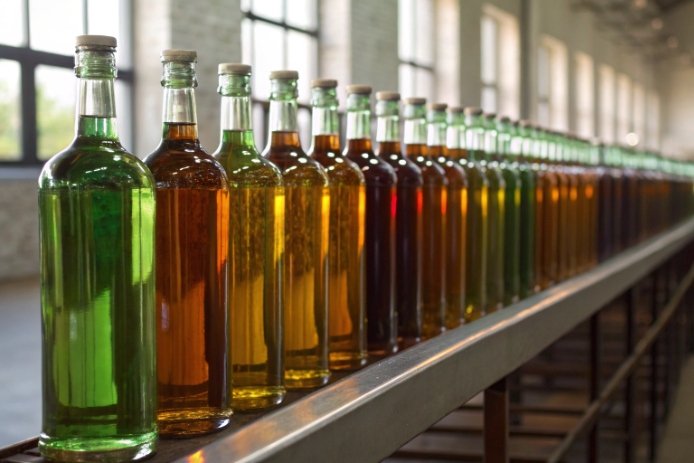
Iron redox sets the “baseline tint” and shifts with furnace conditions
Iron is always present in most glass systems. The Fe²⁺/Fe³⁺ balance changes how green or yellow the glass looks. In high-cullet remelt, that balance can swing with cullet organics and combustion changes. Even when total iron stays similar, the oxidation state can drift. That is why a stable redox 7 KPI and stable cullet cleanliness matter more than adding more decolorizer.
Se–S amber is not only a recipe, it is a redox-controlled system
Amber made with selenium and sulfur depends on controlled redox and sulfate behavior. If the furnace goes too oxidizing, amber can wash out. If it goes too reducing, side reactions increase and deposits or foam risk can rise. High cullet makes this harder because cullet can introduce both organics and variable sulfate content. The best approach is to treat amber production as a “tight window” campaign: stable cullet stream, stable fuel/air, and stable sulfate inputs.
Chromium green magnifies cullet sorting errors
Chromium(III) oxide 8 (Cr₂O₃) is a strong colorant. Small amounts can shift hue. That is good for efficiency, but it also means that mixed-color cullet mistakes become visible quickly. If flint cullet and green cullet mix in the wrong ratio, corrections become expensive and slow. The best fix is upstream: cullet segregation and optical sorting 9.
Cobalt blue is a “ppm-level” problem
Cobalt(II) oxide 10 (CoO) is extremely strong. In remelt, even tiny contamination can tint flint. That is why cobalt control is mostly a cullet and contamination control issue, not a batch correction issue.
| Color system | Main redox sensitivity | What drives drift at high cullet | Best correction strategy |
|---|---|---|---|
| Flint (decolorized) | Medium | Mixed cullet colors, Fe redox swings | Tight cullet sorting + redox stability |
| Green (Fe/Cr) | Low–Medium | Wrong cullet mix, Cr contamination | Segregate streams, minimize corrections |
| Amber (Se–S) | High | Organics + sulfate/redox drift | Lock redox window, stable sulfate inputs |
| Blue (Co) | Low | Trace contamination | Prevent at source, strict screening |
In real operation, it helps to treat redox stability as the “first correction.” When redox is stable, color corrections become smaller and more predictable. When redox is unstable, adding more colorants often creates a chase that never ends.
What impurity limits (ceramics, Ni/Cr, Pb/Cd, TiO₂/ZrO₂) are critical to maintain furnace health and product quality with recycled cullet?
High cullet is only as good as cullet cleanliness. Impurities create the defects that customers remember: stones, pinholes, and delayed breakage.
Ceramics and refractory chips drive stones and wear; Ni/Cr stainless fragments drive inclusions and can trigger rare high-impact failures; Pb/Cd are compliance and contamination risks; TiO₂/ZrO₂ matter most when they arrive as particles or drift enough to change haze and devit behavior.
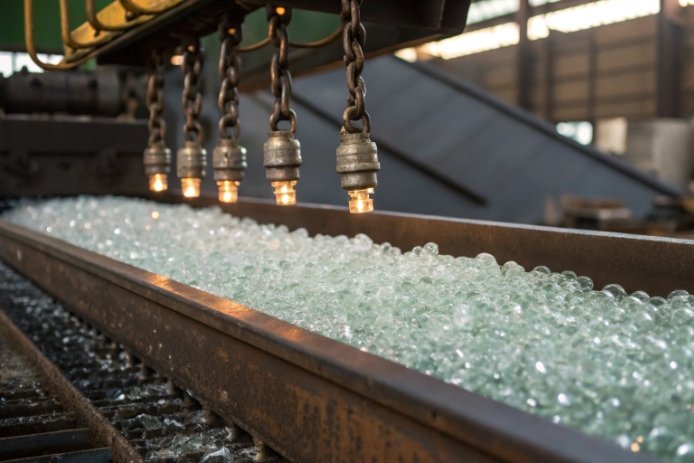
Ceramics are the #1 stone driver in many plants
Ceramic contamination does not melt like glass. It becomes stones or partially dissolved “hard islands.” Those defects can survive into the bottle and become crack starters. Ceramics also damage refractories and can raise furnace maintenance cost. Tight ceramic control is non-negotiable when cullet rises.
Ni/Cr stainless fragments are small, expensive, and dangerous
Stainless steel fragments can survive long enough to form hard inclusions. They can also carry nickel, which is a concern in inclusion-driven failure discussions. Even when failures are rare, the risk is high-impact because it can create delayed breakage or customer safety events. Magnetic separation helps, but stainless needs eddy current and strong screening discipline.
Pb/Cd are mostly compliance and brand-risk items
Lead and cadmium are not typical in modern container glass recipes, but they can enter through wrong cullet streams, decorated scrap, or external contaminants. The cost of one contamination event is huge. A strong program blocks these sources with incoming cullet audits and strict supplier rules.
TiO₂/ZrO₂ are “fine” until they arrive as particles
Stable dissolved traces usually do not hurt. The problem is particles from ceramics, refractories, or contaminated cullet. Those particles become stones or haze points. ZrO₂ particles on their own are often linked to refractory wear. TiO₂ drift can shift whiteness and scatter, which can show as dullness in flint and as opacity variation in decorated products.
| Impurity | Typical source | Main risk | Best screening/control |
|---|---|---|---|
| Ceramics/refractories | MRF contamination, furnace wear | Stones, pinholes, wear | Optical sorting + audits + stone count KPI |
| Ni/Cr stainless | Tools, scrap metal, conveyors | Hard inclusions, rare delayed breaks | Magnet + eddy current + strict cullet spec |
| Pb/Cd | Wrong cullet streams, decorated scrap | Compliance failure | Supplier qualification + periodic lab audits |
| TiO₂/ZrO₂ particles | Refractory chips, contaminated cullet | Stones, haze, devit shifts | Source tracing + refractory management |
A useful habit is to connect impurity screening to one visible quality metric: stones per ton, cords per shift, and customer complaint rate by defect type. When those trends move, cullet screening should be the first place to look.
Does the base recipe change energy use and emissions (SOₓ/NOₓ, CO₂) when raising cullet %, and how should fining chemistry be adjusted?
Cullet usually lowers energy and CO₂, but only if the melt stays calm. If foaming and defects rise, the furnace runs hotter, and emissions can rise again.
Raising cullet reduces carbonate decomposition and often lowers energy demand, but it can shift redox, sulfate behavior, and foaming; fining chemistry should be adjusted to keep bubble removal effective without creating foam, deposits, or unstable SOₓ behavior.

Why cullet can cut energy and CO₂
Virgin batch contains carbonates that release CO₂ during melting. Cullet is already glass, so it avoids that decomposition step. Cullet also melts faster, which can support lower firing for the same pull rate. That is the clean, simple win.
Why emissions can rise if quality becomes unstable
When cullet is wet or contaminated, foaming can increase. Foam blocks heat transfer, so operators fire harder. Higher firing can increase NOₓ formation. Redox swings can also change how sulfur behaves, which can influence SOₓ release and deposit behavior. So the goal is not only “more cullet.” The goal is “more cullet with stable combustion and refining.”
How fining should evolve with higher cullet
With higher cullet, batch gas evolution changes. That can shift the timing of bubble release and removal. A fining plan that was perfect at low cullet may become too aggressive or too weak at high cullet.
-
If sulfate fining is too aggressive, foam risk can rise and deposits can increase.
-
If sulfate fining is too weak, seed count rises and cords become visible because refining is incomplete.
-
Variable-valence fining choices can support oxygen release and bubble removal, but they also interact with redox and color stability.
The best approach is stepwise: increase cullet, then adjust fining to keep seed count low while keeping foam under control. This is also where cullet moisture control pays back fast.
| Change when cullet % rises | What often improves | What can worsen | Practical adjustment |
|---|---|---|---|
| Less carbonate gas | Lower CO₂ from batch | Refining timing shifts | Re-tune fining window and residence time |
| Faster melting | Lower fuel per ton | Higher pull can reduce refining time | Protect refining zone temperature stability |
| More redox variability | None by itself | Color drift, sulfate drift | Tighten cullet organics and combustion control |
| Higher foam sensitivity | None by itself | Higher firing → higher NOₓ | Dry cullet, control SO₃ behavior |
A stable base recipe supports this by keeping viscosity behavior predictable and by keeping redox response smooth. When the base glass is too sensitive, every cullet change becomes an emissions and quality risk. When the base glass is buffered by a stable oxide window, cullet can rise with fewer surprises.
Conclusion
High-cullet success depends on a stable oxide window, clean and sorted cullet, steady redox and fining behavior, and impurity controls that stop stones and color drift before they reach the furnace.
Footnotes
-
Glass recycling reduces waste and saves energy in manufacturing. ↩
-
Glass viscosity determines how glass flows and forms. ↩
-
Liquidus temperature is the limit where crystals start to form in the melt. ↩
-
Devitrification is the crystallization of glass, causing defects. ↩
-
Aluminium oxide improves glass durability and chemical resistance. ↩
-
Chromium(III) oxide is used to give glass a green color. ↩
-
Optical sorting removes contaminants from cullet before melting. ↩
-
Cobalt(II) oxide is a powerful blue colorant for glass. ↩






