
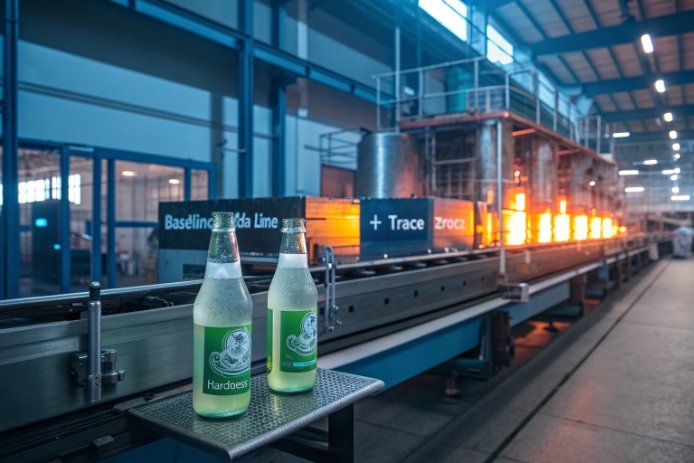
Breakage looks like a handling problem until it keeps happening in the same weak zones. Then the line slows, rejects rise, and customers lose trust.
Zirconia (ZrO₂) can improve bottle strength, but only in a narrow range where it boosts hardness and stiffness without creating stones, cords, or devit that erase the gains.
Zirconia improves “intrinsic” strength faster than it improves “real-world” strength
ZrO₂ can make the glass network stiffer. That can raise hardness and elastic modulus 1, which helps scratch resistance and slows crack growth. Still, bottle failures are rarely controlled by intrinsic properties alone. Most failures are controlled by surface flaws, inclusions, cords near the wall, and residual stress at the heel and finish. So ZrO₂ becomes effective only when the melt stays clean and the surface stays smooth.
The key idea is simple: a bottle with slightly higher modulus but more stones will break sooner. A bottle with the same modulus but fewer cords will often survive longer. That is why ZrO₂ trials must be judged with defect metrics and Weibull scatter, not with one “average strength” number.
Intrinsic strength vs distribution strength
Intrinsic properties change with composition. Real-world strength changes with the flaw population. ZrO₂ can help both, but it can also harm the flaw population if it does not dissolve.
Why the return on ZrO₂ flattens quickly
At low additions, ZrO₂ can tighten the network. Past a point, the plant spends more energy dissolving it and controlling liquidus behavior. That is where stones and cords rise. This is why many bottle furnaces see the best results in a small mid-range, not at the highest ZrO₂ level that looks good on paper.
| What ZrO₂ changes | What improves strength | What can cancel the gain |
|---|---|---|
| Elastic modulus and hardness | less scratching, slower crack growth | undissolved Zr-bearing stones |
| Viscosity curve | more stable forming in some cases | higher viscosity and poorer fining if overdone |
| Liquidus behavior | sometimes neutral in small doses | devit skins in cold zones |
| Melt homogeneity | can improve if it reduces defects | cords if mixing and fining are unstable |
The next sections answer the practical questions that decide whether ZrO₂ is worth scaling.
A good ZrO₂ program is not “add zirconia.” It is “pick a safe loading, prove the mechanism, manage the risks, then verify the gain with real bottle tests.”
What ZrO₂ loading measurably increases impact and burst strength without hurting formability?
A strength additive that slows the line is not a strength additive. It becomes a cost increase that also raises rejects.
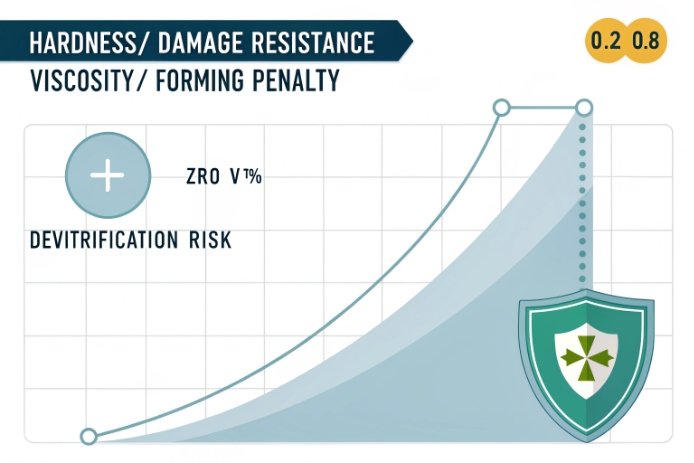
In most soda-lime container lines, ~0.2–0.6 wt% ZrO₂ is the most practical window for measurable strength gains, while ~0.6–1.0 wt% only works when melting, mixing, and refining are strong enough to prevent stones and cords.
Why 0.2–0.6 wt% is often the “safe gain” band
At ~0.2–0.4 wt%, many plants can fully dissolve Zr-bearing inputs without changing the furnace too much. Hardness can rise enough to reduce scuffing and handling damage. That often shows up as better drop performance in distribution tests, not only in lab MOR coupons.
At ~0.4–0.6 wt%, the property gain can continue, but the process risk starts to rise. Viscosity can drift upward, fining can become more sensitive, and any cold spot can turn into devit risk. This is still a workable band when forehearth control is strong and cullet is clean.
At ~0.6–1.0 wt%, the line must “earn” the right to use ZrO₂. That means:
- higher and more uniform melt temperature in key zones
- stronger mixing so Zr does not band in cords
- stricter raw material particle size control
- tighter stone monitoring and faster response rules
How to substitute, not just add
ZrO₂ should usually replace something in the network plan, not just increase total solids. A common practical approach is to treat ZrO₂ as a partial substitute for other intermediates (often within a durability/stiffness package) while keeping the base SiO₂–Na₂O–CaO–MgO window stable. The exact substitution depends on the plant’s viscosity and devit margins.
What “measurable” means in bottle terms
A real improvement means:
- higher median strength and lower scatter (better Weibull modulus 2)
- no rise in stone-related rejects
- no new cord-driven visual defects
- no loss of forming stability at the finish
| ZrO₂ (wt%) | Expected strength effect | Formability risk | Best “go/no-go” metric |
|---|---|---|---|
| 0.0–0.2 | small intrinsic gain | low | scratch/scuff trend + defect trend |
| 0.2–0.6 | most reliable gains | low to medium | burst + drop + Weibull scatter |
| 0.6–1.0 | possible extra gain | medium to high | stone rate and cord rate must stay flat |
| >1.0 | rarely worth it | high | cost per good bottle rises fast |
If the goal is better burst strength, the finish and shoulder quality still dominate. ZrO₂ helps only when it does not disrupt viscosity control that protects the finish geometry.
By what mechanisms does ZrO₂ raise hardness and elastic modulus compared with Al₂O₃ or ZnO?
It is easy to say “ZrO₂ strengthens the network.” It is more useful to explain how that shows up on a bottle line.
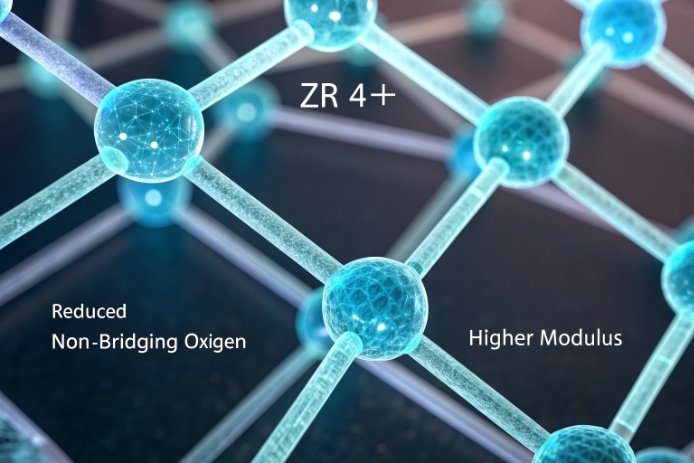
ZrO₂ raises hardness and elastic modulus mainly because Zr–O bonds are strong and Zr⁴⁺ has high field strength, which tightens the glass structure more per unit addition than many modifiers; Al₂O₃ improves durability and stiffness more gently, and ZnO mainly tunes modifier behavior and surface corrosion response.
ZrO₂: stiffening and crack-growth resistance
Zr⁴⁺ tends to create a tighter local structure. That can increase elastic modulus and microhardness 3. On a bottle, this matters because a harder surface resists micro-scratches that become crack starters. Also, a stiffer network can reduce how fast a crack grows once it starts, especially under short impact events.
The real advantage of ZrO₂ is “strength per small dose.” A small amount can move modulus and hardness more than the same amount of a typical modifier.
Al₂O₃: the safer workhorse
Al₂O₃ is an intermediate oxide that supports durability and often improves stiffness in a more forgiving way. It tends to widen the safe processing window compared with ZrO₂. Many container plants already operate with Al₂O₃ in the 1–2+ wt% range. Increasing Al₂O₃ modestly often improves chemical durability 4 and reduces surface hydration sensitivity. That can protect strength over shelf life.
ZnO: a niche tool, not a main stiffness lever
ZnO often behaves like a modifier with some intermediate character. It can improve chemical durability in some soda-lime systems and can influence surface corrosion patterns. It can also help some devit behaviors in specific compositions. Still, ZnO is less often used as the first choice for mechanical strength because it can cost more than alumina and the stiffness gain is usually smaller than ZrO₂ for the same dose.
| Additive | Main strength mechanism | Typical benefit in bottles | Main limitation |
|---|---|---|---|
| ZrO₂ | strong local stiffening, higher hardness | better scuff resistance, higher stiffness | stones if not dissolved, devit sensitivity |
| Al₂O₃ | network stabilization, durability improvement | more stable long-life strength | melting rate penalty if pushed too high |
| ZnO | modifier tuning, durability shift | helps specific corrosion/scuff cases | cost and smaller stiffness impact |
When the main problem is scratch-driven breakage in lightweight bottles, ZrO₂ can make sense. When the main problem is durability drift or broad process stability, Al₂O₃ is often the better first move.
What risks limit the usable ZrO₂ range?
ZrO₂ becomes “too much” long before it becomes “dangerous” in theory. The plant limits it in practice.
The usable ZrO₂ range is limited by devitrification in cold zones, stones from undissolved zircon or refractory spalls, and melt/refining sensitivity that increases cords and seeds if mixing and fining are not stable.
Devitrification and liquidus sensitivity
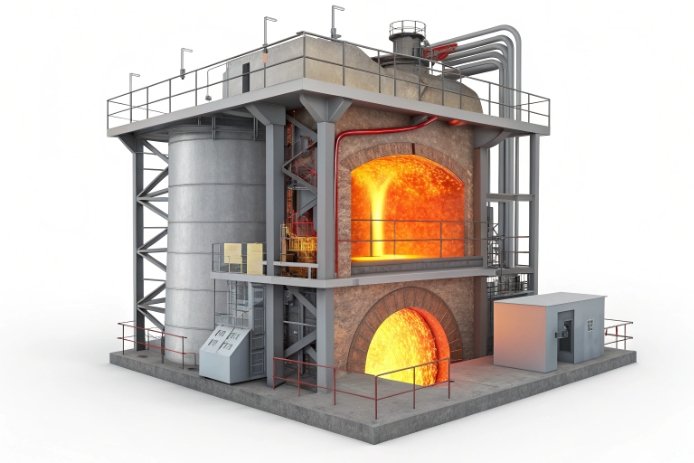
ZrO₂ can shift liquidus behavior and increase the chance of crystal growth on cooler surfaces. In container lines, the danger zones are forehearth corners, spouts, and feeder areas where residence time is high and temperatures are lower. Even if bulk glass stays clear, a thin devit skin on a wall can flake off and become a “stone event.”
This risk grows fast when ZrO₂ rises and when temperature uniformity is weak. That is why the same ZrO₂ level can work in one plant and fail in another.
Stones from zircon raw materials and zircon refractories
Many “zirconia stones” are not from dissolved ZrO₂ re-precipitating. They are from undissolved zircon grains or refractory wear. Sources include:
- coarse zircon-bearing batch components
- poor batch mixing that leaves local Zr-rich pockets
- zircon-containing refractory spalls entering the melt stream
Once a stone enters a bottle wall, impact strength drops sharply. A small stone can cancel the average modulus gain from ZrO₂ across many bottles.
Melt/refining issues that amplify cords
ZrO₂ additions can change viscosity and can change how fining reactions 5 behave. If fining is already close to its limit, small viscosity changes can trap more bubbles and raise seed count. Also, if Zr distribution is not uniform, cords can form. Cords near the surface behave like weak zones, especially in thick bases and heavy shoulders.
| Risk | What it looks like | Why it increases with ZrO₂ | Best control lever |
|---|---|---|---|
| Devit skins | haze streaks, flakes, feeder deposits | higher liquidus sensitivity | forehearth profile, remove dead zones |
| Stones | bright inclusions, customer complaints | undissolved zircon or spalls | raw material size control, refractory wear control |
| Cords | striae and strength scatter | poor mixing and chemistry bands | mixing discipline, stable pull, stable fining |
| Seed increase | sparkle defects, lower burst strength | viscosity and fining timing shift | SO₃ stability, temperature uniformity |
The lesson is simple: the usable ZrO₂ level is not set by “chemistry limits.” It is set by the plant’s ability to keep the melt uniform and clean.
How should producers verify gains before scaling up?
A short trial can lie. ZrO₂ returns in cullet, and defect patterns change slowly. Verification must match the production timeline.
Producers should verify ZrO₂ gains with steady-state bottle tests (drop and impact, internal pressure burst, and repeatable MOR-style tests), then confirm the failure mode with fracture analytics and inclusion tracing before scaling.
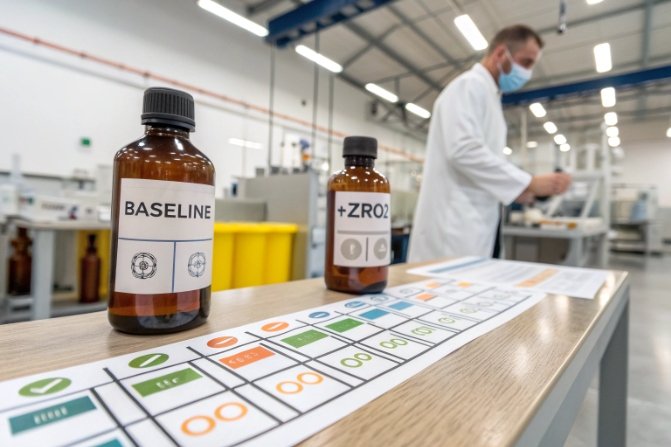
Step 1: Prove the melt is not getting dirtier
Before strength tests, the melt must be checked for new defects:
- stone rate (by visual inspection and automated inspection trends)
- seed count (hot-end checks and lab melt inspection)
- cord/striae rate (especially in thick sections)
- surface roughness trend after normal line handling
If any of these worsen, strength gains will not hold in the market.
Step 2: Use bottle tests that match real failure modes
A verification plan should include:
- Drop/impact testing under controlled angles and heights, plus repeated handling simulation
- Internal pressure burst testing to capture finish and shoulder weakness scatter
- MOR-style testing (ring-on-ring, 4-point bending coupons, or plant-standard M-ORi style index testing) to track intrinsic changes with low noise
- Weibull analysis to track scatter, not only averages
The most valuable number is often the lower-tail improvement (for example, the 5th percentile strength), because real breakage is driven by the weak tail.
Step 3: Do fracture analytics to confirm the mechanism
If bottles break, the origin must be found:
- fracture origin mapping 6 (heel, finish, shoulder, body)
- microscopy and, when needed, SEM/EDS to identify Zr-bearing inclusions
- cord tracing by cross-section imaging
- stress checks (polarimetry) to confirm annealing is not the hidden driver
If origins shift toward stones after ZrO₂ addition, the project should stop even if average burst looks better.
Step 4: Run long enough to include cullet feedback
ZrO₂ will cycle back through cullet. So verification must include:
- at least one full campaign window long enough to stabilize cullet chemistry
- periodic chemistry checks (XRF) to confirm Zr is not creeping upward
- a stop rule if stone rate exceeds a defined ppm or rejects trend line
| Verification phase | What to measure | Pass condition that matters |
|---|---|---|
| Melt quality gate | stones, seeds, cords | no increase vs baseline |
| Strength gate | drop/impact + burst + MOR index | higher lower-tail strength and lower scatter |
| Failure mode gate | fracture origins + inclusion ID | no shift toward stone-origin failures |
| Scale gate | cullet feedback and drift | Zr level stays stable and yield stays high |
If these gates are used, scaling becomes a controlled decision, not a gamble.
Conclusion
ZrO₂ is effective when used in a narrow, well-controlled range, proven with steady-state bottle tests and fracture analytics, and protected by strict defect control and cullet discipline 7.
Footnotes
-
A measure of stiffness; higher modulus means glass resists bending better under load. ↩
-
A statistical measure of variability; high modulus means consistent strength, critical for glass. ↩
-
Resistance to surface indentation; harder glass resists scratches that can lead to cracks. ↩
-
The glass’s ability to resist attack from water and chemicals, crucial for long-term strength. ↩
-
Removing gas bubbles from molten glass; crucial for clarity and strength. ↩
-
Analysis of broken glass surfaces to identify the cause and origin of failure. ↩
-
Strict management of recycled glass quality to prevent contamination and defects. ↩






